
 EN (English)


Major Arcana · 18
The Star
The Brooklyn rooftop after the blackout, where the city's glare goes out and the real stars come back over the harbor.
Card at a glance
- Numerology
- XVII
- Element
- Air
- Astrology
- Aquarius · Saturn and Uranus
- Kabbalistic path
- Tzaddi (Netzach → Yesod)
- Timing
- Late winter · Aquarius season
- Yes / No
- A gentle yes · with patience
Upright
hope after ruin
healing
renewal
faith in the city
inspiration
recovery
quiet optimism
generosity
Reversed
lost faith
burnout
cynicism
false hope
postcard illusion
refusal to look up
The Star in each deck
Every deck reimagines the same archetype. Compare the art, then open a deck to read its full interpretation.
Imagery and symbolism
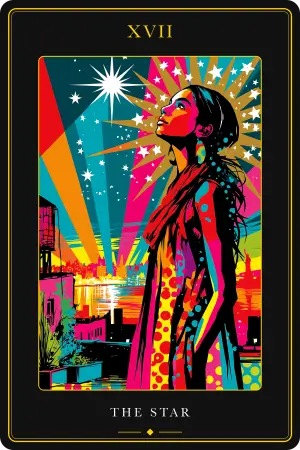
In the Tarot of New York City the riverbank becomes a Brooklyn rooftop after dark, rendered in the deck's pop-art language of saturated color blocks, halftone dot fields, sunburst rays, and black silhouette linework. A young woman stands in profile on the roof, face lifted to the sky. Where the classic Star is nude at the water's edge, here her openness is in the posture: chin up, chest open, guard down. In a city that trains you to watch the street, looking up is the card's act of faith.
A red scarf is wound at her throat, holding the warmth of the heart that survived the cold year, and her dress is patterned with halftone dots and bright patchwork, the deck's shorthand for a life assembled from many pieces and still holding together. Above her burns one great white star ringed by a scatter of smaller ones, on rays of gold, pink, and teal that pour down over the whole scene. The one star is the fixed point to steer by; the small stars are the friends, the habits, the small daily joys that steady a person. That any stars are visible over a lit-up city is the card's quiet miracle.
Below and behind her the skyline glitters across the harbor, its lights running in long reflections on the black water. This is the deck's version of the two pitchers: the star's light is poured out twice, once onto the water and once onto the streets, blessing the inner life and the working city alike. A wooden water tower stands on the left, quiet proof that what sustains her was kept safe through the disaster and is still full, and planters push green leaves over the asphalt beside the parapet. Far off on the right the Statue of Liberty raises her torch, tying the card back to the Newcomer whose blind faith, having survived the Tower, has become seasoned hope.
Core meaning
The Star is what happens after the Tower, and in this deck the Tower is the 1977 blackout, the night every light the city navigated by went out at once. The Star is the climb up to a roof that still stands and the discovery that, with the glare knocked out, the actual stars are visible over the harbor. What the collapse destroyed was the glare that hid the light.
Its meaning is hope in adult form, hope with a history that has read the eviction notice and still looks up. The card stays a horizon rather than a promise. It refuses the postcard lie that New York guarantees your dream and the cynical lie that the city eats every dream alive, and sets a truer position between them: after the worst has happened, light remains for anyone willing to look up, and visibility is enough to navigate by. Reaching it takes patience and the steady, ongoing work of pouring the waters of hope back into the streets.
Upright meaning
Upright, The Star is the rooftop after the blackout, the card that says the hardest part is behind you. A new stage is opening, quieter and cleaner and full of honest hope: recovery after loss, healing after burnout, inspiration returning to work that had gone gray, a folded-away dream taken back out of the drawer. This is the hopeful just off the bus with a headshot in her bag, three hard years in and still believing Broadway is real. The card asks you to believe again the way New Yorkers survive, with patience and fortitude, and to walk toward the horizon calmly rather than expect it overnight.
In love. For couples through a hard chapter it announces healing: tenderness returns and you make plans with horizons in them again. It also carries a subtler warning, since a star is distant and untouchable, and can mark the pedestal effect, projecting a flawless image onto a person until their human reality disappears. Read that way it points to unrequited feeling or love for the potential of a relationship rather than the grounded thing itself.
In career. The callback after the grind. The interview goes right or the project finally uses your actual talent, and meaning returns to work that had become a treadmill. Progress comes through patient navigation, not a sudden leap.
In finances. The first light after a hard stretch: the debt curve bends, the check clears, the side income planted last year shows its first green. The Star's luck is quiet and cumulative rather than a jackpot, and it rewards those who rebuild their reserve in small deposits.
In health. Recovery and repair, the healing card of the deck. Sleep starts working again and energy returns in honest increments, favoring restful, restorative care over punishment.
Reversed meaning
Reversed, The Star is the same rooftop under a sky where nothing can be seen, because the person has stopped looking up. It signals lost faith: the audition circuit ground the belief out of you, the recovery stalled, or hope got postponed so often it quietly turned into the cynicism the city teaches. It can also warn of illusion, believing in a postcard version of the future or someone's glittering empty promises, or of a person so braced against disappointment that they refuse a genuinely good sign when it appears.
There is a gentler reading too. Hopelessness is not always the enemy. In a genuinely immovable or harmful situation, releasing a specific painful hope can be an act of self-preservation, and the reversed card may simply be telling you that your exhaustion is valid.
In love. Hope between two people gone dim, the couple sharing rent and silence after the spark went out. For those searching it can mean dating with the blinds down, braced so hard against letdown that no one real gets in, or chasing a postcard by projecting a dreamed-up partner onto whoever stands nearest.
In career. The shelved headshot: talent parked, meaning drained, a role that pays just enough to postpone the real ambition another year. It can also flag the promotion perpetually promised, or an industry pursued as a fantasy rather than a craft.
In finances. Recovery stalling, a windfall that keeps not arriving, or optimism doing the work arithmetic should do. At the other pole, discouragement so deep the planning stops entirely and guarantees the drift you feared.
In health. Depletion carried as a badge, sleep debt called a lifestyle, recovery postponed because the city does not slow down for it.
Historical notes
The kneeling water-bearer is a fairly late arrival. In the fifteenth-century Italian decks the card was unsettled: the Visconti-Sforza showed a clothed woman holding a single star, the Budapest deck a naked woman reaching to seize one, and the Rothschild and d'Este cards three men in Phrygian caps pointing at the heavens, easily read as the Magi following the Star of Bethlehem. The Minchiate deck even shows a crowned traveler lifting a chalice toward an eight-pointed star. By the sixteenth and seventeenth centuries the French decks turned instead to astronomers seated with calipers, measuring the sky.
The familiar image was fixed by the Tarot de Marseille, which dropped the astronomers and Magi for a naked woman pouring two jugs by the water, a bird in a tree, and one large star among seven smaller ones. Its earliest precursor is the Cary Sheet of about 1500. Waite and Pamela Colman Smith refined that design in 1909, adding the ibis and the distinct streams onto land and water, though Waite still listed the card's old divinatory meanings as loss and abandonment, a memory of the goddess Astraea leaving a corrupt world with only hope behind her. The Tarot of New York City keeps every one of those meanings and relocates the riverbank to a Brooklyn roof.
Correspondences
Number. XVII, the seventeen, whose two digits read like a New Yorker's biography: the 1 of the Newcomer stepping off the bus at Port Authority, and the 7 of the Hermit's lamp lit in one window of a dark building. Together they make a fresh start guided from within. Added, 1 and 7 make 8, and in this deck the eighth arcana is Patience & Fortitude, the two marble lions named on the library steps during the Depression so the city would remember how to survive. Real hope rests on patience and fortitude the way the lions rest on their pedestals.
Astrology. Aquarius, the fixed air sign of the visionary and the humanitarian, ruled traditionally by Saturn and in modern astrology by Uranus. New York is the Aquarian city, eight million strangers running one shared experiment in living together, and the water-bearer pours her light over harbor and streets alike.
Element. Air, the element of Aquarius, the clear mental sky behind the card's healing waters.
Kabbalah. In the Golden Dawn system the Hebrew letter is Tzaddi, the 'fishhook,' root of tzadik, the righteous one. The hook is mental angling, dropping a line into the deep waters of the subconscious to draw up higher truth, along the twenty-eighth path from Netzach to Yesod. Crowley later disrupted this: reading 'Tzaddi is not the Star' in The Book of the Law, he swapped the card with The Emperor and reassigned it to the letter Heh, the 'window,' on the fifteenth path from Chokmah to Tiphereth.
Timing. Aquarius season, and a slow, patient tempo. As a yes or no the card is a gentle yes that asks you to keep steering toward the goal.
Psychological perspective
The Star describes the survivor-optimist, the New Yorker who went through a personal blackout, a lost job or a lost love or a bad year, and came out gentler rather than harder. They notice small light reflexively: stars over the harbor, green in the planter, the free coffee, the kind stranger. They restore themselves through pauses and radiate a calm that other people borrow, sincere in a city that rewards armor and independent in a city that runs on hustle.
The classic imagery reads the same balance through the body. The water-bearer's two hands do distinct work: the right hand, governed by the logical left hemisphere, pours onto the land and grounds insight into practical reality, while the left hand, governed by the intuitive right hemisphere, pours back into the pool and keeps the subconscious source replenished. Health is the balance between the two. Alejandro Jodorowsky names the card's shadow precisely. At its best The Star is the perfection of the gift, giving without demanding anything back. Misapplied, it turns vampiric: if the figure pours only into the pool of old wounds, she becomes a bottomless pit of emotional reclamation, forever feeling unloved and demanding validation from everyone around her. There is an Aquarian loneliness in the card too, the outsider who carries cosmic water to a collective they never quite merge into, sometimes staying too long on the roof when the situation needs someone at street level.
The Star across decks
Early Italian and French decks. Before the water-bearer settled in, the card wandered through astronomers with calipers measuring the firmament and robed Magi in Phrygian caps pointing at the Star of Bethlehem, a celestial and intellectual reading later traded for the kneeling figure by the water.
Crowley-Thoth. Crowley and Lady Frieda Harris steep the card in Thelemic theology. The figure becomes Nuit, goddess of the infinite night sky and the totality of possibility, pouring from a gold and a silver cup to channel her energy into the material world, with echoes of Babalon, who accepts all experience. Here the card is the realization of one's True Will within the vastness of space.
Modern reclamations. Queer and feminist decks like the Earth Mother Magic Tarot recast the nudity as vulnerability rather than spectacle, the power of existing openly and unashamed, and insist a person need not be fully healed to deserve visibility. Lacey Bryant's Slow Tarot relocates the card's healing into quiet domestic surrealism and the weight of ordinary memory.
The Tarot of New York City. This deck keeps the Rider-Waite meanings intact and swaps the riverbank for a Brooklyn rooftop after the 1977 blackout, with the harbor lights and the Statue of Liberty's torch standing in for the water and the guiding star.
In combination and context
The Star only makes full sense in sequence. In this deck it lands directly after the Tower, the 1977 blackout, and only when the city's lights failed could the stars be seen. The Tower strips away the false self, and the Star is the authentic self and the peace that could not have existed before the illusion fell. Set beside the Wheel of Fortune the contrast sharpens its meaning, since the Wheel's luck is sudden while the Star's is quiet, cumulative, and earned through patient navigation.
In love spreads the card takes its color from its neighbours. Paired with the Four of Cups or the Eight of Cups it often confirms unrequited feeling, a relationship that stays a distant wish rather than a lived reality, the querent enamored with an ideal on a pedestal. As an obstacle it names that very pedestal, the flawless image no real person can match.
As a yes or no it answers softly. Pulled for an anxious question like whether an exam will go badly, it is less a prediction than reassurance, a nudge to stop catastrophizing, trust the process, and let the outcome bring healing rather than dread.
Questions for reflection
- Which of your stars survived the blackout untouched, the calling or direction you came to this city for?
- Are you pouring your energy onto the streets of the present, or only back into the pool of old wounds?
- Where is your hope a light to steer by, and where has it become a postcard you are hiding inside?
The general meaning follows the Rider-Waite-Smith reading — the reference used across Tarot Academy. Open a specific deck above for its own interpretation.
Frequently asked questions
Explore the Tarot
Latest Posts
Discover the ancient wisdom of tarot cards and unlock the mysteries of your spiritual journey. Our blog is your gateway to understanding the rich symbolism, meanings, and practical applications of tarot reading.




















































