
 EN (English)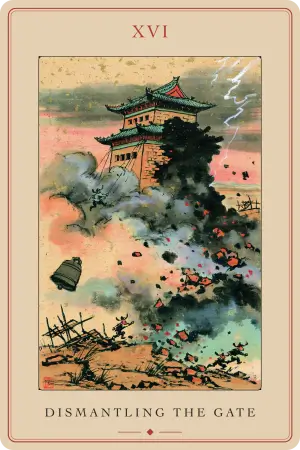


Major Arcana · 18
Lotus Lanterns on Houhai
Hope made by hand: a girl at Houhai sets a paper lotus lantern on black water and keeps one light in her lap.
Card at a glance
- Numerology
- XVII
- Element
- Air
- Astrology
- Aquarius · Saturn and Uranus
- Kabbalistic path
- Tzaddi (Netzach → Yesod)
- Timing
- Summer festival night · Aquarius season
- Yes / No
- Gentle yes · Reversed no
Upright
hope
renewal
healing
quiet recovery
faith in the future
release
generosity
intuition
Reversed
despair
lost faith
disappointment
false hope
empty ritual
wishing instead of acting
hoarded hope
cynicism after loss
Lotus Lanterns on Houhai in each deck
Every deck reimagines the same archetype. Compare the art, then open a deck to read its full interpretation.
Imagery and symbolism
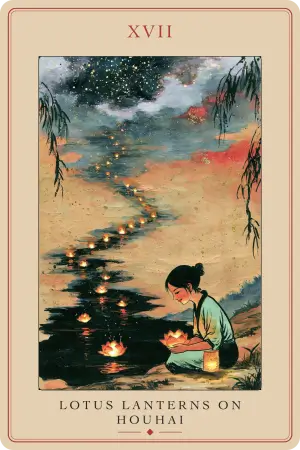
In the Tarot of Beijing the Star is called Lotus Lanterns on Houhai (放河灯, releasing river lanterns). The scene is a summer festival night on the shore of Houhai lake in the old city, drawn in the deck's Feng Zikai manner: a few calm brush lines, ink washes of grey and black, accents of vermilion and teal, warm kraft paper flecked with gold, a small red seal in the corner. There is no naked water-bearer here and no blazing eight-pointed star. There is a girl, a lake, and the lights she and others have made.
She kneels at the water's edge in a teal jacket, holding a glowing paper lotus in both hands, about to set it down. This is the deck's answer to the Rider-Waite maiden with her two pitchers. Instead of pouring water she gives light to the water, and the offering is made rather than found. A procession of lanterns already drifts away from her across the black water, winding toward the horizon in a bright ribbon. At the top of the card that ribbon of lantern-light meets the band of real stars, and the two become indistinguishable. The deck's own text puts it plainly: above her are the real stars, below her the ones people made when the real ones felt too far.
The black water holds the place the Rider-Waite pool held, the unconscious and the unknown future, the element that receives a wish and carries it beyond control. The girl touches its very edge and does not enter it. Beside her knee stands one more lantern, lit but not released. This kept light is the deck's signature addition, hope she has not spent yet, and it is the small economy that separates faith from gambling. Willow branches lean in from both upper corners, the Chinese tree of parting that bends and weeps and does not break, a quiet echo of the trials that come before this card.
Core meaning
Lotus Lanterns on Houhai is Beijing's Star, and the deck states its whole argument in one gesture: hope is a thing you make, not a light that happens to be hanging in the sky. Where the canonical Star is given, a great light already waiting to be noticed, here the star must be folded out of paper and paste, lit with a candle stub, and set on the water by ordinary hands. The cosmic dimension is not lost. It arrives at the horizon, where the line of handmade lights runs into the real constellations and the two become one river.
The deck places this card the first night after a demolition. By the falling gate tower of the previous arcanum the hero has watched the skyline he was learning get torn open, and the Star is the season of quiet mending that follows. The card says the worst is behind you and the time of recovery has begun. Your wish has been made and released, and what is asked now is trust rather than effort. The kept lantern completes the meaning: give your wish to the current completely, and never give the current your last light.
Upright meaning
Upright, the card marks a stage of recovery, clarity, and gentle optimism after a hard stretch. An old dream you had shelved may float back within reach. The instruction is to release what you have been gripping, because a wish works only once you let it leave your hands. Do not stand over the water demanding results. The lantern travels at its own pace. Rest, restore, walk by the water in the evening, and keep one hope unspent as a reserve that belongs to no outcome.
In love. The festival evening a couple finally gets after a hard season: tenderness returning after conflict or loss, hope after a period spent in demolition dust. Feelings move like lanterns on water, unforced and traveling the same direction without being tied together. For those alone, a light is already moving toward you along the dark water, and the task is to be at the shore with your own lantern lit rather than waiting in the dark.
In career. Light returning to work that has been through the dark: motivation back after burnout, recognition arriving quietly for effort released long ago. Applications and proposals sent out now behave like river lanterns. They travel out of sight, and the card says they are still burning. Inspiration comes as a current rather than a lightning bolt, so begin the small ritual of the craft and the larger flow resumes on its own.
In finances. The flowing kind of fortune, a current beginning to move in your favor rather than a windfall crashing down. Earlier efforts start returning light: a payment arrives, a debt clears, an income stream steadies. The card's sum is 8, Beijing's number of prosperity, and money here comes to those who let it circulate. Generosity now is seed rather than loss. One rule from the image holds: keep a reserve.
In health. Convalescence and quiet radiance. Strength returns after illness or exhaustion the way color returns to the shore at dusk, gradually and then unmistakably. Healing here is gentle and water-associated: rest, sleep, warm baths, evening walks, tea instead of stimulation. Trust the body's own current, which knows the direction of repair and needs release, not force.
Reversed meaning
Reversed, the card shows the same lake with no lights on it. Hope has gone out or was never launched. Either you released everything at once and now sit with an empty lap, or you have clutched your last lantern so tightly it has crumpled. The card points to disappointment, lost faith in the future, and exhaustion after a long ordeal. The gate tower fell, but the quiet that followed feels like emptiness rather than peace. It can warn that a promise made to you is a paper lantern with no candle in it, pretty and unable to float. The correction is small and stubborn: do not decide the water is cursed because one lantern sank, and check whether the wish itself needs trimming to a size that can actually float.
In love. A couple on opposite banks of the same dark water, each waiting for the other to launch the first light. Romance reduced to ritual, wishes made about the partner instead of spoken to them, or one person still in love with a lantern that sank long ago. For the disappointed, the card refuses the verdict that love is finished. Grieve the specific loss, then fold something small and true and set it where the other can see it burning.
In career. Work by dead light, going through the motions with the candle out. Creative exhaustion, talent undervalued until its owner stopped valuing it, or hope pinned to a promotion or a promise that turns out to be paper without flame. Sometimes it is the employee who launched a hundred applications and, hearing nothing, decided the whole lake is rigged, when what sank was the aim rather than the water. Rest first, then make one honest, well-lit attempt.
In finances. Hope doing a ledger's job. Money released with a wish instead of a plan, spending to buy back optimism, a venture funded because it would be beautiful if it worked. The card can also mark the opposite error, hoarding every coin out of fear so nothing circulates and nothing returns. Trim the wish to a size that floats and stop confusing the sparkle of a plan with its buoyancy.
In health. A body asked to run on wishing. Symptoms handed to it will pass the way a lantern is handed to the current, rest postponed to an imaginary calmer month, or a self-image chasing an appearance that exists only in pictures. Reverse the ritual's order and light the candle first: sleep, water, warmth, one kept promise to the body. Where a symptom persists, take it to someone qualified, because hope is a companion to care and not a substitute for it.
Historical notes
The Star did not begin with the kneeling water-bearer. In 15th-century Italy its imagery was highly variable: the Visconti-Sforza tarot showed a fully dressed woman holding a single star, while other early sheets showed three men in Phrygian caps pointing up at the heavens, conflating the card with the Magi following the Star of Bethlehem. As the tarot moved to France the focus turned toward astronomy, with male astronomers holding calipers to the sky to measure the firmament.
The modern template was fixed by the Tarot de Marseille in the 17th century: a naked woman kneeling by water beneath a blazing sky, pouring two jugs, a bird in a tree, one large star surrounded by seven smaller ones. Waite and Pamela Colman Smith formalized that design in the 1909 Rider-Waite-Smith deck. Curiously, Waite's own 1910 keywords led with loss, theft, privation, and abandonment, an echo of the myth of Astraea, the virgin goddess of justice who was the last celestial to leave a corrupted world. French occultists such as Éliphas Lévi read the water-bearer as Isis starting the life-giving flood of the Nile, and the large star as Sirius.
The Tarot of Beijing takes the reframing further and inverts the central gesture. The classical Aquarius pours water from a vessel. The girl at Houhai pours light onto water. The direction reverses and the meaning holds: both kneel at the boundary between the human and the elemental and make a free gift across it. Above all, the Beijing card moves the star from the sky into a pair of hands. Hope is no longer received from a friendly cosmos. It is manufactured, in the dark, out of cheap materials, precisely because the cosmos does not manufacture it for us.
Correspondences
Number. 17, and its digits describe the card. The 1 is the single lantern in the girl's hands, one small light against a whole dark lake. The 7 is the contemplative number of intuition and the quiet of a night shore. Their sum is 8, and in Beijing this is no ordinary digit: its sound, ba (八), echoes fa (发), the word for prosperity. Laid on its side, 8 is the lemniscate, drawn on the card as the winding line of lanterns that runs from the girl's hands to the stars without a visible break.
Astrology. Aquarius, the Water-Bearer, the fixed air sign of hope for the many and of the common good. The lantern festival is an Aquarian institution: hundreds of strangers, each with a private wish, together producing a single river of light none of them owns. Its old ruler is Saturn and its modern ruler Uranus, and both sit on the card. Saturn is the discipline of the kept lantern, the refusal to spend everything on one wish. Uranus is the flash of the released one, flung into currents no one controls.
Element. Air, the element of Aquarius, carried here as thought and distant connection, warmth that travels without a wire toward the place where man-made lights merge with real stars.
Kabbalah. In the Golden Dawn system the Star holds the 28th path, from Netzach (Victory) to Yesod (Foundation), and the Hebrew letter Tzaddi, the fishhook, the practice of dropping a hook into deep water to draw up higher feeling. Crowley later disputed this, declaring that Tzaddi is not the Star and reassigning the card to Heh, the window, on the path from Chokmah to Tiphereth. Most readers keep the older Tzaddi.
Elemental dignity. As an Air card it strengthens Swords and other airy majors, sharing their clarity and detachment, and it softens the fire of the arcana around the Tower into the cool of a night shore.
Psychological perspective
The Star describes the psychology of quiet resilience: the person who answers loss not with denial and not with collapse, but with a small constructive ritual. Something ended, the deck places this card directly after the demolition of the Tower, and instead of rebuilding at once or grieving forever, this person goes to the water in the evening and makes a modest act of faith. Acknowledge the dark, then light something in it. It is the healthiest possible sequence.
Such a personality is gentle, receptive, and more durable than it looks. Their optimism is post-catastrophic. It has already survived the thing pessimists warn about, which is why it cannot be argued away. They trust intuition the way a lantern trusts the current, since fighting it has never once helped. They are generous without bookkeeping and comfortable with a solitude that is really connection, because every distant light on the lake is someone like them. Instinctively they stay provident and never invest their entire inner life in one person or one outcome. One lantern always stays in the lap.
In excess the same traits soften into passivity. Releasing becomes avoidance, every difficulty handed to the current instead of confronted. The reserve lantern turns into hoarding, a life spent keeping hope safe and never launching any of it. Some Star personalities even fall in love with wishing itself, endlessly folding paper lotuses for a voyage they never make. The cure is always the same small motion: kneel, set it on the water, open the hands.
Lotus Lanterns on Houhai across decks
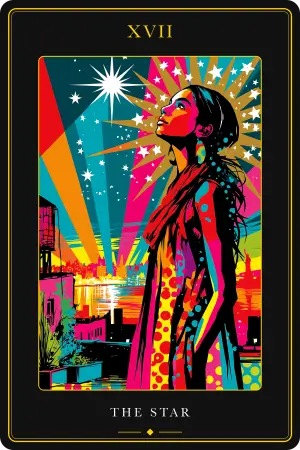
Rider-Waite-Smith. The canonical Star is a naked woman kneeling by a pool, pouring two jugs of water under one great star and seven smaller ones, an ibis in the tree behind her. Hope there is given from the sky and poured back into the world. Beijing keeps the kneeling figure and the water but clothes her, hands her a lantern instead of jugs, and makes her give light rather than pour it.
Tarot de Marseille. The Marseille card set the naked water-bearer template, the bird in the tree, the eight-pointed central star. Beijing keeps the boundary between figure and water and the act of free giving, and replaces the blazing single star with a whole ribbon of small handmade ones running to the horizon.
Crowley-Thoth. Crowley's Star is the goddess Nuit, infinite space and the totality of possibility, linked to Babalon and painted by Frieda Harris with cups of golden and silver light channeling energy into the material realm. His famous line, Tzaddi is not the Star, moved the card to the path from Chokmah to Tiphereth. The Beijing card shares the sense of the human wish becoming part of the order of things, drawn as the old intuition of heaven and humanity in resonance (天人合一) rather than through Thelemic geometry.
Modern reframings. Contemporary decks have reclaimed the Star for somatic healing, queer and feminist vulnerability, and the quiet cumulative luck that later collided with online manifestation culture. The Tarot of Beijing belongs to that movement, but grounds the hope in a specific folk ritual: a real festival on a real lake, hope as a craft with paper and paste that anyone can practice on an ordinary shore.
In combination and context
Lotus Lanterns on Houhai pulls a spread toward recovery, release, and gentle direction, and its meaning shifts with the cards around the water. Following the Tower it reads exactly as the deck intends, the first calm night after the gate tower came down, hope relit at the border between an ended day and a beginning night. Beside cards of healing or rest it deepens into genuine convalescence, and near the Sun that follows it the small handmade light gives way to full day.
The card's sum of 8 warms money and business positions into the flowing, auspicious kind of luck, though its counsel there is always to keep a reserve. With cards of promises or contracts, watch the reversed warning: a beautiful pitch may be a paper lantern with no candle in it, so check for a flame before betting the shore. In relationship spreads its neighbors reveal whether the shore is a congregation or an empty bank, since the Star is the card of solitudes that add up to a shared river of light.
When it keeps appearing, treat it less as a prediction than as an instruction. Make the wish, then let it out of your hands. Send the message, submit the application, put the intention in writing, and release your grip on the result, keeping one hope for yourself that belongs to no outcome.
Questions for reflection
- What wish are you still holding in your lap, and what would it take to set it on the water and open your hands?
- After your own demolition, are you rebuilding at once, grieving forever, or lighting one small thing in the dark?
- Which light have you kept in reserve, and are you protecting it wisely or simply refusing to launch anything at all?
The general meaning follows the Rider-Waite-Smith reading — the reference used across Tarot Academy. Open a specific deck above for its own interpretation.
Frequently asked questions
Explore the Tarot
Latest Posts
Discover the ancient wisdom of tarot cards and unlock the mysteries of your spiritual journey. Our blog is your gateway to understanding the rich symbolism, meanings, and practical applications of tarot reading.




















































