
 EN (English)



Minor Arcana ·
Three of Teacups
Friendship poured in turns: three old friends on low stools, one kettle of shared warmth, thirty years of trust measured in sunflower husks.
Card at a glance
- Numerology
- Three
- Element
- Water (tea)
- Astrology
- Mercury in Cancer · 2nd decan
- Kabbalistic path
- Binah (Understanding) in Briah
- Timing
- Summer · July 2–11 · Cancer season
- Yes / No
- Upright yes · Reversed no
Upright
friendship
celebration
shared warmth
belonging
hospitality
unhurried talk
chosen family
gratitude
Reversed
gossip that wounds
isolation
an empty stool
broken trust
overindulgence
cliques
hollow socializing
Three of Teacups in each deck
Every deck reimagines the same archetype. Compare the art, then open a deck to read its full interpretation.
Imagery and symbolism
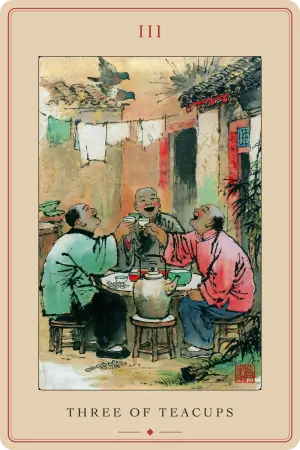
In the Tarot of Beijing the Three of Cups is the Three of Teacups, and the celebration has moved from a harvest field to a small courtyard table. Three old friends sit on low wooden stools, raising their teacups and laughing with their heads thrown back, laughter loud enough to scare the pigeons off the tiled roof. There is no occasion. That is the card's whole claim: friendship is a holiday that requires no date.
Between the friends stand a great white kettle and a small teapot. The large vessel is the common supply of warmth, the small one the portion each person pours for the others, and no one at this table fills only their own cup. This is the deck's picture of the number three, a circle small enough to keep a conversation moving in rounds, like tea poured in turn.
Sunflower-seed husks are scattered across the tabletop and the ground, the residue of hours of talk that solved nothing and repaired everything. In this deck the husks measure time spent generously rather than wasted: thirty years of gossip, the card insists, and not one betrayal between them. Trust here is not declared. It accumulates, husk by husk.
Above the friends, laundry dries on a line strung between the roofs, private linens hanging openly side by side because in this courtyard nothing needs hiding from neighbors. Two pigeons perch on the ridge tiles, the deck's recurring hutong sky-dwellers who carry the city's news, pausing to eavesdrop, drawn by the warmth below. Red door couplets and a touch of vermilion on the eaves bring festival color into an ordinary afternoon. Bamboo at the edge of the scene stands for bonds that bend with the years and do not break, and the small red seal in the corner signs the whole thing as witnessed and true.
Core meaning
The Three of Teacups is Beijing's Three of Cups, the card of joy multiplied by company. Where the Two of Cups holds an intimate pair, the third element opens the couple into a community, and the self is fortified rather than diminished by belonging to it. The deck states its version plainly: the deepest celebration is not a rare festival but a repeatable one, held together by tea, seeds, and people who keep showing up.
This is chosen family made local. It is the courtyard where the stools are always out and the kettle is always warm, the circle that has proven itself over decades and needs nothing proven inside it. The card carries the classic themes of celebration, friendship, and emotional fruition, but the Beijing reading grounds them in the ordinary: tea offered without occasion, old friendships that need no explanation, healing that happens in company rather than alone.
Compared to the Rider-Waite Three of Cups, which dances in a garden at the moment of harvest, the Beijing card sits still. The joy it points to is the kind you can return to every afternoon, not the once-a-year toast. Its lesson is that joy is a practice and a choice, something you set out on the table like an extra cup, not a mood that happens to you.
Upright meaning
Upright, the Three of Teacups points to communication, shared happiness, and belonging. Expect gatherings and warm occasions built around ordinary things done together, or the successful completion of a shared project witnessed by the people who helped you reach it. It favors new friendships, the deepening of old ones, and any creative work brought to a table rather than kept behind a screen. Set out an extra stool, and stay longer than you planned.
In love. A romance at ease in company, built on a solid foundation of friendship and shared daily pleasures. The partner fits naturally at your family's table and among your oldest friends, and being together requires no performance. Often a long friendship is quietly becoming something more, a love that begins the way many things in this deck do, with one person refilling the other's cup.
In career. Camaraderie and fruitful collective effort. It marks achievements worth celebrating with colleagues, productive teamwork at the start of a project where everyone contributes willingly, and a workplace that resembles a shared table more than a hierarchy. Relationships are your strongest asset now, and the lane's recommendation outperforms any advertisement.
In finances. Prosperity shared out the way tea is poured, in turns, with no cup left empty. It favors pooling resources with people you have long trusted: family ventures, neighborhood partnerships, informal trust-based arrangements where reputation matters more than contracts. A period of productive cooperation and comfortable, unshowy sufficiency, provided everyone keeps refilling the common pot.
In health. Well-being sustained socially: morning exercises with familiar faces, walks taken with a friend, meals cooked and eaten together. A shared routine is easier to keep than a private resolution, and laughter and unhurried meals do more for the body than most regimens. The card favors moderate, convivial pleasure, joy taken daily in small doses rather than saved for rare occasions.
Reversed meaning
Reversed, the harmonious circle breaks down. The company that once held you may feel strained: gossip has replaced conversation, someone has quietly stopped coming to the table, or you notice you have been drinking your tea alone by habit rather than by choice. The card can also point to overindulgence, to anxiety hidden behind a cheerful face, or to hollow socializing where the tables are full and the conversations empty. Tend to your relationships before the distance sets, and speak your feelings before they steep into bitterness.
In love. Outside voices intruding on the relationship: gossip, meddling relatives, or friends whose opinions carry too much weight between you. Small resentments accumulate like cold tea, and it can occasionally indicate a third person, jealousy, or divided attention. If the bond was built mostly on shared entertainment, the card asks whether there is a friendship underneath the fun. Close the gate for an evening and talk without an audience.
In career. Team friction, office gossip, or the sense of being left off the invitation. Cliques and whispered rivalries derail common goals, and you may feel your stool at the common table has quietly been taken. It can also mark too much socializing at the expense of the work, or fatigue from performing a cheerfulness you do not feel. Rebuild a few honest working relationships rather than trying to fix the whole courtyard.
In finances. Friction in joint money or the souring of a trust-based arrangement. Disagreements over who contributed what, or who poured more than they drank, can undermine ventures built among friends. Money lent within the circle may turn to resentment, and a shared enterprise may stall because no one wants to name the problem first. Put the awkward conversation on the table before it curdles the friendship.
In health. Social life working against the body: too many rich tables, too much drink at gatherings, sleep sacrificed to company. Loneliness wears the body down too, isolation showing up as fatigue or neglected care. Notice which company leaves you refreshed and which leaves you drained, keep the friendships, and moderate the feasts.
Historical notes
The Three of Cups began as a plain pip. In the Visconti-Sforza Tarot, commissioned for the Milanese court around 1450, the card showed three golden cups arranged in a triangle against an unadorned background, with no figures and no scene, carrying only the numerical and elemental value of three cups of water. The suit itself descends from the Mamluk playing cards that reached European trade routes from Egypt in the 1370s. When French esotericists began assigning divinatory meanings to the pips, Etteilla in 1783 read the card as achievement, success, and healing, and Papus later tied it to Venusian love and emotional equilibrium.
The narrative image most readers know arrived in 1909 with the Rider-Waite-Smith deck. Under Arthur Edward Waite's direction, Pamela Colman Smith drew three maidens dancing in a circle in a harvest garden, raising golden cups in a toast over ground lush with grapes, pumpkins, and apples. She took her cue from Sandro Botticelli's Primavera and its Three Graces, Aglaea, Euphrosyne, and Thalia, the goddesses whose charm turns a gloomy room to joy. In the Thoth Tarot of Aleister Crowley and Lady Frieda Harris, the card is titled Abundance, showing three pomegranate cups filled by golden lotuses that overflow into a calm sea, an image of love finding its goal and multiplying through harmony.
The Tarot of Beijing keeps the meaning and relocates the scene. It trades the dancing Graces for three seated friends, the harvest field for a hutong courtyard, and the raised golden chalices for teacups. The celebration stops being a rare festival and becomes an ordinary afternoon, repeated as often as the kettle is filled.
Correspondences
Number. Three, tied in numerology to creativity, social interaction, and self-expression. Two people share; three form a company. On this card the triad is literal, three friends and three stools, with the toast passing around the table and nowhere to stop. Three is the smallest circle that can hold a conversation going in rounds, and it represents synthesis, two old friends and the years between them producing something neither owns alone. The deck also reads it as harmony of body, mind, and soul: seeds for the hands, gossip for the mind, laughter for the soul.
Astrology. The second decan of Cancer, roughly July 2 to July 11, ruled by Mercury. Cancer's devotion to home and kin widens here by exactly one courtyard, from family to the chosen family of neighbors and lifelong friends. Mercury adds mental agility and quick sociability, the darting wit of table talk and the news that travels the lane faster than the pigeons. The placement describes an intuitive, almost telepathic understanding between close friends who can say a paragraph with a single glance.
Element. Water, which in this deck is tea, feeling made drinkable and warmth passed from hand to hand in a cup. It grounds the card in tenderness and settled trust rather than dramatic emotion.
Kabbalah. The threes sit at Binah, Understanding, the Great Mother who gives form to the raw energy of the twos. Because Cups belong to Briah, the world of Water, this is Binah of Briah, described in the Golden Dawn system as abundance resulting from love, a stable and deeply satisfying emotional reality.
Psychological perspective
This card marks the stage where the self expands outward and discovers it is stronger for the company it keeps. The isolated pair of the Two of Cups admits a third, and the private bond becomes a community. Rachel Pollack, whose Seventy-Eight Degrees of Wisdom framed the tarot as a map of consciousness, read the minor threes as this moment of social integration, the realization that participating in a collective fortifies the ego rather than dissolving it.
The people who carry this arcana are sociable and gifted at keeping friendship alive over decades. They celebrate their friends' successes gladly and turn up on the doorstep unasked when times are hard, valuing harmony and the comfort of a warm circle. Their gossip is affection in disguise, and they can talk about everything while betraying nothing. Reversed, the same person turns inward, avoiding gatherings and drifting from friends without explanation, laughing along at the table while carrying a disappointment no one is shown. That withdrawal often hides wounded trust or a shaky sense of worth that keeps them at the edge of a circle they secretly long to rejoin.
Three of Teacups across decks
Rider-Waite-Smith. Three maidens dance in a circle in a harvest garden, cups raised in a toast, modeled on Botticelli's Three Graces. The Beijing card keeps the sisterhood and the toast but seats its friends on low stools around tea, trading the once-a-year harvest for a repeatable afternoon.
Visconti-Sforza and Marseille. The oldest decks show three cups in a bare triangular arrangement, a pure pip with no human scene. Beijing restores people to the card, as Smith did, but fills the table with the specific residue of long friendship, husks, laundry, and eavesdropping pigeons.
Crowley-Thoth. Crowley titled the card Abundance and painted three pomegranate cups overflowing into a calm sea, an abstract image of love multiplying through harmony. The Beijing courtyard reaches the same idea through the shared kettle, warmth that overflows because no one pours only for themselves.
Modern reframings. Inclusive decks such as Next World Tarot and the Fifth Spirit Tarot have reclaimed the card as queer chosen family, celebration as an act of mutual aid among people estranged from their families of origin. The Tarot of Beijing shares that instinct in a quieter key, its chosen family the neighbors of a single lane who have poured for one another for thirty years.
In combination and context
The Three of Teacups tilts a spread toward company, celebration, and the health of your circle. Beside cards of love it can read as friendship warming into romance, or as a partner welcomed into the wider table. Beside the deck's cards of solitude or departure it sharpens by contrast, the full courtyard measured against an empty stool.
Context decides whether the third presence is a blessing or a warning. Surrounded by cards of trust and gathering, the extra person at the table is a welcome addition, a new friend or a child or a returning face. Surrounded by cards of secrecy, betrayal, or heartbreak, the same third element curdles into gossip, a love triangle, or a friend competing while pretending to celebrate. Reversed neighbors also steer it toward overindulgence, the celebration mutating into escapism, hangover, and social drama.
When the card keeps returning, treat it as an instruction rather than a prediction. Reach for the old, proven company over the impressive new one, acknowledge a recent achievement with the people who watched you earn it, and choose depth of company over breadth of schedule. The card shows three stools, not thirty.
Questions for reflection
- Whose cup have you stopped refilling, and what would it cost you to pour first?
- Which gatherings replenish you, and which are you attending out of habit rather than affection?
- What recent achievement have you rushed past without letting the people who helped you witness it?
The general meaning follows the Rider-Waite-Smith reading — the reference used across Tarot Academy. Open a specific deck above for its own interpretation.
Frequently asked questions
Explore the Tarot
Latest Posts
Discover the ancient wisdom of tarot cards and unlock the mysteries of your spiritual journey. Our blog is your gateway to understanding the rich symbolism, meanings, and practical applications of tarot reading.




















































