
 EN (English)


Minor Arcana · Cups (Water)
Three of Cups
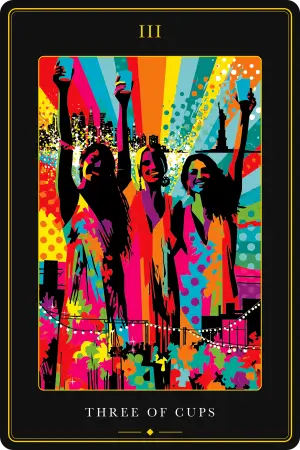
Three friends close together, raising blue deli coffee cups in a single clink over a hot-pink skyline, off the clock at last.
Card at a glance
- Numerology
- 3
- Element
- Water
- Astrology
- Mercury in Cancer · 2nd decan
- Kabbalistic path
- Binah (Understanding) in Briah
- Timing
- Cancer season, early July; celebrations
- Yes / No
- Upright yes · Reversed no
Upright
Celebration
Chosen family
Friendship
Community
Belonging
Shared joy
Reunion
Collaboration
Reversed
Gossip
Cliques
Overindulgence
Isolation
Burnout
Third party
Fallout
Superficial socializing
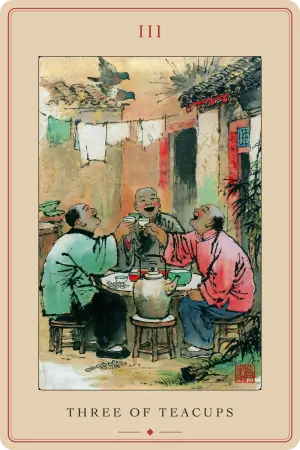
Three of Cups in each deck
Every deck reimagines the same archetype. Compare the art, then open a deck to read its full interpretation.
Imagery and symbolism
In the Tarot of New York City the Three of Cups keeps its old suit name and trades the harvest garden for a night out. Pamela Colman Smith's three dancing maidens are gone. In their place three black silhouettes stand close together and raise their cups in a single celebratory clink, drawn in the deck's pop-art language of halftone dots, sunburst rays, and saturated color.
The cups themselves are the city's own: blue Greek coffee cups, the disposable deli cup New Yorkers carry down every block. Grouped tightly at the dead center of the card, they pool the suit's emotional water into one shared vessel, unity and common purpose made from three paper cups touching. The figures around them are deliberately indistinct. No faces and no hierarchy, so that the whole weight of the image falls on the connection between them rather than on who they are.
Behind the cups the sun explodes outward in bright rays, the sunburst saying that this shared moment makes its own light rather than borrowing it from anywhere else. The background is a dense, vibrating field of magenta and yellow halftone dots, the loud electric charge of the city after dark, a room full of noise and heat.
At the bottom the skyline runs low in hot pink. Here the city is the venue rather than the tower of ambition or the ledger of commerce it plays elsewhere in the deck. It is simply the place that exists so the celebration has somewhere to happen. The picture holds one specific feeling: being in the right place with the right people, off the clock at last.
Core meaning
The Three of Cups is the suit of Water opened out from a couple into a circle. The Ace was the first feeling and the Two was two people meeting across it. The Three adds a third, and a private bond becomes a community. In this deck that shift reads as the exact moment the grid stops being a workplace and turns into a party, the relief of being off the clock with people you actually like.
At its core the card is celebration, belonging, and emotional abundance shared out among a group. The Golden Dawn seated the threes at Binah, the sphere of Understanding and the Great Mother, and titled this one Abundance resulting from Love: the overflowing water of the Cups given a steady, structured form so the joy holds instead of spilling. New York keeps the same idea in cheaper terms. Joy, unlike rent, gets cheaper the more people split it.
Whatever the occasion, a promotion, a signed lease, or just making it to Friday, the energy is light and expansive, and it points outward. The card's whole argument is that surviving a hard city is easier done together, and that the third person is what turns a connection into something that can hold weight.
Upright meaning
Upright, the Three of Cups is the invitation you should say yes to. It marks a stretch of celebration and genuine belonging, when good news gets shared around a table and the people who helped you get there raise a cup with you. Accept the invitation, celebrate the small wins out loud, and give the credit away. The real progress right now is happening around the table, not at the desk you stayed late at.
In love. A joyous, expansive phase. For couples it usually means the relationship folding successfully into a wider social world, the friends approving and the group closing around the two of you, or a celebration of the bond itself at an engagement or an anniversary. For singles it is a strong push to get out, because love here is most likely to arrive through the friend group or at a social event. It shows up in the crowd, not in isolation.
In career. A collaborative, high-morale stretch where you actually enjoy your coworkers. A team project moves because everyone is communicating and sharing the load, and it often lands on a milestone worth celebrating, a well-earned promotion or the launch party after a hard build. It favors networking and open goodwill among colleagues over solitary grinding.
In finances. Money that flows through the group. It points to shared success: a profitable collaboration, a crowdfunding campaign that hits, a venture with friends that actually pays. It reads as a favorable sign for spending on experiences with the people you love, the dinner and the shared trip, in a season when there is enough to go around.
In health. A body fueled by good company. Physical wellbeing benefits directly from an active, positive social life, and group fitness, team sport, or just walking the city with friends suits you now. For this card, laughter and belonging do real medical work.
Reversed meaning
Reversed, the Three of Cups is the hangover and the group text gone toxic. The celebration has run too long, or it was never real to begin with, and you can feel isolated in the middle of a crowded room. Go home early. Stop looking for deep connection in shallow places, and if a circle is draining you with drama or excess, step back and take stock of who you actually want around you.
In love. Third-party interference and misplaced priorities. Friends may be too involved in the relationship, handing out unsolicited advice or stirring drama, and it can point to a love triangle or to socializing that keeps crowding out intimacy. When one partner is spending more nights at the bar than tending the bond, the card's counsel is plain: put the partnership before the party.
In career. A cliquey, isolating workplace. Gossip and office politics make the job unbearable, collaboration breaks down as people take credit rather than share it, and a project can fail simply because the team could not work together. It can also mark the office party regretted the next morning. Keep your boundaries clear and address a toxic culture before it spreads.
In finances. Money bleeding out through the social calendar. You may be overspending to keep up with a certain crowd, or hemorrhaging cash on nightlife, and it can flag a dispute inside the group, an unpaid loan or a split bill that curdles into resentment. Tighten the budget and stop buying rounds you can't afford.
In health. The physical bill for overindulgence. Late nights, heavy drinking, and a diet run ragged by a hectic scene are catching up with the body, which is asking for a detox. It can also show the strain of social anxiety or of navigating a draining friend group. Prioritize rest and hydration, and take a real break from the scene.
Historical notes
Under the paper coffee cups sits one of the oldest cards in the deck. The Cups suit descends from the Mamluk playing cards that reached Europe in the 1370s, and in the Visconti-Sforza Tarot painted for the Milanese court around 1450 the Three was a plain pip: three golden cups set in a triangle against a bare ground, no figures and no scene, read purely for the number and the element.
Divinatory meaning was added during the occult revival. Etteilla, writing in 1783, tied the card to achievement, success, and relief, and later in the nineteenth century Papus read it through Venus as mutual affection realized. The scene most readers now picture arrived in 1909, when Pamela Colman Smith, working under Arthur Edward Waite, drew three maidens dancing in a harvest garden and raising golden cups in a toast, borrowing from the Three Graces of Botticelli's Primavera. Aleister Crowley's Thoth deck, painted with Lady Frieda Harris and published in 1944, abstracted the same idea into three cups fashioned from pomegranates, fed by golden lotuses and overflowing into a calm sea, and titled it Abundance. The Tarot of New York City keeps that thread of shared joy and swaps the garden for a rooftop, the golden chalices for deli coffee cups.
Correspondences
Number. Three, the number of creative synthesis, where two forces meet and something new is born. In this deck it is the city's own arithmetic: one person is a stranger, two are a couple, three are a crew. Three is the triangle, the first stable shape and the one the city builds its bridges from, and on this card that triangle is drawn in the raised arms and cups, friendship as load-bearing structure.
Astrology. The second decan of Cancer, roughly July 2 to July 11, ruled by Mercury. Cancer, a cardinal water sign of the Moon, supplies the emotional ground and the need for a chosen family. Mercury adds the exchange on top of it: the conversation and the shared laughter that pass almost without words among close friends.
Element. Water, the suit's element, here carrying feeling into the realm of community and shared emotion.
Kabbalah. Binah, the sphere of Understanding, in Briah, the Kabbalistic World of Water. The Golden Dawn placed the union of King and Queen resolving into the number three and named the result Abundance resulting from Love, the overflowing cup steadied under the discipline of Saturn so its emotion stays fruitful.
Elemental dignity. As a Water card it strengthens beside Earth and meets tension with Fire, so the neighbouring cards decide whether the celebration deepens or burns itself out.
Psychological perspective
Read psychologically, the Three of Cups is the moment the self discovers it is fortified rather than diminished by joining a group. The Two of Cups was the intimate pair. The Three introduces a third element and turns an inward-facing bond into a community, the outward expansion of the ego into social life. Rachel Pollack's influential reading placed exactly this stage in the Minor Arcana, the day-to-day work of integrating with others.
The deck gives that drive a face in its connectors, the social glue of the city. They are the ones who organize the dinner, know the bartender, and make sure nobody is left standing alone, and they read the city as a shared experience rather than a competition. Their warmth is generous and it spreads.
Reversed, the same energy sours. The scene becomes an escape from oneself rather than a connection to others, socializing as avoidance, drama manufactured to stay at the center of attention, the fair-weather friend who is present for the celebration and gone when the check lands or the mood turns serious. The task the card sets is to tell real community, which returns energy, from the false kind that only drains it.
The Three of Cups across decks
The archetype of shared joy holds steady while the picture changes. In the Visconti-Sforza and other early pip decks it is three golden cups in a triangle, meaning read from number and suit alone. In the Rider-Waite-Smith deck it becomes three women dancing in a harvest garden of grapes and pumpkins, raising their chalices in a toast, an echo of the Three Graces. Crowley's Thoth deck, which titles the card Abundance, abstracts them into three pomegranate cups filled by golden lotuses and overflowing into a still sea, emotion made fertile and calm.
The Tarot of New York City keeps each of those functions and swaps the objects for the city's own. The garden becomes a night out under halftone dots, the golden chalices become the blue Greek coffee cups sold on every corner, and the three dancing figures become three black silhouettes with no faces, so any group of friends can stand in them. The harvest sun becomes a pop-art sunburst, and the fertile ground becomes a hot-pink skyline that serves only as the venue. Under every version sits the same water of the Cups multiplied through company.
In combination and context
The Three of Cups shifts with the company it keeps, because it describes a group and groups take their color from who is in them. Beside the Two of Cups the wider circle sets off against the intimate pair, community around a couple. With The Empress or The Sun it leans fertile, the shared celebration of a pregnancy or a growing family, a baby shower rather than a bar. In love readings its numerical hint of a third person can turn anxious, but a third party only becomes cheating when the harder cards confirm it: the Three of Swords with the Seven of Swords for betrayal and deception, or The Devil for a toxic triangle ruled by excess. Without those, the third element is usually harmless, an over-involved friend, a demanding job, or a welcome new arrival. Paired with the Nine of Wands or Nine of Pentacles in a romance it often reads as the friendzone, real affection that stays firmly platonic.
Position sharpens it. As advice it says accept the invitation and share the credit, break isolation on purpose. As an obstacle it can be a social life that drains more than it gives, or a reliance on the crowd to avoid a harder solitary task. Reversed or shadowed by betrayal cards it warns of gossip, cliques, and the celebration that rings hollow. Upright and well-supported it is one of the deck's clearest promises that the people around you are, right now, your greatest asset.
Questions for reflection
- Which invitation have I been declining, and what would it cost me to say yes this week?
- Who actually shows up for me because they want to, not out of obligation, and when did I last tell them so?
- Where am I performing joy for an audience instead of feeling it with my people?
The general meaning follows the Rider-Waite-Smith reading — the reference used across Tarot Academy. Open a specific deck above for its own interpretation.
Frequently asked questions
Explore the Tarot
Latest Posts
Discover the ancient wisdom of tarot cards and unlock the mysteries of your spiritual journey. Our blog is your gateway to understanding the rich symbolism, meanings, and practical applications of tarot reading.




















































