
 EN (English)


Minor Arcana ·
Two of Teacups
One teapot, two cups the same size: connection as an equal exchange no one keeps count of.
Card at a glance
- Numerology
- Two
- Element
- Water
- Astrology
- Venus in Cancer · 1st decan
- Kabbalistic path
- Chokmah (Wisdom)
- Timing
- First decan of Cancer · about June 21 to July 1
- Yes / No
- Upright yes · Reversed no
Upright
connection
partnership
equal exchange
mutual trust
warm friendship
harmony
reunion
two-way communication
Reversed
imbalance
false harmony
one-sided giving
poor communication
estrangement
distrust
cold tea
breakup
Two of Teacups in each deck
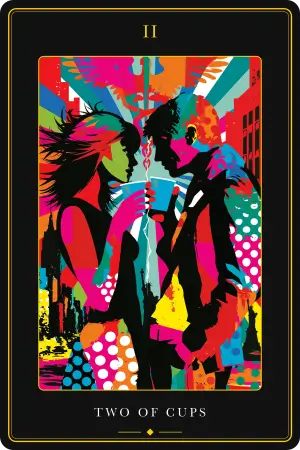
Every deck reimagines the same archetype. Compare the art, then open a deck to read its full interpretation.
Imagery and symbolism
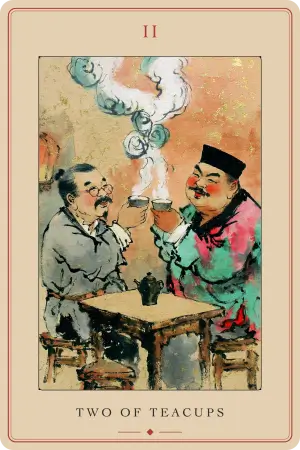
In the Tarot of Beijing the Two of Cups becomes the Two of Teacups, and the pledging couple of the classic card is replaced by two men in an old teahouse. They sit at a small square table with cups raised in a quiet toast. One is an aging scholar in a plain grey robe and round spectacles; the other a prosperous, rosy-cheeked friend in a festive robe of teal and pink. One has learning, the other has money, and at this table neither fact carries the slightest weight. The proof is in their hands: the cups they raise are the same size.
Between them stands a single dark teapot. This is the deck's answer to the Rider-Waite caduceus, the whole esoteric symbol reduced to plain teahouse mechanics: one source filling two cups in turn. Whoever notices the other's cup running low pours, and no one counts. The steam from the two cups rises and merges overhead into one cloud of white and teal, so that two separate feelings become a single shared warmth above the table.
This is a Feng Zikai ink sketch, where nothing is drawn without need, so that joined cloud carries the card's entire argument: what each person brings separately becomes, above the table, indivisible. The scene sits on warm kraft paper flecked with gold, the flecks thickest around the two figures, as if the ordinary air of the teahouse had been quietly gilded by their company. A red lantern glows in the corner and a small red seal marks the card. Both men are bareheaded of pretense, faces open, mid-story and entirely at ease. It is the Beijing way of saying what the old card says with garlands and laurels: an offered cup is an offered heart.
Core meaning
The Two of Teacups is Beijing's Two of Cups, the Golden Dawn's Lord of Love, and this deck states its lesson in a single image: one pot, two cups, no hurry. Connection here is an equal exchange. Neither party dominates or drains the other, and the bond holds because the pouring goes both ways.
The card is agnostic about what kind of relationship it describes. It reads the same for romance, for friendship, and for a working partnership, because what it measures is the quality of the reciprocity rather than the label on it. It marks the moment when two people stop performing and simply sit down together, when communication becomes real. It can be a first meeting that feels like recognition, or a reunion of old friends who pick up mid-sentence after years apart.
Where the number one is the single cup and the isolated self, two is the pair: the passage from independence to interaction. The card carries the raw creative potential of that step, since most joint work in the world begins when exactly two people agree to try. In this deck the number is drawn literally. Two friends, two cups, one table between them, and even the steam obeys, rising from two cups and joining into one cloud. Two remain two, and still make something single.
Upright meaning
Upright, the Two of Teacups is a strong sign for forming attachments and renewing old ones. It favors the start of a bond as much as the deepening of one, and it points to harmony, mutual attraction, and respect resting on trust. The card's one instruction is equality: offer the cup with both hands, give your full attention rather than a passing glance, and refill the other person's cup as often as your own. Let the bond steep at its natural pace, because tea forced too fast turns bitter.
In love. Deep emotional connection and mutual understanding, two people at one small table with the rest of the world reduced to background noise. It suits opening your heart, deepening an existing relationship, or rekindling an old one over familiar warmth. The love it describes rests on quiet daily care, the refilled cup and the saved seat, more than on grand gestures.
In career. Alliance and successful collaboration built on mutual benefit, the scholar and the merchant at one table whose skills fill each other's gaps. It favors a merger of complementary ventures, a lasting bond with a client or investor, and harmony inside a team where a shared goal makes the work flow. Important negotiations tend to end well when both sides arrive as equals and leave as such.
In finances. Partnership and profit that begin over tea rather than over contracts, though the contract follows. Joint ventures prosper here because the card's condition is met: balance and equality in the dealings, with trust between partners as the working capital. It can also mark a useful exchange of resources or timely material help from someone who counts you a friend.
In health. Acceptance of your body and a working balance between inner state and outer form. Like a good pot of tea, well-being comes from proportion and patience: steady nourishment, regular movement, unhurried care. Health and beauty are not achievements to force but relationships to maintain, the way one keeps a friendship, attentively and a little every day.
Reversed meaning
Reversed, the pot still stands between two people, but only one of them keeps pouring. The card points to imbalance and strain: a false harmony, a toast raised out of habit rather than feeling, or a bond where one partner steadily sacrifices their own interests to keep the peace. Turn a full cup over and the contents spill; the taste of the relationship is unchanged, but the containment has failed. The trouble is usually poor communication, unspoken grievances, or plain misunderstanding that neither side has cleared up.
In love. Real trouble in a romantic bond, from simple misunderstanding to a full loss of connection: the two of you still at the table, but the tea long cold. Often one partner has stopped pouring, unwilling or unable to stay emotionally present, leaving the other to hold the warmth alone. Small disagreements curdle into resentment, and the card advises an honest look at whether the closeness can be rewarmed and whether both people want to try.
In career. Conflict and possible separation between partners. Collaboration has become a source of strain instead of strength, with roles unclear and expectations unspoken, and every meeting cools the relationship a little further. At work it can mark an uneven division of labor, one person carrying the pot for the whole table while resentment steeps in silence. The remedy is old-fashioned: sit down, pour honestly, and say what has gone unsaid.
In finances. Friction inside a financial partnership, the pot shared but the pouring not. It points to imbalance and misunderstandings that can end in losses or a deal gone sour. Look closely at any agreement sealed on goodwill alone, since disputes over budgets and the division of returns are typical here. Vague terms and eroded trust cost real money.
In health. A rift between how you feel and how you treat your body, often dissatisfaction with your appearance or exhaustion from chasing a physical ideal. The pattern is swings that drain rather than build, strict restraint followed by neglect. The card's counsel is moderation, a steadier and kinder routine kept at the pace of tea rather than the pace of fire.
Historical notes
The Two of Cups carries one of the oldest continuous meanings in the deck, and each tradition drew it differently. The Tarot de Marseille kept the two cups almost secondary, staging an alchemical scene beneath them: two angelic figures work at an alembic where a phoenix undergoes fiery rebirth, and a strange flower sprouts fish heads for leaves. The imagery belongs to the hermetic idea of the Chemical Wedding, in which human love and physical union serve as vessels for the transformation of the soul.
The 1909 Rider-Waite-Smith deck, illustrated by Pamela Colman Smith under A.E. Waite, moved the scene outdoors. A youth and a maiden pledge their troth, raising two chalices at equal height, crowned with floral garlands and laurels of victory. Between them hovers the card's most striking symbol, the Caduceus of Hermes surmounted by a red winged lion's head, its twin serpents standing for the harmonizing of opposing forces and its lion for the courage that genuine union requires. Crowley and Lady Frieda Harris's Thoth Tarot dropped the human figures altogether, setting two cups on a calm sea fed by a lotus, with silver and gold dolphins entwined around the stalk, an image Crowley tied to his axiom that love is the law, love under will.
The Tarot of Beijing takes this long lineage and translates it into a teahouse. The garlands and laurels become two friends genuinely at ease, and the Caduceus, that elaborate emblem of merged opposites, becomes a plain dark teapot pouring one source into two cups. The esoteric machinery of the Chemical Wedding is set aside and its plain meaning kept: two people making, out of what each brings, one shared warmth.
Correspondences
Number. Two, the number of the pair, of balance, peace, and diplomacy. It is the union of opposites in which two different forces learn to cooperate rather than compete, and it marks the passage from the single cup to the shared pot. In the Golden Dawn system all the Twos correspond to Chokmah, the second sphere on the Tree of Life, the first outward flow of energy reaching beyond the isolated self.
Astrology. The first decan of Cancer, roughly June 21 to July 1, ruled by Venus. Cancer is a cardinal water sign governed by the Moon, the most receptive sign of the zodiac and the one where Jupiter is exalted. When Venus, the planet of attraction and harmony, sits inside Cancer's protective warmth, the result is an enveloping, deeply rooted affection, the astrological equivalent of a stranger handed a full cup with both hands.
Element. Water, which in this deck flows through every teacup. The suit governs feeling, intuition, and sincerity, and the card turns that current toward genuine emotional exchange and the pull toward another person.
Angels and names. The Golden Dawn placed the card under the Divine names Yah and El and the Archangel Muriel, with the decan angels Ayael and Chavuyah. Ayael carries the title "delights of the sons of men," linking the card to the plain human experience of pleasure and connection.
Psychological perspective
The person of this card connects easily and deeply, the kind who can make a stranger feel like a regular within one cup of tea. They listen well and speak openly, and they show care through small practical gestures: the refilled cup, the saved seat, the remembered detail. They perceive the world through relationships and do their best work in pairs and teams, valuing balance and mutual respect, keeping friendships for decades, and preferring a modest table with good company to dining alone in splendor.
The shadow of the card is what happens when that sensitivity turns inward and becomes a barrier. Then the same person seems touchy, guarded, or distant, and their courtesy reads as a closed door. They may take without noticing what it costs the giver, or keep a private tally of every cup they pour. Conflicts and quiet estrangements follow, and the loneliness that results only deepens the pattern. What they need most, an honest and equal exchange, is exactly what they find hardest to allow, which is why the card's counsel so often turns back on the querent: build the receptive, generous atmosphere inside yourself first, and the outward bond follows.
Two of Teacups across decks
Rider-Waite-Smith. The canonical Two of Cups shows a youth and maiden exchanging chalices beneath the winged lion and entwined serpents of the Caduceus, love staged as a formal pledge crowned with garlands. The Two of Teacups keeps the equality and the exchange but strips the ceremony, seating two ordinary friends at a teahouse table where the pledge is simply a shared pot.
Tarot de Marseille. The Marseille card hides its meaning in alchemy, two angels at an alembic distilling a phoenix from fish and fire. Beijing keeps the idea of two things becoming one but moves it from the subterranean furnace to the open air, where the transformation is nothing more mysterious than steam from two cups joining into a single cloud.
Crowley-Thoth. Crowley removed the human figures and painted the elemental mechanics of love, dolphins of silver and gold entwined in overflowing water, an image of his equation that unity divides into a balanced two. The Beijing card restores the humans and lets the teapot do the same work the lotus does, one source feeding two vessels in turn.
Modern decks. Recent versions keep the RWS symbols while warning that this marriage card promises no permanence, since forever is not a promise any card can make. The Tarot of Beijing shares that restraint. It shows a bond warm enough to gild the air around it and still insists the tea must be allowed to steep, held only by whoever keeps choosing to pour.
In combination and context
The Two of Teacups pulls a spread toward connection, and its neighbors reveal what kind. Beside cards of celebration it opens outward from the insular pair toward a wider circle, the way the Three of Cups breaks the private bond into shared company. Beside the Ten of Cups it reads as the foundation that lasting security is built on, the first willing acceptance of another person that later stabilizes into a settled home.
A frequent confusion is the Two of Cups against The Lovers. Both show union, but The Lovers is a Major Arcana card of fated choice and life-altering crossroads, while the Two of Teacups is the daily, practical feeling of loving another human being. It is the more reliable sign of a healthy mutual bond precisely because it rests on active participation rather than destiny. In reconciliation questions the surrounding cards matter most: alongside cards of departure and moving on, the Two of Teacups often shows a former partner who has poured a new cup with someone else, and its truest counsel becomes an invitation to reconcile with yourself.
When the card keeps returning, treat it less as a forecast of a specific person and more as a standard to hold your connections against. Look honestly at how the giving and receiving are divided, have the difficult conversation while the tea is still warm, and pay as much attention to how you receive as to how you give.
Questions for reflection
- Where in your life is only one person keeping the pot full, and what would it take to make the pouring equal?
- When you were last handed a full cup with both hands, did you let yourself receive it, or did you reach to pour instead?
- Which bond have you been rushing toward certainty, and what would change if you let it steep at its own pace?
The general meaning follows the Rider-Waite-Smith reading — the reference used across Tarot Academy. Open a specific deck above for its own interpretation.
Frequently asked questions
Explore the Tarot
Latest Posts
Discover the ancient wisdom of tarot cards and unlock the mysteries of your spiritual journey. Our blog is your gateway to understanding the rich symbolism, meanings, and practical applications of tarot reading.




















































