
 EN (English)



Minor Arcana · Cups (Water)
Three of Cups
Smith put three women in a circle on harvest ground, raised their cups into a single toast, and hung a turquoise sky behind them.
Card at a glance
- Numerology
- 3
- Element
- Water
- Astrology
- Second decan of Cancer (July 2–11), ruled by Mercury
- Kabbalistic path
- Binah (Understanding), where the Threes sit
- Timing
- The middle ten days of Cancer, high summer at the harvest
- Yes / No
- Upright yes, reversed no
Upright
Celebration
Friendship
Community
Shared joy
Gratitude
Teamwork
Hospitality
Emotional expression
Reversed
Conflict
Isolation
Broken friendship
Gossip
Overindulgence
Lost trust
Overspending
Disappointment
Three of Cups in each deck
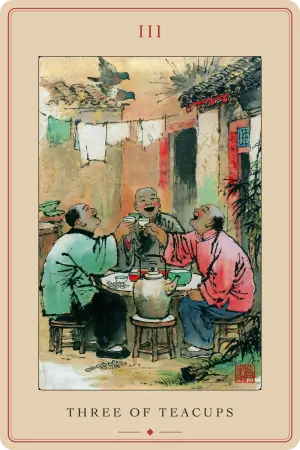
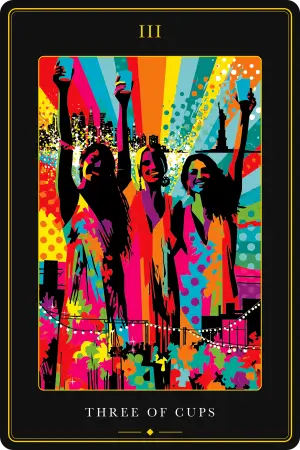
Every deck reimagines the same archetype. Compare the art, then open a deck to read its full interpretation.
Imagery and symbolism
Pamela Colman Smith drew this card as a dance already in progress. Three women stand in a ring in a garden, arms overlapping, each lifting a golden cup so the three meet in one toast above the circle. Nobody leads the movement and nobody stands outside it, which is the whole argument of the composition: this deck reads the scene as solidarity and support, an exchange of emotions among equals. Nothing here is staged for an audience.
The ground does a great deal of work here. Smith heaped the garden with ripe fruit, grapes and a pumpkin and apples lying where they fell, and this deck reads that abundance as natural fertility and as proof that shared effort yields results. The joy in the card has been grown. It is the harvest of labour done together, not a mood that arrived on its own.
The dresses carry their own meaning. This deck ties them to earth, nature and vitality, with the women themselves standing for creative energy and deep feeling. One wears red robes and red undergarments for passion, courage and ambition, and readers often take her as the driving force of the group, an energy capable of turning domineering if the circle sours. A second wears white under an orange-gold overlay, warmth and nurture and the tending of shared hopes. The third is in plain white for purity, truth and innocence, though some divinatory readings see a naive member kept in the group only while she remains useful, which is where the card's shadow enters the picture.
One woman wears a floral wreath. This deck reads it as innocence, hope and passion, and allows that it can point to marriage. Behind all three the sky is turquoise, framing the gathering with a sense of divine origin and open exchange. The celebration is set against heaven, not inside a room.
This deck also names the three figures as the three aspects of the Goddess, Maiden, Mother and Crone, which binds the card to the life cycle, to growth and to creation. Alongside that reading sits Smith's classical source. She worked from the Three Graces, Aglaea for radiance, Euphrosyne for mirth and Thalia for blooming warmth, the Greek goddesses of charm, nature, human creativity and festivity, and she took their arrangement from Botticelli's Primavera. Their particular power is to turn a gloomy setting joyful, which makes happiness a communal creation rather than a private stroke of luck.
Core meaning
This deck states the card in plain terms: joy, friendship and shared celebration, the exchange of emotions and the value of community. What it keeps returning to is participation. The card marks gatherings and social events built around interaction, and it can equally mark the successful completion of a project, a stretch of harmony, or mutual support arriving when it is needed.
Upright it points to new friendships or to old ones deepening, and this deck treats that as a practical window rather than a mood: a favourable time for creative work, for celebrations, and for bringing people together to share something good. Its standing recommendation is to enjoy the company, express gratitude for what you have achieved, and take an actual moment to celebrate instead of moving straight to the next task.
Across this deck's live categories the reading holds its shape. In money it is pooled resources and rewards distributed among everyone who contributed. In business it is a prosperous partnership and a milestone worth marking. At work it is group involvement and achievements shared with colleagues. In romance it is companionship resting on a foundation of friendship. In general relationships it is warmth, hospitality and social harmony. In the physical realm it is health pursued in company. The same three cups, raised in six different rooms.
Upright meaning
Upright, this deck reads communication, shared happiness and participation. Expect gatherings centred on interaction and entertainment, and expect them to be worth attending. It is a period for strengthening your relationships, making time for the people in them, and recognising your own successes out loud. The instruction attached is to immerse yourself in the present and take part rather than watch.
In love. Companionship and a deep emotional connection, with the romance often built on an existing friendship and shared interests. This deck expects growth here, potentially leading to joint plans for the future, and it describes a stretch of fun, mutual understanding and real satisfaction inside the partnership. It also allows for a platonic friendship turning serious and settling into a long-term bond founded on genuine mutual feeling.
In relationships more broadly. Warmth and social harmony, with an increase in gatherings, parties and time spent among friends. The period is marked by emotional unity and closeness with your wider circle, effective mutual assistance inside groups, and new connections forming around shared interests. This deck specifically allows for old ties being renewed and past friendships reviving. Interactions run on acceptance and gratitude, which makes it an excellent time for hospitality.
In work. Group involvement and creative collaboration, often marking professional achievements that ought to be shared with colleagues rather than claimed alone. This deck expects fruitful teamwork, possibly at the start of a new project where everyone actively participates, with group discussion and mutual support building solid results. Share what you know to strengthen the team. It can also indicate a formal celebration for a job well done, or a network widening through seminars and conferences that open new career opportunities.
In business. Successful collaboration and strong teamwork, with a prosperous partnership forming around shared goals. This deck expects group effort to pay off in a specific milestone: a major project finished, a contract signed, new clients acquired. High levels of interaction are necessary right now, and the card highlights social connection and the practical exchange of experience. An unexpectedly productive meeting may connect you with new partners or investors.
In money. Collaboration and shared success, with collective effort yielding prosperity distributed among everyone involved in the venture. This deck points to a joint business where members pool their resources, time and skills, and it says that actively participating in partnerships is what lifts your income. It is honest about the condition attached: shared success still requires sustained combined effort from everyone.
In the physical realm. The benefits of mutual support, with opportunities to join communities that share your fitness goals, from yoga studios to sports clubs. This deck reads group effort as highly effective here and suggests finding a workout partner or building a meal plan with someone. Positive changes in appearance tend to follow a more active life and better food. The emphasis falls on the social side of physical well-being: classes attended with friends, group rides, meals where everyone brings a recipe.
Reversed meaning
Reversed, the circle breaks. This deck describes conflict, disconnection and unreciprocated feeling, with harmony disrupted and mutual support withdrawn. Family and friendship ties get tested by misunderstandings and old resentments. You may hit barriers to cooperation, fall out with friends or business partners, or simply drift apart from people without any single incident to point at. The deck also reads underlying anxiety and internal struggle here, the private version of a public falling-out.
What it asks for is direct. Communicate your feelings openly and honestly to surface whatever is hidden, work to restore trust instead of retreating into isolation, find the source of the imbalance, and use patience to reach a compromise rather than winning the argument.
In love. Communication breakdown, with misunderstandings and disputes overshadowing affection. You or your partner may be worn out by routine and wanting novelty. This deck allows that the card can indicate a third person, jealousy or infidelity, and it also warns of the opposite problem, a couple that has isolated itself socially or leaned on the relationship so hard that personal growth stops. Disappointment is likely where the partnership was built on unrealistic expectations, and in some cases the card points to a separation outright.
In relationships more broadly. Disconnection and a refusal to offer mutual support, with breaches of trust and dissatisfaction with your current circle. This deck describes withdrawal from group activity and a loss of shared goals, and in place of warmth it names jealousy, envy and destructive rivalry that poisons the interactions. Excessive demands and unreasonable competition make emotional conflicts worse. It also warns of false celebrations, insincere feeling and empty conversation where the time simply goes.
In work. Team friction, workplace drama and a sense of isolation. Competition and animosity among colleagues derail the shared objective, and you may feel underappreciated or watch your accomplishments go unrecognised. This deck also reads overload and an absence of personal boundaries here, and it traces a drop in team morale directly to practical delays in finishing projects. Reworking your approach to teamwork and building productive relationships with peers becomes necessary.
In business. Overload, differing opinions and conflicts of interest inside a team, with a partnership no longer functioning as intended. Poor communication reduces the group's effectiveness and stalls progress. This deck cautions against selfishness and against an overly strong focus on personal ambition, both of which undermine team harmony and productivity. It allows for corporate disagreement between stakeholders, a reliable business community fragmenting, or a breakdown in professional culture.
In money. Struggles in joint financial projects and breakdowns in collaboration, with disagreement and a lack of shared goals actively blocking success. Hostility or poor communication can sabotage a group effort and leave a project unfinished and unprofitable. This deck also warns against neglecting your own interests for the group, since an imbalance between individual needs and collective demands ends in financial loss.
In the physical realm. Dissatisfaction with your appearance, or too much reliance on standards other people set. Chasing beauty trends drains energy rather than delivering satisfaction. This deck warns that excessive socialising can cost you physically, through a neglected exercise routine, overindulgence in food or alcohol at events, or stress-eating. Watch for anyone who pressures or criticises your health choices, and find a workable balance between your social life and what your body actually needs.
Historical notes
The scene Smith drew is not the old one. In the Visconti-Sforza deck commissioned for the Milanese court around 1450, the Three of Cups is a bare pip: three ornate golden cups arranged symmetrically in a triangle against a plain ground, with no figures, no narrative and no emotional subtext at all. The card carried its numerical and elemental value and nothing else, three for multiplicity and the foundational stage of completion, the cups for emotional and spiritual flow, drawing on the chalice imagery of medieval religious art with its communal feasting and divine provision. Behind that lie the Mamluk playing cards that reached European trade routes from Egypt in the 1370s, whose cups, swords, coins and polo mallets became the Italian suits.
Meanings were fitted to these pips during the occult revival. Etteilla, in his 1783 Manière de se récréer avec le jeu de cartes nommées Tarot, read the Three of Cups as achievement, success, healing and relief, one of the earliest attempts to adapt tarot specifically for divination. Papus later tied it to Venusian love, beauty and emotional equilibrium.
The dancing women arrived in 1909. Working under A. E. Waite, Smith illustrated the pips with human figures and real activity, which made the esoteric content legible without memorising numerological tables. Waite, in his 1938 Shadows of Life and Thought, called her a "most imaginative and abnormally psychic artist" who had drifted into the Golden Dawn. Her scenic pips appear to draw on the Renaissance Sola Busca deck and on her own 1903 illustration The Hill of Hearts Desire, conceived during a stay in Winchelsea.
There is a hard irony in the authorship. Smith drew the deck's most generous picture of friendship while living largely outside one. She and Waite were paid very little for the deck, and she died in obscurity. Her poem "Alone" records the isolation directly: "Alone and in the midst of men... In spite of all I'm left to dwell." The circle of three exists on the card partly because it was missing from the life of the woman who painted it.
Correspondences
Number. Three. This deck reads it as creativity, social interaction and self-expression, channelled here toward unity and creative joy. Three forms the triad, the process in which two elements combine to produce a third, and the card shows that synthesis as a gathering. The number also carries harmony among body, mind and soul, the balance between internal energy and external environment that spiritual progress depends on.
Astrology. The second decan of Cancer, roughly July 2–11, ruled by Mercury. This deck reads the decan's psychic depth as soul-level communication and the happiness found in close relationships, built on a basic need to exchange emotions. Cancer is cardinal water, ruled by the Moon, deep in feeling and protective by instinct, described esoterically as "eddies of swirling water, a force that renders powerful." Mercury brings mental agility, sociability and quick reactions into that placid water. The result is an intuitive, nearly telepathic connection: friends who send whole paragraphs across a room with one glance. Mercury here paints a picture rather than speaking, favouring non-verbal understanding and deep empathy over forced conversation.
Element. Water. This deck grounds the card in emotional richness and communicative joy, with intuition and deep connection at the front, and it reads the image itself as tender and inwardly at ease.
Kabbalah. All the Threes belong to Binah, Understanding, the Great Mother who takes the raw dynamic force of Chokmah and gives it form and capacity. Because Cups correspond to Water and to the world of Briah, this card is Binah of Briah. Under the Archangel Tzaphkiel, who governs the forces of Saturn, the overflowing water of the suit gains a steadying quality that restrains the otherwise overstrong cup-action and keeps the emotion from dissipating. The Golden Dawn called the result "Abundance resulting from Love."
Ritual associations. Practitioners working this card's energy use the colour orange and the number eight, with storax, frankincense, opal, wheat and honey, seeking blessings of friendship, relaxation and artistic inspiration.
Elemental dignity. A Water card, it flows kindly with Earth and softens Fire, while restless Air scatters its warmth.
Psychological perspective
The people this deck attaches to the upright card are highly sociable and good at building friendships. They take genuine interest in others, celebrate their friends' successes gladly, and show up during the hard stretches. They value harmony and comfort in their dealings, keep a wide circle, and enjoy organising the gatherings that hold it together. Warmth, generosity and emotional openness define them, and they often end up at the centre of the room, thriving on interaction and on marking shared milestones. They know how to appreciate the present, and they will stand up for the people they love.
Reversed, the portrait closes. These are people who lean toward introversion and reserve, who avoid social events, prefer solitude and sometimes put distance between themselves and their friends. Holding relational harmony while meeting their own needs proves difficult. They isolate and hide what they actually feel, which makes sharing a problem nearly impossible. Outward cheerfulness can sit on top of private disappointment, and this deck traces some of that to self-esteem trouble that keeps them from fully joining in.
Underneath the social reading sits a developmental one. The Three of Cups marks the outward expansion of the self into a group: where the Two of Cups is the union of two, the third element turns an isolated relationship into a community. Rachel Pollack, whose psychological reading of the deck shaped modern practice, framed the moment as the recognition that the self is fortified rather than diminished by belonging. The card's demand is quieter than its picture suggests. It asks where you are being held, and whether you are letting yourself receive that support, which makes joy a practice and a choice rather than a mood that happens to arrive.
The Three of Cups across decks
Visconti-Sforza. Three golden cups in a symmetrical triangle on a plain ground, painted for the Milanese court around 1450. No figures, no scene, no emotion. Multiplicity, elemental water and numeric expansion, and nothing beyond that.
Rider-Waite-Smith. The version on this page is the one that gave the card its cast. Smith turned the triangle of cups into three women dancing in a harvest garden, drew on the Three Graces and on Botticelli, and let this deck read the trio as Maiden, Mother and Crone. Joy, sisterhood, community and emotional victory, with the Golden Dawn title Lord of Abundance behind it. Everything most readers picture when the card is named comes from here.
Crowley-Thoth. Painted by Lady Frieda Harris over five years between 1938 and 1943, the Thoth version drops human figures entirely in favour of sacred geometry, and it is titled "Abundance" outright. Three cups fashioned from pomegranates, fertility and the underworld and Persephone's story, are filled by golden lotuses pouring water that overflows into a calm deep sea. Crowley read it as undirected primordial love finding its goal and multiplying through synthesis: spiritual fertility, passive success, the realisation of worth. Harris repainted cards up to eight times to satisfy what Crowley called his "Vanadium Steel yardstick" of esoteric accuracy.
Modern inclusive decks. Because Smith drew three women, the card spent decades as an emblem of female friendship and women's circles, and modern creators have deliberately opened it. Transient Light Tarot uses genderless silhouettes and renames gendered cards. Fifth Spirit Tarot works to dismantle the binary altogether. Rainbow Tarot and Luna Sol Tarot show trans, non-binary and gender-nonconforming figures with visible top-surgery scars, body hair and diverse bodies, framing the toast as unapologetic queer joy. Next World Tarot places the celebration in a post-apocalyptic political setting where it reads as revolutionary love and mutual aid among marginalised communities. The One World Tarot and Tarot of the Divine push for racial and cultural range so the circle reflects a global community. Across these decks the card sheds its "girls' night out" shorthand and becomes a statement about chosen family, which for people estranged from their families of origin is a survival mechanism as much as a pleasure. The androgyny traditional astrology assigns to Mercury, the decan's ruler, supports the reading.
In combination and context
Because Smith drew three figures, love readings often jump straight to a third party, and this is the card's most contested territory. Many experienced readers call that assumption a harmful misinterpretation rooted in insecurity, arguing that the card more often says a partner needs time with their friends, or that a couple is leaning on each other for everything and should reconnect with the community around them. Reading a complex emotional state as a headcount does the card a disservice.
The association is not baseless under specific conditions, since three does introduce an outside element to a pair. Reversed, or flanked by cards of betrayal and secrecy, the narrative gets considerably more likely. The combinations readers cite are the Three of Swords with the Seven of Swords for heartbreak plus deception, the reversed High Priestess or the Moon for hidden affairs or paranoia about a partner's social circle, the Devil for a toxic triangle governed by excess, the Ten or Five of Swords for backstabbing inside a known circle, and a reversed Six of Wands for an ego inflated by juggling people. Without those, the third element is more often an overbearing in-law, a demanding job, or a welcome new arrival.
The fertility line runs through the same suit sequence. The Ace of Cups is the seed of emotion, the Two the union of two, and the Three the creation of a third life, which is why the card turns up in conception and pregnancy readings and why its harvest imagery ties it to the Empress. Alongside the Sun it suggests a happy birth, alongside an Ace of Cups or Wands the spark of conception, alongside a Page of Cups or Pentacles news of a new arrival.
In early dating the card is often read as the friendzone, since its affection is fundamentally platonic. Beside the guarded Nine of Wands it says someone enjoys your company but will not open further; beside the Nine of Pentacles it says someone is happily single and content. On reconciliation the answer stays ambiguous: the card does mark reunions and shared history, but it tends toward a healthy friendship or a pleasant brief crossing of paths rather than a restored romance. Position colours it as well. As advice it says organise the gathering, forgive the friend, inject some joy into a stagnant situation. As an outcome it promises celebration and belonging, provided you check whether the community around you gives energy or takes it.
Questions for reflection
- Smith drew the joy standing on a harvest, fruit that somebody grew. What in your life are you celebrating without having noticed the work that produced it?
- This deck sees a possible naive member in the woman in plain white, kept in the circle only while she is useful. Have you ever been her, and are you certain nobody in your circle is her now?
- The card asks where you are being held. Who currently shows up for you because they want to, and are you actually letting them?
The general meaning follows the Rider-Waite-Smith reading — the reference used across Tarot Academy. Open a specific deck above for its own interpretation.
Frequently asked questions
Explore the Tarot
Latest Posts
Discover the ancient wisdom of tarot cards and unlock the mysteries of your spiritual journey. Our blog is your gateway to understanding the rich symbolism, meanings, and practical applications of tarot reading.




















































