
 SQ (shqip)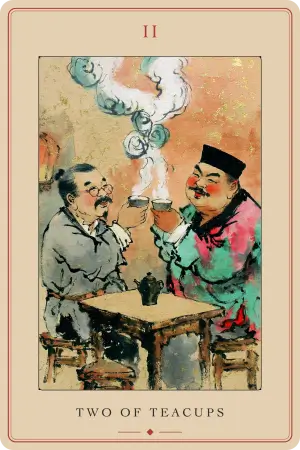



Arkana e Vogël ·
Three of Teacups
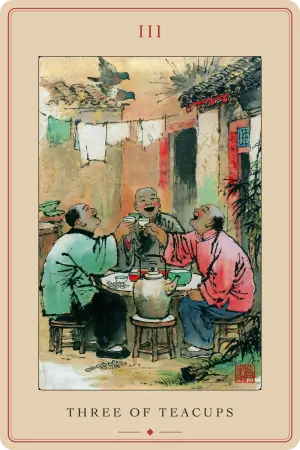
Friendship poured in turns: three old friends on low stools, one kettle of shared warmth, thirty years of trust measured in sunflower husks.
Karta me një shikim
- Numerologjia
- Three
- Elementi
- Water (tea)
- Astrologji
- Mercury in Cancer · 2nd decan
- Shtegu kabalistik
- Binah (Understanding) in Briah
- Koha
- Summer · July 2–11 · Cancer season
- Po / Jo
- Upright yes · Reversed no
Drejt
friendship
celebration
shared warmth
belonging
hospitality
unhurried talk
chosen family
gratitude
Mbrapsht
gossip that wounds
isolation
an empty stool
broken trust
overindulgence
cliques
hollow socializing
Three of Teacups në çdo pako
Çdo kuvertë riimagjinon të njëjtin arketip. Krahaso artin, pastaj hap një kuvertë për të lexuar interpretimin e saj të plotë.
Perspektiva psikologjike
Kjo letër shënon fazën ku vetvetja zgjerohet së jashtmi dhe zbulon se është më e fortë nga shoqëria që mban. Dyshja e izoluar e Dyshit të Filxhanëve pranon një të tretë dhe lidhja private kthehet në komunitet. Rachel Pollack, e cila e trajtoi tarotin si një hartë të ndërgjegjes në veprën e saj 'Seventy-Eight Degrees of Wisdom', i lexonte treshet minore si ky moment i integrimit social, koha kur kuptojmë se pjesëmarrja në një kolektiv e forcon egon, nuk e shpërbën atë.
Njerëzit që mbajnë këtë arkanë janë të shoqërueshëm dhe kanë talentin për ta mbajtur miqësinë gjallë ndër dekada. Ata i festojnë sukseset e miqve të tyre me kënaqësi dhe shfaqen në prag të derës pa u ftuar kur kohët janë të vështira, duke vlerësuar harmoninë dhe ngrohtësinë e një rrethi miqësor. Thashethemet e tyre janë dashuri e maskuar; ata mund të flasin për gjithçka pa tradhtuar asgjë. Kur letra shfaqet mbrapsht, i njëjti person mbyllet në vetvete, i shmanget mbledhjeve dhe largohet nga miqtë pa shpjegim, duke qeshur në tavolinë teksa mbart një zhgënjim të fshehtë që nuk ia tregon askujt. Ajo tërheqje shpesh fsheh një besim të lënduar ose një ndjenjë të lëkundur të vlerës personale që i mban ata në skajet e një rrethi ku thellë brenda tyre dëshirojnë t'i rikthehen.
Treshi i Filxhanëve të Çajit në letra të ndryshme
Rider-Waite-Smith. Tre vajza kërcejnë në një rreth në një kopsht gjatë të korrave, me gota të ngritura në dollinë e tyre, modeluar sipas Tre Graces të Botticellit. Letra e Pekinit e ruan vëllazërinë dhe dollinë, por i ul mikeshat në stola të ulët rreth çajit, duke këmbyer të korrat e përvitshme me një pasdite që përsëritet.
Visconti-Sforza dhe Marseille. Letrat më të vjetra tregojnë tre kupa në një faqosje trekëndëshe të pastër, pa ndonjë skenë njerëzore. Pekini u rikthen njerëzit letrës, ashtu siç bëri Smith, por mbush tavolinën me gjurmët specifike të një miqësie të gjatë, lëvozhga, rroba në tel dhe pëllumba që përgjojnë.
Crowley-Thoth. Crowley e titulloi letrën Bollëk (Abundance) dhe pikturoi tre kupa shegësh që derdhen në një det të qetë, një imazh abstrakt i dashurisë që shumohet përmes harmonisë. Oborri i Pekinit përcjell të njëjtën ide përmes çajnikut të përbashkët, ngrohtësi që rrjedh ngase askush nuk po e mbush filxhanin vetëm për vete.
Rikrijimet moderne. Letrat gjithëpërfshirëse si Next World Tarot dhe Fifth Spirit Tarot e kanë përkthyer letrën si familje e zgjedhur për komunitetin queer, festimi si një akt i ndihmës reciproke mes atyre të huajësuar nga familjet e origjinës. Taroti i Pekinit ndan atë instinkt, por me një ton më të qetë; familja e tij e zgjedhur përbëhet nga fqinjët e një rrugice të vetme që kanë mbushur filxhanët për njëri-tjetrin prej tridhjetë vitesh.
Në kombinim dhe kontekst
Treshi i Filxhanëve të Çajit e anon leximin drejt shoqërisë, festimit dhe shëndetit të rrethit tuaj. Pranë letrave të dashurisë, mund të interpretohet si një miqësi që ngrohet drejt romancës, ose si një partner i mirëpritur në rrethin tuaj të gjerë. Pranë letrave të vetmisë ose largimit, mprehet përmes kontrastit, oborri i mbushur krahasuar me një stol bosh.
Konteksti vendos nëse prania e tretë është një bekim apo paralajmërim. E rrethuar nga letrat e besimit dhe tubimit, personi i tepërt në tryezë është një shtesë e mirëpritur: një mik i ri, një fëmijë, apo një fytyrë që rikthehet. E rrethuar nga letrat e fshehtësisë, tradhtisë ose zemërthyerjes, i njëjti element i tretë degradohet në thashetheme, një trekëndësh dashurie, ose një mik që garon ndërsa bën sikur feston. Kur rrethohet nga letra mbrapsht, mund të udhëzojë drejt teprimeve, një festim që shndërrohet në arratisje nga realiteti, dhimbje koke e të nesërmes, dhe drama sociale.
Kur letra kthehet vazhdimisht, trajtojeni si një udhëzim dhe jo si një parashikim. Zgjidhni shoqërinë e vjetër e të provuar mbi të renë që përpiqet të bëjë përshtypje; pranojini arritjet tuaja me njerëzit që ju panë t'i fitonit ato, dhe zgjidhni thellësinë e marrëdhënieve në vend të gjerësisë së kalendarit tuaj social. Letra tregon tre stola, jo tridhjetë.
Reversed meaning
Reversed, the harmonious circle breaks down. The company that once held you may feel strained: gossip has replaced conversation, someone has quietly stopped coming to the table, or you notice you have been drinking your tea alone by habit rather than by choice. The card can also point to overindulgence, to anxiety hidden behind a cheerful face, or to hollow socializing where the tables are full and the conversations empty. Tend to your relationships before the distance sets, and speak your feelings before they steep into bitterness.
In love. Outside voices intruding on the relationship: gossip, meddling relatives, or friends whose opinions carry too much weight between you. Small resentments accumulate like cold tea, and it can occasionally indicate a third person, jealousy, or divided attention. If the bond was built mostly on shared entertainment, the card asks whether there is a friendship underneath the fun. Close the gate for an evening and talk without an audience.
In career. Team friction, office gossip, or the sense of being left off the invitation. Cliques and whispered rivalries derail common goals, and you may feel your stool at the common table has quietly been taken. It can also mark too much socializing at the expense of the work, or fatigue from performing a cheerfulness you do not feel. Rebuild a few honest working relationships rather than trying to fix the whole courtyard.
In finances. Friction in joint money or the souring of a trust-based arrangement. Disagreements over who contributed what, or who poured more than they drank, can undermine ventures built among friends. Money lent within the circle may turn to resentment, and a shared enterprise may stall because no one wants to name the problem first. Put the awkward conversation on the table before it curdles the friendship.
In health. Social life working against the body: too many rich tables, too much drink at gatherings, sleep sacrificed to company. Loneliness wears the body down too, isolation showing up as fatigue or neglected care. Notice which company leaves you refreshed and which leaves you drained, keep the friendships, and moderate the feasts.
Historical notes
The Three of Cups began as a plain pip. In the Visconti-Sforza Tarot, commissioned for the Milanese court around 1450, the card showed three golden cups arranged in a triangle against an unadorned background, with no figures and no scene, carrying only the numerical and elemental value of three cups of water. The suit itself descends from the Mamluk playing cards that reached European trade routes from Egypt in the 1370s. When French esotericists began assigning divinatory meanings to the pips, Etteilla in 1783 read the card as achievement, success, and healing, and Papus later tied it to Venusian love and emotional equilibrium.
The narrative image most readers know arrived in 1909 with the Rider-Waite-Smith deck. Under Arthur Edward Waite's direction, Pamela Colman Smith drew three maidens dancing in a circle in a harvest garden, raising golden cups in a toast over ground lush with grapes, pumpkins, and apples. She took her cue from Sandro Botticelli's Primavera and its Three Graces, Aglaea, Euphrosyne, and Thalia, the goddesses whose charm turns a gloomy room to joy. In the Thoth Tarot of Aleister Crowley and Lady Frieda Harris, the card is titled Abundance, showing three pomegranate cups filled by golden lotuses that overflow into a calm sea, an image of love finding its goal and multiplying through harmony.
The Tarot of Beijing keeps the meaning and relocates the scene. It trades the dancing Graces for three seated friends, the harvest field for a hutong courtyard, and the raised golden chalices for teacups. The celebration stops being a rare festival and becomes an ordinary afternoon, repeated as often as the kettle is filled.
Correspondences
Number. Three, tied in numerology to creativity, social interaction, and self-expression. Two people share; three form a company. On this card the triad is literal, three friends and three stools, with the toast passing around the table and nowhere to stop. Three is the smallest circle that can hold a conversation going in rounds, and it represents synthesis, two old friends and the years between them producing something neither owns alone. The deck also reads it as harmony of body, mind, and soul: seeds for the hands, gossip for the mind, laughter for the soul.
Astrology. The second decan of Cancer, roughly July 2 to July 11, ruled by Mercury. Cancer's devotion to home and kin widens here by exactly one courtyard, from family to the chosen family of neighbors and lifelong friends. Mercury adds mental agility and quick sociability, the darting wit of table talk and the news that travels the lane faster than the pigeons. The placement describes an intuitive, almost telepathic understanding between close friends who can say a paragraph with a single glance.
Element. Water, which in this deck is tea, feeling made drinkable and warmth passed from hand to hand in a cup. It grounds the card in tenderness and settled trust rather than dramatic emotion.
Kabbalah. The threes sit at Binah, Understanding, the Great Mother who gives form to the raw energy of the twos. Because Cups belong to Briah, the world of Water, this is Binah of Briah, described in the Golden Dawn system as abundance resulting from love, a stable and deeply satisfying emotional reality.
Psychological perspective
This card marks the stage where the self expands outward and discovers it is stronger for the company it keeps. The isolated pair of the Two of Cups admits a third, and the private bond becomes a community. Rachel Pollack, whose Seventy-Eight Degrees of Wisdom framed the tarot as a map of consciousness, read the minor threes as this moment of social integration, the realization that participating in a collective fortifies the ego rather than dissolving it.
The people who carry this arcana are sociable and gifted at keeping friendship alive over decades. They celebrate their friends' successes gladly and turn up on the doorstep unasked when times are hard, valuing harmony and the comfort of a warm circle. Their gossip is affection in disguise, and they can talk about everything while betraying nothing. Reversed, the same person turns inward, avoiding gatherings and drifting from friends without explanation, laughing along at the table while carrying a disappointment no one is shown. That withdrawal often hides wounded trust or a shaky sense of worth that keeps them at the edge of a circle they secretly long to rejoin.
Three of Teacups across decks
Rider-Waite-Smith. Three maidens dance in a circle in a harvest garden, cups raised in a toast, modeled on Botticelli's Three Graces. The Beijing card keeps the sisterhood and the toast but seats its friends on low stools around tea, trading the once-a-year harvest for a repeatable afternoon.
Visconti-Sforza and Marseille. The oldest decks show three cups in a bare triangular arrangement, a pure pip with no human scene. Beijing restores people to the card, as Smith did, but fills the table with the specific residue of long friendship, husks, laundry, and eavesdropping pigeons.
Crowley-Thoth. Crowley titled the card Abundance and painted three pomegranate cups overflowing into a calm sea, an abstract image of love multiplying through harmony. The Beijing courtyard reaches the same idea through the shared kettle, warmth that overflows because no one pours only for themselves.
Modern reframings. Inclusive decks such as Next World Tarot and the Fifth Spirit Tarot have reclaimed the card as queer chosen family, celebration as an act of mutual aid among people estranged from their families of origin. The Tarot of Beijing shares that instinct in a quieter key, its chosen family the neighbors of a single lane who have poured for one another for thirty years.
In combination and context
The Three of Teacups tilts a spread toward company, celebration, and the health of your circle. Beside cards of love it can read as friendship warming into romance, or as a partner welcomed into the wider table. Beside the deck's cards of solitude or departure it sharpens by contrast, the full courtyard measured against an empty stool.
Context decides whether the third presence is a blessing or a warning. Surrounded by cards of trust and gathering, the extra person at the table is a welcome addition, a new friend or a child or a returning face. Surrounded by cards of secrecy, betrayal, or heartbreak, the same third element curdles into gossip, a love triangle, or a friend competing while pretending to celebrate. Reversed neighbors also steer it toward overindulgence, the celebration mutating into escapism, hangover, and social drama.
When the card keeps returning, treat it as an instruction rather than a prediction. Reach for the old, proven company over the impressive new one, acknowledge a recent achievement with the people who watched you earn it, and choose depth of company over breadth of schedule. The card shows three stools, not thirty.
Pyetje për reflektim
- Kujt ke reshtur t'i rimbushësh filxhanin, dhe çfarë do të të kushtonte që të derdhje ti i pari?
- Cilat mbledhje ju rimbushin energjitë, dhe në cilat po merrni pjesë nga zakoni dhe jo nga dashuria?
- Cilën arritje të fundit e keni kaluar me nxitim pa lejuar që njerëzit që ju ndihmuan ta dëshmojnë?
Kuptimi i përgjithshëm ndjek leximin e Rider-Waite-Smith — referenca që përdoret në të gjithë Tarot Academy. Hap një kuvertë specifike më lart për interpretimin e saj të veçantë.
Pyetjet e shpeshta
Eksploroni Tarotin
Postimet e fundit
Zbuloni urtësinë e lashtë të kartave të tarotit dhe zhbllokoni misteret e udhëtimit tuaj shpirtëror. Blogu ynë është porta juaj drejt kuptimit të simbolikës së pasur, kuptimeve dhe aplikimeve praktike të leximit të tarotit.




















































