
 EN (English)


Minor Arcana ·
Four of Teacups
Apathy amid plenty: three cups gone cold and a fourth steaming at his elbow, and the man will not lift his head.
Card at a glance
- Numerology
- Four
- Element
- Water
- Astrology
- Moon in Cancer · 3rd decan
- Kabbalistic path
- Chesed (Mercy)
- Timing
- Third decan of Cancer · about July 12 to 21
- Yes / No
- Upright no, or not yet · Reversed yes
Upright
apathy
boredom in plenty
withdrawal
missed offer
discontent
reflection
saturation
taking things for granted
Reversed
waking up
new appetite
accepting help
second look at refusals
hardened isolation
escapism
renewed focus
gratitude
Four of Teacups in each deck
Every deck reimagines the same archetype. Compare the art, then open a deck to read its full interpretation.
Imagery and symbolism
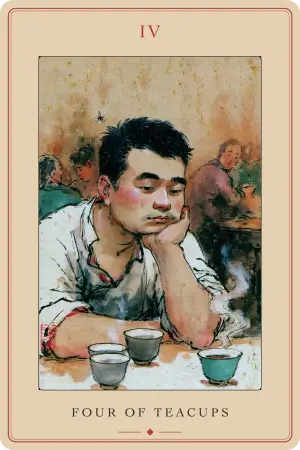
In the Tarot of Beijing the Four of Cups moves indoors, into a crowded teahouse, and that single change carries the card. The Rider-Waite youth sulks alone under a tree. Here the young man is surrounded by company, conversation, and service, so his solitude reads as a choice and not a circumstance. He slumps at the table, cheek propped on his fist, collar loose, eyes fixed on nothing. The folded arm and the head that needs holding up are this deck's version of the original's crossed arms and legs: a body closed to what sits in front of it.
Three grey cups stand near his elbow, drawn in the same washed-out ink as his shirt. They have gone cold, and no steam rises from them. These are the pleasures already poured and already ignored, past joys and offers and affections that curdled into furniture. The fourth cup enters from the edge of the card. Everything the RWS hands to a figure emerging from a cloud, this deck gives to a waiter's unseen gesture. The cup is teal, one of the deck's two accent colors, freshly filled, and a ribbon of white steam climbs from it, the liveliest line in the whole drawing. The offer is not supernatural. It is human, near, and perishable, because steam does not wait. He does not look at it. The gap of a few inches between his lowered eyes and the rising steam holds the entire meaning of the card.
Behind him the teahouse goes on in soft, blurred washes, pairs of patrons leaning together and pouring. The background is warm and social so that his detachment reads as self-imposed: the world has not withdrawn from him, he has withdrawn from it. Above his head hangs a single small mosquito, drawn in two or three hair-thin strokes, the itch he cannot name circling a man who has everything he ordered. The warm kraft-paper ground is flecked with gold, this deck's steady reminder that ordinary hours carry value whether or not anyone notices, and here the flecks hang over a man who notices nothing. The small red seal sits quietly in its corner, the artist present at the table he drew.
Core meaning
The Four of Teacups is Beijing's Four of Cups, the card of apathy in the middle of plenty. Cups are water, and in this deck the water is tea, the element of feeling, memory, and bond. The number four is stability, the walls of the courtyard house, the resting number after the movement of three. Bounded water in a cup is peace, but water left standing too long goes stale, and that is the state the card names. Comfort has quietly turned into routine and satisfaction into saturation.
The man has more than he can taste. Life poured for him three times, and he looked at the wall while the cups went cold. Now a fourth is set down warm at his elbow and he refuses it without quite noticing he is doing so, waiting for something better that has no name. This is a stage of reflection, and reflection has its worth. The danger is only that the steam rises, curls, and disperses while he decides whether to look up. Where the canonical Four of Cups shows ascetic dissatisfaction under an open sky, the Beijing card frames the same withdrawal inside a warm, busy room, which sharpens the point: the tea is fine, the drinker is tired.
Upright meaning
Upright, the Four of Teacups marks a period of inner withdrawal and mild discontent. You may be turning down offers, invitations, or affection while telling yourself none of it is quite right. The card asks you to lift your eyes from the wall and take honest stock of what is already on your table before concluding it holds nothing. Give yourself quiet time, but set a limit on it the way a teahouse sets closing hours, and at least smell the next cup before you refuse it.
In love. The couple who have stopped tasting each other, or the single person who lets suitors pass while staring at the wall. Affection has become furniture and fresh gestures cool unclaimed. One partner's attention has turned inward toward a private dissatisfaction they cannot name and so cannot discuss. The advice is one motion: lift your head, and smell what is offered before waving it away.
In career. The plateau after the climb. The position is secure and the tasks are known, and the days repeat like refills of the same pot. Competence has outlived its curiosity, and you can do the job with your cheek on your fist. Something new is likely being offered nearby, a project or transfer or invitation, and you are positioned to miss it through simple failure to look up.
In finances. A full table and no appetite. Income arrives and obligations are met, yet the whole stable arrangement gives no pleasure and bores you. Statements go unopened and a fresh proposal may steam at your elbow, a side income or better arrangement, while you look at the wall. Nothing is collapsing. Something is quietly going cold.
In health. Physical life gone flat rather than wrong. The routines stand, meals and walks and sleep in the same order, and they have stopped tasting of anything. Motivation is the missing ingredient, and it is missing because you have stopped examining what is offered. The body does need a quiet season of rest and slower rhythm. Let the stillness restore you, but do not furnish it and move in.
Reversed meaning
Reversed, the Four of Teacups swings between two doors. Through one comes the waking: the head lifts off the hand, the eyes find the steam, and the man realizes the teahouse has been warm and noisy around him all along. Appetite returns, refusals get a second look, and cold cups worth reheating get reheated. Through the other door the withdrawal completes itself. He has sat so long over cold cups that the waiter stopped coming, chances are no longer offered because they were refused too many times, and detachment has hardened into isolation.
In love. Either the thaw or the freeze. One partner wakes, notices the row of cold cups, and reintroduces appetite through renewed courtship and revived rituals. Or coldness settles for good, offers stop coming, and the space between two people at one table grows wider than the lane outside. Test it with one warm gesture and watch whether it is taken up.
In career. The wake-up or the cost of long drift. On the lighter side interest returns in an awkward rush, applications and questions and volunteered hands, and you scramble to catch offers before they finish cooling. On the heavier side chances for growth were allowed to pass and the flatness thickened into real disengagement. Change the shape of your day before you change your job, because often the routine went cold and not the work.
In finances. The return of financial appetite, or the price of ignoring it. Options waved away for months suddenly look worth a second smell, so go back through what you turned down and check whether any cup is still warm. The harder reading is that opportunities were missed outright and regaining lost ground now takes real effort. Either way, stop treating your finances as scenery.
In health. Reawakening or accumulated neglect. In the brighter sense appetite returns for movement and care, and stale habits are recognized as stale and replaced without mourning. In the heavier sense fatigue deepened while it was ignored and small signals were dismissed until they grew loud. The card also carries the shadow of escapism, using drink or numbness to blur reality, and its counter is to reconnect with the body. Choose one physical offer you have been refusing and take it this week while it is still warm.
Historical notes
The Four of Cups took shape as a study of dissatisfaction, and each foundational tradition read that dissatisfaction differently. In the 1909 Rider-Waite-Smith deck, drawn by Pamela Colman Smith to A.E. Waite's design, a solitary youth sits under a large tree with arms crossed, three cups on the ground before him and a fourth offered by a disembodied hand from a grey cloud. He ignores all four. The image sits on a spectrum from the Buddha under the Bodhi tree rejecting hollow pleasures to a spoiled child refusing to engage.
Aleister Crowley's Thoth deck, painted by Lady Frieda Harris, names the card Luxury and gives it the darker subtitle The Seeds of Decay. Four ornate golden cups sit on a tumultuous sea of Cancer's water, fed by pipe-like roots from a central lotus, sealed off from the outside world. Behind the golden glamour lurks the grey emptiness of comfort that has stopped growing. The older Tarot de Marseille reads the four cups as emotional containment, a perimeter of stylized cups around a central flower that protects the emotional core while deciding who is let inside the tribe and who is kept out.
The Tarot of Beijing inherits all three readings and relocates them to a teahouse. The lone tree becomes a crowded social room, the hand from a cloud becomes a waiter's ordinary gesture, and the divine offer becomes a perishable human one that will go cold if it is not claimed. The refusal is the same refusal the card has always shown. The setting simply makes it harder to blame anything but the drinker.
Correspondences
Number. Four, the number of walls. In this deck it is the number of the siheyuan, the courtyard house enclosed on four sides, and every Four in the minor arcana shows what enclosure does to its suit. The Four of Kites ties celebration to the four corners of a gate, the Four of Coins seals a man inside his own shutters, and the Four of Teacups builds the walls out of mood. Four is stability, foundation, the resting number that sits down after the growth of three. Applied to water, that steadiness is double-edged: still water is peace, still water left too long is stale.
Astrology. The Moon in the third decan of Cancer, roughly July 12 to 21. Cancer is the sign of the shell, of home and the walled courtyard of the self, and its third decan carries the need for protection to the point where the shell keeps out nourishment along with danger. The Moon rules here in its own sign, patron of everything half-lit and inward, the same moon that hangs over the deserted hutong in this deck's eighteenth major arcanum. Under it feelings rise and recede on their own schedule, which is why the card counsels patience with the mood rather than war against it.
Element. Water, in this deck poured as tea. It governs feeling, memory, and bond, and the Four describes the heart at slack tide, full and still and going stale. Water needs movement to stay fresh, so the card's whole warning is about circulation withheld.
Kabbalah. Chesed, the sphere of Mercy on the Tree of Life, in the suit of Water. Chesed is loving, structuring kindness, the benevolence of a secure upbringing, and its shadow is exactly the danger the card names: comfort so complete that a person refuses to leave the enchanted circle and engage with the friction real growth requires.
Elemental dignity. Water under the stabilizing four turns passive and inward. Beside fiery or airy cards it can read as the drag that slows their momentum, and beside other water cards it deepens the withdrawal into genuine retreat.
Psychological perspective
The person of this card is a quiet sitter, thoughtful and inwardly busy, weighing their life the way a scholar weighs a line of verse. To others they can seem aloof or ungrateful, since gifts go unopened and compliments slide off, but they are rarely cold in fact. They are simply elsewhere. Often they sit between chapters, the old flavor faded and the new one not yet chosen, and they would rather hold the emptiness than fill it with the wrong thing. They know something is missing and cannot yet say what.
The deeper mechanism is a trance of isolation, the felt belief that one is alone and misunderstood, which the person confirms by refusing help when it is offered or failing to ask for it when it is needed. The fourth cup hovers in plain view and gets waved away, not from true contentment but from a quiet fear that any new joy accepted will be taken back. Modern readers push back on treating this as pure failure. Boredom is a luxury, and the safety to sit and contemplate one's mild dissatisfaction means the basic needs are already met. The work of the card is to tell mindful retreat, the necessary pause to gather strength, from the self-absorbed refusal that slowly starves the spirit it means to protect.
Four of Teacups across decks
Rider-Waite-Smith. A youth under a tree ignores three cups on the ground and a fourth held out from a cloud, arms crossed, gaze down. The Beijing card keeps his closed posture and his refusal but trades the open field for a teahouse and the cloud's hand for a waiter's, so the offer becomes human and time-limited rather than divine.
Tarot de Marseille. Four stylized cups frame a central flower, an abstract diagram of emotional containment and boundary. Beijing keeps the containing four but reads it through the siheyuan, the courtyard whose walls give rest and, held too long, give staleness.
Crowley-Thoth. Crowley titles the card Luxury and subtitles it The Seeds of Decay, painting sealed golden cups on Cancer's restless sea. The Beijing card meets that same warning in the three cups gone grey and cold, comfort that stopped circulating and began to sour.
Modern reframings. Recent decks defend the Four of Cups as healthy boundary-setting and self-preservation rather than mere sulking. The Tarot of Beijing holds both readings at once. The mosquito and the cold cups warn against stagnation, while the steaming teal cup and the warm room insist that some offers are genuinely worth accepting.
In combination and context
The Four of Teacups sets a baseline of emotional stillness that the cards around it push toward rest or toward rot. Beside the Ace of Teacups the metaphor turns literal, the Ace becoming the actual fourth cup offered from the sky, and the spread asks whether you will stay safe in your apathy or risk the heart on a new beginning. With this deck's Hermit the withdrawal reads as chosen and fruitful, loneliness used as a tool for real renewal rather than a rut.
Stronger cards force the stillness to break. Beside the Fool the reading turns into a directive to let go of old regret and take the leap before the steaming cup goes cold. With Death the stagnation reaches critical mass and the old structure collapses to make way for movement, whether wanted or not. Beside the Devil the card's escapism curdles into bondage, withdrawal hardened into addiction that demands intervention. In a plain yes-or-no question it usually answers no, or wait until your perspective shifts, except when the question is about drawing a boundary or refusing something draining, where it turns into an emphatic yes.
When the Four of Teacups keeps surfacing, read it as the card's own advice made insistent: lift your head, name what you are waiting for, and smell the nearest warm cup before the steam is gone.
Questions for reflection
- Which three cups on your own table have gone cold while you looked at the wall, and what would it cost to taste one again?
- When you refuse an offer lately, is it real discernment or the old fear that any new joy will be taken back?
- What are you actually waiting for, named plainly, and is it something the world could ever set steaming at your elbow?
The general meaning follows the Rider-Waite-Smith reading — the reference used across Tarot Academy. Open a specific deck above for its own interpretation.
Frequently asked questions
Explore the Tarot
Latest Posts
Discover the ancient wisdom of tarot cards and unlock the mysteries of your spiritual journey. Our blog is your gateway to understanding the rich symbolism, meanings, and practical applications of tarot reading.




















































