
 EN (English)



Major Arcana · IV
The Emperor
Pamela Colman Smith's armored commander on a ram-carved throne, cosmic Aries authority forged over barren red mountains.
Card at a glance
- Numerology
- IV
- Element
- Fire
- Astrology
- Aries · ruled by Mars
- Kabbalistic path
- Heh (Chokmah → Tiphereth)
- Timing
- Spring · Aries season
- Yes / No
- Upright yes · Reversed no
Upright
authority
structure
stability
discipline
leadership
protection
strategy
control
Reversed
despotism
rigidity
abuse of power
loss of control
domination
stubbornness
coercion
The Emperor in each deck
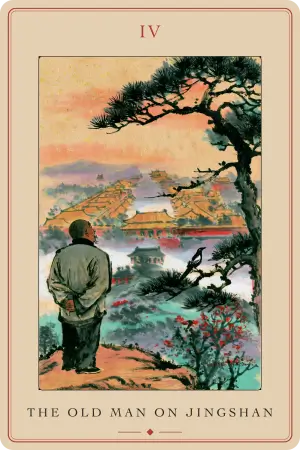
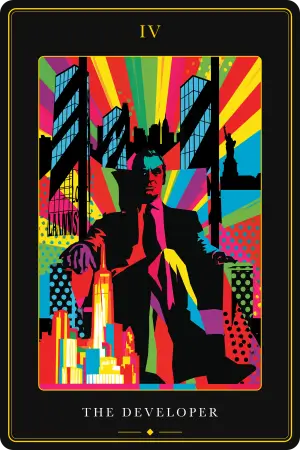
Every deck reimagines the same archetype. Compare the art, then open a deck to read its full interpretation.
Imagery and symbolism
Pamela Colman Smith drew this Emperor for A.E. Waite in 1909, and her most decisive move was to strip away centuries of European monarchy. Gone is the crossed-leg pose of legal judgment and the imperial eagle of earlier decks. In their place she seated him on an imposing stone throne carved with four ram heads and clad him for a fight, turning a stationary lawmaker into a militant commander.
The symbols read one by one. The four rams tie the card straight to Aries, and in this deck's reading they also stand for the four cardinal directions and the four elements of fire, water, earth, and air. His robe is passionate red, but beneath it Smith painted full plate armor, proof he is ready to defend what he governs. In his right hand he raises a scepter for active authority, often drawn as an ankh, and in his left he holds a golden orb, his dominion over earth and sky. The golden crown marks his rank as head of state or family, and his long white beard carries age and settled experience.
The setting finishes the argument. Behind him rises a range of rust-red, barren mountains with a thin river threading through, Martian country with none of the fertile water that floods The Empress's garden. The stone blocks under the throne give it a permanent footing. His gaze is fixed forward, undistracted, a look of plain practicality and self-assurance. The eagle that sat on older shields is gone from the picture, though the archetype keeps its far-sighted, detail-catching vision.
Core meaning
You already know the Emperor as authority, structure, and the archetypal Father. What Smith's card sharpens is the temperament behind that role: a ruler who forges order out of chaos through logic and resilience, not one who inherits it. His strict, fair authority is earned and held by will, the same way his throne stands on hard stone rather than in a fertile court.
His number, IV, is the number of foundation: four walls, four seasons, four directions, four elements. Raw energy pressed down into solid, measurable form. In the deck's own reading the four is not entirely static; it is a foundation built from experience, meant to carry future development rather than freeze it. He is the earthly father of The Fool, tending and harvesting what Mother Nature grows, joining the role of protector to the natural world.
Upright meaning
Upright, the Rider-Waite Emperor brings stability, order, and authority to a spread, often a person of real influence whose courage and control drive the situation. He calls for firm, decisive action and asks you to take responsibility, put things in order, and stand on your principles. This is achievement earned through discipline and strategy, not luck.
In love. A reliable, steadily developing bond where long-term planning takes precedence and one partner may step into a protective, highly responsible role. It reads as a good time for serious commitment, a proposal or a formalized partnership, with the focus on building a secure future together.
In career. Time to take full responsibility, often through a promotion or a step into leadership. Your strategy is solid and rests on intellect and disciplined willpower. The card also points to a powerful mentor or a demanding manager who values structure and rewards respect for the hierarchy.
In finances. Stability and strict control over resources, with a focus on long-term goals. It favors careful investment, particularly in solid assets like real estate, and can signal backing from a reliable authority figure. You have the discipline to build lasting prosperity.
In health. A call to discipline and a structured routine: steady diet, consistent exercise, and dropping harmful habits. Because the card values stability, any new regimen works best introduced methodically rather than through extreme, sudden shifts.
Reversed meaning
Reversed, the Emperor points to dictatorship, unchecked power, or a total loss of control. It flags overly strict rules, inflexibility, and a hold on power for its own sake, and just as often the opposite failure: an inability to manage anything at all. The container has become a cage, or there is no container left.
In love. A relationship strained by control and dominance, where one partner dictates terms and refuses to share responsibility. It warns of violated boundaries and rigid, tyrannical behavior, and urges a serious re-evaluation to restore mutual respect and basic equality.
In career. Severe management problems, either weak authority breeding chaos or a dictatorial style that alienates the team. Expect power struggles, delays, and distrust from partners or employees until the leadership approach is reassessed.
In finances. Disorder and lost control: poorly considered decisions, undisciplined spending, or failed investments. It can point to mounting debts or a lost income source, and reads as a blunt warning to avoid risky projects and get a strict grip on the budget.
In health. A breakdown in discipline, whether total neglect of diet and exercise or the opposite extreme of punishing overtraining and crash diets. The remedy is balanced, rational control of the daily routine, sometimes with a specialist's help toward a sustainable plan.
Historical notes
The Rider-Waite Emperor is the endpoint of a long argument about how to picture power. The fifteenth-century Visconti-Sforza card shows a bearded king with orb and scepter, his imperial eagle a loaded political device that the Visconti adopted only after Gian Galeazzo bought the ducal title in 1395. The Tarot de Marseille then fixed his most famous pose, seated in profile with legs crossed into the shape of a four, the posture of the highest-ranking man in the room and his right to pass judgment.
Politics kept rewriting him. During the French Revolution printers were legally forced to scrub royal symbols from their woodblocks, so his crown became a Phrygian liberty cap, his scepter a harmless flower, and the eagle vanished; some decks replaced him outright with a Moor holding a sun-topped scepter. The nineteenth-century occultists read the old pose the other way, with Levi and Wirth seeing his crossed legs and upright torso as the alchemical sign for sulfur, spirit ruling matter.
Waite and Smith cut all of it loose in 1909. They abandoned the eagle and the crossed-leg pose of judgment, set him on a stone throne of four ram heads, dressed him in armor, and dropped him into a barren red mountain landscape, remaking a terrestrial ruler as a figure of cosmic, Aries-driven authority. The 1970s Morgan-Greer Tarot built directly on this RWS foundation, combining Waite's work with Paul Foster Case's into saturated close-up scenes that kept the astrological reading intact.
Correspondences
Number. He is IV, the number of foundation and physical reality: four directions, four elements, four seasons, four walls. His domain is the solid, measurable world where ideas condense into form, a foundation built to support what comes next.
Astrology. He answers to Aries, the cardinal fire sign ruled by Mars, whose headstrong, pioneering drive the ram heads on his throne make plain, and the rust-red mountains behind him are distinctly Martian ground. Cartomancers also tie him to the Sun exalted in Aries and to the Sun in Capricorn, the latter stressing his commitment to responsibility and continuity.
Element. Fire. His is the martial, forging heat that conquers ground and holds it.
Kabbalah. His Hebrew letter is Heh, the window, and on the Tree of Life he walks the path from Chokmah to Tiphereth. Crowley later swapped this letter with The Star, giving the Emperor Tzaddi, the fish hook, though most readers keep the older Heh.
Elemental dignity. Beside Wands his fiery drive intensifies, turning strategy into forceful, goal-directed action.
Psychological perspective
Sallie Nichols reads The Empress and The Emperor as the macrocosmic Mother and Father, and in Jungian terms this is the Ruler firming up ego-consciousness and mastering the material plane, the necessary act of building a self before deeper mysteries can be met. Someone carrying this energy has innate authority and a strong spirit: organized, goal-oriented, quick to analyze, and entirely unafraid of responsibility. Their love of order builds secure structures, and their rationality drives consistent results.
The shadow is the same trait gone hard. The drive for control can curdle into tyranny and what the Thoth tradition calls rational despotism, law placed above ethics. A stubborn refusal to admit mistakes alienates others, and a fixation on the goal can crowd out empathy for the people in the way. Progressive readers often meet him as the face of patriarchy, and the more experienced add a caution: a strong dislike of the Emperor usually points to an unresolved quarrel with authority in the reader, and when he keeps appearing, take it as a nudge to stop reacting and take charge of your own life.
The Emperor across decks
Set beside Smith's armored commander, other decks show how far her redesign traveled.
Tarot de Marseille. The classic Emperor sits in profile, legs crossed into a four, the eagle shield at his side, the image of a ruler entitled to judge, everything RWS deliberately left behind.
Crowley-Thoth. Crowley reassigned his Hebrew letter from Heh to Tzaddi in the famous switch with The Star and painted the archetype's shadow as rational despotism, a rulership drained of feeling. M.M. Meleen's Thoth-based Pharos Tarot renames him The Azimuth, marking the observer's fixed coordinates with a fish-hook anchor so he supplies the true north by which The Star's cosmos is navigated.
Modern decks. Recent creators try to save his core of protection and structure from the monarchical baggage. Jen Cownie and Fiona Lensvelt argue he need not be male or even human, and could as easily be the calm voice of an air traffic controller or the seatbelt on a turbulent flight. The Spacious Tarot renders him as a regimented field of poppies, discipline as scaffolding that lets beautiful things grow, and the Anna K Tarot strips away the armor entirely for a chess player thinking several moves ahead.
In combination and context
The Emperor anchors whatever spread he lands in and pulls it toward control, responsibility, and discipline. Set beside The Empress he completes a whole, his boundaries giving her boundless creativity a safe place to take form. With The Hierophant he stacks worldly authority on top of spiritual tradition, a sign to work within established structure or formal teaching.
His fire compounds with momentum and initiative. Alongside The Chariot he becomes an almost unstoppable will, strategy married to drive, and with the Ace of Pentacles he points to the solid start of a lucrative, well-built venture.
In love spreads his neighbors reveal whether the boundary is healthy. Backed by steadying cards he reads as a mature person holding a line and building a dependable future; ringed by the reversed authority cards he tips into the domineering partner who controls through leverage. When he stalks a reading, treat him not as an outside force but as a prompt to build routine and reclaim your footing.
Questions for reflection
- Where is a lack of structure costing you, and what routine could steady it the way stone steadies this throne?
- Do you use your authority to protect and make space for others, or only to control them?
- What are you ready to take ownership of and build on solid ground?
The general meaning follows the Rider-Waite-Smith reading — the reference used across Tarot Academy. Open a specific deck above for its own interpretation.
Frequently asked questions
Explore the Tarot
Latest Posts
Discover the ancient wisdom of tarot cards and unlock the mysteries of your spiritual journey. Our blog is your gateway to understanding the rich symbolism, meanings, and practical applications of tarot reading.




















































