
 EN (English)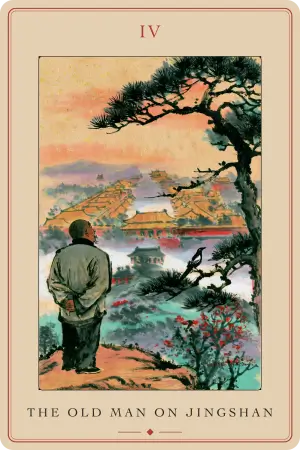


Major Arcana · 6
The Calligraphy Master
Tradition as a hand passed from hand to hand: an old master closes his weathered hand over a child's and guides the first brushstroke.
Card at a glance
- Numerology
- V
- Element
- Earth
- Astrology
- Taurus · ruled by Venus
- Kabbalistic path
- Vau (Chokmah → Chesed)
- Timing
- Early morning · spring · Taurus season
- Yes / No
- Yes, by the proven route · Reversed no
Upright
mentorship
apprenticeship
living tradition
fundamentals
formal study
lineage
discipline as care
rites of passage
Reversed
dead ritual
dogmatism
rote copying
rebellion against the academy
broken lineage
hollow formalism
learning alone
The Calligraphy Master in each deck
Every deck reimagines the same archetype. Compare the art, then open a deck to read its full interpretation.
Imagery and symbolism
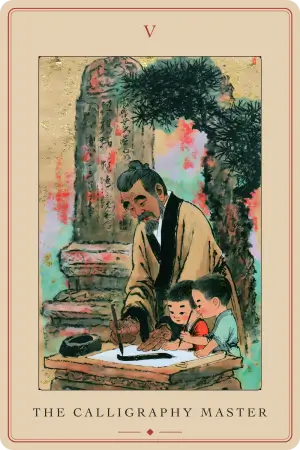
In the Tarot of Beijing the Hierophant is the Calligraphy Master (国子监先生), and the throne between two temple pillars becomes a stone table in the courtyard of the Guozijian, the old Imperial Academy of Beijing. The card is drawn in the deck's Feng Zikai manner: calm brush lines, grey and black washes, accents of vermilion and teal on gold-flecked kraft paper, a small red seal in the upper corner. Everything cosmic here is shown through the small and human.
The master leans over the table and guides two boys through their first brushstrokes, his weathered hand closed over a small one that holds the brush. This replaces the raised hand of blessing in the classical card. Blessing in Beijing is not a gesture made at a distance but a hand placed over yours. The two boys stand where the two tonsured monks kneel in the Rider-Waite image, yet they are not supplicants. They are children, cheeks still round, one in red and one in teal, because tradition here is received at the very beginning of life rather than after any renunciation of it.
Behind the master rises a stone stele carved with the classics, weathered, moss-touched, its characters half-legible with age. The stele is the card's crown and its twin pillars at once, the fixed vertical axis of transmitted knowledge. Yet the master's back is to it. He does not read from the stone; he absorbed it long ago, and now it passes through his hand into fresh ink. The freshly written character on the white paper, wet and black and alive, answers the faded characters on the stone: the same words five hundred years apart, and the whole meaning of the card lies in that gap being crossed by one old hand and one small one.
The pine spreading over the scene is the traditional emblem of constancy and long life, evergreen through every Beijing winter, sheltering the lesson the way lineage shelters a student. The ink stone at the table's edge is the humble vessel of the art: knowledge must be ground patiently, a little at a time, with water and pressure, before a single stroke is possible. The blank paper before the children carries the weight the crossed keys carry at the classical Hierophant's feet. It is the door not yet opened, the sentence not yet written, everything the tradition exists to make possible rather than to prevent.
Core meaning
The Calligraphy Master is Beijing's Hierophant, and the deck states his meaning in one line: tradition here is not a wall but a hand passed from hand to hand. Where the canonical Hierophant dispenses doctrine from a throne between two grey pillars, this old man says nothing and simply closes his hand over the student's. His subject is transmission itself, the warm mechanics of one hand teaching another how to begin.
He is the Mentor of the deck, the Keeper of the Lineage. In this tarot the Hero is the Newcomer of Card 0, who stepped off the train with a paper address in his fist; sooner or later that address leads him to a courtyard where an old man puts a brush in his hand and corrects his grip without a word. The master does not give the Hero power. He gives the Hero form: how to sit, how to begin, how to fail correctly and try again. Through him the Hero learns belonging, to a school and a craft and a chain of hands reaching back past the oldest stele.
Unlike the archetypal priest, the master claims no monopoly on the sacred. His authority ends deliberately, since the whole aim of his teaching is the day the student's hand no longer needs his over it. He is the one figure in the Hero's journey whose success is measured by his own growing unnecessariness. That is why he is not writing his own masterpiece on this card. He is holding a child's hand, and the character taking shape is, in every sense, not his.
Upright meaning
Upright, the Calligraphy Master appears when the situation asks you to learn the way things have long been done before you attempt to do them your own way. This points to structured study, apprenticeship, examinations, joining an established institution, or seeking counsel from someone who carries decades of practice in their hands. Find the person whose hand has made this stroke ten thousand times and let them guide yours. Do not skip the fundamentals; in Beijing no one blows a sugar dragon or pours from a long-spout kettle without years of copying the basics. The forms are not the opposite of freedom. They are its foundation.
In love. The relationship done properly: introductions to the family, tea poured for the elders, intentions stated aloud. It strongly favors formalization, the engagement and the registry office and the banquet, and unions built on shared values and the patient daily practice of care. One partner may be the other's teacher in some domain. This is the pine over the courtyard, evergreen and slow-growing, giving shade for decades.
In career. Structured environments: education, government, established companies, skilled crafts, and the apprenticeship dynamic wherever you already are. Progress runs through learning, a course or certification, a probation served with humility, a senior colleague whose corrections are worth more than praise from anywhere else. If you are experienced, the card assigns you students, and your standing will grow through how you teach. It promises the recognition Beijing respects most, earned so thoroughly that no one disputes it.
In finances. The old, slow, proven road. Income comes from qualification and reputation, the diploma and the license and the name that decades of honest work have made trustworthy. It favors conservative instruments over speculation. Help may arrive through a mentor or an institution, sometimes as an inheritance of method rather than of cash. Money spent on learning fundamentals returns for a lifetime, so keep accounts the way the master keeps the copybook, regularly and legibly.
In health. Discipline as tenderness, the way Beijing's mornings have always known it: the elders at the Temple of Heaven at dawn, the same slow forms every day for forty years. The card favors teacher-led practice, tai chi and qigong, swimming with a coach, the traditional cuisine eaten at traditional hours. It values a mentor for the body whose corrections you actually follow, and regularity over intensity. Beauty here is cumulative, like calligraphy, the health that ten thousand identical mornings quietly deposit.
Reversed meaning
Reversed, the Calligraphy Master shows the hand on top pressing too hard, or the student wrenching free of it. The academy has become a wall instead of a doorway: rules recited without meaning, correction without warmth, a curriculum that no longer answers the questions being asked. It can indicate quitting a course of study, conflict with a mentor, distrust of official advice, or the discovery that the teacher's stroke was never as perfect as it looked. Sometimes it simply means there is no master available and you must copy from the stele alone, by lamplight, forgiving yourself the crooked strokes. Distinguish the tradition from the person currently administering it. Do not burn the copybook because one teacher was cruel.
In love. The copybook has replaced the couple. The relationship may be correct in every visible stroke, approved by the families and proper on every holiday, yet empty on the paper: duty performed, love unwritten. It warns against marrying to satisfy the lane's expectations and against a partner who corrects you like a strict examiner. Alternatively it shows a couple in open rebellion against tradition, writing their own crooked and living script, and asks you to know whether that is freedom or mere reaction.
In career. The workplace has become a dead academy. Rules get recited, not applied; management corrects your grip while the paper stays blank; your ideas are rejected because that is not how it is done here. It can show a toxic mentor who keeps you small to keep you dependent, an exam failed or endlessly postponed, or your own stubborn refusal to learn the fundamentals of a role you consider beneath your talent. If the school is dead, leave it without burning it. If your pride is the problem, pick the brush back up.
In finances. Two opposite failures. The first is calcified conservatism, money kept so safely it quietly shrinks, blind trust in an advisor merely because they are senior. The second is reckless rejection of the rules, dodging taxes and skipping contracts and despising financial discipline as beneath your talent, crooked strokes in the ledger that get read aloud later at the worst moment. It can also mark money lost to institutions themselves, fees and formalities and an expensive course that taught nothing. Reread every document before signing.
In health. Discipline curdled into tyranny or truancy. On one side a regime enforced like a cruel examiner, punishing diets and joyless training, the body treated as a student who is never good enough. On the other, total abandonment of routine, every fundamental skipped. It can also point to bad authority over your health: outdated advice followed out of deference, a clinic trusted for its reputation rather than its results. Reset to fundamentals held kindly, modest consistent practice and guidance you verify.
Historical notes
The card began as a literal churchman. In the earliest luxury decks, such as the Visconti-Sforza tarot of around 1450, the fifth trump was titled Il Papa, the Pope, enthroned in the triple tiara and holding the keys to the kingdom. He sat beside L'Imperatore as one of the two competing powers of the age, church and empire. As the imagery standardized in the Tarot de Marseille he stayed Le Pape, a bearded elder in a red cloak and blue robe, holding a triple cross and blessing two small tonsured acolytes kneeling before him.
The rename to a universal figure came from the French occult revival. In 1781 Antoine Court de Gebelin, seeking to de-Christianize the deck, called the card Le Grand-Pretre, the High Priest. In 1856 Eliphas Levi dubbed him the Grand Hierophant, borrowing the title of the chief priest of the Eleusinian Mysteries, the initiator who displayed the sacred objects to initiates inside the Telesterion. The word itself is Greek, hierophantes, one who shows the holy. The 1909 Rider-Waite-Smith deck fixed the modern image: a figure on a stone throne between two grey pillars, a triple crown, one hand raised in benediction, crossed gold and silver keys at his feet, two acolytes robed in roses and lilies.
The Tarot of Beijing keeps the function and drops the papacy entirely. There is no throne, no tiara, no keys, no doctrine handed down from a height. What remains is the pure act the card was always about: an elder placing his hand over a younger one so that a skill can pass between them. The stele carries the classics the way the stone throne once carried authority, but the master has his back to it, because the point was never the stone. The point is the next hand.
Correspondences
Number. V, and in this deck the number drawn exactly on a hinge: behind the master the carved past, before the children the blank future, between them one living hand. Five sits at the center of the row from one to nine, the crossing point between what has been and what is coming. It is the number of the human being, head and two hands and two feet, and of the five brushstroke elements from which every Chinese character is built. Five brings movement into the stable square of four, which is why the most conservative arcana carries the digit of change: transmission is not preservation in a jar but a living transfer, and every generation the ink must be ground fresh.
Astrology. Taurus, the fixed earth sign ruled by Venus. Nothing is more Taurean than calligraphy taught in the old academy: the same stroke repeated a thousand times, the ink ground by hand, mastery measured in years rather than moments of inspiration. Taurus values what endures, and this card is built of enduring things, the stone stele and the evergreen pine and the old man whose knowledge outlasted the dynasty that certified it. Venus softens the authority, since the traditions the master protects exist to bring harmony and shared values, not obedience for its own sake.
Element. Earth, the patient bodily accumulation of skill. Knowledge here is ground like ink, a little at a time, with water and pressure, and it settles into the hand the way soil settles: slowly, and then permanently.
Kabbalah. His Hebrew letter is Vau, the nail or hook, on the path from Chokmah to Chesed. Just as a nail joins two pieces of wood, Vau joins two things the card holds together, the raw wisdom of the stele and the accessible doctrine the child can actually receive. The master is the nail between five centuries ago and tomorrow morning.
Elemental dignity. As fixed earth the card steadies the fire cards beside it and grounds the airy ones, lending structure and staying power. Its risk beside other earthy or fixed cards is inertia, order hardening into refusal of change.
Psychological perspective
The Calligraphy Master describes a psyche organized around transmission, a person who experiences meaning most fully when passing something on. Their inner world is structured and loyal, to teachers long dead, to methods long proven, to standards no one is checking anymore except their own conscience. They internalized authority early and made peace with it, so rules feel to them like a well-fitted robe rather than a cage. They are motivated by continuity and quietly frightened by rupture, and they express love through correction and time given rather than through words: the hand over the hand, not the speech.
At their best they carry a patience that outlasts any student's frustration, a fairness both households on the lane will accept, and the knack of making a beginner feel that the fundamentals are an honor rather than a punishment. People bring them their unformed beginnings, first drafts and first jobs and first children, knowing they will be steadied and not judged. Under stress the same psyche calcifies. Correction becomes control, the method becomes the identity, any deviation by a student feels like personal betrayal. The unhealthy version confuses being needed with being loved and grips the small hand so tightly that no character can be written at all. The healthy version remembers that the goal was always its own unnecessariness.
The Calligraphy Master across decks
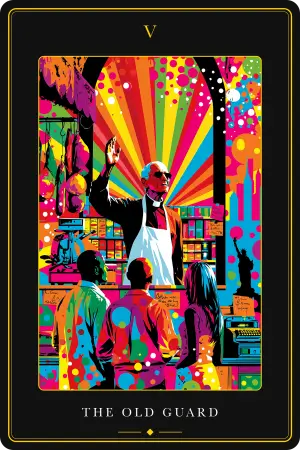
Rider-Waite-Smith. The canonical Hierophant sits on a stone throne between two grey pillars, wearing a triple crown, one hand raised in blessing, crossed gold and silver keys at his feet, two robed acolytes kneeling before him. The Calligraphy Master keeps the teaching relationship and discards the church. The kneeling monks become standing children, the blessing hand becomes a hand laid over a small one, and the keys at the feet become blank paper on the table.
Tarot de Marseille. The classic Le Pape is a bearded elder in red and blue, holding a triple cross and gesturing over two tonsured acolytes seen from behind. Beijing preserves that intimate scene of an elder instructing two juniors, but strips the papal robes and sets it in an academy courtyard rather than a church.
Crowley-Thoth. Crowley's Hierophant is overwhelmingly Taurean, backed by a bull and its Indian counterpart the elephant, with a woman girt with a sword standing before him as Venus in militant form. He frames the card as initiation into a new spiritual aeon. The Beijing deck shares the Taurus signature and the theme of initiation, but keeps the setting domestic and the initiation ordinary, a first brushstroke rather than a cosmic mystery.
Modern reframings. Recent independent decks work to save the card's themes of learning and community from its patriarchal, ecclesiastical baggage. The Wild Unknown shows a crow atop a key; Motherpeace recasts the figure as a female crone facilitating lifelong learning; queer decks such as the Hierophanies Tarot render a non-binary elder initiating others into a chosen family. The Tarot of Beijing belongs to that movement, its master an ordinary teacher whose authority comes from ten thousand repetitions rather than from any pulpit.
In combination and context
The Calligraphy Master pulls whatever spread he lands in toward learning, tradition, and formal commitment, and asks the Guozijian question of the cards around him: what are you building that a student could inherit? Beside the Newcomer, this deck's Fool, he is the courtyard the paper address was always leading to, the seeker meeting the teacher who shows him how to begin. With the Old Man on Jingshan, this deck's Emperor, worldly authority stacks on institutional tradition, a sign to work inside established structure or formal teaching.
His fixed earth steadies more volatile neighbors. Alongside cards of grief or scarcity he reads as the counsel sought and the shelter offered, the therapist or the elder or the institution that holds a person through a hard passage. With cards of union he points to a formal, documented, long partnership, the marriage blessed by both households rather than the private elopement. Near cards of rebellion or sudden change he marks the tension the card was born with, five as the tremor of change that tradition must answer, and the reading turns on whether the old form is being renewed or merely defended.
When he keeps appearing in a reading, treat him as an instruction rather than a person: today, learn properly or teach properly, with nothing in between. Find the steadier hand and let it guide yours, or place your own hand over someone less experienced. Either way the day favors the classical route over the shortcut, the official channel and the respectful call to the elder. Read what is carved on the stele before you write anything of your own.
Questions for reflection
- Whose steadier hand could you let guide your first stroke right now, and what pride has kept you from asking?
- Where are you defending a crooked stroke as a style, when the honest thing is to copy the fundamental again?
- If a teacher's masterpiece is the next hand rather than a scroll, who are you quietly teaching, and are you loosening your grip enough for them to write?
The general meaning follows the Rider-Waite-Smith reading — the reference used across Tarot Academy. Open a specific deck above for its own interpretation.
Frequently asked questions
Explore the Tarot
Latest Posts
Discover the ancient wisdom of tarot cards and unlock the mysteries of your spiritual journey. Our blog is your gateway to understanding the rich symbolism, meanings, and practical applications of tarot reading.




















































