
 EN (English)


Major Arcana · 6
The Old Guard
Fifty-one years behind the same deli counter, an apron worn like vestments and a hand raised to tell the block how it's done.
Card at a glance
- Numerology
- V
- Element
- Earth
- Astrology
- Taurus · ruled by Venus
- Kabbalistic path
- Vau (Chokmah → Chesed)
- Timing
- Spring · Taurus season
- Yes / No
- Neutral · seek counsel
Upright
Tradition
Mentorship
Neighborhood wisdom
Institutions
Apprenticeship
Belonging
Standards
Continuity
Reversed
Dogmatism
Gatekeeping
The closed shop
Hostility to newcomers
Outdated rules
Rebellion
Crisis of belonging
The Old Guard in each deck
Every deck reimagines the same archetype. Compare the art, then open a deck to read its full interpretation.
Imagery and symbolism
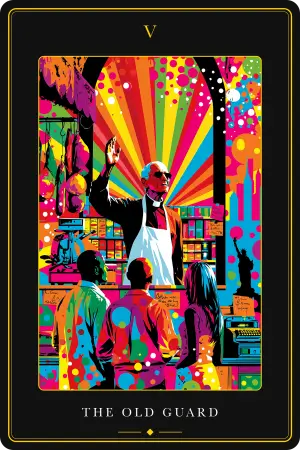
In the Tarot of New York City the Hierophant becomes the Old Guard, and the marble church of the classic card becomes a corner deli. He stands behind the counter of a shop he has run for fifty-one years, and in this deck the deli is his temple. The card is drawn in the deck's pop-art language: halftone dot fields and saturated color blocks that render tradition as loud, alive, and present-tense rather than faded into the past.
He wears a white clerical collar under a white work apron. That single detail is the deck's central claim: in this city the man who has kept the same counter for half a century is a priest, and the shop is a parish. His right hand is raised in the Hierophant's classic gesture of blessing, though here it reads at once as a benediction and as the hand of a shopkeeper settling an argument. This is how it's done.
Behind him a great black arch frames the scene like the portal of a cathedral, and through it a sunburst of rainbow rays radiates from his shoulders. It is the pop-art halo of a man who has become the light source of his own block, and the rays double as the stained glass of his church of cold cuts.
Where the Rider-Waite-Smith Hierophant sits between two grey pillars, the Old Guard stands between the pillars of his trade. On one side cured meats hang from hooks above the slicer, old-world craft and knowledge passed hand to hand. On the other, shelves of canned goods sit stacked in exact chromatic order, inventory kept as liturgy with every item in its ordained place.
Before him stand three customers with their backs to us, this deck's version of the Hierophant's tonsured monks. They are the congregation of the counter, the regulars who come not only for sandwiches but for verdicts, and they receive the day's doctrine along with their change.
Handwritten signs taped to the shelves and the register replace the crossed keys at the Hierophant's feet. Prices, house rules, cash only, be back in five: these are the keys of this temple and the sacred texts of a neighborhood institution, written in the keeper's own hand and obeyed without question. The ancient cash register at the right is his altar and his archive, the machine he refuses to replace, ringing the same bell it rang in three different decades.
In the background the Statue of Liberty raises her torch in a mirrored echo of his raised hand, and the halftone skyline glows behind the arch. The card quietly insists that the immigrant shopkeeper and the statue in the harbor are keepers of the same flame.
Core meaning
The Old Guard keeps every traditional Hierophant meaning, orthodox tradition, institutional teaching, and the hierarchy that carries belief down the generations, and pours them into an apron and a counter. The archetypal reading is the one you already have: the figure who translates the accumulated wisdom of a community into a doctrine an ordinary person can hold and use. What this deck adds is an address for it. Tradition here comes down to a specific man on a specific corner telling you, unprompted, the right way to slice it.
His argument is that a city this fast needs things that refuse to move. New York tears itself down and rebuilds continuously, and what makes the destruction survivable is the network of fixed points where a community stores what it has learned: the deli, the parish, the union hall, the teacher, the elder. The Old Guard is one of those anchors. The block turns over, the faces at the counter change, the languages change, and the rules and the right way to slice it stay.
Inside this deck he is the first institution the Newcomer meets. The kid who stepped off the bus at Port Authority with no map ends up, sooner or later, at this counter, being told how things are done here. The Old Guard gives the Hero what the city itself never offers, which is structure: the codes, the debts, the manners, and the memory of a neighborhood. To draw him is to be pointed toward a mentor, an institution, or a tradition, and asked what you still owe to the people who came before you.
Upright meaning
Upright, the Old Guard favors tradition, proven method, and the people who have been doing this longer than you. He counsels respect for established rules and for the answer that already exists in a mentor, an institution, or a custom. This is a time for formal learning and for joining something larger than yourself, a union, a congregation, a guild, a marriage, a neighborhood association, and for showing up to learn the counter from the inside. Follow the procedure even when it feels slow, because it was built out of other people's mistakes so you would not have to repeat them. The city rewards those who honor its codes before they rewrite them.
In love. Commitment the traditional way, a relationship that moves deliberately toward known milestones: meeting the family, the shared lease, the ring, the ceremony with the old block in attendance. It rests on shared values and favors constancy over spectacle, the partner who shows up every day and remembers how you take your coffee. Love here looks like the couple who have kept the same counter together for decades, unglamorous and unshakable.
In career. Structure, seniority, and learning the craft properly. Work within the rules of the house rather than against them, apprentice yourself to the veteran who has the knowledge you need, and treat certification or credentialing as a real path forward. For those already senior, the card is a mandate: you are the keeper of the standards now, and part of the job is teaching the kid who just walked in. Tenure here is authority you earn, the weight of accumulated experience and reliability.
In finances. Stability built the long way: steady income from proven sources, conservative instruments, and habits inherited from people who survived leaner times. Money is managed by rules. Pay yourself first, never touch the principal, count the cash in the register every night. In this card, boring money is good money.
In health. The proven regimen: routine, discipline, and methods with a long lineage. It favors the classic over the trendy, the barber who has cut the block's hair for forty years and the walk-everywhere constitution of the lifelong city dweller. Treat the body as something maintained daily, like a shop that is swept, stocked, and opened on time.
Reversed meaning
Reversed, the Old Guard is the deli that stopped changing thirty years ago and calls it integrity. It can mark rules that no longer serve anyone, authority demanding a deference it stopped earning, or your own reflexive obedience to how it's done. It can equally mark your rebellion: leaving the family business, questioning the doctrine, or opening the new place down the block that the old man swears won't last. Ask which rules protect the neighborhood and which just protect someone's habit. Some of those rules were load-bearing, so learn what a tradition was for before you discard it. If a mentor has hardened into a warden, thank them and walk.
In love. Tradition has entered the relationship as a cage. It shows up as families pushing marriage on their own timeline, communities enforcing roles neither partner wants, or a bond performed for the block instead of lived for each other. Sometimes the card celebrates the rebellion it implies, the couple who marry against expectations or love across the lines the old guard drew. Decide together which customs you keep because they feed you and which you keep only because someone older is watching.
In career. The suffocating side of institutional life: rigid procedures that outlived their purpose, a hierarchy that rewards tenure over talent, a boss who treats every suggestion as insubordination. You may feel blocked by gatekeepers or in open conflict with management whose worldview expired a decade ago. The reversal can also point back at you, at a refusal to learn the established way before improvising. Before you burn the rulebook, read it once carefully. Take the craft with you and leave the cage.
In finances. Conservatism curdling into loss: the business that refused to modernize until the customers stopped coming, or the savings strategy from 1985 applied to 2026. It can also mean losses from rejecting sound traditional advice out of pure rebellion. Keep the discipline the old ways taught you and let the methods update. The rule was never the register. The rule was counting the money.
In health. Routines fossilized past their usefulness: a training method from decades ago applied to a body that has changed, or a refusal to see a specialist because we never needed doctors. The reverse trap is dismissing everything traditional in favor of each new trend, which is its own kind of dogma. Keep the walking and the real food the old ways taught, and let go of the specific rules that time has disproven.
Historical notes
He began as Il Papa, the Pope. In the Visconti-Sforza deck of around 1450 he sits enthroned in full papal regalia with the triple tiara, the keys, and a crosier, an image drawn straight from a Church that then ruled the Papal States as a political power. Some scholars think the figure was modeled on Amadeus VIII of Savoy, briefly the anti-pope Felix V and father-in-law to the Visconti duke.
Standardized in the Tarot de Marseille as Le Pape, he became a bearded elder in red and blue blessing two tonsured acolytes. His image often ran afoul of censors. Protestant and anti-clerical regions swapped him for Jupiter in the Besançon deck and for Bacchus in the Vandenborre, and in Bologna the Church itself replaced the four authority cards with Moorish kings after a 1725 offense.
The rename came with the French occult revival. In 1781 Court de Gébelin recast the Pope as Le Grand-Prêtre and tied him to an imagined Egyptian priesthood, and in 1856 Eliphas Levi dubbed him the Grand Hierophant, borrowing the title of the chief priest of the Eleusinian Mysteries. The Greek hierophantēs was the one who showed the sacred things to initiates, and with that word the card left the Vatican for the older mystery schools.
The Tarot of New York City carries that long movement one step further. Each earlier version answered a local question about where sacred authority could plausibly sit: a Renaissance pope, a Marseille elder, a Greek initiator. This deck moves him behind a deli counter, because in this city the figure who actually keeps a community's rules is often the shopkeeper who has fed the block for fifty-one years. The vestments become a work apron over a clerical collar, the marble church becomes a corner store, and the two kneeling acolytes become three regulars waiting for their sandwiches and their verdict.
Correspondences
Number. He carries the number five, the numeral V, which sits at the center of the run from one to nine and works as a hinge between what came before and what comes next. That is where the Old Guard stands, at the counter between the neighborhood that was and the neighborhood that is arriving, handing the first to the second one transaction at a time. Five is also the number of change and friction, so his fixity is a point the turning wheel of the city moves around rather than an escape from it.
Astrology. Taurus rules him, the fixed earth sign of constancy, patience, and value built slowly on a solid foundation. There is no more Taurean figure in the city than the man who opened the deli, paid it off, outlasted three waves of gentrification, and never once considered moving. Taurus is ruled by Venus, which ties his standards and rituals to shared values and material comfort, the harmony of a place where everyone has an order and a welcome. Taurus governs the throat and the appetite, and fittingly the Old Guard feeds his neighborhood and dispenses his doctrine across a counter of food.
Element. Earth. His is the stable, unmoving ground that preserves systems and outlasts trends, the strength and the limitation being the same trait: he does not move.
Kabbalah. He holds the 16th path, from Chokmah (Wisdom) to Chesed (Mercy). His Hebrew letter is Vau, the nail. Just as a nail joins two boards, he fixes ethereal truth to the material plane, translating raw divine wisdom into the merciful, usable doctrine an ordinary mind can carry.
Elemental dignity. Beside the deck's money cards his earthy stability roots further into property and institutions; beside the Lovers he points toward formal, sanctioned commitment.
Psychological perspective
On the deck's street-level Fool's Journey, the Old Guard is the Newcomer's first institution. Having arrived in the city as raw, unformed potential, the Hero now meets formal education, cultural conditioning, and the belief systems of the wider group, and has to learn how to belong. He must sublimate his own chaotic wants to a shared code before he is ready for the independent choices that come later. This is a real rite of passage, restrictive on purpose, since a person has to understand the rules of a community before they are mature enough to make their own.
Jung casts this figure as the Wise Old Man, the mentor who distills long experience into teachable lessons, though the same archetype also carries the Persona and the whole machinery of institutional belief. The Old Guard is the outward, visible path to what a community holds sacred, the one that offers ritual, standing, and a congregation, where the intuitive inner path belongs to the High Priestess.
As a personality he is organized around duty, standards, and belonging, an identity fused with a shop or a block and experienced as a moral vocation. Under the gruffness there is almost always generosity: the extended credit, the plate that appears for whoever needs it, the door held open past closing for a regular. His central danger is that the same structure which stabilizes him can rigidify into dogma, until he confuses his own habits with laws of nature and clings to authority past the point where it serves anyone. His hardest task is learning that letting the block change is not the same as letting it down.
The Old Guard across decks
Tarot de Marseille. Le Pape keeps his papal shape, a bearded elder in red and blue raising his hand over two kneeling acolytes, the Church rendered as a trump.
Crowley-Thoth. Crowley plants him firmly in Taurus, backed by a bull and its Indian equivalent the elephant and ringed by the four cherubs of the Powers of the Sphinx. His wand carries three interlaced rings for the Aeons of Isis, Osiris, and Horus, the child Horus rides in a pentagram over his heart, and a woman girt with a sword, his Babalon, stands before him.
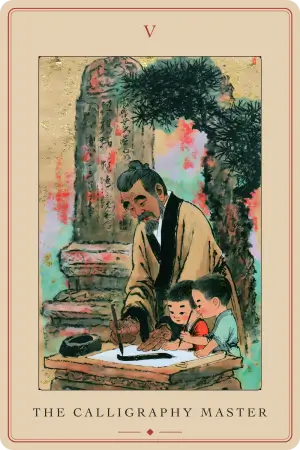
Modern decks. Kim Krans's Wild Unknown reduces him to a crow perched on a key as a jagged current charges it from above. Motherpeace makes him a female crone and teacher, the Zombie Tarot casts him as a mid-century news anchor broadcasting to the masses, and the Hierophanies and Queer Witch decks recast him as a non-binary elder initiating others into chosen family, a reminder that even rebel communities build their own traditions.
The Tarot of New York City. This deck keeps the Hierophant's meaning whole and gives it a storefront. The papal throne becomes a spot behind the counter, the triple tiara becomes a clerical collar under a work apron, the crossed keys become handwritten signs taped to the register, and the two acolytes become three regulars waiting on their sandwiches. Where the classic card seats authority inside a church, the Old Guard earns it across fifty-one years of a city trying to break him.
In combination and context
The Old Guard is read against the other figures of this deck, and his sharpest relationship is with the Newcomer at the start of the arc. The Newcomer arrives with a duffel bag and no map; the Old Guard is the counter the Newcomer washes up at and the first voice that tells him how the city works. A spread holding both frames the whole distance from arrival to belonging, from a stranger the block has not decided about yet to a person who knows the rules well enough to keep them. He stands one card past the Developer, the deck's Emperor, so where the Developer imposes order from a glass tower, the Old Guard maintains it from behind a counter at street level.
The classic combinations still hold under the apron. Set beside the Emperor he doubles into systemic control, moral authority fused with worldly power. Paired with the High Priestess he balances his outward tradition against her inward mystery. With the Lovers he reads as a formal marriage or a bond rooted in shared morals and community approval. With Death he is the painful, necessary tearing down of an old tradition, and with the Tower he becomes the collapse of a trusted institution or a crisis of faith. Beside the Fool, this deck's Newcomer, he flips into a wilder lesson: learn the rules thoroughly so you can break them well.
As a straight yes or no he stays neutral and sends you to counsel first. Ask the mentor, the lawyer, or the elder and check the plan against the established rules. If the action fits the system the answer leans yes, and if it breaks the system the answer leans no.
Position sharpens him. As advice he tells you to respect the counter, follow the proven method, and learn from the one who has outlasted three landlords and two recessions. As the obstacle he is the gatekeeper and the rule enforced past its expiration date. As the outcome he promises belonging, a place at the counter earned by honoring what holds it up.
Questions for reflection
- Which traditions and standards in your life still feed the block, and which only guard someone's comfort?
- Where are you handing your judgment to an authority or an institution instead of deciding for yourself?
- What are you keeping for the people who come after you, and what did it cost the ones who kept it for you?
The general meaning follows the Rider-Waite-Smith reading — the reference used across Tarot Academy. Open a specific deck above for its own interpretation.
Frequently asked questions
Explore the Tarot
Latest Posts
Discover the ancient wisdom of tarot cards and unlock the mysteries of your spiritual journey. Our blog is your gateway to understanding the rich symbolism, meanings, and practical applications of tarot reading.




















































