
 EN (English)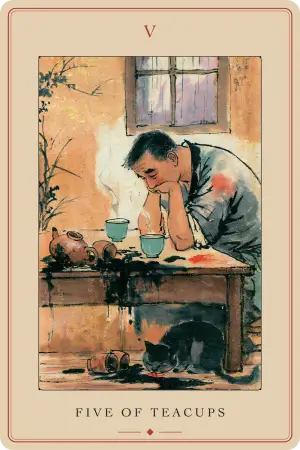


Minor Arcana ·
Six of Teacups
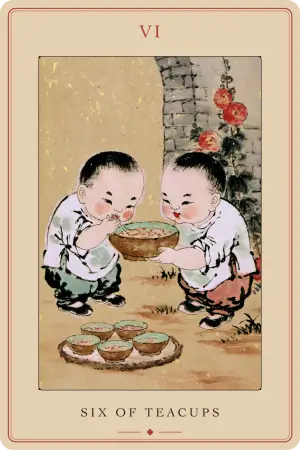
Memory drawn in faded ink: two children share one bowl of haw-berry water beneath a hutong archway, sweetness that counts only once it is passed on.
Card at a glance
- Numerology
- 6
- Element
- Water
- Astrology
- Sun in Scorpio, second decan · Nov 3–12
- Kabbalistic path
- Tiphareth (Beauty) in Briah
- Timing
- Early November · return and reunion
- Yes / No
- Upright yes · Reversed no
Upright
nostalgia
reunion
kindness freely given
inner child
old friends
generosity
emotional safety
roots
Reversed
toxic nostalgia
stuck in the past
idealizing
old grievances
refusing to grow up
dependence
homesickness
clinging
Six of Teacups in each deck
Every deck reimagines the same archetype. Compare the art, then open a deck to read its full interpretation.
Imagery and symbolism
In the Tarot of Beijing the Six of Teacups is drawn as a memory rather than a scene. Two small children sit beneath a grey brick hutong archway, sharing sweet haw-berry water from a single bowl: one drinks from a spoon while the other holds the bowl steady with both hands. The ink is paler here than on the deck's other cards and the kraft paper runs warmer, so the picture looks the way the heart actually keeps the past, softened and lit from within.
The one shared bowl is the center of the card. In a deck where an offered cup is an offered heart, a bowl held by one child so the other can drink is affection at its plainest: help given before it is asked, sweetness that counts only once it is passed on. Neither child owns the bowl, and the gift is the holding.
The haw-berry water is the taste of a Beijing childhood, kin to the candied hawthorn sold at temple fairs, and it stands for the flavors that carry a whole season back on a single sip. Six small cups wait on a tray at the children's feet, servings poured in advance for friends who have not arrived yet, and they also mark the six-fold rhythm of the suit, feeling brought into balance and handed from person to person.
The archway frames the threshold of the hutong, the edge of the childhood world, safe and known and small in the good way; passing under such an arch is how every Beijinger leaves home and returns to it. Hollyhocks climb the wall behind, the humble red flower of every old courtyard, an ordinary happiness that asks for no garden and comes back faithfully each year. Gold flecks in the aged paper and a small red seal finish the deck's sentence: memory keeps its own gilding, and even a faint recollection bears the stamp of something that truly happened.
Core meaning
Read together, the Beijing card means a return to origins that heals: the past visited the way a guest visits a beloved courtyard, warmly and gratefully, then back out through the archway into the present. The reader already knows the archetype's core, the Six of Cups as nostalgia, childhood, and kindness freely given. This deck's contribution is where it sets that meaning. The European courtyard becomes a hutong lane, and the exchange of flower-filled cups becomes one bowl two children share.
That single bowl is the whole argument. Six is the number of care made concrete, and here the care is literal: one child drinks, the other holds, and next time they trade places. The sweetness exists only because it is shared, and no one is counting who gave more. The card asks you to remember who you were before the world taught you to keep accounts, and to let that warmth clarify what you actually value now.
Upright meaning
Upright, the Six of Teacups marks a gentle, restorative season. An old friend reappears, a familiar taste or street brings a whole period of life back, a family story resurfaces, a small gift arrives with no strings attached. Reunions go well now, and children, elders, and family history come to the foreground. The card's counsel is to visit the past deliberately and with gratitude, then carry the warmth back into the present: call an old friend, walk a street you grew up on, cook the dish a grandmother made. Accept help the way a child accepts a held bowl, without embarrassment, and offer it the same way.
In love. The tenderest reading in the suit, affection with the purity of first feeling. It often signals the return of a first love or an old flame, a reunion after separation, or a new bond that feels familiar from the start, as if you had shared a courtyard as children. Couples benefit from revisiting their beginnings, the street of the first date, the old photographs, the small daily services that made the bond sweet.
In career. Old professional connections bear fruit. A former colleague recommends you, a past employer calls you back, or a skill learned long ago becomes valuable again. Proven methods and past successes can be repeated with confidence, and mentorship is favored in both directions, whether you are guided by an old teacher or steadying the bowl for a newcomer.
In finances. Money that arrives from the past: an old debt repaid, income from a project long finished, a gift or inheritance from family, warm help from a childhood friend. Old and tested sources prove reliable, and family support given without conditions is well aspected. This is a season of modest sweet sufficiency rather than windfall, six small cups, all of them full.
In health. Care that returns to what once did you good, the foods of childhood cooked simply, walks in familiar places, the game you loved before exercise became a duty. Healing happens in company, cooking together or walking with an old friend, and the body responds to being treated as patiently as one child holds the bowl for another.
Reversed meaning
Reversed, the memory-card gets mistaken for the present. The ink of the past is faded, yet you keep trying to draw today with it. This shows up as being stuck in nostalgia, idealizing an old relationship or a lost home, reopening childhood wounds, or waiting for life to taste the way it did in the old courtyard. Someone from the past may return and stir feelings better left settled, and old grievances between former friends or within the family can resurface. The remedy is to thank the past and set it back on the tray: tell warm memory apart from its gilded version, resolve or release old grudges rather than re-steeping them, and learn to hold the bowl yourself rather than waiting for someone to hold it for you.
In love. A returning ex disturbs a present relationship, or a partner is measured endlessly against a first love and always loses. Sometimes the couple lives on memories of its own early sweetness while the present bowl stands empty, or the bond never matures, two people playing house and avoiding the adult conversation. Grieve what is truly over, and pour today's affection into today's cup.
In career. Work held back by the past: clinging to an old post out of comfort, refusing new methods because the old ones taste familiar, or longing for a former job that memory has repainted sweeter than it was. Old workplace grievances with a colleague or a boss can sour the present team. Decide what from your working past is a recipe and what is only a habit, keep the first and retire the second.
In finances. Habits inherited and never examined: spending patterns copied from the family courtyard, dependence on relatives' money past its season, or reviving an old venture purely out of sentiment. Old entanglements resurface and ask for honest settlement, unreturned loans between friends or unresolved family money grievances. Audit what the past actually costs you.
In health. The body caught in the past: comfort eating that tries to drink childhood back one sweet at a time, grief over lost youth, or refusal to accept the body's present season. Old patterns learned in the family courtyard, how food was used or how the body was spoken of, may quietly run the present. Keep the warmth of the old remedies and discard their expired instructions.
Historical notes
The Six of Cups took its modern form in the 1909 Rider-Waite-Smith deck, drawn by Pamela Colman Smith under Arthur Edward Waite's direction. Her scene is an old cobblestone courtyard backed by the stone walls of a large estate: a taller child hands a flower-filled cup to a smaller one, more chalices stand about, and a guard with a halberd walks away in the background. Uniquely in the suit, the cups are filled with five-pointed white flowers, read by esoteric writers as lilies or thornless roses, purity of intention that has taken root. Waite described the picture plainly as children playing in a garden, which fixed the mainstream reading of youth and sweet nostalgia, though later scholars such as Rachel Pollack found an unequal power dynamic in the taller figure's cumbersome glove.
Older decks framed the six differently. The Tarot de Marseille, across the fifteenth to seventeenth centuries, arranged six stylized chalices symmetrically around central foliage, closer to a table setting than a narrative, and read the number as convivial harmony in the emotional realm. The Golden Dawn gave the card its astrological title, the Lord of Pleasure, from the Sun in the second decan of Scorpio.
The Tarot of Beijing keeps the archetype and relocates it completely. The European courtyard becomes a hutong archway, the exchanged flower-cups become one shared bowl of haw-berry water, and the guard and castle give way to hollyhocks and grey brick. What survives untouched is the meaning the RWS card carries: safe memory and kindness handed freely from one person to another.
Correspondences
Number. Six, the number of harmony and restoration after the loss and spilled cups of the five. It is the number of the family table, of care made concrete and love expressed as service. On this card the six is enacted literally: six small cups of sweetness stand ready on the tray while, above them, one bowl passes between two children. Six also closes one small cycle and turns softly into the next, which is why the card leans toward memory and return.
Astrology. The Sun in the second decan of Scorpio, roughly 10°–19° of the sign, around November 3–12. Scorpio's water runs deep and keeps what mattered, which gives the card its depth of recollection, the way one taste of haw-berry water raises a buried summer. The Sun, ruling the decan, keeps that memory warm rather than heavy, the gold flecked into the aged paper: clarity and gladness, noon light remembered at dusk.
Element. Water, in this deck the element of the offered cup: feeling, memory, intuition, and the bonds that steep slowly between people.
Kabbalah. The sixes correspond to Tiphareth, the sphere of Beauty and Harmony at the center of the Tree of Life, expressed here in Briah, the world of emotion. Tiphareth is the sphere of the Sun, which is why the Six of Cups feels like a crystallized, sunlit moment held apart from ordinary time.
Psychological perspective
Psychologically the Six of Teacups is about the inner child and the memory that shapes an adult without being noticed. The people it describes are warm-hearted and loyal, keepers of old bonds and family stories: they remember who held the bowl for them and rarely forget a kindness, tending traditions, birthdays, and recipes, making any room feel like a familiar courtyard. Their softness is genuine and their sentimentality sincere, and they give the way children share, wholly and gladly.
Drawn as a stalker card, the one that keeps falling out of the deck across shuffles, the Six of Cups usually points inward rather than toward outside romance. The task is re-parenting: offering the younger self the safety and unconditional love it may have lacked, releasing a long-held grudge, or letting a repressed memory finally be looked at in daylight. The shadow of the same temperament is a life lived facing backward, every new person measured against an old friend and found wanting, the courtyard of childhood mistaken for a place to live in rather than to visit.
Six of Teacups across decks
Rider-Waite-Smith. Two children in a walled courtyard exchange flower-filled cups while a guard patrols the background, the standard image of nostalgia and generous giving within safe walls. The Beijing card keeps that emotional core and moves it into a hutong lane, replacing the exchanged cups with one shared bowl of haw-berry water.
Tarot de Marseille. Six chalices sit symmetrically around central foliage, a decorative arrangement that reads the number as steady, convivial harmony rather than a story about children.
Crowley-Thoth. Crowley and Frieda Harris named the card Pleasure and painted copper lotus cups with water flowing in a continuous stream. In their alchemy the deep waters of Scorpio are putrefaction, the breaking down of the ego, and the Sun is the gold recovered afterward: joy earned by facing one's own demons.
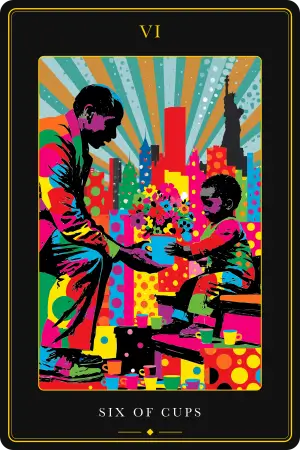
Modern decks. The Wild Unknown draws a plain tree above ground over a vast rainbow root system, shifting the card from personal nostalgia to compassion for the unseen histories everyone carries. Indie decks push further, with Pavlov's Tarot showing an adult lighting the way for his younger, pre-transition self and the Light Seer's picturing an old man with his senior dog. The Tarot of Beijing sits in this modern lineage, telling the story through haw-berry water and a single held bowl instead of an exchange of cups.
In combination and context
The Six of Teacups pulls a spread toward memory, and the cards around it decide whether that memory heals or traps. Reconciliation spreads often place it as the bridge that can bring two people back together or as the very illusion keeping them apart, so read the neighbors carefully. Beside cards of grief or loss it can be the comfort that restores, the held bowl offered after the five's spilled cups. Beside cards of stagnation or refusal it warns that the nostalgia has curdled, that someone is keeping the six cups full for guests who are not coming back.
In love readings the card validates the feeling of having known someone forever, though experienced readers caution against treating it as a green light to revive a toxic relationship. It acknowledges that the past is on your mind, not that the past should be resurrected. When it keeps returning across a reading, take it as a summons to inner-child work, a call to steady your own bowl and re-parent the child who once needed someone else to hold it.
Questions for reflection
- Whose bowl were you once given, steadied by someone so you could drink, and could you reach that person now with a call or a visit?
- Which memory are you visiting for warmth, and which one have you quietly moved into and started living in?
- Where could you hold the bowl for someone today, without being asked and without keeping the receipt?
The general meaning follows the Rider-Waite-Smith reading — the reference used across Tarot Academy. Open a specific deck above for its own interpretation.
Frequently asked questions
Explore the Tarot
Latest Posts
Discover the ancient wisdom of tarot cards and unlock the mysteries of your spiritual journey. Our blog is your gateway to understanding the rich symbolism, meanings, and practical applications of tarot reading.




















































