 EN (English)



Minor Arcana · Cups (Water)
Six of Cups
Smith set two children in an old walled courtyard, filled six cups with white flowers, and had the taller hand one to the smaller while a guard walks away behind them.
Card at a glance
- Numerology
- 6
- Element
- Water
- Astrology
- Second decan of Scorpio (November 3–12), ruled by the Sun
- Kabbalistic path
- Tiphereth (Beauty), where the Sixes sit
- Timing
- The middle ten days of Scorpio, deep autumn
- Yes / No
- Upright yes, reversed no
Upright
Nostalgia
Childhood
Innocence
Reunion
Memory
Generosity
Safety
Inner child
Reversed
Toxic nostalgia
Stuck in the past
Clinging to an ex
Immaturity
Idealizing
Letting go
Fear of change
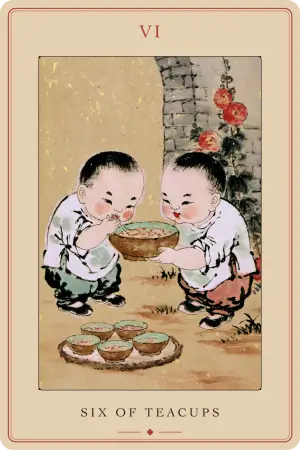
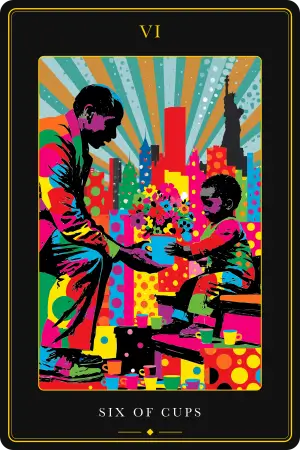
Six of Cups in each deck
Every deck reimagines the same archetype. Compare the art, then open a deck to read its full interpretation.
Imagery and symbolism
Pamela Colman Smith drew this card as a moment of giving held still. Two children stand in an old cobblestone courtyard, dressed in old-fashioned clothes, and this deck reads them at once as an image of memory, innocence, and enduring ties to the past. The taller of the two, often read as an older sibling or an adolescent, hands the smaller a cup, and Waite's own gloss stayed simple, "children playing in a garden."
The cup is not empty. Uniquely in the suit, the six chalices are filled with five-petalled white flowers, read by esoteric writers as lilies or thornless roses. The white marks purity of intention and uncorrupted feeling without a hidden agenda, and filling water cups with earth and flora grounds the emotion, a sign that these feelings have taken root and produced something lasting. This deck reads the gesture directly: the boy gives the girl a bouquet in a cup, a small gift of grace that turns an ordinary moment into something special, a sign of gratitude and hospitality.
Around and behind the children the setting does its own work. Four cups stand in the foreground, one rests on a pedestal beside a heraldic shield marked with an X, a St. Andrew's cross, and one is the cup being passed. Behind them rises the stone wall of a large estate or house, which this deck reads as safety and stability, the warmth and protection of home. The high walls hold the harsh adult world at bay so that innocence can flourish, whether that safe space is a real childhood home or a remembered one. The light blue sky above the roofs points to spirituality and a reach toward the infinite, and the flowers scattered through the scene stand for beauty and harmony, tenderness and a sense of contentment.
Two details repay a closer look. The taller child's hand is wrapped in a heavy glove or mitten, which Rachel Pollack read as a mark of restriction or an unequal dynamic, generosity flowing downward from the one who holds the power, the way it does in the Six of Pentacles. And in the distance a warrior with a weapon, a watchman carrying a halberd, walks away from the scene. This deck reads him as a note of protection and the ability to prevent danger. The research records the debate around him: the guard who keeps the sanctuary safe so the children can play, adult responsibility receding into the background, or the querent himself walking away from a memory that is beautiful but must not be lived in. Together these symbols point past simple nostalgia toward the deck's own summary, the past used to heal oneself and move forward.
Core meaning
This deck reads the Rider-Waite Six of Cups as nostalgia, pleasant memory, childhood and the past, the card that connects the present to what came before. It is a return to roots and a sense of inner harmony, and the deck is careful to say the symbols point past nostalgia alone: the past is used here to heal oneself and move forward.
The number carries that harmony. Six is the number of balance restored after the conflict of the fives, and in the Qabalah the Sixes belong to Tiphereth, Beauty, the sun-centred sphere at the heart of the Tree of Life. When the water of the Cups suit meets that solar, harmonising energy, emotional turbulence is stilled into a crystallised moment of feeling. That is why the card seems frozen in time, an idealised snapshot of emotional perfection held apart from the ordinary forward rush of things. This deck's numerology reads the six the same way, as harmony and beauty, an exchange of energy between people who care for each other, keeping the material and the spiritual in balance.
At its centre the card is the sweetness of memory and the innocence of the inner child. It is the pull back toward who you were before the world taught cynicism, and the purity of giving a gift simply to see someone smile. The six cups filled with flowers point to a state of joy that comes and goes yet stays in memory, and the whole scene invites you to travel inward, back to simpler times and the people who shaped you.
Upright meaning
Upright, this deck reads a return to the past, often to recreate pleasant memories, a period of warmth and emotional security in which romance often has a place. Memories resurface and you may want to relive them. Old friends, familiar faces and places gain weight, and you may find yourself searching for your roots or trying to understand how earlier experiences shaped who you are. The recommendation attached is gentle: acknowledge the importance of your past, revisit familiar places, and let warm memories offer solace and clarity as you reflect on your path.
In love. Nostalgia and the influence of the past on the present, sometimes the renewal of an old relationship or the reappearance of someone who stirs up feeling. This deck reads a warm, comfortable connection filled with attention and care, room for deep feeling, sincere love and mutual understanding. It also warns of stagnation if a couple stays at the same level, unwilling to change and leaning only on familiar patterns.
In relationships more broadly. Warmth and harmony with those around you, old friendships remembered and fond memories revived. This deck reads it as a favourable time for reunions and social gatherings, connections restored and met with joy and respect, a light exchange of feelings and memories. Communication carries support and a readiness to help.
In work. Satisfaction and a settled, spiritual calm. This deck reads comfort in the workplace and support from colleagues, harmony that opens creative ability and a favourable atmosphere for growth. As a card of memory it points to repeating past successes with proven methods, and to information from former teachers or colleagues that brings both pleasant memory and useful skill.
In business. Elements of the past finding their place in the present, the revival of old business connections and a reassessment of familiar projects. This deck reads a return to the simpler, fundamental aspects of the business that got lost during expansion, time-tested strategies worth reapplying, and collaboration with people from the past that brings new momentum to current work.
In money. Income that flows from earlier achievements, a return to methods that once worked. This deck reads the receipt of gifts from former connections, the return of an old debt, profit from old projects, or money from a forgotten client, with a strong chance of unexpected dividends from old partners. The perspective it offers on finances is reliable and a little nostalgic.
In the physical realm. Nostalgia for a time of more energy and health, a wish to reclaim a former lifestyle. This deck reads an intuitive approach to changing the body, since such changes have been tried before, and a return to exercises used in the past. It asks you to accept and love your body's history, adjust eating habits, and give yourself care.
Reversed meaning
Reversed, this deck reads a tendency to live in the past and a reluctance to accept change. Old grievances, unfinished business and past conflicts resurface, and there may be missed opportunities or a futile wish to change what is already done. You feel unwilling to move forward because you are attached to familiar times, drawn to stay in a comfort zone and avoid new challenges. The recommendation is to let go, release the emotional burden of old memories, address what was left unresolved, and stop fearing what is new. The research sharpens the shadow: nostalgia that calcifies into a prison, an old relationship or era romanticised through rose-tinted glasses while the real incompatibility is ignored, a heart quietly broadcasting that it is already occupied by a ghost.
In love. Attachment to outdated patterns that hold back the present, unpleasant memories or old traumas colouring current interactions. This deck reads a relationship built on idealising the past or expecting the present to follow old patterns, a fixation on former ties and a fear of change, one partner constantly living in memory while the connection stalls. It is the need to let go of what has ended before something new can arrive.
In relationships more broadly. Communication problems rooted in the past, relationships stuck and forward movement blocked. This deck reads old grievances resurfacing, a reluctance to enter new bonds or release old attachments, and the risk of missing new people because you prefer a familiar, comfortable circle. The situation asks for acknowledgment and reconciliation with the past.
In work. Stagnation and lingering trouble, nostalgia or an obsession with the past holding your career back. This deck reads difficulty letting go of old obligations, an urge to return to a more comfortable former position, and outdated approaches that cause problems in current tasks. Too narrow a focus on past stages shrinks the view of what is possible now.
In business. An inability to let go, a business fixated on old methods and outdated principles until it stagnates. This deck reads over-reliance on past ideas and a fear of innovation, obstacles rooted in old habits that no longer serve, and too much attention to past successes to notice new opportunity. It asks you to update your thinking and adopt a fresh approach.
In money. A reluctance to release the past and a return to habits that bring no prosperity, a regression to old financial mistakes. This deck reads dependency on help from others, an obsession with outdated ways of earning, and a fear of investing in anything new. It asks you to free yourself from old obligations and use past lessons to move forward.
In the physical realm. An excessive attachment to the body's past, a reluctance to adapt to the changes of age or injury. This deck reads regret over health chances missed, an unwillingness to change old diets or routines even when they cause discomfort, and an attachment to a former weight or image that blocks self-acceptance now. It is time to update the picture and let yourself move on.
At its more hopeful, the research notes, the reversal can also mark the moment a person finally leaves the courtyard of youth, forgives the past, and steps into adult independence.
Historical notes
The courtyard scene is a Rider-Waite-Smith creation. Working under A. E. Waite in 1909, Pamela Colman Smith turned a numbered pip into the tableau of the two children, the filled cups and the departing guard, and Waite's own description stayed simple, "children playing in a garden." The layers readers now debate, the gloved hand, the double-faced child, the watchman, all sit inside that deceptively sweet picture.
Older and later decks frame the number differently. The Tarot de Marseille shows six stylised chalices arranged symmetrically around central foliage, close to a formal table setting, an image of conviviality and the steady beauty the number six carries in the emotional realm. Crowley and Lady Frieda Harris's Thoth deck names the card "Pleasure," its copper cups fed by water flowing in a calm continuous stream. In the Thoth system that pleasure is hard-won: the deep water of Scorpio stands for the alchemical stage of putrefaction, the breaking down of the ego, and the joy arrives only after the darkest material has been faced and purified.
One more layer belongs to this card's placement. The second decan of Scorpio falls in early November, and the research ties its magical image from Crowley's 777, a man riding a camel with a scorpion in his hand, creatures of extreme environments that survive by retreating into a protected inner world. That retreat into memory is exactly what Smith's walled garden draws.
Correspondences
Number. Six, the number of harmony and restoration after the conflict of the fives, the conscious choice to accept help and cross back toward emotional stability. This deck reads it as balance, love and beauty, a favourable balance of the physical and the spiritual, tied to obligations, care for others, and the renewal of a cycle.
Astrology. The card is the second decan of Scorpio, roughly 10 to 19 degrees, which this deck places at about November 3–12, under the Sun. Scorpio's fixed water concentrates and holds emotional experience, and the Sun casts the light of conscious awareness into those hidden depths, so buried memory, childhood experience and old karma rise into view. This deck reads the Sun as strength, confidence and a jolt of positive energy that heightens intuition, while cautioning that it can also exaggerate the focus on oneself and the past.
Element. Water, the element of emotion, intuition and the subconscious, here grounded by the earth and flowers packed into the cups. This deck reads it as strong emotional experience and a doorway to childhood and family memory.
Kabbalah. On the Tree of Life the Sixes belong to Tiphereth, Beauty, the sun-sphere at the centre of the Tree, mediating between the higher spiritual worlds and the lower material ones. Because Cups work in the world of Briah, this is Tiphereth expressed through feeling, the suit's emotion crystallised into a still, radiant moment.
Elemental dignity. A Water card, it rests easily with the Earth that fills its cups, which is why its feelings take root, and it warms to rather than fights the solar energy of Tiphereth that it carries.
Psychological perspective
Psychologically, the Six of Cups is the meeting of the adult self and the inner child. Under the Sun in Scorpio it brings the light of awareness into the oldest and most protected rooms of the psyche, which is why the research finds it surfacing so often in shadow work and inner-child healing. Its healthy expression is re-parenting, offering your younger self the safety and unconditional love they may have lacked, and this deck describes people with warm hearts who value old connections, create cozy surroundings, and find inspiration in small details.
The card's shadow is the failure to integrate that past. Memory that is not processed calcifies, and nostalgia becomes a way of living backward. The research notes that the tall figure and the small figure can mirror a childhood wound rather than a healthy adult bond, which is how trauma bonding sometimes disguises itself as a soulmate connection. When the card keeps reappearing, a well-known "stalker" that falls out of the deck again and again, the usual counsel is not to chase an old romance but to address the imprints of early life quietly steering the present, to re-parent the inner child rather than look outward. Its mandate is to honour the past as a teacher while refusing to let it become a cell.
The Six of Cups across decks
Each tradition lights a different facet of the card. In the Rider-Waite-Smith deck, the version this page follows, it is the courtyard exchange of flower-filled cups with the watchman in the background, weighted toward nostalgia, safety and generous giving. In the Tarot de Marseille it is six chalices set symmetrically among foliage, an emblem of conviviality and the steady harmony of the number.
Crowley and Lady Frieda Harris's Thoth deck names it "Pleasure," the balanced high point of the suit reached only after the ego has been broken down and purified. Modern decks stretch the archetype further. The Wild Unknown draws a plain evergreen above a vast rainbow root system, turning the card toward compassion for the unseen history everyone carries. Indie decks push it further still: one by a trans creator has the adult self hold up a lantern to guide his pre-transition younger self, and the Light Seer's Tarot shows an adult with an aging dog, folding grief and the preciousness of passing time into the same nostalgic frame.
In combination and context
The Six of Cups is best read against its cousin the Six of Pentacles. Both show generosity flowing downhill, but the Pentacles keep a ledger where the Cups give unconditionally, so the Six of Cups is warmth offered for its own sake, a gift handed over simply to see another smile. In reconciliation readings it is one of the cards most often pulled, and experienced readers treat it with care. It confirms that the past is on the querent's mind and that they crave the comfort of familiarity, yet it is not a green light to resurrect a relationship that ended for good reason, and it can flag trauma bonding wearing the mask of destiny.
The card is also a famous stalker, the one that keeps falling out of the deck. When it does, the reading usually points inward, to a repressed memory or an inner child asking to be re-parented, rather than outward to romance. Position colours it too. As advice it says reconnect with what once brought you joy and give freely; as an outcome it promises a reunion or a return to safe ground, with the quiet caution not to mistake the courtyard walls for a place to live forever. In a yes-or-no reading the upright card is a tender yes, especially about reunions, while reversed it reads as no, a sign the querent is caught in a cycle and must release the past before the outcome they want can arrive.
Questions for reflection
- Smith wrapped the taller child's hand in a heavy glove, which Pollack read as restriction. When you give from nostalgia, whose hand is gloved, and who really holds the power?
- This deck reads the walled courtyard as a safe space, real or remembered. Which memory are you visiting for comfort, and is it healing you or keeping you seated inside the walls?
- A guard walks away from the children in the background. What beautiful memory are you being asked to honour and then walk on from before it becomes a place you live?
The general meaning follows the Rider-Waite-Smith reading — the reference used across Tarot Academy. Open a specific deck above for its own interpretation.
Frequently asked questions
Explore the Tarot
Latest Posts
Discover the ancient wisdom of tarot cards and unlock the mysteries of your spiritual journey. Our blog is your gateway to understanding the rich symbolism, meanings, and practical applications of tarot reading.