
 EN (English)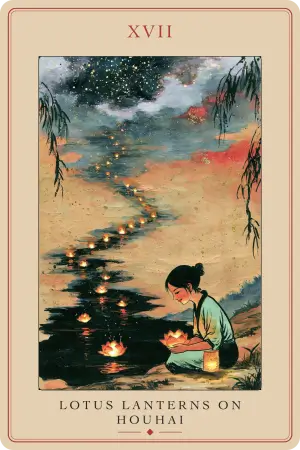


Major Arcana · 19
The Rabbit Lord's Night
Everything familiar, nothing certain: a Mid-Autumn midnight in a Beijing hutong, guarded by a clay Rabbit Lord on the windowsill.
Card at a glance
- Numerology
- XVIII
- Element
- Water
- Astrology
- Pisces · ruled by Neptune
- Kabbalistic path
- Qoph (Netzach → Malkuth)
- Timing
- Mid-Autumn night · autumn
- Yes / No
- No, upright and reversed
Upright
intuition
the subconscious
dreams
half-knowledge
folk memory
illusion
receptivity
walking the dark
Reversed
self-deception
deceit
anxiety mistaken for intuition
disorientation
secrets
nightmares
superstition
refusing to name a fear
The Rabbit Lord's Night in each deck
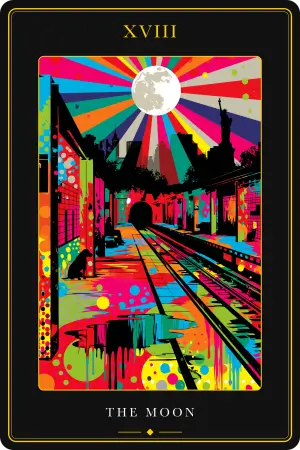
Every deck reimagines the same archetype. Compare the art, then open a deck to read its full interpretation.
Imagery and symbolism
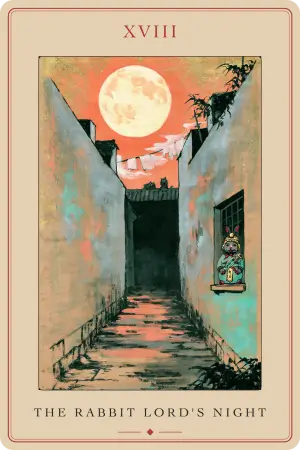
In the Tarot of Beijing the Moon becomes the Rabbit Lord's Night (兔儿爷), a Mid-Autumn midnight in a deserted hutong. The whole classical drama of the card is retold through one narrow lane between two grey walls, drawn in a handful of calm brush lines with washes of ink, vermilion, and teal on warm kraft paper flecked with gold. There are no towers, no wolf, no crayfish.
The full moon hangs enormous in a burning apricot sky, wedged exactly between the walls. It is the same moon as the Rider-Waite card, but here it is the Mid-Autumn moon, the moon of family reunion shining on an empty lane. Its light is abundant and explains nothing: the passage beneath it only grows darker.
The two grey walls stand in for the two towers, the boundary between the known and the unknown. They are ordinary courtyard walls, and that is the deck's whole point: in Beijing the border of the otherworld runs through your own alley. The dark passage between them, leading into pure ink, is the classical road into the subconscious, the one that leads somewhere the daylight mind refuses to name.
On the windowsill stands the painted clay Rabbit Lord (Tu'er Ye) in his general's helmet, banner at his back. He is the Mid-Autumn folk protector, the moon's own official on earth, the deck's answer to the Moon's face in the sky. He replaces the dog and the wolf as the card's watcher, instinct domesticated into a household god. He is small, humble, slightly comic, and the only figure on the card who is not afraid.
Two cats cry somewhere out of sight, shown as two pairs of eyes glinting on the rooftop. They inherit the howling dog and wolf, the animal voices of the night, one tame and one wild, both invisible. You hear them and cannot verify them, which is the Moon's entire epistemology. On the line, laundry moves like ghosts, sheets and shirts turned uncanny by wind and moonlight. Moonlight pools on the wet stones of the lane, the reflecting water of the classical card, so the road itself becomes the pool from which old fears might climb. A spray of bamboo leans over the wall from an unseen courtyard, gold flecks catch in the sky, and a small red seal sits in the corner, the artist's quiet signature on the night.
Core meaning
The Rabbit Lord's Night is Beijing's Moon, and the deck compresses its meaning into one sentence: everything is familiar, nothing is certain. The card takes the most known thing in the world, your own lane and your own walls, and shows that under a different light it becomes a frontier. The daylight map of your life stops working. The same window, the same lane, and yet nothing is quite sure of itself.
This is the card of the deep subconscious, of intuition, dreams, and half-knowledge. Something important is happening below the surface of events: hidden motives, unspoken feelings, dreams that keep returning. Information is incomplete or distorted, and what you have been told is not the whole story. In the older decks this is the descent into the unconscious; here it is that same descent retold at street level, the hero's own neighborhood gone strange.
Yet the card is not hostile. The Rabbit Lord stands guard on the windowsill, so the night has its own protectors. Folk wisdom, instinct, and inherited memory keep watch over those who walk the lane respectfully. The Moon's lesson in this deck is that the dark is populated, though not only with fears. It also holds guardians, and learning to tell the two apart is the whole of the card's teaching.
Upright meaning
Upright, the Rabbit Lord's Night describes a period of ambiguity, strong undercurrents, and half-light. Do not force a clarity that has not arrived. Walk the lane slowly, listen to the cats you cannot see, and postpone binding decisions until the moon sets and the morning bell rings. Trust your intuition, which is your best instrument now, but check it against facts where facts exist. Notice your dreams; in this period they carry mail.
In love. Enormous feeling with imperfect visibility, the full Mid-Autumn moon over two people. The attraction is deep and half-wordless, a bond felt in the body and the dreams before it is ever stated. Shared silences and night walks bless the romance with mystery, but not everything between you is lit. Trust what you sense about this person, then do the daylight thing and ask, tell, show. Mystery makes a beautiful courtship and a poor foundation.
In career. The office has its own dark lane: undercurrents, unannounced changes, decisions made behind paper windows. Your formal picture is incomplete, but your felt sense of moods and silences is unusually accurate, so trust it. This is a strong time for creative, intuitive, behind-the-scenes work and a weak time for demanding final answers. Keep working steadily down the middle of the lane.
In finances. The moonlight on this deal is beautiful and explains nothing. Figures are incomplete, terms ambiguous, some part of the picture in shadow. What glitters may be the moon on wet stones rather than silver. A persistent quiet feeling about an opportunity deserves attention, especially in unconventional ventures others cannot yet appraise. Keep reserves, avoid haste, and sense the market rather than storm it.
In health. The card of night rhythms and quiet signals. Listen to the body's moonlit language: sleep and dreams, cycles and tides, the fatigue that daylight schedules ignore. Health here is guarded by small nightly rituals rather than heroic effort, regular sleep and evening walks and warmth. Recurring tension or recurring images deserve gentle attention, and dreams may carry accurate news about your condition.
Reversed meaning
Reversed, the guardian has been taken from the windowsill and the lane is left to its fears. Confusion deepens into disorientation, until you no longer tell the laundry from the ghosts or your intuition from your panic. The position points to self-deception, deceit from others, or a fog someone is keeping around you on purpose. Turn on a lamp, name your fears one by one, and verify information instead of divining it. A named fear shrinks to the size of a clay figurine.
In love. The moonlight has curdled into fog: mistrust, evasions, jealousy fed by imagination, or genuine deceit. One partner may be hiding something, or nothing is hidden and the ghosts are home-made, old fears projected onto the present. Stop divining and start talking. Truth relaxes in the light while deception flinches, and this fog will not clear on its own until someone opens a door.
In career. The workplace fog turns toxic or self-inflicted. There may be intrigue, misinformation, or a role whose real content differs from its description; just as often the distortion is internal, anxiety reading rejection into every silence. Do not make career decisions inside this state. Restore facts first, ask direct questions, get things in writing, and never resign at midnight.
In finances. Financial fog with someone standing in it: concealed conditions, manipulated numbers, or your own wishful accounting. Losses here trace to unverified belief rather than bad luck. Postpone commitments, audit everything, and demand documents you can read at noon. If a partner keeps you in the dark for your own good, the dark is the product.
In health. The body's night goes wrong: broken sleep, anxious exhaustion, signals ignored or magnified by fear into imagined catastrophes. A distorted mirror may be at work, a self-image that no longer matches the real reflection. Restore a steady sleep rhythm first, since almost every ghost on this card feeds on sleeplessness, and get real information about worrying symptoms instead of consulting your fears at 3 a.m.
Historical notes
The Moon's imagery has never been fixed. The fifteenth-century Visconti-Sforza card shows no nocturnal landscape at all, only the Roman goddess Diana holding what looks like an unstrung bow or a white girdle of purity. Other early decks were equally free: a Budapest card shows a man straining to hold the moon up like Atlas, and the Tarot de Paris shows a man serenading a woman on her balcony. The card was allegory, not prophecy.
When the tarot was mass-produced in France, the Tarot de Marseille stripped away the goddess and introduced the moonlit scene every modern reading rests on: a pool of water, a crayfish, two howling dogs, two towers. The interpretation shifted toward deception and the distortions of night, when moonlight makes familiar trees loom like monsters. The first recorded meaning, from a 1750 manuscript, is a single word: Night. In the nineteenth century Eliphas Levi added a path sprinkled with drops of blood winding between the towers, linking the card to sacrifice and the soul's passage through the underworld.
The 1909 Rider-Waite-Smith deck, drawn by Pamela Colman Smith for Arthur Edward Waite, kept the Marseille scene and Levi's path but rendered it with psychological depth: the crayfish rising from the pool as primitive instinct, the dog and wolf as the tamed and untamed mind. Crowley's Thoth deck went further, recasting the card as a Gateway of Resurrection with Anubis-guarded pillars and the scarab god Kephera pushing the sun up through the dark.
The Tarot of Beijing retells that whole lineage in one hutong. The towers become two grey courtyard walls, the dog and wolf become two unseen cats, the crayfish-pool becomes moonlight on wet stones, and the howling animals become laundry stirring like ghosts. The one wholly new figure is the Rabbit Lord on the windowsill, the folk guardian who answers the sky's cold moon with a small clay official who is not afraid.
Correspondences
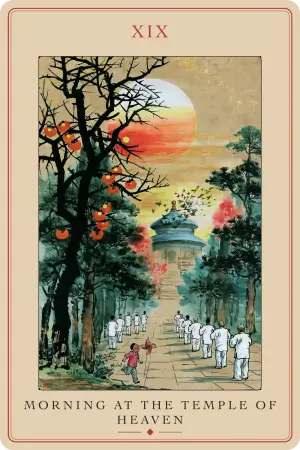
Number. XVIII, the eighteenth gate, standing between the released lanterns of the Star and the sunrise over the Temple of Heaven. Its digits give 1 and 8: the single traveler who walks into the lane at all, and the upright figure of infinity that rules everything cyclical on the card, the moon's phases and the lunar year that returns the Rabbit Lord to the windowsill each Mid-Autumn. Added, 1 plus 8 makes 9, the Hermit's number, so the lesson of the eighteenth card leads back to patient light carried covered through the dark.
Astrology. Pisces, the water sign of depth, dreams, dissolving boundaries, and the difficulty of telling vision from illusion. This is the very air of the night hutong. In the deck's own world the card sits on Mid-Autumn night, the great festival of the moon in the Chinese lunar calendar, whose timekeeper governs sowing, festivals, and reunions alike.
Element. Water: the subconscious, emotion, and primordial instinct, fluid and reflective like the moon that has no light of its own and only returns the sun's. The moonlight pooling on the lane's wet stones is this element made visible.
Ruling planet. Neptune, the planet of dreams, illusion, and the blurring of boundaries, which makes it hard to tell physical reality from psychological fantasy.
Kabbalah. The path of Qoph, the letter meaning the back of the head, running from Netzach to Malkuth at the base of the Tree of Life. Qoph is the most primitive part of the brain, the seat of instinct and the split between pleasure and fear, illuminated only by reflected lunar light.
Psychological perspective
The Moon is the classic card of the Shadow, the repressed and unacknowledged parts of the personality, the thoughts and traumas the conscious ego finds too painful to hold. Jung's circle read the moon as an image of the Anima, the buried emotional and intuitive current in the psyche. When the card appears it works less as a prediction than as a mirror, showing that the querent's reality is distorted by their own fears and projections.
A person who embodies this arcana lives with one ear turned to the invisible. They are emotionally porous, feeling atmospheres and reading the pause before anyone speaks, connected to their dreams and to the old family knowledge kept half in earnest, like the Rabbit Lord on the windowsill. Their intuition often proves right where analysis fails, and they can sit with other people's fears without flinching because they know their own by name.
The same porousness leaves them exposed. They are prone to anxiety and insomnia, and to moods that shift like moonlight on wet stones. Under stress they retreat inward and lose the path back, mistaking projections for perceptions and waiting forever for one more sign before deciding. Their growth is the card's own discipline: to walk the night lane at a steady pace, honoring the feelings without handing them the keys to the house.
The Rabbit Lord's Night across decks
Tarot de Marseille. The Moon is a moonlit landscape of pool, crayfish, two dogs, and two towers, read as the deception and fear of night. Beijing keeps the structure exactly and translates it into a hutong: the towers become grey walls, the dogs become unseen cats, the pool becomes moonlight on the stones.
Rider-Waite-Smith. Smith's card adds psychological depth, the crayfish as primitive instinct and the dog and wolf as the tamed and wild mind beneath one moon. The Rabbit Lord's Night carries the same reading but swaps the cold lunar face for a warm clay guardian who stands watch over the same descent.
Crowley-Thoth. Crowley painted the Moon as a Gateway of Resurrection, Anubis pillars and the scarab Kephera hauling the sun up through the dark, all terror and rebirth. Beijing shares the sense that the dark is a threshold to be crossed rather than merely feared, but answers it with folk humor instead of Egyptian mysticism.
Modern reframings. Many recent decks lean into the Moon as intuition and the witch's validation of magic over pure reason. The Tarot of Beijing belongs to that turn, insisting that intuition is not a private talent but inherited equipment, protectors left along the lane by everyone who walked it before.
In combination and context
The Rabbit Lord's Night colors a spread with ambiguity and pulls its neighbors toward the unseen. Beside the Tower it warns that self-deception or an uncovered deceit will bring sudden collapse. Beside Justice it can point to false accusation or slander built on lies, though if both fall reversed the truth is finally uncovered. Beside the Lovers it raises the illusion of love, a false lover, or a bond strained by things left unsaid.
The surrounding cards also tell you which fog you are in. A common reading technique is to look at the card behind the Moon for the source of the anxiety and the card ahead for the way through. Neighbors of rest and daylight suggest the confusion is clearing, while cards of secrecy or temptation, the Seven of Swords or the Devil, sharpen its warning toward real deception rather than only inner projection.
In a yes or no reading the card almost always answers no. This is less a permanent refusal than a reading of the present: too much is unclear, hidden, or unverified to move affirmatively yet. When the Rabbit Lord's Night keeps returning, treat it not as a verdict but as an instruction to walk the lane calmly, name the fears one at a time, and wait for the morning bell before you decide.
Questions for reflection
- Which fear have you been treating as a prophecy, and what happens to it when you say it out loud?
- What in your life is entirely familiar yet no longer certain, and are you willing to walk it slowly rather than force the light?
- Where is your intuition carrying accurate mail that your daylight reasoning keeps refusing to open?
The general meaning follows the Rider-Waite-Smith reading — the reference used across Tarot Academy. Open a specific deck above for its own interpretation.
Frequently asked questions
Explore the Tarot
Latest Posts
Discover the ancient wisdom of tarot cards and unlock the mysteries of your spiritual journey. Our blog is your gateway to understanding the rich symbolism, meanings, and practical applications of tarot reading.




















































