
 BE (беларуская)


Малодшыя Арканы ·
Four of Teacups
Апатыя сярод дастатку: тры кубкі астылі, а чацвёрты дыміцца пад рукой, але чалавек не падымае галавы.
Кароткі агляд карты
- Нумералогія
- Чатыры
- Стыхія
- Вада
- Астралогія
- Месяц у Раку · 3-і дэкан
- Кабалістычны шлях
- Хесед (Міласэрнасць)
- Час
- Трэці дэкан Рака · прыкладна з 12 па 21 ліпеня
- Так / Не
- У прамым становішчы не, альбо яшчэ не · У перавернутым так
Прамое становішча
апатыя
нуда ў дастатку
адыход у сябе
упушчаная прапанова
нездаволенасць
рэфлексія
перасычанасць
успрыманне як належнага
Перавернутае становішча
абуджэнне
новы апетыт
прыняцце дапамогі
перагляд адмоў
зацвярдзелая ізаляцыя
эскапізм
адноўлены фокус
ўдзячнасць
Four of Teacups ў кожнай калодзе
Кожная калода пераасэнсоўвае адзін і той жа архетып. Параўнайце мастацтва, а затым адкрыйце калоду, каб прачытаць яе поўную інтэрпрэтацыю.
Псіхалагічная перспектыва
Чалавек на гэтай карце моўчкі сядзіць, задуменны і паглыблены ў сябе, узважваючы сваё жыццё гэтак жа, як вучоны ўзважвае радок верша. Іншым ён можа здавацца адчужаным або няўдзячным, паколькі падарункі застаюцца неадкрытымі, а кампліменты пралятаюць міма вушэй. Аднак насамрэч ён рэдка бывае халодным: ён проста недзе ў іншым месцы. Часта такі чалавек знаходзіцца паміж раздзеламі жыцця, калі стары смак ужо знік, а новы яшчэ не абраны. Ён хутчэй захавае пустэчу, чым напоўніць яе нечым непатрэбным. Ён ведае, што чагосьці не хапае, але пакуль не можа сказаць, чаго менавіта.
Больш глыбокі механізм заключаецца ў трансе ізаляцыі, унутранае перакананне ў сваёй адзіноце і незразуметасці. Чалавек пацвярджае гэта, адмаўляючыся ад дапамогі, калі яе прапануюць, або не просячы пра яе, калі яна патрэбна. Чацвёрты кубак вісіць навідавоку, але ад яго адмахваюцца. Гэта адбываецца не з-за сапраўднага задавальнення, а з-за ціхага страху, што любая новая прынятая радасць будзе адабрана. Сучасныя таролагі не згодныя лічыць такі стан абсалютнай няўдачай. Нуда з'яўляецца раскошай. Бяспека, якая дазваляе сядзець і разважаць пра сваю лёгкую нездаволенасць, азначае, што базавыя патрэбы ўжо задаволеныя. Задача карты палягае ў тым, каб адрозніць усвядомленае адзіноцтва і неабходную паўзу для аднаўлення сіл ад эгацэнтрычнай адмовы, якая павольна знішчае дух, што спрабуе абараніць.
Чацвёрка Чайных кубкаў у розных калодах
Rider-Waite-Smith. Юнак пад дрэвам ігнаруе тры кубкі на зямлі і чацвёрты, які працягваюць з воблака, скрыжаваўшы рукі і апусціўшы позірк. Пекінская карта захоўвае яго закрытую позу і адмову, але змяняе адкрытае поле на чайную, а руку з воблака на руку афіцыянта. Такім чынам, прапанова становіцца чалавечай і абмежаванай у часе, а не боскай.
Tarot de Marseille. Чатыры стылізаваныя кубкі атачаюць цэнтральную кветку: абстрактная дыяграма эмацыйнага стрымлівання і межаў. Пекінскае таро захоўвае чатыры элементы, але асэнсоўвае іх праз сыхэюань (siheyuan), унутраны дворык, сцены якога даюць адпачынак, але пры занадта доўгім знаходжанні прыносяць застой.
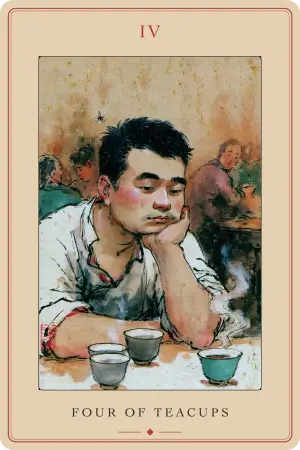
Crowley-Thoth. Кроўлі называе карту Раскоша (Luxury) з падзагалоўкам Насенне распаду (The Seeds of Decay), малюючы запячатаныя залатыя кубкі на неспакойным моры Рака. Пекінская карта падтрымлівае гэтае папярэджанне праз тры пасівелыя і астылыя кубкі, камфорт, які перастаў цыркуляваць і пачаў псавацца.
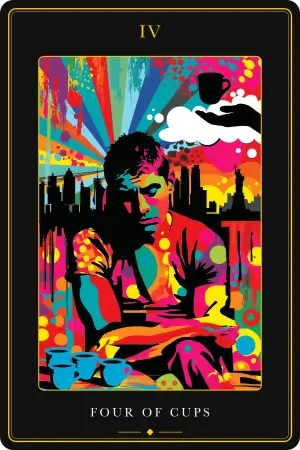
Сучасныя пераасэнсаванні. Нядаўнія калоды абараняюць Чацвёрку Кубкаў як сімвал усталявання здаровых межаў і самазахавання, а не проста капрызаў. Пекінскае таро спалучае абодва прачытанні. Камар і астылыя кубкі папярэджваюць пра стагнацыю. У той жа час, дымлівы бірузовы кубак і цёплы пакой нагадваюць, што некаторыя прапановы сапраўды варта прыняць.
У спалучэнні і кантэксце
Чацвёрка Чайных кубкаў усталёўвае базавы ўзровень эмацыйнага спакою, які суседнія карты схіляюць альбо да адпачынку, альбо да распаду. Побач з Тузом Чайных кубкаў метафара становіцца літаральнай: Туз выступае ў ролі таго самага чацвёртага кубка, прапанаванага з неба. Расклад пытаецца, ці застанецеся вы ў бяспечнай апатыі, ці рызыкнеце сэрцам дзеля новага пачатку. Разам з Пустэльнікам гэтай калоды адыход успрымаецца як свядомы і плённы. Адзінота выкарыстоўваецца як інструмент для сапраўднага абнаўлення, а не як руціна.
Больш моцныя карты прымушаюць парушыць спакой. Побач з Блазнам прачытанне ператвараецца ва ўказанне адпусціць старыя шкадаванні і зрабіць крок наперад, пакуль дымлівы кубак не астыў. Разам са Смерцю стагнацыя дасягае крытычнай масы, і старая структура бурыцца, саступаючы месца руху, незалежна ад таго, жаданы ён ці не. Побач з Д'яблам эскапізм карты перарастае ў залежнасць, а ізаляцыя патрабуе ўмяшання. У простым пытанні «так ці не» яна звычайна адказвае «не» альбо прапануе пачакаць, пакуль не зменіцца ваша перспектыва. Выключэннем з'яўляюцца пытанні пра ўсталяванне межаў або адмову ад таго, што высмоктвае сілы. У такім выпадку яна ператвараецца ў катэгарычнае «так».
Калі Чацвёрка Чайных кубкаў пастаянна з'яўляецца ў раскладах, успрымайце гэта як настойлівую параду самой карты: падніміце галаву, назавіце тое, чаго вы чакаеце, і ўдыхніце водар бліжэйшага цёплага кубка, пакуль не знікла пара.
Reversed meaning
Reversed, the Four of Teacups swings between two doors. Through one comes the waking: the head lifts off the hand, the eyes find the steam, and the man realizes the teahouse has been warm and noisy around him all along. Appetite returns, refusals get a second look, and cold cups worth reheating get reheated. Through the other door the withdrawal completes itself. He has sat so long over cold cups that the waiter stopped coming, chances are no longer offered because they were refused too many times, and detachment has hardened into isolation.
In love. Either the thaw or the freeze. One partner wakes, notices the row of cold cups, and reintroduces appetite through renewed courtship and revived rituals. Or coldness settles for good, offers stop coming, and the space between two people at one table grows wider than the lane outside. Test it with one warm gesture and watch whether it is taken up.
In career. The wake-up or the cost of long drift. On the lighter side interest returns in an awkward rush, applications and questions and volunteered hands, and you scramble to catch offers before they finish cooling. On the heavier side chances for growth were allowed to pass and the flatness thickened into real disengagement. Change the shape of your day before you change your job, because often the routine went cold and not the work.
In finances. The return of financial appetite, or the price of ignoring it. Options waved away for months suddenly look worth a second smell, so go back through what you turned down and check whether any cup is still warm. The harder reading is that opportunities were missed outright and regaining lost ground now takes real effort. Either way, stop treating your finances as scenery.
In health. Reawakening or accumulated neglect. In the brighter sense appetite returns for movement and care, and stale habits are recognized as stale and replaced without mourning. In the heavier sense fatigue deepened while it was ignored and small signals were dismissed until they grew loud. The card also carries the shadow of escapism, using drink or numbness to blur reality, and its counter is to reconnect with the body. Choose one physical offer you have been refusing and take it this week while it is still warm.
Historical notes
The Four of Cups took shape as a study of dissatisfaction, and each foundational tradition read that dissatisfaction differently. In the 1909 Rider-Waite-Smith deck, drawn by Pamela Colman Smith to A.E. Waite's design, a solitary youth sits under a large tree with arms crossed, three cups on the ground before him and a fourth offered by a disembodied hand from a grey cloud. He ignores all four. The image sits on a spectrum from the Buddha under the Bodhi tree rejecting hollow pleasures to a spoiled child refusing to engage.
Aleister Crowley's Thoth deck, painted by Lady Frieda Harris, names the card Luxury and gives it the darker subtitle The Seeds of Decay. Four ornate golden cups sit on a tumultuous sea of Cancer's water, fed by pipe-like roots from a central lotus, sealed off from the outside world. Behind the golden glamour lurks the grey emptiness of comfort that has stopped growing. The older Tarot de Marseille reads the four cups as emotional containment, a perimeter of stylized cups around a central flower that protects the emotional core while deciding who is let inside the tribe and who is kept out.
The Tarot of Beijing inherits all three readings and relocates them to a teahouse. The lone tree becomes a crowded social room, the hand from a cloud becomes a waiter's ordinary gesture, and the divine offer becomes a perishable human one that will go cold if it is not claimed. The refusal is the same refusal the card has always shown. The setting simply makes it harder to blame anything but the drinker.
Correspondences
Number. Four, the number of walls. In this deck it is the number of the siheyuan, the courtyard house enclosed on four sides, and every Four in the minor arcana shows what enclosure does to its suit. The Four of Kites ties celebration to the four corners of a gate, the Four of Coins seals a man inside his own shutters, and the Four of Teacups builds the walls out of mood. Four is stability, foundation, the resting number that sits down after the growth of three. Applied to water, that steadiness is double-edged: still water is peace, still water left too long is stale.
Astrology. The Moon in the third decan of Cancer, roughly July 12 to 21. Cancer is the sign of the shell, of home and the walled courtyard of the self, and its third decan carries the need for protection to the point where the shell keeps out nourishment along with danger. The Moon rules here in its own sign, patron of everything half-lit and inward, the same moon that hangs over the deserted hutong in this deck's eighteenth major arcanum. Under it feelings rise and recede on their own schedule, which is why the card counsels patience with the mood rather than war against it.
Element. Water, in this deck poured as tea. It governs feeling, memory, and bond, and the Four describes the heart at slack tide, full and still and going stale. Water needs movement to stay fresh, so the card's whole warning is about circulation withheld.
Kabbalah. Chesed, the sphere of Mercy on the Tree of Life, in the suit of Water. Chesed is loving, structuring kindness, the benevolence of a secure upbringing, and its shadow is exactly the danger the card names: comfort so complete that a person refuses to leave the enchanted circle and engage with the friction real growth requires.
Elemental dignity. Water under the stabilizing four turns passive and inward. Beside fiery or airy cards it can read as the drag that slows their momentum, and beside other water cards it deepens the withdrawal into genuine retreat.
Psychological perspective
The person of this card is a quiet sitter, thoughtful and inwardly busy, weighing their life the way a scholar weighs a line of verse. To others they can seem aloof or ungrateful, since gifts go unopened and compliments slide off, but they are rarely cold in fact. They are simply elsewhere. Often they sit between chapters, the old flavor faded and the new one not yet chosen, and they would rather hold the emptiness than fill it with the wrong thing. They know something is missing and cannot yet say what.
The deeper mechanism is a trance of isolation, the felt belief that one is alone and misunderstood, which the person confirms by refusing help when it is offered or failing to ask for it when it is needed. The fourth cup hovers in plain view and gets waved away, not from true contentment but from a quiet fear that any new joy accepted will be taken back. Modern readers push back on treating this as pure failure. Boredom is a luxury, and the safety to sit and contemplate one's mild dissatisfaction means the basic needs are already met. The work of the card is to tell mindful retreat, the necessary pause to gather strength, from the self-absorbed refusal that slowly starves the spirit it means to protect.
Four of Teacups across decks
Rider-Waite-Smith. A youth under a tree ignores three cups on the ground and a fourth held out from a cloud, arms crossed, gaze down. The Beijing card keeps his closed posture and his refusal but trades the open field for a teahouse and the cloud's hand for a waiter's, so the offer becomes human and time-limited rather than divine.
Tarot de Marseille. Four stylized cups frame a central flower, an abstract diagram of emotional containment and boundary. Beijing keeps the containing four but reads it through the siheyuan, the courtyard whose walls give rest and, held too long, give staleness.
Crowley-Thoth. Crowley titles the card Luxury and subtitles it The Seeds of Decay, painting sealed golden cups on Cancer's restless sea. The Beijing card meets that same warning in the three cups gone grey and cold, comfort that stopped circulating and began to sour.
Modern reframings. Recent decks defend the Four of Cups as healthy boundary-setting and self-preservation rather than mere sulking. The Tarot of Beijing holds both readings at once. The mosquito and the cold cups warn against stagnation, while the steaming teal cup and the warm room insist that some offers are genuinely worth accepting.
In combination and context
The Four of Teacups sets a baseline of emotional stillness that the cards around it push toward rest or toward rot. Beside the Ace of Teacups the metaphor turns literal, the Ace becoming the actual fourth cup offered from the sky, and the spread asks whether you will stay safe in your apathy or risk the heart on a new beginning. With this deck's Hermit the withdrawal reads as chosen and fruitful, loneliness used as a tool for real renewal rather than a rut.
Stronger cards force the stillness to break. Beside the Fool the reading turns into a directive to let go of old regret and take the leap before the steaming cup goes cold. With Death the stagnation reaches critical mass and the old structure collapses to make way for movement, whether wanted or not. Beside the Devil the card's escapism curdles into bondage, withdrawal hardened into addiction that demands intervention. In a plain yes-or-no question it usually answers no, or wait until your perspective shifts, except when the question is about drawing a boundary or refusing something draining, where it turns into an emphatic yes.
When the Four of Teacups keeps surfacing, read it as the card's own advice made insistent: lift your head, name what you are waiting for, and smell the nearest warm cup before the steam is gone.
Пытанні для роздуму
- Якія тры кубкі на вашым уласным стале паспелі астыць, пакуль вы глядзелі ў сцяну, і чаго б каштавала зноў пакаштаваць адзін з іх?
- Калі вы апошнім часам адмаўляецеся ад прапановы, гэта сапраўдная праніклівасць ці стары страх таго, што любая новая радасць будзе адабрана?
- Чаго менавіта вы чакаеце, калі назваць гэта прама? Ці здольны свет увогуле паставіць гэта гарачым побач з вамі?
Агульнае значэнне прытрымліваецца чытання па сістэме Райдэра-Уэйта-Сміт — эталону, які выкарыстоўваецца ў Tarot Academy. Адкрыйце канкрэтную калоду вышэй для яе ўласнай інтэрпрэтацыі.
Частыя пытанні
Даследуйце Таро
Апошнія Публікацыі
Адкрыйце старажытную мудрасць карт тарот і раскрывайце таямніцы вашага духоўнага падарожжа. Наш блог - гэта ваш шлях да разумення багатай сімволікі, значэнняў і практычнага прымянення чытання тарот.




















































