 EN (English)



Minor Arcana · Cups (Water)
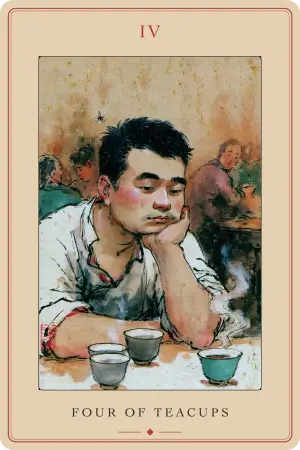
Four of Cups
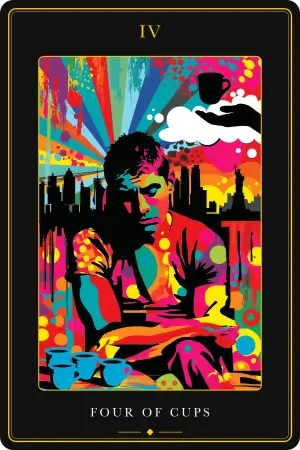
Smith seated a youth under a healthy tree with his arms and legs crossed, set three cups on the grass in front of him, and had a fourth held out from a cloud he never looks at.
Card at a glance
- Numerology
- 4
- Element
- Water
- Astrology
- Third decan of Cancer (July 12–21), ruled by the Moon
- Kabbalistic path
- Chesed (Mercy), where the Fours sit
- Timing
- The closing ten days of Cancer, midsummer turning inward
- Yes / No
- Upright no, or wait; reversed yes
Upright
Apathy
Contemplation
Boredom
Discontent
Withdrawal
Missed opportunity
Complacency
Reevaluation
Reversed
Awakening
New perspective
Re-engagement
Acceptance
Conscious refusal
Escapism
Stubbornness
Overcoming apathy
Four of Cups in each deck
Every deck reimagines the same archetype. Compare the art, then open a deck to read its full interpretation.
Imagery and symbolism
Pamela Colman Smith drew this card as a refusal held in the body. A young man sits on the ground beneath a large tree with his arms folded across his chest and his legs crossed, and this deck reads that posture as a man closed off, physically declining both what the world offers him and any change to his situation. The arms and legs make a shut circuit. Nothing gets in and nothing leaves.
Three cups stand on the grass directly in front of him. This deck reads them as past joys and pleasures that have gone flat, things once worth having that now register as insignificant. They are not taken from him. They sit within reach, unregarded.
The fourth cup arrives from outside the scene entirely, held out by a disembodied hand emerging from a cloud. That hand is one of Smith's recurring devices across the Aces and several pips, and here it carries the same charge: this deck reads the cloud as the heavens or the spiritual forces offering help, and the cup itself as an unexpected offer or opportunity. The youth gives it nothing. Absorbed in his own interior weather, he cannot see or value what is being handed to him.
The setting argues against him at every point. His cloak is green, and the trees around him are green, and this deck reads that colour as growth and life, pointing to solutions and prospects for well-being that the man ignores. The same green marks his connection with nature, his concentration and his tranquility, so the cloak works both ways: it is the calm he has achieved and the growth he is declining. The tree above him is sturdy and healthy, giving stability and safety. The sky is blue and the day is clear, which this deck reads as peace and harmony that the character enjoys without ever fully appreciating. Only the mountain in the background carries difficulty, standing for obstacles.
What results is a deliberate contrast. This deck names it directly: a pleasant, colourful landscape set against the inner discontent of the figure in the middle of it. Nothing in the picture has gone wrong. That is the problem the card is describing.
The posture stays ambiguous on purpose, and the tradition has read it along a wide spectrum. At one end the youth is the ascetic under the tree, close to the Buddha beneath the Bodhi tree, turning from shallow emotional offerings toward a higher truth on the grounds that a fourth cup would only bring more of the same. At the other he is a spoiled child in a glass-half-empty sulk, locked in habit and unable to appreciate what he already holds. Both readings live in the same folded arms.
Core meaning
This deck states the card as internal detachment and a focus on emotions, a period of reflection and self-analysis in which you take stock of your emotional state and your relationships. Alongside the apathy it insists on something the generic reading tends to lose: introspection and inner strength, an energy turned toward self-purification and self-analysis. The stability is real. So is the boredom.
What this deck keeps returning to is the moment comfort tips over. It describes a stretch of satisfaction that has become stagnation and a loss of motivation to change anything, introspection and completeness sitting in the same hand as routine and unexpected inner dissatisfaction. Its sharpest formulation is that emotional balance may have been bought at the cost of stability. You declined offers because you were expecting something greater, and now nothing is arriving at all.
The elemental logic underneath is a conflict. Cups are Water, which has to move to stay alive, and four is stability, boundaries and consolidation, the four walls and four corners of a settled life. Bind water that tightly and it becomes a stagnant pool. Among the Minor Fours only Cups turns the pause sour: Wands celebrates, Swords rests, Pentacles hoards, and Cups goes still. This deck's own numerology says the same thing from the other side, warning that the number 4 becomes a symbol of stagnation and immobility unless you break free of habitual boundaries and try something new.
Across this deck's live categories the reading holds its shape. In money it is security without joy. In business it is contentment that overlooks unrealised growth. At work it is rest that has curdled into routine. In romance it is stability gone monotonous. In general relationships it is a deliberate turn inward from social life. In the physical realm it is dissatisfaction with the body paired with no clear idea what to do about it. The same folded arms, in six different rooms.
Upright meaning
Upright, this deck reads dissatisfaction with the current situation, apathy, and an unwillingness to see and accept new opportunities. There is boredom here, a lack of motivation to go further, and a passive resistance to change. Underneath sits the deeper movement the deck names alongside it: self-analysis, deep contemplation, a reevaluation of the benefits and values you already have, disillusionment with material things, and a pursuit of the spiritual. The refusal of the fourth cup can be the beginning of something rather than only a mistake.
The recommendations attached are specific. Accept the current situation and appreciate what you have. Stay open to new opportunities instead of overlooking the pleasure your present circumstances can actually bring. Reassess your values and priorities, give time to your inner world, and take the break that clears negative thinking and restores energy. This deck goes so far as to say be open to possibilities that look unpromising, and to pay attention to what happens around you.
In love. Stability mixed with emotional fatigue and boredom. Opportunities are available and go unnoticed, and this deck is blunt that chances get missed in this period of introspection. The relationship has become monotonous and needs a refresh. Alongside that sits stagnation proper: apathy and indifference, feelings dwindling or gone, a reluctance to acknowledge new possibilities as though you were closed off and afraid of change. What it leaves is a lingering sense that things are not going as you wanted while other prospects stay undiscovered.
In relationships more broadly. Inner solitude and self-reflection, with social connections turning secondary while your attention goes inward. You may withdraw from social life to concentrate on personal experience, often from dissatisfaction with your current relationships or with how you communicate. This deck is careful here: stepping back does not mean cutting people off, and the pause is a chance to rethink your ties and find new ways for them to grow. It also names plain saturation, a genuine weariness of social life, and the useful thing that comes of it, realising which interactions you want to leave behind.
In work. A period of rest and stabilisation after an active phase, meant for reassessing what you have achieved and absorbing the experience. The card also exposes internal dissatisfaction with a job that looks prosperous from outside. Routine has set in, enthusiasm has gone, and this deck describes a hunch that something is not right that is quietly holding your career back. Self-reflection is needed to sort which dreams are still true from which no longer match reality. Stability is not the issue. Variety is.
In business. Contentment with the current state of affairs and a reluctance to take on new projects or offers. This deck tells you to look around more carefully, because unrealised opportunities and unconsidered options for growth are sitting there. It names a particular texture of tedium: repetitive, similar proposals that bring no satisfaction. Balance the running of daily operations against exploring what change might offer, and use the pause to plan or simply rest. If the business no longer inspires you, rethink the strategy.
In money. Stability that arrives bundled with stagnation. Your plans brought material prosperity and no joy with it, and the absence of growth frustrates even while the situation stays secure. This deck reads saturation, missed opportunities, and a wish for something more. Conditions are sufficient without being satisfying. You may want to experiment or take a risk, and instead you limit yourself to what is already available.
In the physical realm. Physical dissatisfaction: tired of the old diet, workouts producing nothing. You know something has to change and you have neither a clear idea nor the motivation. This deck warns that dwelling on discontent with your current shape is what makes you overlook real opportunities to improve. It also names sensory overload, where deep focus on the inner world means ignoring the body, and attention shifts from exercise toward meditation, relaxation and solitude.
Reversed meaning
Reversed, the bounded water breaks its banks. This deck reads awakening awareness, a new understanding of the situation, and a fresh start after stagnation: overcoming apathy, overcoming the fear of the new, returning to reality, making up for missed opportunities. The figure looks up. He leaves the meditation and the deep contemplation behind, embraces what life is offering, and shows the decisiveness to accept a new reality.
The deck also runs the reversal the other way, and both readings are live. In its darker sense it points to a lack of motivation and an unwillingness to see anything positive, being stuck in the past, losing touch with reality, and the powerlessness or inner emptiness that comes from rejecting help. Sometimes it is simply an over-critical or over-sensitive temperament that cannot appreciate what it has. The recommendation is to acknowledge the feeling, look inward for the sources of joy, accept that outside help may be needed, and introduce new stimuli.
The wider tradition adds a third possibility worth holding onto. The reversal can mean the cup is seen clearly and declined on purpose. The individual looks at what is offered and decides that it is not for them. That is discernment, not apathy, and the tradition treats it as a sign of high emotional intelligence.
In love. Dissatisfaction, despair, apathy, disagreement and insincerity, a state where old feelings have faded and new ones have not arrived. This deck asks you to examine expectations that may be too high, notice what is being overlooked, and listen to your own emotions. It also names the refusal to see reality, either denying that something is wrong or avoiding a new relationship out of fear of change. Set against that, the same reversal can bring renewed interest, past mistakes corrected, and old bonds reforged.
In relationships more broadly. A need to widen your circle and leave your comfort zone, with intense changes in how you communicate that can produce conflict and misunderstanding along the way. This deck asks for deeper integration with the people around you and for careful, unhurried steps. Its warning is the mirror image: communication problems driven by refusing to leave a comfortable world, an unwillingness to engage, an inability to listen to anyone else's viewpoint.
In work. Missed opportunities, dissatisfaction and self-absorption, with chances for professional growth left unused. You feel stuck, low, bored with repetitive tasks. This deck calls it a denial of reality, staying fixed on the dissatisfaction instead of taking the step forward. Opportunities get missed when a viewpoint becomes too entrenched or when new offers are actively ignored, and focusing on the negative leads straight to professional stagnation.
In business. Opportunities lost to inattention and an unwillingness to change, with stubborn adherence to familiar patterns costing you innovation. A monotonous approach produces stagnation, and this deck warns specifically about undervaluing new proposals because you are fixed on past failures. It cautions against the deadlock that comes from having no inspiration or energy left. Flexibility and a reconsidered attitude are what let the business grow again.
In money. A reassessment of ambitions and renewed interest in financial prospects, a release from monotony and settled thinking. This deck points toward risky but promising options and toward vital decisions you previously rejected. Reevaluating your values restores financial balance and clears out old negative beliefs about money, and opportunities you overlooked become visible as the perspective shifts.
In the physical realm. Physical reevaluation, the recognition that your old approach to your body no longer serves. This deck reads readiness for change, a search for a new lifestyle, and release from old habits, whether that means adjusting food or finding a different form of activity. It is honest that motivation may still be missing at the start, and traces that reluctance to fatigue or emotional burnout that has to be addressed before balance returns.
One further shadow belongs here. Because the card is tied to escapism and to Water, which rules liquids, the reversal can indicate substance abuse, alcohol or drugs used to escape reality entirely, and days lost to intoxication. In a supportive spread it reads as the emergence from exactly that, the decision to get clean. Esoterically it also warns of ungrounded psychic work, too long in trance, and a need to reconnect with physical reality.
Historical notes
The scene Smith drew is not the old one. In the Tarot de Marseille, which predates both the Rider-Waite-Smith and Thoth systems, the Four of Cups is strict geometry with no narrative at all: four stylised cups placed in the four corners of the card around a central pillar-like flower. What it depicts is containment. The cups form a perimeter protecting the emotional core, and the tradition reads the card as the Mercy of the Queen and the loving foundation of a secure upbringing, while also making it a hard boundary card that decides who is inside the emotional tribe and who is an outsider. In a relational reading the Marseille Four can be a family so tightly knit that it refuses a new partner and eyes newcomers with suspicion. Comfort that protects, and that eventually has to be permeated for an adult to expand.
Waite and Smith replaced the diagram with a person. The RWS version puts a single figure on the ground under a tree and gives the abstraction a face, a posture and a landscape, so that emotional containment becomes something you watch someone do. The hand from the cloud is Smith's addition to the argument. Marseille had no way to show an offer being made and refused; the RWS card makes the refusal the entire subject.
Crowley and Lady Frieda Harris went the other way in the Thoth Tarot and removed the human narrative in favour of esoteric geometry. They titled the card "Luxury" and gave it the darker subtitle "The Seeds of Decay." Four ornate golden cups sit on a wavy, tumultuous light blue sea, the astrological waters of Cancer, fed by pipe-like roots running from a central lotus, under the silvery-grey clouds of the Moon. The system is sealed. The plant life is closed off from the outside world and trapped inside its own structural perfection, which is why Crowley called it a blind alley and a dead stop: behind the golden glamour lies the grey tristesse of emptiness. The relationship is comfortable and taken entirely for granted, shielded from risk, and because of that the waters have started to foul.
Between the Marseille perimeter and the Thoth diagram, the RWS card is the one that made the Four of Cups legible to ordinary readers, which is why the youth with folded arms is now what most people picture when the card is named.
Correspondences
Number. Four. This deck reads it as steadiness and stability, practicality and a firm foundation, and it uses the number as an instruction: look at your feelings through the lens of logic and rationality, which is what constructiveness, systematicity and orderliness mean applied to emotion. Four is closely linked to matter and the physical environment, so it grounds the card in reality and points to the emotional balance that sustainable growth needs. As an even number it carries balance and harmony, the inner equilibrium that comes from understanding and accepting what you feel. This deck also states the failure mode plainly: focus only on what is known and familiar, and the number of stability and order becomes a symbol of stagnation and immobility.
Astrology. The third decan of Cancer, roughly July 12–21, ruled by the Moon. This deck reads that decan as a call for security, understanding and closeness, on the principle that finding safety and stability is what lets a person open to new experience without fear. The Moon stands for maternal instinct, care and understanding, influencing feeling directly while also carrying the cyclic nature of life. The wider tradition presses the point harder: Cancer is the Moon's own home, so this is an exceptionally potent placement and one prone to extreme sensitivity and to retreat into the crab's shell. On that reading the apathy is rarely a passing mood. It is flatness left behind by repeated disappointment, or an over-sensitised reaction to a world that feels too sharp.
Element. Water. This deck grounds the card in deep emotionality, intuition and a capacity for empathy, with the possibility of an immersion in feeling whose substance you cannot always explain. Through that connection the card points to intuitiveness and emotional recharge. Water needs to circulate to stay alive, which is precisely what the fourth wall of the number prevents.
Kabbalah. All the Fours belong to Chesed, Mercy, the loving and structuring kindness associated with the maternal figure and with the benevolence of a secure upbringing. Because Cups correspond to Water, this card is Chesed expressed through feeling: safety so complete it stops asking for anything. Qabalistic commentary names the shadow directly, an arrested development in which someone so enveloped in comfort refuses to engage with the outside world and stays in a perpetual daydream, avoiding the friction that individuation requires. Childhood belongs inside that enchanted circle. The adult only emerges once it is broken.
Elemental dignity. A Water card, it settles comfortably with Earth and can dampen Fire, while Air tends to disturb its heavy calm.
Psychological perspective
The people this deck attaches to the upright card are frequently found in contemplation. They analyse situations carefully and can look withdrawn or detached from the world outside them, often because they are working through a period of self-realisation. Sometimes they read as apathetic and indifferent to what is put in front of them, since they are looking for something different or more significant. They search for deep understanding and get absorbed in their inner world easily. This deck names the specific bind they are in: they see situations objectively and stay passive, dissatisfied and wanting change, unable to define what they actually want or need.
Reversed, that portrait opens. These are people experiencing an inner awakening, coming out of apathy and becoming active toward what is being offered them. They take interest in details they used to ignore, look for new directions and find their place. They reassess what they feel and move back into an active life, and by appreciating what they once overlooked they let new opportunities turn positive. What defines them is readiness for change and openness to new experience.
Underneath the portrait sits the card's real question, which is about the nature of the withdrawal. One kind is the trance of isolation, the deeply felt but false conviction that you are alone and fundamentally misunderstood. It runs on self-limiting belief: the fourth cup is in plain sight and gets refused anyway, out of unworthiness or a fear that any new joy will be taken away again. Habitually refusing help, or failing to ask, builds walls that drain the joy out of a life and repel the very thing that would fix it. The isolation becomes a self-fulfilling prophecy while the remedy hovers in the air, undelivered.
The other kind is mindful retreat, and modern readers defend it vigorously. Here the person is protecting stable energy on purpose, declining to import chaos until the footing is more solid, which takes the maturity to say no to an immediate opportunity. One commentator puts it well: boredom is never negative, it is a distinct luxury. Having the safety to sit under a tree contemplating a mild dissatisfaction means the survival needs are already met. The pause stills the emotional waves that make clear thinking impossible, much as water poured into a bounded vessel settles.
The question the card asks is which one you are doing. Are the walls currently in place protecting the spirit, or slowly starving it of the experience a full life requires?
The Four of Cups across decks
Tarot de Marseille. Four stylised cups in the four corners around a central pillar-like flower, pure geometric abstraction with no scene and no figure. The card is about the perimeter itself, emotional containment and the establishment of boundaries around a protected core. It carries the Mercy of the Queen and a secure upbringing, and it also decides who belongs to the emotional tribe and who does not, which in a relational reading can be the family too tightly sealed to admit anyone new.
Rider-Waite-Smith. The version on this page is the psychological one. Smith turned the perimeter into a person, seating a youth under a healthy tree with his arms and legs crossed, three flattened joys on the grass and a fourth cup extended from a cloud he refuses to look at. This deck reads the scene as introspection and inner strength alongside boredom, apathy, disappointment and dissatisfaction, merging stability and sensuality into a focus on self-purification. Smith also built the contrast the card is famous for: green cloak, green trees, a sturdy tree, clear blue sky, a mountain of obstacles behind, and a figure who appreciates none of it. Everything most readers picture when the card is named comes from here.
Crowley-Thoth. Painted by Lady Frieda Harris and titled "Luxury," with the subtitle "The Seeds of Decay." Four ornate golden cups stand on a tumultuous light blue sea, the waters of Cancer, fed by pipe-like roots from a central lotus under silvery-grey lunar cloud. No human being appears. The system is sealed off from the world and trapped in its own perfection, a blind alley where the zenith of comfort has been reached and crossed and the still water has begun to foul. Behind the golden glamour, grey emptiness.
Later decks. Most modern decks follow the RWS scene and keep its two load-bearing elements, the crossed arms and the ignored gift, since that pairing is what makes the card readable at a glance. Read together the three traditions map the same warning from three angles: dissatisfaction in the RWS, containment in Marseille, and in Thoth the quiet decay of a comfort held too long.
In combination and context
The Four of Cups sets a baseline of emotional stillness that its neighbours either break or deepen. Beside the Ace of Cups the metaphor becomes literal, since the Ace is the fourth cup the cloud is holding out. The querent stands between the safe, slightly stale parameters of the three cups on the ground and a frightening new emotional beginning, and in dating readings the pairing often shows one person offering an overflowing heart while the other stays withdrawn and unready to receive it.
With The Hermit the withdrawal turns deliberate. The Hermit's wisdom-seeking introspection lifts the apathy of the Four into something closer to sweet peace and satisfaction, a distance that is a necessary condition for spiritual renewal rather than a failure to engage. In relationship readings this pair suggests someone thinking of the querent heavily from a distance, mixing quiet loneliness with real respect while still preferring the safety of that distance to actual contact. They love the idea of the person more than they want the person's company.
With The Fool the reading turns into a directive. The Fool's leap of faith is the catalyst that breaks the emotional homeostasis, and the message is to release past regret and take the risk, with the warning that the cup floating in the sky will not wait forever. The Wheel of Fortune does the same work through fate rather than choice, promising an interruption to the stagnation and a new interest arriving shortly, traditionally within fifteen days. Justice puts the withdrawal under analysis instead, weighing fairness and deciding on principle whether engagement is warranted.
Darker company sharpens the shadow. With Death the situation has become so stagnant that it is bored to death: apathy reaches critical mass, the old emotional structure can no longer hold itself up, and the querent is ejected from the rut whether or not they wanted to go. With The Devil the escapism has hardened into bondage, the daydreams or the drinking mutating from a coping mechanism into an addiction that holds the person captive inside their own numbness.
Position and question type matter as much as the neighbours. In a yes-or-no reading the card is notoriously stubborn, and the working consensus is no, not until you shift your perspective, or more precisely wait, since the timing is wrong and you need space before adding anything else. Asked about setting a boundary, cutting contact with someone toxic, or turning down a draining offer, it flips to an emphatic yes. As advice it reads two ways depending on where the querent already is: look up and engage if you have been hiding from life, or take the retreat and recharge if the world has been draining you. In location spreads it points to a quiet public park or anywhere designed for solitary withdrawal, somewhere you go to sit alone with your thoughts.
Questions for reflection
- Smith put three cups on the grass in front of the youth, joys that have gone flat rather than been taken away. Which of yours are still within reach and no longer register?
- This deck reads the green cloak as both tranquility and growth being ignored. Is the calm you are protecting right now restoring you, or keeping you seated?
- The hand from the cloud is offering something the figure never looks at. What has arrived in your life recently that you dismissed because it did not come in the form you were waiting for?
The general meaning follows the Rider-Waite-Smith reading — the reference used across Tarot Academy. Open a specific deck above for its own interpretation.
Frequently asked questions
Explore the Tarot
Latest Posts
Discover the ancient wisdom of tarot cards and unlock the mysteries of your spiritual journey. Our blog is your gateway to understanding the rich symbolism, meanings, and practical applications of tarot reading.