
 EN (English)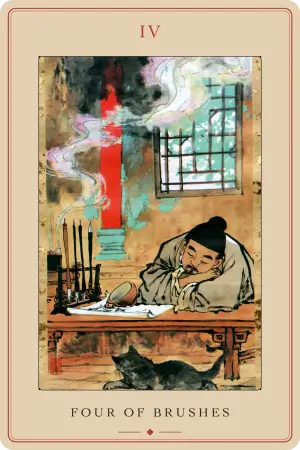


Minor Arcana ·
Five of Brushes
A xiangqi game won and a courtyard lost: victory that costs more in goodwill than it gains on the board.
Card at a glance
- Numerology
- 5
- Element
- Air
- Astrology
- Venus in Aquarius · first decan
- Kabbalistic path
- Geburah (Severity)
- Timing
- Late autumn · Aquarius (Jan 20–29)
- Yes / No
- Upright no · Reversed leaning yes
Upright
conflict
hollow victory
gloating
rivalry
sharp words
one-upmanship
winning at a cost
isolation
Reversed
reconciliation
apology
releasing resentment
accepting defeat
mending the lane
humility
false peace
rebuilding trust
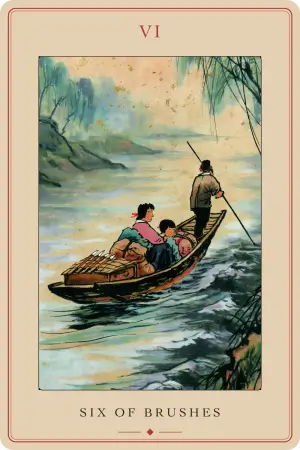
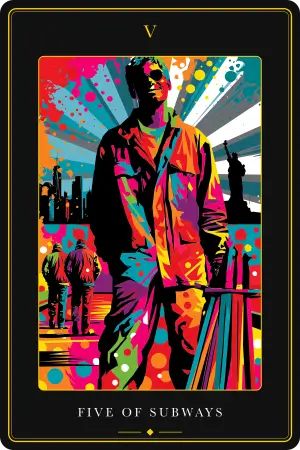
Five of Brushes in each deck
Every deck reimagines the same archetype. Compare the art, then open a deck to read its full interpretation.
Imagery and symbolism
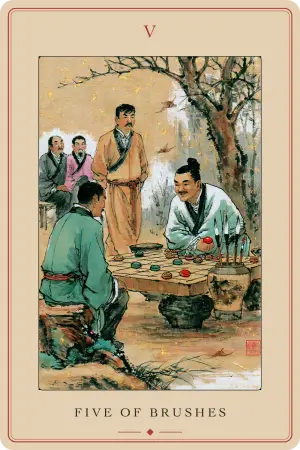
In the Tarot of Beijing the Five of Brushes moves the old scene of a costly victory from a windswept battlefield to a stone xiangqi table in a city park. The game is over, or as good as over. The winner leans across the board, smiling, a captured piece already in his hand. His pleasure is real and unhidden, and in this deck that open pleasure is the wound the card depicts.
Opposite him the defeated player is shown from behind, the deck's quiet way of saying he is already leaving. His stiff back is the second half of the story: face lost, pride bruised, tomorrow's empty seat foretold.
Around the table stand and sit the onlookers. One watches the winner with a flat, unreadable expression. The others exchange the glance that, in a hutong, works as a verdict. No one applauds. Where the Rider-Waite scene sends the defeated off across an empty plain, here the community stays, and its silence is the judgment.
Beside the board a jar holds the suit's brushes, tips up like a sheaf of captured weapons. The Brushes are the suit of mind, words, and trials, so their presence at a game of xiangqi says the real contest was intellectual, and every cutting remark made over this table was a stroke of ink that cannot be unmade. The pieces carry the suit's muted greens, with one burning accent of vermilion, the deck's color of vital force, clutched in the winner's fist. He holds that red piece the way the old victor gathers swords: legally his, worth less with every second he keeps it.
Above the scene a bare tree spreads leafless branches across gold-flecked kraft paper. The season is late autumn, and the warmth is going out of the picture even as the winner smiles. Two birds fly out of the frame in the background, like the goodwill of the company leaving with them. In the corner the small red seal records the scene, as on every card of the deck: in the lane nothing is forgotten, least of all a graceless victory.
Core meaning
The Five of Brushes is Beijing's Five of Swords, the card of a victory that costs more than it wins. Its whole argument fits one image: a man wins the game and loses the courtyard. He has broken no rule. Nothing on the board was against the rules, and yet tomorrow the stone table will be lonely.
In the canonical deck this is the pyrrhic victory on a battlefield, a smirking figure gathering swords while the beaten walk away. Beijing keeps the sting and changes the stakes. In a hutong, where everyone will see everyone again tomorrow, the tragedy is social rather than military. The card speaks of a conflict, argument, or contest you can win, and probably will, at a price paid in relationships, goodwill, and your own standing in the circle you live in.
This is the suit of Brushes at its midpoint crisis: intellect and quick calculation turned into a weapon, the sharp mind that spots an opponent's weakness three moves early and cannot resist using it. The lesson underneath is plain. Dominance without grace is a slow form of self-exile, and the true score in this deck is not the position on the board but the number of people willing to sit down opposite you tomorrow.
Upright meaning
Upright, the Five of Brushes shows you standing at, or just past, a hostile disagreement: a quarrel, a contest of wits, a fallout where someone wins at the direct expense of someone else. It confirms you likely have the sharpness to win, and it doubts the value of the particular win. Before you press your advantage, the card asks what the table will look like tomorrow. Win, if you must, the way a good player wins, quietly, leaving your opponent his face. It also warns of the cost carried in your own head: the fight replayed at night, the harsh words rehearsed again, the mental exhaustion that outlasts the argument.
In love. A couple who have started keeping score. Arguments are won and lost, one partner has become the stronger debater, and every victory drives the two a move further apart. You can checkmate someone into silence, but not into closeness. Put the brush down; being right is the cheapest prize love offers and the most expensive to collect.
In career. The office as a xiangqi park, with competition for position and credit under an audience that is always watching. You may be in a genuine contest and equipped to win it, but the manner of the win is remembered longer than the win itself. A colleague corrected in front of the meeting turns into an onlooker, and onlookers turn into opponents. Compete and defend your work firmly, and let the other side keep their face.
In finances. Disputes over money that damage more than the purse: contested inheritance, debts between friends, sharp bargaining that crosses from shrewd into predatory. You may take the better share and find the win taxed heavily in goodwill. In the lane the vendor whose scale cheats once loses the whole street, so treat reputation as the currency behind the currency and avoid deals closed in a spirit of triumph over the other party.
In health. The somatic bill for conflict, and the danger of turning self-improvement into combat. Quarrels lodge in the jaw and shoulders, sleep goes to replayed arguments, and a punishing regimen wins a fitter body while breeding resentment of it. The card counsels separating effort from cruelty and letting the nervous system settle.
Reversed meaning
Reversed, the Five of Brushes is the morning after the game, when the winner comes back to the park and finds the stone table empty. It signifies recognizing what a victory cost, weariness with feuding, and the first steps back toward the table. Old disputes may still smolder, a neighbor who has not greeted you since, a colleague quoting your sharp words back at you, or you may be the one nursing the loss and replaying it move by move. The healthiest form of the card puts the pieces back in the box for good. The risk is a false peace, an apology offered only to skip past the discomfort, with the resentment buried and not dead.
In love. The truce. The exhausting season of quarrels is ending, and one partner returns to the table with tea rather than a rematch. It is time to apologize for the sharpest words and to let a disputed point die unresolved for the sake of the evening, provided both people actually leave the game instead of pausing it. If only the contest remains, a graceful ending is itself the healing move.
In career. The end of an office war. A conflict with a colleague or manager has run past its usefulness, and the card advises setting down the pieces: conceding the point that no longer matters, or accepting a lost contest and carrying the loss with a straight back. Watch the urge to re-litigate old rounds, since nothing marks a person in a team like the inability to stop replaying a lost argument.
In finances. The accounting after the quarrel. Admit what the money conflict actually cost in fees, energy, and relationships, and stop feeding a dispute that consumes more than it can return. It may mark the settling of an old feud: repaying a contested debt to be free of it, or accepting a smaller share for peace. A loss acknowledged cleanly stops costing you, while a loss disputed forever compounds like bad interest.
In health. A ceasefire with your own body. The battle approach of extremes and hostile self-inspection has stopped producing results and started producing damage. The card favors rest after overtraining, gentle rehabilitation, and a normal relationship with food and the mirror. Stop measuring your body against a rival's or your younger self's, since those games have no final round.
Historical notes
The Five of Swords carried the meaning of loss long before its Beijing restaging. Etteilla, writing in the late eighteenth century, gave the upright card the keyword Perte, loss, and illustrated it with the fall of Queen Zenobia to the Roman emperor Aurelian: a tactical triumph that was, for the defeated, the loss of sovereignty and dignity. Reversed, his tradition read Deuil, mourning, the burial and final goodbyes after the fighting stops.
The Hermetic Order of the Golden Dawn gave the card its enduring title, the Lord of Defeat, and fixed its place on the Tree of Life. All four fives sit in Geburah, the sphere of Severity ruled by Mars, so the airy intellect of Swords poured into a martial sphere yields mental cruelty and the breakdown of a fragile peace. Aleister Crowley kept the title Defeat for the Thoth deck and made the image abstract: broken and clashing swords over a murky ground, the torn rose petals of Venus scattered by the conflict.
The scene most readers picture came with the 1911 Rider-Waite-Smith deck. Pamela Colman Smith painted a young man with a self-satisfied smirk holding three swords, two more abandoned at his feet, while two defeated figures walk away under jagged gray clouds beside a choppy sea. The Tarot of Beijing takes that staging indoors to the lane. It trades the coastal battlefield for a stone xiangqi table and the swords for captured game pieces, and it keeps the community present as witnesses rather than sending the losers off alone, so the defeat becomes a matter of face and standing rather than arms.
Correspondences
Number. Five, the number of disturbance at the midpoint. Standing at the center of the path from one to ten, it breaks open the stable square built by the four: the four walls of the courtyard, the four legs of the stone table. In the suit of Brushes it becomes conflict of thought made audible, the argument and the contest played for pride. Fives hurt because they teach, and the empty table after a graceless win is the tuition.
Astrology. The first decan of Aquarius, roughly January 20 to 29, ruled by Venus. Aquarius supplies the independent, original mind that must be free and must be right, brilliant in invention and difficult in company. Venus, planet of affection, is an uneasy guest here: the players came to the park for companionship, and the game turned fellowship into a contest of pride. Closeness and superiority sit at the same table, and superiority wins the game while closeness quietly leaves.
Element. Air, in this deck the element of the brush: mind, words, and calculation, everything that travels between people as speech and ink. Air is quick and restless, and it can cut as cleanly as a glass-coated kite string.
Kabbalah. Geburah, the fifth sphere, Severity or Judgment, governed by Mars. It is the necessary force of breakdown that severs what is no longer viable, the surgical knife rather than cruelty for its own sake, though in the suit of Air that severity turns easily into the weaponized word.
Elemental dignity. A Brushes five among other Brushes or Air cards sharpens into pure mental combat and paranoia. Beside the watery suit of feeling it reads as a heart wounded by cold argument, and beside steadying earth cards or a calming major it softens toward the reconciliation the reversed card describes.
Psychological perspective
The people of this arcana are the strongest players in the park, and the ones others quietly hope will lose. Quick-minded and verbally brilliant, they see an opponent's weakness three moves ahead and cannot resist using it. They win arguments at family dinners, dominate meetings, and keep careful count of every victory, treating conversation as a board and people as pieces. That is exactly why their circle thins each year, and they genuinely do not understand why winning has made them lonely.
Underneath the sharpness the card often points to a defensive, fractured psychology: someone who feels so powerless inside that they must control the outside to feel safe, and who mistakes a victimhood reflex for clear sight. At the extreme it shows a mind at war with itself, projecting hostility that is not there, suspecting a colleague of scheming or a partner of betrayal without evidence, and manufacturing the very conflict it fears. The card's advice in that state is to stop fighting the wrong person and to notice that the thoughts are battling the feelings. The reformed version of this personality, the player who has finally heard the silence around the table, becomes the one who teaches the young hotheads not how to win but when not to.
Five of Brushes across decks
Etteilla and Marseille. The older French traditions read the pip through keywords rather than scenes, Perte upright and Deuil reversed, loss softening into the mourning that follows a conflict. The Beijing card keeps that arc of loss and recovery but gives it faces and a setting.
Rider-Waite-Smith. Smith's smirking swordsman on the windswept shore is the direct ancestor of the Beijing scene. The Five of Brushes preserves the gloating victor and the departing defeated, then swaps the swords for xiangqi pieces and surrounds the pair with a watching community.
Crowley-Thoth. Crowley's Defeat is pure abstraction, broken swords and shredded Venusian roses over a clouded field. Beijing shares its diagnosis, love damaged by cold intellect, but returns it to a human scene: the vermilion piece in the winner's fist stands in for those torn red petals.
Modern reframings. Recent decks increasingly read the Five of Swords as necessary boundary-setting rather than simple bullying, the courage to take back your swords and walk away from a toxic table. The indie Exile Tarot pushes this furthest, casting the card as liberation from harm. The Tarot of Beijing holds both readings at once: the graceless win to avoid, and the clean walk away that the reversed card blesses.
In combination and context
The Five of Brushes colors a spread with conflict and the hidden cost of winning, and its exact message depends on the company it keeps. Read the cards that follow it in the suit: the six carries the querent away from troubled water toward calmer passage, so the two together promise the argument does end, while the seven turns toward stealth and reassessment after the open fight.
The clarifiers the tradition pulls for this card translate cleanly to the lane. A Queen of Cups beside it counsels passive alertness, staying emotionally grounded and communicating without striking back. Justice alongside it promises that balance returns through consequence, but only if the querent takes the high road and keeps strict, honest boundaries. Near cards of rest or departure the Five of Brushes reads as a fight worth declining or leaving. Near cards of pride and authority it warns that a win here will empty the courtyard.
When it keeps returning in your readings, treat it less as a prediction of a fight and more as a question repeated until answered: after today's games, are there more people or fewer who would gladly sit down opposite you tomorrow?
Questions for reflection
- In your current dispute, what will the table look like tomorrow, and is the win worth the empty seat across from you?
- Where are you keeping score in a relationship, and what would change if you stopped playing to win and started playing to stay?
- Whose sharp words are you still replaying, and what would it cost to put those pieces back in the box for good?
The general meaning follows the Rider-Waite-Smith reading — the reference used across Tarot Academy. Open a specific deck above for its own interpretation.
Frequently asked questions
Explore the Tarot
Latest Posts
Discover the ancient wisdom of tarot cards and unlock the mysteries of your spiritual journey. Our blog is your gateway to understanding the rich symbolism, meanings, and practical applications of tarot reading.




















































