
 EN (English)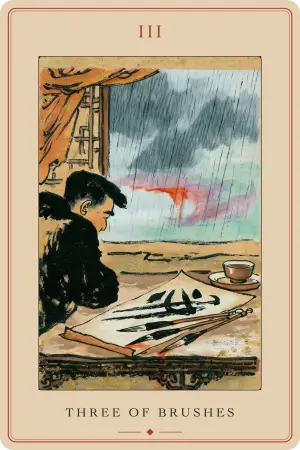


Minor Arcana ·
Four of Brushes
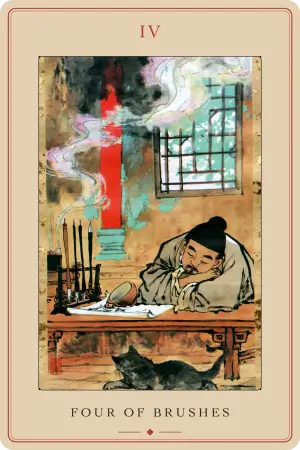
Sanctioned rest: a scholar asleep at his desk, brushes on the rack, the unfinished page waiting under a teacup.
Card at a glance
- Numerology
- 4
- Element
- Air
- Astrology
- Jupiter in Libra · third decan
- Kabbalistic path
- Chesed (Mercy)
- Timing
- Autumn · a pause between efforts
- Yes / No
- Soft no · not right now
Upright
rest
recovery
meditation
contemplation
retreat
inner peace
boundaries
stillness
Reversed
burnout
exhaustion
restlessness
insomnia
avoidance
refusal to rest
stagnation
depletion
Four of Brushes in each deck
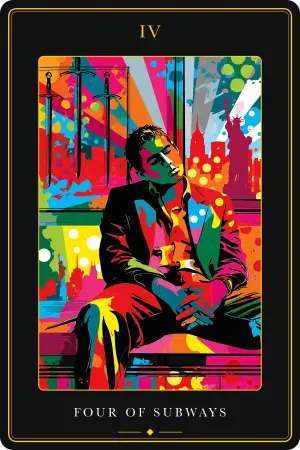
Every deck reimagines the same archetype. Compare the art, then open a deck to read its full interpretation.
Imagery and symbolism
In the Tarot of Beijing the Four of Swords is the Four of Brushes, and the tomb of the classic card becomes a quiet temple room in old Beijing. A scholar has fallen asleep at his desk, head resting on his hand, still in his cap and robe, and the whole room conspires to let him sleep. His pose is the deck's answer to the recumbent knight on the sarcophagus: the small daily practice of stopping rather than the image of death.
The four brushes stand on the rack, tips upward, with none of them still loaded with ink. Brushes are this deck's suit of air, the mind and its words and trials, so a brush on the rack is a thought deliberately set down. Where the Rider-Waite-Smith card hangs three blades over the sleeper and lays a fourth beneath him, here all four instruments rest together in good order, threatening nothing while they wait. The first stroke cannot be unmade, and so the wise hand does not make it tired.
The unfinished page lies open, weighted by an overturned teacup. This is the card's quietest symbol and its most important: the work is unfinished, and that is allowed. The teacup belongs to the deck's suit of feeling, and it holds the page as if to say that kindness toward oneself is what keeps unfinished work safe. Nothing is torn up. The sentence will wait for a rested hand.
Incense smoke rises in slow coils, proof that nothing in the room is moving or striving, and an image of thought settling like sediment in still water. A latticed window opens onto green leaves, replacing the stained-glass window of the classic card with the plain blessing of a tree in daylight, since the world does not need watching every hour. Behind the sleeper a red pillar, the deck's vermilion accent, holds the room up so the man does not have to. The temple cat crosses beneath the desk without a sound, honoring the rest the way the sleeper's own discipline does. A small red seal sits in the corner, because even the work of resting is signed.
Core meaning
The Four of Brushes is Beijing's card of sanctioned rest, and the deck states its whole meaning in one line: rest, too, is discipline. After a hard stretch of mental effort, study, argument, decisions, examinations of every kind, the mind demands a deliberate withdrawal to recover. The scholar asleep at his desk carries the same message the classic knight on the tomb does, that the sleep is respite rather than defeat.
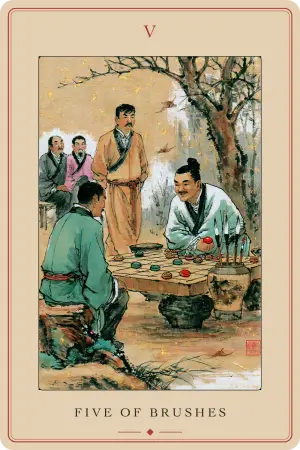
The card marks the pause that follows the wound of the Three and comes before the return to conflict of the Five. It is the courtyard the road passes through, not the road itself. The pause is not a failure of the work; it is part of the work. Relax and replenish your energy, and let what is unresolved settle the way ink clears once the inkstone is left still. The Golden Dawn named the Four of Swords the Lord of Rest from Strife, and this deck keeps that mercy: the restless, piercing energy of the mind is given a structure in which to lie down.
Upright meaning
Upright, the Four of Brushes is a mandate for stillness, the cathedral hush after a long battle rendered as a temple room at rest. You have been through mental strain, and the wise move now is a genuine withdrawal to recuperate. Lay your brushes on the rack the way the scholar does, placed and not dropped. Weight the unfinished page with a teacup and trust it will still be there when you wake. The answers you are chasing arrive in silence and deep rest sooner than in another round of frantic analysis.
In love. A period of quiet and contemplation. Pause to sort out your feelings before writing the next line of the story, and weigh the relationship without pressure. For a couple this is a shared breath, the distance protective and the unfinished page kept safe while both partners recover. For a single person it is a necessary retreat from dating to let old heartbreak heal. Move gently around each other's need for rest, the way the temple cat walks softly around the sleeper.
In career. Step back to see the project whole. A day of true rest will outperform a week of grinding through mental fog. The current task has reached a natural resting point, so reassess what you have done and take a real break, even a leave of absence to head off burnout. Renew your skills while you pause, since the scholar's desk is a place of study as much as labor, and avoid workplace conflict: do not pick up a brush in anger.
In finances. Pause major moves. This is a static period, the coins on the rack like the brushes, better spent revising budgets and long plans than chasing quick gains. Preserve your capital rather than deploying it, and make thoughtful decisions in place of impulsive ones. Money, like ink, writes best once it has been allowed to settle.
In health. Sleep, silence, and slow days are the medicine. Shift to gentle practices, tai chi at dawn, unhurried walks, meditation with the window open to green leaves, and treat early nights as the most productive thing you can do. This is prescribed convalescence, and the benefit is real, since rest shows in the face before it shows anywhere else.
Reversed meaning
Reversed, the boundary of the quiet room is breached and the scholar has refused to sleep. The incense has burned down, the ink has gone gritty, and the page is worse for every stroke added after midnight. Most often this is the alarm clock of burnout: driven by anxiety or outside pressure, you push on with an empty reservoir until the body forces the break you would not schedule, through illness, collapse, or insomnia. Read the other way, the reversal can mean the healing is done and the sleeper is waking, ready to take up the brushes and re-enter the world.
In love. An imbalance between closeness and rest. Endless discussion and unresolved argument circle like stale incense smoke until one or both partners are worn out. Someone is being given too little space, or a silence that began as rest has hardened into avoidance, the page left under the teacup so long that neither of you dares lift it. Be honest, and take an agreed breath together rather than drifting apart by default.
In career. Burnout that is overdue for attention. Work has become a burden because nothing in it renews you, the same characters copied by a hand too tired to improve them, and the mistakes a rested person would not make are creeping in. The opposite trap also shows here, a pause stretched into avoidance with tasks left under the teacup until they go stale. Either way the balance is broken. Return to the desk only once your hand is steady.
In finances. Money worries that will not let you rest. You have spent too much energy and too many resources, yet circumstances keep you working the abacus late into the night. Guard against decisions made from exhaustion, since a tired hand blots the ledger, and do not let panic replace planning. Take the strain seriously, restore self-control, and get real rest, because clear accounts need a clear head.
In health. Overexertion and depletion. Neglected recovery shows as tired skin, dull eyes, and a body running on obligation. Watch for insomnia, disrupted rhythms, and lowered immunity, and beware overdoing self-improvement until the pursuit itself becomes the ailment. Even the finest brush is ruined if it is never cleaned and rested. Make recovery a scheduled part of the routine rather than an afterthought.
Historical notes
The Four of Swords took its familiar shape in the 1909 Rider-Waite-Smith deck, where Pamela Colman Smith drew a knight in full armor lying supine on a stone tomb inside a quiet cathedral, hands pressed in prayer. The scene likely draws on tombs in a church at Winchelsea near Rye, where Smith spent time with the actress Ellen Terry, and on the medieval vigil in which a knight passed a night in solitary prayer before initiation or battle. Three swords hang above him for past conflict, and a fourth lies beneath him for the gathered, resting mind. A stained-glass window in the corner carries the word PAX, peace, and the noli me tangere scene of Mary Magdalene meeting the risen Christ, marking the rest as renewal rather than a tragic end.
Earlier and parallel decks read the four differently. The Tarot de Marseille interlaces the four blades into a stable, protective pattern, a mandala of calm rather than a human scene. Crowley and Lady Frieda Harris titled their Thoth version Truce, four swords meeting at the center of a forty-nine-petalled rose, a peace they meant as fragile and temporary, since air resists the stagnation of a stable four.
The Tarot of Beijing keeps the meaning and changes the whole scene. The crypt and the stone knight give way to a temple room and a sleeping scholar, the hanging blades become four brushes on a rack, and the saint's blessing in stained glass becomes an ordinary tree at a latticed window. What survives intact is the message: this is rest, not death.
Correspondences
Number. Four, the number of the square, and in this deck the square has a native home: the square hole of the Beijing copper coin, the four walls of the siheyuan courtyard, the four corners of the page on the desk. Four is the number of things put properly in their place. After the first stroke of the Ace, the hesitation of the Two, and the wound of the Three, it calls for a pause and a re-ordering before the suit goes on.
Astrology. The third decan of Libra, roughly October 13 to 22, ruled by Jupiter. Libra is cardinal air, the sign of balance and the weighing of opposites, and Jupiter is the planet of expansion and higher wisdom. Their meeting is a diplomatic suspension of hostilities, a mind broad enough to step back from small conflicts and let the nervous system settle so later judgment stays fair.
Element. Air, the suit of Brushes, brought here to a point of stillness. The wind drops, the incense rises straight, and thought is finally allowed to settle before it moves again.
Kabbalah. On the Tree of Life every Four sits at Chesed, the sphere of mercy and the first stable structure below the Abyss. Applied to Yetzirah, the world of the intellect, Chesed grants the exhausted mind a merciful boundary to rest inside, which is why the Golden Dawn called this the Lord of Rest from Strife.
Elemental dignity. As an air card among air, it deepens other Brushes and Swords toward thought and mental strain, and it cools the fire cards beside it, asking even urgent matters to pause before they act.
Psychological perspective
The person of this card knows how to lay the brush on the rack. They clear the mind of unnecessary noise the way a scholar clears his desk before sleep, and they seek out a quiet place, a temple bench or an early-morning courtyard, to steady their mood and order their thoughts. Solitude is a tool to them rather than a punishment, and they postpone action rather than move from exhaustion. What they set aside they return to. Their pages are weighted, and the people around them instinctively lower their voices the way the temple cat softens its step.
The shadow is the scholar who will not sleep. Worn down by argument and deadline, this state badly needs peace and keeps picking the brush back up instead. Thinking turns rigid and repetitive, the same sentence rewritten ten times without improving, and productivity falls precisely because the person will not stop. Crowley's warning names the deeper trap: rest can curdle into appeasement, a mind too tired or too afraid to solve its own problem, calling avoidance by the name of peace.
Four of Brushes across decks
Rider-Waite-Smith. The armored knight lies on his tomb in a still cathedral, three swords hung above and one beneath, a stained-glass PAX promising peace. The Four of Brushes keeps the meaning of sanctioned rest and trades the crypt for a temple room and the effigy for a living scholar who has simply fallen asleep at his work.
Tarot de Marseille. The four blades interlace into a calm, protective pattern with no human figure at all. Beijing likewise makes the rest architectural, but through the ordered desk, the brushes squared on the rack, and the four-cornered page rather than through crossed steel.
Crowley-Thoth. Harris paints four swords meeting at the center of a forty-nine-petalled rose under the title Truce, a peace Crowley calls fragile and warns can become the appeasement of a cowardly mind. The Beijing reversed card meets that same shadow in the scholar who mistakes hiding for rest.
Modern reframings. Many contemporary decks soften the tomb toward a hammock, a nap, or a meditation cushion to rescue the gentle meaning from the grim image. The Tarot of Beijing belongs to that movement, showing rest as an ordinary, dignified habit: a working person allowing himself to sleep, the cat walking quietly around him.
In combination and context
The Four of Brushes reads as the pause between the Three and the Five of its suit. If the rest it advises is genuine, the sleeper wakes restored; if it is skipped, the querent walks straight from the wound of the Three into the costly conflict of the Five. Set beside the Nine of the suit, its opposite number, it shows the desperate need for rest being blocked by midnight anxiety, a mind that cannot stop racing, which often points to real support being needed.
Among the Major Arcana its neighbors color the pause. With the Hermit it deepens into chosen solitude and inner work. With the Star it becomes profound healing, the rest that lets renewal be received. With the Lovers it reads as a partner who feels genuine warmth but lacks the bandwidth to act, the choice postponed until recovery is done. With the Devil it warns of rest used as avoidance, a retreat that has quietly become a hiding place.
When the card keeps returning, treat it as permission rather than a verdict. Lay the day's work down in good order, weight the unfinished page with a teacup, and trust that a rested hand will make the cleaner line.
Questions for reflection
- Where in your life is a page waiting under the teacup, set aside in good order, and where is one you are simply afraid to look at?
- If the air of your day were incense smoke, would it rise in calm coils or be torn to shreds, and what one hour could you let it rise quietly?
- What are you trying to solve by gripping the brush harder, when setting it on the rack might solve it for you?
The general meaning follows the Rider-Waite-Smith reading — the reference used across Tarot Academy. Open a specific deck above for its own interpretation.
Frequently asked questions
Explore the Tarot
Latest Posts
Discover the ancient wisdom of tarot cards and unlock the mysteries of your spiritual journey. Our blog is your gateway to understanding the rich symbolism, meanings, and practical applications of tarot reading.




















































