
 EN (English)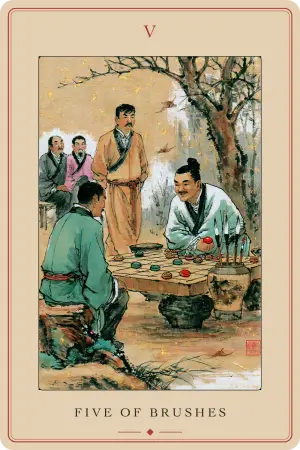


Minor Arcana ·
Six of Brushes
A crossing made in daylight: a household poles across the grey canal with its papers packed and its quarrels left on the far bank.
Card at a glance
- Numerology
- 6
- Element
- Air
- Astrology
- Mercury in Aquarius · 2nd decan
- Kabbalistic path
- Tiphareth (Beauty, Harmony)
- Timing
- Dawn · late January to early February · Aquarius season
- Yes / No
- Yes, if you are willing to move forward · Reversed no
Upright
transition
crossing
relocation
recovery after conflict
safe passage
not looking back
guided departure
quiet resolve
Reversed
looking back
stalled crossing
refusal to leave
carrying the storm aboard
stagnation
delayed relocation
unfinished goodbye
Six of Brushes in each deck
Every deck reimagines the same archetype. Compare the art, then open a deck to read its full interpretation.
Imagery and symbolism
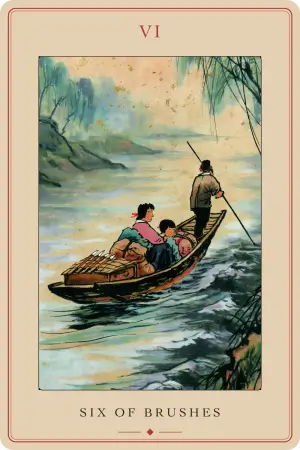
In the Tarot of Beijing the Six of Swords becomes the Six of Brushes, and the ferry has moved to a city canal. A flat-boat pushes along the grey water at dawn: a mother, a child, their bundles, and a locked document chest with six brushes rolled neatly on top, tips clean and white. The whole card is built on one movement, the suit of mind and words carried across water, the element of feeling. The palette is the deck's ink register: black and grey water, a wash of teal willows, gold flecks in a warming sky, and a single accent of vermilion in the woman's jacket.
The canal is Beijing's own waterway world, the old network along which grain and goods and families moved for centuries. To cross it is not to bolt into wilderness. It is to travel a road the city itself provides, so the transition reads as legitimate and prepared, part of the order of life rather than a flight from it. The family in the boat is a household in transit, not a lone escapee. What matters travels together.
The document chest is the heart of the picture: a life's papers, contracts, letters, and records packed and locked before departure. The six brushes lying rolled on top are the trials of the suit, every dispute and verdict and hard letter of the earlier cards, no longer standing like fence posts or striking like arrows but furled, tied, and carried as instruments. Experience has been converted from wound into tool. The poler at the stern faces forward and works the bamboo pole with an unhurried, exact effort, the steady will that turns a decision into a crossing. No one in the boat looks back.
Two more details fix the scene as Beijing's. Willows lean from both banks, the classical Chinese emblem of parting, since a willow branch was the traditional gift to a departing traveler, so the trees themselves bid the family farewell. And in the corner sits the small red seal that marks every card of this deck, quietly certifying the crossing as if it had been stamped, recorded, and made official.
Core meaning
The Six of Brushes is this deck's card of transition, the bittersweet passage from turbulence to calmer water. It announces a change that has already been decided: a move, a departure, a change of position, the end of a dispute, carried out calmly with everything essential packed. The water behind the stern is rough and the water ahead is smoother, and the card lives in the stretch between them. This is not a triumph and not a defeat. It is a crossing.
Where the canonical Six of Swords sets refugees adrift on open water under a grey sky, Beijing routes the same journey down a city canal with the papers in order and the dawn coming up. The emphasis shifts from escape toward composure. The trials of the suit of Brushes, the arguments, the harsh letters, the examinations, are behind the boat, and what travels forward is only what you learned and what you wrote. The deck names the hardest task in the whole image plainly: no one looks back, and that discipline is treated as work rather than coldness. Progress here is the steady push of the pole, so relief arrives not as joy but as quiet, and for now the quiet is enough.
Upright meaning
Upright, the card marks a crossing well made. A hard chapter is genuinely ending, and you are moving toward smoother water at a measured pace, carrying your knowledge and your records and leaving the quarrel itself on the far bank. Honor the decision with the discipline in the picture: do not reopen closed letters, and keep your eyes on the water ahead. If someone steady is poling for you, a helper or a mediator or a person who knows the water, accept the escort without apology.
In love. A couple crossing to calmer water together after quarrels and hard words. It often marks a shared move, relocating for each other or starting over in a new district, undertaken like the family in the boat with no one looking back at the old address. Both partners agree which arguments are archived and leave the rolled brushes tied. For someone leaving a relationship, it promises a dignified departure, grief carried rather than spilled, the parting made at dawn in clarity.
In career. A transition handled with composure: a transfer to a new team, a relocation for a position, or a quiet exit from a conflicted workplace. You leave carrying the document chest, your record and references and lessons, and the card favors handovers done properly, since how you cross is remembered longer than why you left. A mentor or recruiter may pole this passage. If you stay in place, it still means a shift to calmer duties in the same canal.
In finances. A financial crossing: leaving an unprofitable arrangement or a draining obligation and moving assets calmly to safer water. The chest is your paperwork in order, settled debts and closed accounts and signed agreements. Costs tied to relocation or travel are indicated and worth it. The card often signals steady recovery after turbulence, not a windfall but the gradual return of stability, so keep records and do not reopen concluded money quarrels.
In health. Recovery read as a crossing, the steady passage from illness, exhaustion, or stress toward smoother water. It favors rehabilitation and every gradual protocol: physiotherapy at pole pace, sleep restored night by night, the nervous system carried gently out of a storm of overthinking. Since Brushes is the suit of mind, this is the mind and body truce, anxious thoughts rolled and tied so the body can finally rest. Measure progress by the water, calmer each week.
Reversed meaning
Reversed, the boat is turned midstream or never launched. You know the crossing is necessary, yet the near bank keeps you. You reread the letter with the struck-through character instead of burning it, replay the argument instead of leaving it, and the bundles are packed while the family still stands on the shore. The card signals delayed relocation, disrupted travel, trouble with documents, or an inner refusal to accept that a chapter has ended. Sometimes it warns of the opposite failure, a flight so hasty that the storm was carried aboard: you changed the district but not the mind, and the old grief unpacked itself first in the new courtyard.
In love. A couple, or a heart, stuck midstream. One partner keeps rowing back, quoting old fights verbatim and punishing today with last year's evidence, so the rolled brushes come untied and every archived quarrel floats loose in the boat again. It can also mark a departure endlessly postponed out of guilt, fear of open water, or a secret hope of being called back. The counsel is exact: close the chapter properly or recommit fully, and stop standing with one foot on the bank.
In career. The crossing refused or spoiled. A transfer delayed, a resignation drafted and never sent, or a new post accepted while the mind still commutes to the old one. You may be replaying a conflict with a former manager and mistaking rumination for reflection, or you fled too fast and found the same storm at the new desk because the lessons were never gathered. The card warns of messy handovers and references soured by a graceless exit, so close the files and finish the departure properly.
In finances. A crossing that stalls: a payment delayed midstream, a relocation that costs more than planned, paperwork that will not clear. You may be clinging to an unprofitable arrangement out of familiarity or fleeing a problem that boards the boat with you, since debts follow unpacked. It warns against escape spending, because changing the address does not change the budget, and against trouble with documents in transit, so verify every paper twice and chase confirmations in writing.
In health. Recovery stalled by the backward glance. The body is ready to heal, but the mind keeps rowing to the near bank, replaying the stress or the diagnosis moment, and the rumination keeps the nervous system in rough water. It marks abandoned rehabilitation and treatments dropped midstream, or the escape pattern of changing gyms and diets and doctors at the first discomfort while the underlying habit travels along unexamined. Slow the crossing rather than cancel it, and do the mind's packing that was skipped.
Historical notes
In the standard Rider-Waite-Smith tradition, illustrated by Pamela Colman Smith under A. E. Waite in 1909, the Six of Swords shows a cloaked figure huddled beside a child in a flat-bottomed boat while a ferryman poles them across a wide expanse of water. Six swords stand upright, driven point-down through the floorboards at the bow. The water on the ferryman's side is choppy and the water ahead is glass-like, opening toward a distant grey shore. The passengers are passive and bowed, evoking the archetype of the refugee taking only what can be carried, and modern readers have likened them to families fleeing conflict.
One modern reading of that image, the so-called Sink or Leak hypothesis, notes that the heavy swords are stabbed through the hull itself. Pull them out midstream and the boat floods, so the blades stop being mere baggage and become the structural supports keeping the vessel afloat. The lesson is patience with one's own defenses: the coping mechanisms that survived the storm cannot safely be dismantled until the boat reaches dry land.
The Tarot of Beijing keeps that whole architecture of transition and translates it into the city's own idiom. The open sea becomes a Beijing canal, the anonymous ferryman becomes a poler working a bamboo pole, and the six swords stabbed through the floor become six brushes rolled and tied on a locked document chest. The refugee's bundle becomes a household's records carried into a legitimate new life. The card's core survives intact while its danger softens, since a canal at dawn is a road the city provides rather than a flight into the unknown.
Correspondences
Number. Six, the number of balance, care, and restored order. After the five, the quarrel that emptied the courtyard, six gathers what was scattered and sets it level: a family in one boat, bundles trimmed so the hull sits even, six brushes laid in a row on the chest. Six is also the number of service, since someone stands at the stern and poles for the others. In the suit of Brushes, where the numbers count thoughts and words, six means thoughts brought into order for the road, not erased but carried and pointed forward.
Astrology. Mercury in Aquarius, the second decan of the sign, roughly January 30 to February 8, a window that centers on Imbolc and the first return of longer days. Aquarius is fixed air, giving the mind its wide view from midstream where both banks are visible at once. Mercury is the planet of roads, messages, and safe conduct, and in this card it is the poler at the stern, the intelligence that knows the water, plans the route, and gathers the papers. Together they describe a transition performed by a clear mind, the feelings real but carried rather than spilled.
Element. Air, the suit of thought, language, and judgment, here set atop water, the element of feeling. The crossing is the intellect navigating emotional depths, rationality steering the boat while the grief travels quietly below deck.
Kabbalah. All the sixes belong to Tiphareth, the central sphere of Beauty and Harmony, associated with the Sun and equilibrium. The Golden Dawn called this card the high point of the mental suit, its rare oasis of clarity, and titled it the Lord of Earned Success, progress won through effort and the release of obsolete paradigms. In the Thoth tradition Crowley renamed it Science, the mind's power to step back and view its own trouble objectively.
Psychological perspective
The person of this card is in mid-crossing, having decided to leave a hard situation and carrying it out with quiet discipline. They do not slam gates. They pack carefully, take what was learned, and go at dawn without theatrics, and they treat not looking back as a form of work rather than coldness. Often they are the steady figure at the stern, the friend who knows the water or the mediator who ferries others out of conflict, and they promise smoother water rather than paradise because that is what they can deliver.
The deeper lesson is cognitive distance, what Crowley called Science. By physically moving away from the scene of the trouble, the mind gains the vantage needed to see the situation whole instead of drowning in it. The shadow of that same gift is excessive detachment, using cold logic as an escape hatch to avoid the necessary grief of departure. Under a stalled crossing there is usually an unmourned loss, something left behind without a goodbye, and until it is grieved every crossing feels like a betrayal and every new shore feels temporary.
The Six of Brushes across decks
Rider-Waite-Smith. The canonical Six of Swords sends a cloaked woman and child across open water in a punt, six blades stabbed through the floorboards, the archetype of the refugee escaping turbulence. The Six of Brushes keeps that exact journey but moves it onto a Beijing canal and swaps the swords in the hull for brushes rolled on a document chest, softening flight into a prepared, legitimate departure.
Tarot de Marseille. The older pip cards show six swords arranged in a symmetrical lattice with no boat and no travelers, the meaning read from number and suit rather than from a scene. Beijing belongs firmly to the Smith line that made the card a narrative crossing, then gives that narrative a specific city and hour.
Crowley-Thoth. Crowley titled the card Science and painted six swords meeting at their points on a Rosicrucian cross, an image of total mental focus and objective distance. The Beijing card carries the same idea in its quiet poler and its rolled brushes: experience examined and archived rather than felt raw.
Modern reframings. Decks such as Nicoletta Ceccoli's read the crossing as the bittersweet loss of childhood innocence, a melancholy child ferried into the adult world of proof. The Tarot of Beijing shares that tenderness but resolves it toward composure, the willows on the bank waving the family off and the dawn promising that the far shore genuinely exists.
In combination and context
The Six of Brushes pulls a spread toward movement, relief, and the practical business of leaving well. Its meaning sharpens against its neighbors. Beside the Three of Wands the theme of travel is reinforced toward long-distance relocation, emigration, or launching a venture across water. Next to the deck's Chariot the contrast is instructive, since the Chariot charges forward by force of will while this boat is poled forward by surrender and support, so the pairing asks whether the moment calls for a muscular charge or a quiet passage.
With Death nearby the card reads as a rite of passage with no looking back, a life-altering relocation once the storm has passed. Against the Eight of Cups it clarifies what is carried versus what is abandoned: the Eight walks away alone and leaves its cups behind, while the Six brings its household and its records across together. Beside the deck's Five of the suit, the quarrel just survived, it reads as the earned truce that follows, the courtyard emptied and now the calm departure from it.
When the card keeps returning in a reading, treat it as the deck's instruction rather than a mere description. Pack your six brushes, accept the hand that steers, move at the pace of the pole, and do the hardest work in the picture by keeping your eyes on the smoother water ahead.
Questions for reflection
- What are the six brushes you would roll and carry across, the lessons worth keeping, and what quarrel would you leave tied to the far bank?
- Is the near bank holding you out of genuine unfinished business, or out of fear of open water and a quiet hope of being called back?
- If you have already crossed but the old storm came with you, what goodbye did you skip that still needs to be grieved?
The general meaning follows the Rider-Waite-Smith reading — the reference used across Tarot Academy. Open a specific deck above for its own interpretation.
Frequently asked questions
Explore the Tarot
Latest Posts
Discover the ancient wisdom of tarot cards and unlock the mysteries of your spiritual journey. Our blog is your gateway to understanding the rich symbolism, meanings, and practical applications of tarot reading.




















































