Старэйшыя Арканы · 12

Справядлівасць

Горад падсумоўвае тое, што вы зрабілі, і зачытвае вынік на прыступках будынка суда.

Кароткі агляд карты

Нумералогія
XI
Стыхія
Паветра
Астралогія
Шалі · кіруецца Венерай
Кабалістычны шлях
Lamed (Geburah → Tiphereth)
Час
Восень · сезон Шаляў
Так / Не
Так, калі вы былі справядлівымі · умоўна

Прамое становішча

сумленнасць адказнасць прычына і вынік вердыкт шчырасць кантракты баланс належная працэдура

Перавернутае становішча

прадузятасць падробленыя вагі карупцыя пазбяганне юрыдычныя праблемы абвінавачванне дысбаланс безадказнасць

Справядлівасць ў кожнай калодзе

Кожная калода пераасэнсоўвае адзін і той жа архетып. Параўнайце мастацтва, а затым адкрыйце калоду, каб прачытаць яе поўную інтэрпрэтацыю.

Псіхалагічны погляд

Гэты аркан апісвае псіхалогію чалавека, які трымае вагі роўнымі ў няроўным горадзе. Уся яго структура пабудаваная на дакладнасці: ён патрабуе, каб рахунак быў сапраўдным, гісторыя расказвалася так, як яна адбылася, а чэк дзяліўся ў адпаведнасці з тым, што было з'едзена. Яго мысленне грунтуецца на доказах, і ён мяняе пазіцыю, калі мяняюцца факты, што ў горадзе гучнай упэўненасці робіць яго непрыкметна рэдкім. Ён – той самы сябар, якому абодва бакі давяраюць вырашыць спрэчку, што з'яўляецца найвышэйшай псіхалагічнай адзнакай гэтай карты.

У лепшым выпадку гэта аб'ектыўнасць без холаду. Ён уважліва выслухоўвае абодва бакі перад прыняццем рашэння і спакойным тонам агучвае суровую праўду, прымяняючы да сябе тыя ж стандарты, што і да іншых. Калі памыляецца, ён прызнае гэта і плаціць за гэта без тэатральнасці. Ценявы бок – гэта калі вагі ператвараюцца ў клетку. Калі імкненне да дакладнасці даходзіць да крайнасці, яно перарастае ў рыгіднасць: чалавек пачынае спрачацца з-за розніцы ў тры даляры і не можа пакінуць дысбаланс у спакоі, блытаючы правату са справядлівасцю. Празмерная рацыянальнасць можа адгарадзіць ад пачуццяў, з-за чаго эмацыйныя звароты ўспрымаюцца як спроба ўмяшання ў доказы, а блізкасць пакутуе ад перакрыжаванага допыту. Больш развітая асоба вучыцца таму, што дэманструе фігура на прыступках, дзе яе меч усталяваны, а не занесены для ўдару: суджэнне як надзейны падмурак, на якім можна стаяць, і вагі, якія могуць узважваць ласку гэтак жа дакладна, як і доўг.

Справядлівасць у іншых калодах

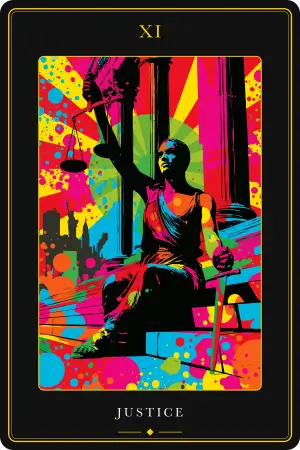
Tarot of New York City. Галоўны аргумент гэтай калоды заключаецца ў тым, што справядлівасць – гэта грамадзянская падзея, якая адбываецца публічна. Справядлівасць сядзіць на вуліцы на прыступках будынка суда на Плошчы Фолі, вагі паднятыя над галавой, а меч уваткнуты ў зямлю вастрыём уніз. За ёй паўтонавым сілуэтам прамалёўваецца гарызонт і Статуя Свабоды. Поп-арт палітра падкрэслівае, што наступствы ў гэтым горадзе яскравыя і з'яўляюцца ў поўным колеры, а спалучэнне факела і вагаў ставіць пытанне, ці знаходзяцца свабода і справядлівасць у раўнавазе адна з адной.

Tarot de Marseille. Тут Справядлівасць захоўвае сваё старое месца пад нумарам VIII. Гэта каранаваная фігура на троне, якая трымае падняты меч у адной руцэ і вагі ў іншай – простая эмблема ўзважанай меры да таго, як акультысты яе ўскладнілі.

Rider-Waite-Smith. Уэйт перанёс гэтую карту на месца XI і змясціў яе ў закрытую прастору: каралеўская фігура сядзіць паміж дзвюма шэрымі калонамі, за ёй вісіць фіялетавая заслона, меч падняты, а вагі апушчаныя. Яна ніколі не мае павязкі на вачах, таму што духоўная справядлівасць патрабуе глядзець праўдзе проста ў вочы.

Crowley-Thoth. Карта была перайменаваная ў Рэгуляванне (Adjustment) і намаляваная лэдзі Фрыдай Харыс, абапіраючыся на егіпецкую багіню Маат, якая ўвасабляе касмічную праўду і парадак, перамяшчаючы фокус на дакладную раўнавагу прыроды, а не на чалавечы суд.

Sacred India Tarot. Архетып з'яўляецца ў вобразе Варуны, ведычнага бога вод і Рыты – прынцыпу натуральнага парадку і праўды, што разглядае справядлівасць як фундаментальны закон сусвету.

У камбінацыях і кантэксце

Справядлівасць набывае свой дакладны тон ад масці, якая знаходзіцца побач. Разам з Кранамі яна звяртаецца да прафесійнай этыкі і хуткіх кіраўнічых рашэнняў, сітуацыі, якая патрабуе неадкладнага выпраўлення. З Кубкамі яна факусуецца на роўнасці ў адносінах і часта паказвае на шлюб або сумесны пераезд, хаця ў перавернутым выглядзе можа азначаць развод або юрыдычнае расстанне. З Метро яна абвастраецца да кантрактаў, рацыянальнага выбару і часам цяжкай юрыдычнай бітвы. З Жэтонамі яна ператвараецца ў фінансавыя праверкі, выплачаныя даўгі і афіцыйныя дзелавыя пагадненні.

Пазіцыя ў раскладзе кіруе ёй не менш. У мінулым яна адзначае ранейшы разлік або рашэнне, якое заклала падмурак, на якім вы зараз стаіце. У сучаснасці гэта заклік сумленна ацаніць сваю рэальнасць, а не абапірацца на зручную ілюзію. У пазіцыі выніку яна прадказвае момант сапраўднай адказнасці, развязку, якая можа быць некамфортнай, але будзе сапраўднай і канчатковай. У якасці перашкоды яна называе пазбяганне самой праўды, адмаўленне, якое вы выкарыстоўваеце, каб адкласці непазбежны разлік.

Справядлівасць часта блытаюць з Судом, і гэтую розніцу варта ўлічваць. Справядлівасць – гэта ўнутраныя, сучасныя вагі. Яна тычыцца чалавечай этыкі і непасрэдных наступстваў зямных выбараў, гэта кверэнт, які правярае ўласныя рахункі на прыступках будынка суда. Суд – гэта знешні, экзістэнцыяльны заклік, гук трубы, які патрабуе поўнага перараджэння. Справядлівасць узважвае, наколькі справядлівая праца ці адносіны. Суд – гэта ўсведамленне таго, што вы больш увогуле не можаце жыць у іх. У падарожжы героя гэтай калоды, Справядлівасць – гэта момант, калі Навічку, які выйшаў з аўтобуса на аўтавакзале Порт-Аторыці, нарэшце прад'яўляюць рахунак. Толькі той герой, які засвойвае гэтыя вагі, гатовы да прыпынення Павешанага, што ідзе следам.

Reversed meaning

Reversed, the figure on the Foley Square steps holds a scale someone has quietly leaned on. The card points to bias and dishonesty in the situation: the verdict bought before the hearing, the landlord's lawyer against your no-lawyer, the credit taken by the person who did the least, the fine print that turns out to be the whole contract. A decision is being made without balance, influenced by connections or money instead of facts. It can foreshadow legal complications, a dispute that drags, or an accusation that is not true.

Reversed Justice often means the imbalance is partly yours. Consider the corner you cut, the thing you did not disclose, the responsibility you keep rescheduling while its bill grows interest in the dark. The way back to balance starts with the debt you can settle yourself. Get everything in writing, get real professional help where the matter is legal, and make sure your own pan of the scale holds nothing false before you demand an audit of anyone else's.

In love. One person carries the apartment, the plans, and the emotional maintenance while the other contributes reasons. Scorekeeping replaces generosity, and being right matters more than being close. In harder readings it touches the breakup where one keeps everything.

In career. Credit flows uphill to whoever spoke last, the promotion is decided before the interviews begin, and two sets of rules apply to two tiers of people. There may be an HR matter or a contract handled improperly. Document everything, contemporaneously.

In finances. The financial scale is leaned on: the lease clause that eats the deposit, the split that rounds against you, the claim denied on a technicality. Losses may trace to their dishonesty or your own untracked expenses and unread agreements.

In health. The body's scale knocked off balance by extremity, whether overtraining without recovery or care deferred until the sleep debt compounds. The body keeps flawless books, and every extreme is recorded for a later bill.

Historical notes

For centuries Justice sat at VIII and Strength at XI. That was the order in the fifteenth-century Mantegna cards and the Tarot de Marseille, matching how the cardinal virtues were placed in the Italian gaming and Minchiate decks. The change came with the Hermetic Order of the Golden Dawn, which insisted the twenty-two trumps line up exactly with the Hebrew alphabet and its astrological signs. In their system the letter Teth answers to Leo and Lamed to Libra, and since Leo comes before Libra in the solar year, the Leo card (Strength) had to precede the Libra card (Justice).

Arthur Edward Waite carried that switch into the Rider-Waite-Smith deck of 1909, making Strength VIII and Justice XI, and defended it in The Pictorial Key to the Tarot only with the line that he did it 'for reasons which satisfy myself,' keeping the astrology hidden from the uninitiated. The new number had its own logic: eleven reduces to two, tying Justice numerically to Judgement (XX, also a two), a resonance between the two cards of reckoning. Aleister Crowley later rejected the swap, returning the card to VIII and renaming it Adjustment, though he kept the Golden Dawn's Libra and Lamed attributions intact. The Tarot of New York City follows the Waite numbering, keeping Justice at XI on its courthouse steps.

Correspondences

Number. XI. In numerology a master number, read here as two matched uprights: the two pans of the scale, the two parties before the bench, the two columns behind the seated figure. In this deck the eleven also reads like two towers, two rails of a subway track, two rivers bracketing an island, a city built on paired lines kept level. Reduced to 2 (1 + 1) it becomes the number of partnership and the small private evenness of the deuce: splitting the check correctly, keeping your word on the handshake deal.

Astrology. Libra, the sign of the scales, the only sign shown by an instrument rather than a creature, with Venus as its ruler. Libra governs balance, partnership, contracts, and negotiation, and does its thinking in the space between two parties, which is exactly where this card sits, weighing in the open air of Foley Square. Venus shows in the card's unexpected beauty, its pop-art color and level poise: fairness here is attractive as well as correct.

Element. Air, the intellect and clear reason behind every judgment, the same clarity the card's sunburst and bright field carry.

Kabbalah. The Hebrew letter is Lamed, the 'ox goad,' an instrument of direction and discipline. Its path runs from Geburah (Severity, Mars) to Tiphereth (Beauty, the Sun), so the card is the active mitigation of force that keeps the center in balance, not a static peace. Crowley's title Adjustment names that continual recalibration.

Elemental dignity. Beside Cups the card often means marriage or a civil union, and reversed there a separation. Beside Swords it turns to contracts and legal disputes, beside Wands to workplace ethics and fast decisions, beside Pentacles to financial audits and settled debts. As a yes or no it answers conditionally: yes if your conduct has been fair, otherwise a warning that the same measure falls on you.

Psychological perspective

This arcana describes the psychology of the person who keeps a level scale in an unlevel city. The structure is organized around accuracy: they need the account to be true, the story told the way it happened, the check split the way the meal was eaten. Their thinking is evidentiary, and they change position when the facts change, which in a city of loud certainty makes them quietly rare. They are the friend both sides trust to settle the dispute, the highest psychological credential this card recognizes.

At its best this is objectivity without coldness. They hear both sides fully before deciding and deliver a hard truth in a steady tone, applying to themselves the standard they apply to others. When wrong, they say so and pay for it without theatrics. The shadow is the scale becoming a cage. Taken too far, the drive for accuracy hardens into rigidity: the person who relitigates a three-dollar discrepancy and cannot let an imbalance rest, confusing being right with being just. Excessive rationality can wall off feeling, so emotional appeals register as attempts to tamper with the evidence and intimacy suffers under cross-examination. The developed version learns what the figure on the steps models, the sword planted rather than brandished: judgment as a settled foundation to stand on, and a scale that can weigh grace as accurately as it weighs debt.

Justice across decks

Tarot of New York City. This deck's whole argument is that justice is a civic event done in public. Justice sits outdoors on the Foley Square courthouse steps, scales raised overhead and sword planted point-down, the skyline and the Statue of Liberty behind her in halftone silhouette. The pop-art palette insists that consequence in this city is vivid and arrives in full color, and the pairing of the torch and the scale asks whether liberty and justice are being kept level with each other.

Tarot de Marseille. Here Justice keeps its old seat at VIII, a crowned figure enthroned with an upright sword in one hand and the scales in the other, the plain emblem of weighed measure before the occultists elaborated it.

Rider-Waite-Smith. Waite moved the card to XI and enclosed it: a regal figure between two gray pillars, a violet veil behind, sword raised and scales held low, never blindfolded because spiritual fairness demands looking straight at the truth.

Crowley-Thoth. Retitled Adjustment and painted by Lady Frieda Harris, the card draws on the Egyptian goddess Maat, who embodies cosmic truth and order, pulling the focus toward the exact equilibrium of nature rather than a human court.

Sacred India Tarot. The archetype appears as Varuna, the Vedic god of the waters and of Rta, the principle of natural order and truth, framing justice as a fundamental law of the universe.

In combination and context

Justice takes its exact tone from the suit beside it. With Wands it turns to professional ethics and fast executive decisions, a situation demanding immediate correction. With Cups it centers on relational equity and often points to marriage or moving in together, though reversed it can mean divorce or legal separation. With Swords it sharpens into contracts, rational choice, and sometimes a hard legal battle. With Pentacles it becomes financial audits, settled debts, and formal business agreements.

Spread position steers it just as much. In the past it marks an earlier reckoning or decision that laid the ground you now stand on. In the present it is a call to assess your reality honestly rather than lean on a comfortable illusion. In the outcome position it predicts a moment of genuine accountability, a resolution that may be uncomfortable but will be authentic and final. As an obstacle it names the avoidance of truth itself, the denial you are using to delay an inevitable reckoning.

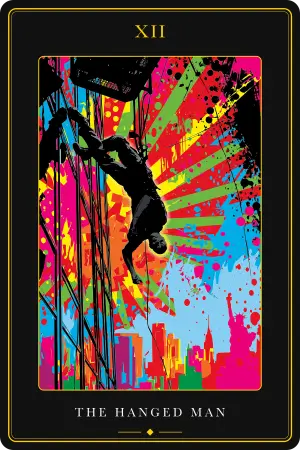
Justice is often confused with Judgement, and the difference is worth holding. Justice is the internal, present scale, concerned with human ethics and the immediate consequences of earthly choices, the querent auditing their own accounts on the courthouse steps. Judgement is the external, existential call, the trumpet blast that demands a full rebirth. Justice weighs whether a job or relationship is fair. Judgement is the realization that you can no longer live inside it at all. In this deck's hero's journey, Justice is where the Newcomer who stepped off the bus at Port Authority is finally presented with the bill, and only the hero who internalizes the scale is ready for the suspension of the Hanged Man that follows.

Пытанні для роздуму

  • Калі б вагі сітуацыі, у якой вы знаходзіцеся, ацэньваў нехта, хто не мае асабістага інтарэсу ў вашай гісторыі, што б яны паказалі пра вашу ўласную ролю ў ёй?
  • Дзе вы чакаеце, пакуль горад вынесе вердыкт, які вы ўжо маеце права вынесці самастойна?
  • Што вы несяце на ўласнай шашы вагаў, якое вы яшчэ не ўраўнаважылі?

Агульнае значэнне прытрымліваецца чытання па сістэме Райдэра-Уэйта-Сміт — эталону, які выкарыстоўваецца ў Tarot Academy. Адкрыйце канкрэтную калоду вышэй для яе ўласнай інтэрпрэтацыі.

Часта задаваныя пытанні

Апошнія Публікацыі

Адкрыйце старажытную мудрасць карт тарот і раскрывайце таямніцы вашага духоўнага падарожжа. Наш блог - гэта ваш шлях да разумення багатай сімволікі, значэнняў і практычнага прымянення чытання тарот.