
 EN (English)



Major Arcana · XXI
The World
The circle closed, wholeness earned at the end of the long journey.
Read the complete guide: The World Arcana in Tarot: A Complete Guide to Its Symbolism and Meaning
Card at a glance
- Numerology
- XXI
- Element
- Earth
- Astrology
- Saturn
- Kabbalistic path
- Tav (Yesod → Malkuth)
- Timing
- Completion · the close of a long cycle
- Yes / No
- A resounding yes
Upright
completion
fulfillment
achievement
wholeness
integration
success
culmination
homecoming
Reversed
lack of closure
incompletion
stagnation
shortcuts
loose ends
delayed success
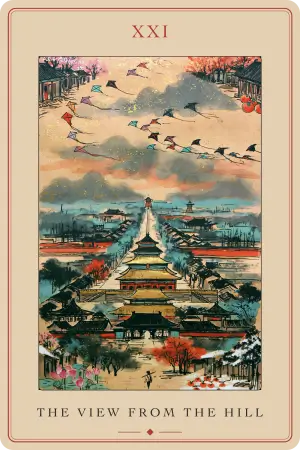
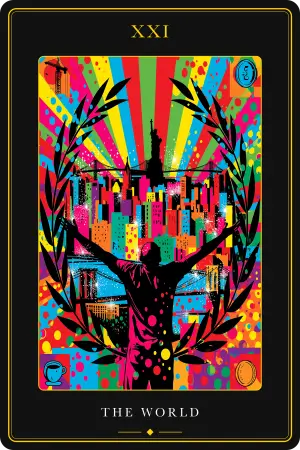
The World in each deck
Every deck reimagines the same archetype. Compare the art, then open a deck to read its full interpretation.
Imagery and symbolism
A dancing figure hovers at the center of the card, wreathed in green laurel, one leg crossed behind the other in mid-step. She is a divine androgyne, often named for Hermaphroditus, and the balance she embodies is the whole point: masculine and feminine, conscious and unconscious, heaven and earth reconciled in a single body. In each hand she holds a wand. The Magician back at the start of the journey held only one, raised to draw power down into a single ego; two wands say that by the end the dualities have been mastered and evened out.
The laurel wreath is victory and the evergreen cycle of nature, and it is tied top and bottom with red ribbons knotted into lemniscates, the infinity sign, so the whole card reads as a closed loop where one cycle's end feeds the next one's beginning. Some read the wreath itself as an Ouroboros, the serpent swallowing its tail.
In the four corners sit the tetramorph: a man, an eagle, a lion, and a bull. Drawn from the visions of Ezekiel, they stand here for the four fixed signs, the four elements, and the four suits, Aquarius and air, Scorpio and water, Leo and fire, Taurus and earth. They are the rigid structural frame of the material world, and the dancer at the center is the quintessence, the fifth element of spirit that holds the four in harmony.
Core meaning
The World is the last numbered trump and the terminus of the Fool's Journey, the point where every lesson of the previous twenty cards resolves into synthesis. It is the alchemist's magnum opus realized, the gold finally drawn out of the lead of experience, the macrocosm reflected perfectly in the microcosm. When it appears, warring opposites have been reconciled and a major cycle of growth has genuinely closed.
But the card is ruled by Saturn, and that keeps the joy honest. This completion is not accidental or instant. Saturn is the Lord of Time and the great taskmaster, and the wholeness The World promises is forged in the crucible of discipline, restriction, and the maturity only time can grant. Its number holds the same message: twenty-one is three times seven, material completion multiplied by spiritual completion, integration made total.
Upright meaning
Upright, The World is one of the most positive cards in the deck, the pinnacle of achievement and the successful close of a long arc. Waite associated it with recompense and with voyage, a change of place, and it carries an unmistakable sense of arrival. The counsel inside it is to celebrate the victory and rest, while still tying the final knot so the circle closes cleanly.
In love. A deep sense of completeness, unity, and coming home, often perfect compatibility or a fated, lasting bond reaching its final form, like a long-awaited marriage. As an outcome, though, it can be more sober, a relationship that has gone as far as it can and completes naturally, or the end of one phase and the start of another, the honeymoon giving way to settled partnership.
In career. The summit after years of quiet work, a major project finished, a program completed, a financial target hit, a debt cleared, real mastery and recognition. It rewards you for closing the circle properly and finalizing the loose paperwork before the next ambition.
In finances. A long-held goal reached, a debt cleared, a solid foundation laid for what comes next.
In health. The body and spirit arriving at homeostasis, the successful culmination of a long recovery, healing fully integrated.
Reversed meaning
Reversed, The World is a frustrating lack of closure. Its signature is the Final Mile Syndrome: reaching the very end of a cycle, with completion visible and within reach, then stopping, sabotaging, or grabbing a cheap shortcut that prevents true integration. The temptation to declare victory before it is earned is strongest right here.
Underneath the reluctance is fear. Genuinely finishing means facing the void of what comes next, and if you have spent years defined by a struggle or an unmet goal, reaching it strips that identity away. So people cling to a chapter past its natural end, enduring stagnation rather than the disorientation of becoming someone new. The reversed card asks a pointed question: have you actually integrated the lessons, or are you only surviving the experience and refusing to let it end.
In love. Unfinished business and emotional blocks, love withheld, or a toxic cycle of unrequited feeling the querent will not release even as the signal to move on is clear.
In career. A plateau, a stagnant routine, scattered energy that cannot carry a project over the line, momentum quietly drained by loose ends.
In finances. A stalled goal, a warning to avoid new risks until the current circle is actually closed.
In health. Cutting corners on rest, sleep debt, and exhaustion from ignoring the body's need for rhythm and closure.
Historical notes
In the fifteenth-century Italian decks like the Visconti-Sforza, The World was a scene of earthly dominion, a celestial sphere or globe held aloft by angelic figures, the classical and Christian imagery of Renaissance humanism. The card's lasting structure was set later in France, where the Tarot de Marseille titled it Le Monde and fixed the arrangement that lasted for centuries: a semi-nude figure standing inside an almond-shaped wreath, framed at the four corners by the four beasts of the Apocalypse.
That central wreath is a mandorla, or Vesica Piscis, the shape made where two equal circles overlap, which the Pythagoreans read as the meeting of heaven and earth and medieval artists drew around Christ in glory. Waite and Pamela Colman Smith refined the Marseille design in 1909, making the figure a dynamic dancer with two wands and binding the laurel with lemniscate ribbons. Crowley went further still in 1944, renaming the card The Universe and pulling its focus from earthly completion out to the whole cosmos.
Correspondences
Number. XXI, the twenty-one, which factors as three times seven, material completion multiplied by spiritual completion, so the number itself reads as flawless integration on both planes.
Astrology. Saturn, the furthest visible planet and the old 'ring-pass-not,' the boundary of the known world. As the Lord of Time and cosmic taskmaster it governs structure, limitation, and the hard discipline through which real wholeness is earned, and it links back to Binah, the Great Mother, the dark matrix of form.
Element. Earth, grounding the card in Malkuth and the fully manifested physical world, the place where the spiritual blueprint finally crystallizes into something solid.
Kabbalah. The Hebrew letter is Tav, the twenty-second and final letter of the alphabet, on the thirty-second path from Yesod (Foundation) down to Malkuth (Kingdom). It is the lowest and heaviest bridge on the Tree, the conduit through which astral and psychological energies precipitate into hard reality.
Timing and yes/no. The card marks completion and the close of a long cycle rather than a season. As a yes or no it is a resounding, unqualified yes, the circle closing in your favor.
Psychological perspective
In Jungian terms The World is individuation completed, the moment the conscious and unconscious minds stop warring and come together in the dancing androgyne. It is the alchemical wedding consummated, the squaring of the circle where spirit finally settles comfortably into matter, and it reads as a homecoming to the self. The knowledge from the long road is no longer just remembered, it is lived in the body, and the person has actually become who the journey built rather than merely carrying the story of it.
The shadow of this card is unusually precise and worth naming. Its danger is the reluctance to finish, the Final Mile Syndrome, and the reason it bites so hard is that completion demands a small death. To end a cycle for real is to lose the identity you built inside it and face the disorientation of becoming new. That is why people stall on the threshold, staying in a situation well past its healthy end out of a quiet terror of closure. The work of The World is the courage to let the old self die so genuine integration can happen.
The World across decks
Tarot de Marseille. Titled Le Monde, the card centers a semi-nude figure inside a mandorla, the Vesica Piscis read as a cosmic womb and a portal between heaven and earth, with the four apocalyptic beasts anchoring the corners, the essential geometry every later deck inherited.
Crowley-Thoth. Crowley renamed it The Universe and Lady Frieda Harris abandoned flat allegory for sweeping lines of cosmic force. The card stages the Orphic creation myth of Eurynome, the goddess dancing up from Chaos and treading the serpent Ophion underfoot, the wreath swapped for the plane of the ecliptic, and at the very base the early periodic table of elements, the raw building blocks of matter born from the divine dance.
Modern decks. Contemporary versions keep the meaning while reshaping the frame. The Motherpeace Tarot renders the whole deck in a circular format to honor the feminine and the cyclical, and other modern decks recast the dancer and her wreath in their own idioms, but the function holds: absolute culmination and the harmonizing of opposites.
In combination and context
The most charged pairing in the deck is The World with The Fool, the omega meeting the alpha. The Fool is pure unmanifested potential stepping off the cliff, and The World is total mastery of every lesson, so together they hand the querent a master key: you have earned the right to begin again, this time at a far higher level, using one completed cycle as the launchpad for the next. In a career that reads as the serial pioneer who has mastered one field and fearlessly enters a new one; in love, as a person whole enough to stay themselves while risking real vulnerability again. Both reversed, it flips to purgatory, refusing to close a chapter that needs to end and using that as an excuse to dodge the next leap.
Against the Wheel of Fortune the difference is instructive. The Wheel is the external turning of fate, transient luck outside your control, while The World is the internalized mastery of those same cycles, an earned and far more permanent resolution. Paired with The Chariot it is the destination after the drive, the point where the armor comes off because the war is won. Sitting right after Judgment, it is the final integration that the awakening was leading toward all along.
Questions for reflection
- What cycle in your life is genuinely complete, waiting only for you to let it end?
- Where are you stopping just short of the finish, and what are you afraid completion would cost you?
- If this chapter closed cleanly today, what new journey would you be free to begin?
Most common combinations with The World
The pairs readers meet most often with this card, read with both cards upright. Open one for the reversed readings.

The Fool
HarmoniousOne cycle is complete, and you have earned the right to start the next at a higher level.

Judgment
HarmoniousAwakening leads to completion: a long chapter closes with its lessons learned and its reward earned.

Wheel of Fortune
HarmoniousA long cycle closes in success, and fortune turns straight into the next chapter.

The Chariot
HarmoniousDetermination carries a long project home, and the cycle closes in balance and recognition.

The Hanged Man
HarmoniousSurrender completes the cycle: after a long pause, a chapter closes whole and at peace.

Five of Cups
MixedA chapter closes with real loss in it: grieve what spilled, then count what still stands.
Combinations are common patterns, not rules
The readings here describe how a pair most often reads. Check each one against two things before you apply it. The first is the question: the same pair says one thing about a relationship and another about a job offer, and the question decides which side of the pair matters. The second is the background, meaning what the querent already knows about the situation, the position each card holds in the spread, and the cards around the pair. When the question or the background points another way, go with them over the general reading. Each pair page lists the exceptions that come up most often.
The general meaning follows the Rider-Waite-Smith reading, the reference used across Tarot Academy. Open a specific deck above for its own interpretation.
Frequently asked questions
What does The World tarot card mean?
It means completion, fulfillment, wholeness, and integration: the successful close of a major cycle and the terminus of the Fool's Journey. It is assured success, but success earned through trial and Saturn's discipline rather than handed over easily.
Is The World a yes or no card?
Yes. In a yes-or-no reading The World is one of the most resounding and unqualified affirmatives in the deck, a sign the circle is closing in your favor and the outcome you asked about is arriving.
What does The World mean in love?
Upright it points to completeness and unity, the feeling of coming home, often a lasting or fated bond reaching its final form like a marriage. As an outcome, though, it can also mean a relationship cycle that has run its full course and completes naturally, or the end of one phase and the beginning of a steadier one.
What is the reversed World meaning?
Reversed, it is a lack of closure and the Final Mile Syndrome, stopping or sabotaging right before genuine completion out of fear of what finishing would cost. It shows up as plateaus, stagnant routines, loose ends, and a refusal to let a chapter that is clearly over actually end.
What does it mean when The World and The Fool appear together?
It is the Ouroboric loop, the end of the journey meeting its beginning. You have earned the right to start over at a much higher level of consciousness, carrying all the accumulated wisdom into a new leap. If both are reversed, it means being stuck between worlds, unwilling to close the old chapter or risk the new one.
What are The World's astrological and Kabbalistic correspondences?
It is ruled by Saturn, the planet of time, structure, and limitation, and its element is Earth, grounding it in the material world. On the Tree of Life it holds the thirty-second path from Yesod to Malkuth under the Hebrew letter Tav, the final letter of the alphabet, and its number twenty-one factors as three times seven, total material and spiritual integration.
Explore the Tarot
Latest Posts
Discover the ancient wisdom of tarot cards and unlock the mysteries of your spiritual journey. Our blog is your gateway to understanding the rich symbolism, meanings, and practical applications of tarot reading.

















