
 EN (English)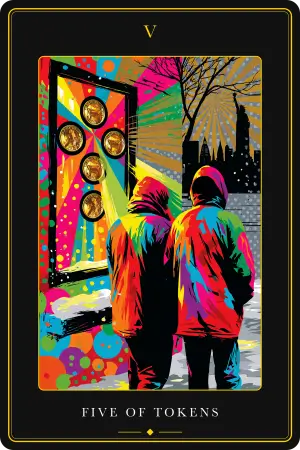


Minor Arcana · Pentacles (Earth)
Six of Tokens
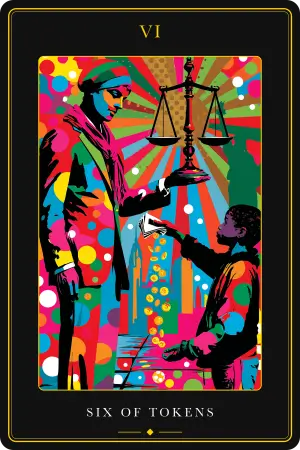
Someone the city has been good to raises the scales and passes folded bills down to a boy, golden tokens spilling between them: generosity with the measure still in hand.
Read the complete guide: Six of Pentacles Tarot Card: A Complete Guide to Its Symbolism and Meaning
Card at a glance
- Numerology
- 6
- Element
- Earth
- Astrology
- Moon · Taurus (second decan)
- Kabbalistic path
- Tiphareth (Beauty) in Assiah
- Timing
- Early May · second decan of Taurus
- Yes / No
- Upright yes · Reversed no
Upright
generosity
mutual aid
fair exchange
patronage
giving and receiving
circulation
reciprocity
measured scales
Reversed
the crooked scale
strings attached
one-sided giving
exploitation
charity as performance
refusing help out of pride
hoarding
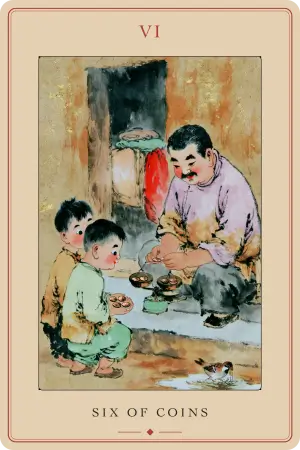
Six of Tokens in each deck
Every deck reimagines the same archetype. Compare the art, then open a deck to read its full interpretation.
Imagery and symbolism
In the Tarot of New York City the Six of Tokens stages a moment the city produces every day and rarely photographs: the giving hand on the sidewalk. Two figures meet on a crosswalk in a blaze of pop-art color. On the left stands a tall, elegant figure in a vivid patchwork coat and a long pink scarf, dressed in the same riot of dots and color-blocks as the world around them. This is someone the city has been good to, and the prosperity has soaked all the way into the clothes. One hand, held high, raises a set of balance scales. The other passes a fold of bills down to a boy who reaches up to receive them.
The scales lifted overhead are the card's central symbol, inherited straight from the Rider-Waite-Smith image. They declare that this giving is measured justice rather than impulse or theater. The giver weighs what they give, so the act restores balance instead of buying gratitude. Raised above both figures, the scales belong to neither of them. Fairness presides over the exchange the way a streetlight presides over a corner.
Between the two figures a stream of golden subway tokens spills down through the air toward the boy's open lower hand. The token is this deck's coin, money in its most democratic New York form, the same brass disc in every pocket rich or poor. Falling like the alms in the original card, the tokens say that what is really being handed over is access: the means to move, to get somewhere, to ride. The boy receives with both hands, one accepting the bills and one open beneath the falling tokens, his posture attentive rather than servile. He stands for everyone the city's wheel has set down low this turn, and his upturned face completes the exchange, because giving needs a receiver and receiving well is its own half of the act.
Behind them the skyline rises in silhouette, the Empire State and Chrysler spires among stacked color-block buildings, placing the exchange where the deck insists it belongs: not in a temple but in the street. On the right the Statue of Liberty stands ghosted in green, the city's own patron of the arriving and the empty-handed, quietly endorsing the scene. A sunburst of rays erupts from behind the scales, and fields of halftone dots and confetti circles fill every surface. The radiance streams outward from the point of exchange itself, so the act of giving becomes the sun of this card, and abundance reads not as a pile but as a burst, wealth mattering only in the moment it moves.
Core meaning
The Six of Tokens is the archetype of material exchange restaged on a New York sidewalk: the movement of resources between people, whether money, time, energy, or attention. It carries the full weight of the traditional Six of Pentacles, the card the Golden Dawn titled the Lord of Material Success, and it sits in the suit's sequence as the correction after the Five. Where the Five of Tokens left two people out in the cold past a lit window, the Six opens the door and lets resources flow back toward even.
The deck keeps the card's harder question intact. Charity here is generous, but it is also thoughtful, and the scales are the reason why. Giving that restores balance is different from giving that buys applause or keeps a recipient kneeling. The person holding the scales holds the power, which is why the card asks the giver to check the motive and the receiver to accept without shame. Its steady lesson is that in this city everyone eventually stands on both ends of that sidewalk, benefactor now and supplicant later, and neither role fixes a person's worth. The measure of having made it is what you hand back down.
Upright meaning
Upright, the Six of Tokens marks generosity that circulates and comes back multiplied. Help is being given or received, a debt is repaid, a favor returns, and resources move to where they are needed instead of sitting locked in one account. It is the tip that changes a shift, the loan between friends that saves a month, the mentor who makes the introduction, the mutual aid table on the corner. The counsel is to give with awareness rather than guilt, and if you are the one in need, to let yourself receive, since accepting help graciously is itself a gift to the giver.
In love. A relationship where the scale between giving and receiving sits level, partners who show up in practical, unglamorous ways and keep rough count of nothing. It can also describe one partner acting as the material or emotional patron for a while, supporting the other through school or grief or a lean stretch, and doing it without condescension or a bill sent later.
In career. Reward and acknowledgment for diligence: the raise that lands, the bonus, the public credit for the project you carried. It often points to a benefactor at work, the manager who advocates for you in a room you are not in, or the veteran who teaches you the real way things are done. You may also be that figure for someone else, and the mentoring you extend circulates back as reputation.
In finances. Money in motion rather than money at rest: a loan repaid, a grant, a fair settlement, the return of previously invested funds. It favors tipping well, giving to mutual aid, and lending where the trust is real, because circulation is what creates abundance and the scales over the exchange promise that what flows out returns clean.
In health. A considerate relationship with your own body, which gives constantly and asks what you give back. Eating in a way that returns what the day takes, movement matched to what the body can offer, rest treated as repayment rather than laziness. It can also mark care that is shared, helping someone else with their health or receiving that kind of care yourself.
Reversed meaning
Reversed, the scale is held crooked. The exchange has gone unequal: someone gives too much and receives nothing back, or the help on offer arrives with strings, an obligation or a debt that quietly compounds. It can describe charity as performance, generosity used as leverage, a benefactor who needs the recipient to stay kneeling. Just as often it points inward, to the refusal to accept help out of pride or shame, standing in the cold past the lit window rather than knocking. The flow the upright card celebrates has jammed, and both sides grow poorer for it. The medicine is to audit the exchange honestly and restore even scales before more moves.
In love. One partner gives while the other mostly receives, and the asymmetry corrodes the connection into resentment on one side and entitlement or guilt on the other. It can show support curdled into control, care used as leverage, or plain neglect, one person feeling like staff in their own relationship. Name the imbalance out loud rather than keep silently keeping score.
In career. Effort and reward have come apart. You may be carrying a disproportionate share without adequate pay or credit, or watching recognition flow to the wrong people. It can point to exploitation dressed as opportunity, unpaid overtime framed as loyalty, a boss whose favors create debts. The opposite fault also appears: coasting on colleagues' generosity or hoarding knowledge that should be shared.
In finances. Loans go unrepaid, help is promised and withheld, or aid comes with hidden strings. Investments may not yield the anticipated returns, and funds get mismanaged or drained by someone who takes without giving back. There is risk of loss through greed or fraud, and an inner side too, fear of scarcity, shame about needing help, or giving money away to buy approval.
In health. An unbalanced exchange with your own body, giving it too little and demanding too much. Running on caffeine and debt-sleep, skipping meals to save time or money, spending on everything except health. The body keeps this ledger precisely, and the invoice comes as fatigue or the injury that forces the pause you would not take. The opposite imbalance also fits: a punishing regime that turns care into control.
Historical notes
The Six of Tokens inherits its scene from the Rider-Waite-Smith Six of Pentacles, drawn by Pamela Colman Smith in 1909 under A.E. Waite's direction. There a well-dressed man in what Waite called the guise of a merchant stands elevated over two kneeling beggars, dropping coins with his right hand while his left holds a pair of scales that weigh their needs. The giving is measured, equitable by his judgment but not equal, and a heavy horizontal line across the background marks the scene as one of Smith's stage cards, hinting that the charity might be a role played for optics. A small red square in the kneeling figure's pocket, read as a theater ticket or a tarot card, confirms Waite's warning that everything here is not as it seems.
Older and parallel traditions frame the same balance in their own keys. The Golden Dawn named the card the Lord of Material Success and set it at the second decan of Taurus under the Moon. In the Tarot de Marseille it is the Six of Coins, six discs arranged among floral work with no figures at all. In Crowley and Harris's Thoth deck it becomes the Six of Disks titled Success, its coins laid out as the geomantic figure Populus, a gathering of people, circled around a radiant center to echo Tiphareth. This deck keeps the archetype whole and moves it to the street: the merchant becomes an elegant figure in a patchwork coat, the weighed coins become subway tokens spilling through the air, and the theatrical stage becomes an actual New York sidewalk beneath the skyline and the Statue of Liberty.
Correspondences
Number. Six, the number of harmony, balance, and stability, the equilibrium of the six directions of the grid, which suits a city whose own street plan is a grid of crossroads. In the suit's sequence it is the repair after the Five: it takes the lack of the five and answers it with care, the door opening and the hand extending. With the suit of Tokens it becomes equity and fair exchange in the material sphere, abundance measured not by the size of the pile but by whether it moves.
Astrology. The Moon in Taurus, ruling the second decan of Taurus from roughly the first to the tenth of May. Taurus supplies the steadiness, the slow accumulation that finally produces enough to share, while the Moon adds the felt sense of who needs what, the giver who reads the street and notices the person the crowd walks past. Traditionally the Moon is exalted in Taurus, its restless emotional tides steadied by fixed Venusian earth, so the card marks generosity that is grounded and attuned at once.
Element. Earth, the suit of Tokens, carrying money, rent, work, and material security. Earth here is the sidewalk itself, well-being built slowly, block by block, real only when it circulates.
Kabbalah. As a Six it belongs to Tiphareth, Beauty, the harmonious heart of the Tree of Life. In the suit of Earth this is Tiphareth in Assiah, transcendent balance filtering down into material success and physical well-being.
Elemental dignity. Its Earth is settled and radiant rather than in crisis, and through Tiphareth on the middle pillar it ties true material success to intuition and an understanding of universal law rather than brute force.
Psychological perspective
The Six of Tokens audits the ledger of giving and receiving, not only in money but in every currency the city runs on: affection, patience, time, attention. Its exalted Moon in Taurus says the exchange is meant to happen with emotional ease and a natural rhythm. When the flow is healthy, a person gives from genuine overflow and receives without flinching, sensing where resources should go and making the giving reliable rather than a single dramatic gesture.
When the flow is dammed, the card exposes two opposite dysfunctions. At one pole sits the martyr who gives compulsively, tying self-worth to being needed and depleting themselves in the process, giving from a hunger to be needed rather than from overflow. At the other sits the person who cannot receive at all, blocking help and rightful abundance out of pride, shame, or a fear of being seen as weak, walking past the lit window in the cold rather than knocking. The card's quiet mandate is that receiving gracefully matters as much as giving generously. Refuse either one and the circuit breaks, and the result is stagnation.
The Six of Tokens across decks
The same balance of giving and receiving appears in different settings across the tradition, and this deck's contribution is to move it from a staged tableau to a real corner. In the Tarot de Marseille it is the Six of Coins, six discs in a balanced arrangement among floral work, an emblem of material harmony with no figures at all.
In the Rider-Waite-Smith deck it is the merchant weighing his coins over two kneeling beggars, staged and ambiguous, the version that made the card a study in the power beneath generosity and the source this deck follows. In Crowley and Harris's Thoth deck it becomes the Six of Disks titled Success, its coins laid out as the geomantic figure Populus and circled around a radiant center to echo Tiphareth, wealth valued for its function and radiating out to a community. The Tarot of New York City keeps the archetype whole and swaps the merchant's platform for the sidewalk: the well-dressed man becomes an elegant figure in a patchwork coat and pink scarf, the weighed coins become subway tokens falling through the air, and the beggar becomes a boy who receives with both hands. The scales stay raised overhead in every version, and the balance stays the same: generosity is only just when it is measured.
In combination and context
Numerologically the Six of Tokens follows the exclusion of the Five and answers it, the crossroads where resources start flowing back toward even after a hard stretch in the cold. It grounds the number six in the material world, one brass token that costs the same for every rider, and it insists that six of them is not a fortune but enough to share. Surrounding cards shift its charge sharply. Paired with an authority card like The Emperor it can tip toward power imbalance, a partner rigid about what they will give and deciding unilaterally what the other gets. Following the Five of Tokens it reads as hardship relieved, shelter and patronage found after the cold. Around exploitative or secretive cards it leans toward strings, debt, and hidden conditions.
Spread position sharpens it further. In a slot for what to let go of it becomes a command: stop overgiving to people who never reciprocate, and prioritize your own stability before trying to save others. In a post-breakup reading it exposes who was overextending and who was only taking, the scales tipped to emotional bankruptcy for the giver. As advice it says give only what you can genuinely afford, ask for help when you need it, and accept blessings gracefully. As an outcome it promises balance restored, as long as the terms of the exchange are honest and the value flows both ways.
Questions for reflection
- Look at the exchanges you are in right now. Where are you overgiving out of guilt, where are you overdrawing, and what would even actually look like?
- The scales are raised overhead so fairness belongs to neither hand. When you give lately, are you measuring the gift to help, or to be seen helping?
- If you are the one in need this turn, what pride or shame is keeping you outside the lit window when the door is closer than it feels?
The general meaning follows the Rider-Waite-Smith reading, the reference used across Tarot Academy. Open a specific deck above for its own interpretation.
Frequently asked questions
Explore the Tarot
Latest Posts
Discover the ancient wisdom of tarot cards and unlock the mysteries of your spiritual journey. Our blog is your gateway to understanding the rich symbolism, meanings, and practical applications of tarot reading.




















































