
 EN (English)



Minor Arcana · Wands (Fire)
Four of Wands
Four garlanded staves stand open like a gateway, two figures wave their bouquets beneath them, and the castle waits across the moat: the harvest is in and the threshold is yours to cross.
Read the complete guide: Four of Wands Tarot Card: A Complete Guide to Symbolism and Meaning
Card at a glance
- Numerology
- Four
- Element
- Fire
- Astrology
- Venus in Aries, third decan (April 11–20)
- Kabbalistic path
- Chesed (Mercy) in Atziluth
- Timing
- Mid-April, third decan of Aries
- Yes / No
- Upright yes · Reversed no
Upright
Stability
Celebration
Homecoming
Consolidation
Alliances
Triumph
Rest
Family happiness
Reversed
Instability
Disrupted plans
Discord
Fragile alliances
Lack of support
Loss of enthusiasm
Feeling unwelcome
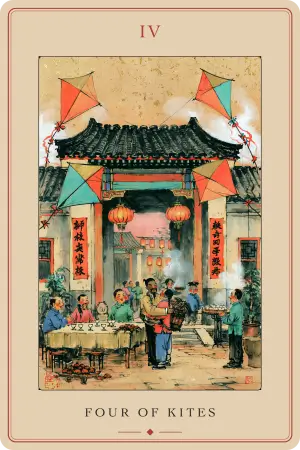
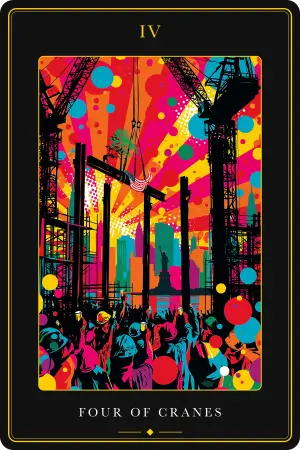
Four of Wands in each deck
Every deck reimagines the same archetype. Compare the art, then open a deck to read its full interpretation.
Imagery and symbolism
Pamela Colman Smith builds this card as a stage set with three depths. In the foreground, four tall wooden staves stand planted firmly and symmetrically in the earth, bound at the top by a lush garland of fruit, leaves and flowers. In the midground, two figures raise their arms and wave small bouquets. Behind them a formidable stone castle rises, and revelers gather on a bridge that spans a moat leading to the manor. The garlanded staves borrow directly from the chuppah, the Jewish wedding canopy, which is why this deck's card is so firmly tied to marriage, rites of passage and formal ceremony.
This deck reads its own props closely. The wreath of laurel branches framed by the four wands is victory and success, the completion of a process toward a goal, and the celebrants wear wreaths on their heads to repeat the point. The four wands themselves create an enclosed space that stands for home, structure and orderliness: they form a foundation, the completion of one process and the start of the next stage. The castle is strength, security and material well-being achieved through effort. The harvest stands for spiritual and material achievements earned through hard work.
Colour carries the mood. The yellow background is energy, vitality, celebration and joy; the yellow and green tones through the scene read as wealth, prosperity and abundance; and the celebrants' red and green outfits signal desire, action, passionate emotion, renewal and plenty. Green trees and festive clothing fill out an atmosphere of cheerfulness.
There is one more thing Smith did, and modern readers have made much of it. The viewer stands outside the scene, separated from the celebration by the framing wands in front and the moat behind. The foreground works as a threshold, the midground figures as the performance, the background castle as the sanctuary. Waite's design invites you to cross the bridge and come in, but the staging also admits a colder reading: a public display of joy watched from across the water, which is where the card's facade shadow begins.
Core meaning
In the Rider-Waite deck the Four of Wands is prosperity, stability and harmony in home and family: consolidation of position, peace after a turbulent period, the joy of a goal achieved and satisfaction in joint effort. The Golden Dawn called this card the "Lord of Perfected Work," and what Waite and Smith did in 1909 was translate that abstraction into a human milestone anyone can recognise. The harvest is safely gathered, the territory is claimed, and the community is ready to rest and celebrate.
The number four gives the restless suit of Fire its first real container. Where the Ace sparked, the Two planned and the Three watched the ships, the Four plants the staves in the ground and hangs a garland on them. It is a deliberate pause, a structured intermission before the conflict of the Five, and the stability it offers is genuine while it lasts.
The deck's own advice is plain: acknowledge and celebrate what you have achieved, rest, and spend time with loved ones. Even accomplishments short of the final goal are worth marking. Appreciate the moment of stability and security, and use it to strengthen the bonds with your people and your home.
Upright meaning
Upright, this card describes a period of stability and steadiness in which effort finally yields tangible results. It points to foundations, strong connections and current achievements, and it leans hard toward home and family: security, the building of a base, feeling at home among friends. It marks a union, a meeting, a readiness to build a future, the establishing of a family or a family project. In a yes-or-no reading it is a yes. As a card of the day it says step back from striving, gather your people, and let joy be the reward that makes the work worthwhile.
In love. Stability, harmony and mutual respect, a relationship built on strong mutual feelings where both partners contribute equally. It is a classic marker of closeness, marriage or a long-term romance, a happy home, shared social events and celebration, possibly cohabitation. The period ahead is calm and secure, supported by shared goals and ambitions.
In career. Accomplishment and established control: the successful completion of a project or professional phase, often accompanied by news of a promotion, award or recognition from the professional community. Work brings satisfaction and pride, and the moment calls for celebrating with colleagues and enjoying the sense of unity. In business it shows growth on solid foundations, a family or group enterprise, a sustainable partnership, and a favourable window for expansion or new directions once you have rested.
In finances. Success, stability and the consolidation of achievements: a period of financial well-being, steady cash flow, profit from a completed stage or project, investments that pay off. The future promises stability and abundance, and the card grants a secure position from which to actually enjoy the fruits of labour. Celebrations may bring generous gifts, and generous expenses with them.
In health. Stability and growth through daily care: discipline in workouts, harmony with the body and its capabilities, practices like yoga, Pilates or running. Find joy in movement and a balanced diet, listen to what the body needs, and let self-care be part of the celebration rather than another chore.
Reversed meaning
Reversed, the harmony this card promises is disrupted. The reading turns to anxiety and instability: previous successes stop feeling satisfying, plans grow uncertain, and the sense of home or belonging wavers. There are family disagreements and a lack of domestic warmth, projects that cannot be realised, difficulties reaching agreement. In a yes-or-no reading it turns to no. The deck's counsel is to work on the issues rather than mourn the picture: evaluate your position in the relationships that matter, improve communication, revisit the plan, and stay patient enough that disappointment does not swallow the bigger picture.
In love. Instability, tension or open conflict: anxiety, dissatisfaction or a fear of commitment. Goals fall out of alignment, interest cools, and it can feel as if one partner is carrying more than the other. The card asks both people to acknowledge the problems honestly, give each other space where needed, and avoid rash decisions or unhealthy pressure.
In career. Problems at the workplace: hard work going unrewarded, a project that fails to deliver, isolation from the team, or home circumstances bleeding into the job. Monotony and work exhaustion reach a peak and demand fresh energy or a new angle. In business it warns of team conflict, inadequate planning, discord between partners and stalled cooperation; negotiations are necessary before the structure fragments further.
In finances. Stagnation or instability where security was assumed. A space once considered safe is threatened, a solid structure turns out to be fragile, returns disappoint, expenses run high, profits are postponed. Reassess the economic strategy, review the plans, and price in the risks before they arrive.
In health. Inadequate attention to the body: lapsed discipline in diet, no routine, no exercise. The card warns of the consequences of excess or neglect and asks for a thorough return to basics, since the foundation being shaken here is physical.
Historical notes
Before Waite and Smith, the card had no scene. The Tarot de Marseille's four batons weave into a sturdy lattice or X reaching to the corners of the card, with flowers emerging from the gaps between them, proof that rigid order can still breed organic growth. One 17th-century Belgian Marseille deck, the Gerard Bodet, even carries a printing accident in which blue ink spilled across the bottom of this fiery card, an image many later readers cherished as raw fire suddenly cooled and calmed.
The Golden Dawn's instruction manual, Book T, prescribed something far stranger than a country dance: two white angelic hands issuing from clouds, clasped in the secret grip of the First Order, holding four crossed wands with flames at the junction, and smaller wands above and below bearing the sigils of Venus and Aries. The order's colour scales, preserved through the Whare Ra temple in New Zealand, called for emerald green wands on a blood-red field under violet clouds, and tied the card to the alchemical stage of Calcination, the Reddening, in which impurities burn away to reveal a stable core.
Waite and Smith's 1909 revolution was to turn that machinery into a human scene: a harvest festival at a castle gate, a wedding canopy, people you could imagine joining. Crowley's Thoth deck later swung back to geometry, titling the card "Completion" and crossing four wands tipped with the Ram of Aries and the Dove of Venus around a single contained flame. The Rider-Waite version remains the one that made the Lord of Perfected Work legible as an ordinary, joyful day.
Correspondences
Number. Four, the number of stability, steadiness and calm: the four elements, four directions and four seasons, linked in the trumps to The Emperor. In this deck's numerology the four frames the active energy of Wands inside strength and foundational reliability. It marks the completion of a task and well-earned rest after real effort, and in society it stands for community, agreement and the joy of reaching a common goal together.
Astrology. Venus in Aries, the third decan of Aries, April 11–20, a sector traditionally ruled by expansive Jupiter, which amplifies the card's themes of celebration and good fortune. Venus is in detriment in Aries, the planet of love set on the battlefield of Mars, and the deck reads the pairing generously: Venus adds harmony, alliance, attraction and the desire to share success, while the third decan gives Aries its full confidence and a pragmatic readiness to fight for goals. The joy is loud, immediate and adrenaline-fuelled, and it is not built to stay unchanged.
Element. Fire, in Atziluth, the world of pure will and emanation. Here the fire is brought indoors to the hearth, where it gives warmth, safety and a gathering place.
Kabbalah. Chesed, Mercy, the fourth Sephirah, in Atziluth: the first step of manifestation below the Abyss, where divine will begins to organise into ideal structure. The decan's angelic rulers, Nanael and Nithael, add the two halves of the card's promise, Nanael grounding fiery inspiration in philosophical understanding and Nithael guarding legitimate authority and the stability of the sanctuary.
Elemental dignity. A Fire card that strengthens beside Air and meets tension with Water, so its neighbours decide whether the celebration holds or the ground shifts.
Psychological perspective
The person carrying this card's upright energy is in a state of harmony and stability earned through hard work and perseverance. They hold a clear vision of their goals and the drive to realise them, cooperate easily, and can see the bigger picture well enough to run several projects at once while staying grounded. Reversed, the same person meets obstacles that drain enthusiasm, motivation and direction until stagnation sets in; fear of change keeps some of them stuck, and instability and chaos fill the space where long-term goals used to be. They need support or guidance to restore their footing.
The deeper psychology of the card is about letting a milestone actually land. Fiery temperaments sprint from one finished task straight into the next and burn out on the way, and this card interrupts the cycle with a mandate to rest, gather and take guilt-free pleasure in what is done. It honours the grand occasions, weddings and graduations, and equally the micro-milestones: a brutal week survived, a difficult conversation finally had, a quiet Saturday that feels safe. Joy that goes unwitnessed tends to shrink; joy shared with a community takes root.
The shadow is the container itself. Alejandro Jodorowsky warns that the peril of the Four is stagnating without evolving, the artist painting the same picture forever, the couple whose passion has hardened into routine. Fire held in a furnace too long without new fuel goes out, and the fortress walls that felt safe begin to feel like a gilded cage. Inhabit the arrival fully, then be willing to leave through the same gateway you entered.
The Four of Wands across decks
Set beside its relatives, the Rider-Waite version's distinguishing move is hospitality: it is the only classic rendering that stages the Perfected Work as a party you could walk into. The Tarot de Marseille keeps pure geometry, four batons in a flowering lattice, order read through pattern and number. The Golden Dawn's Book T version is a vision of angelic hands and flaming wands under the sigils of Venus and Aries, divine resolution rather than human festivity. Crowley's Thoth card, titled "Completion," balances the aggressive Ram against the peaceful Dove in a closed, high-tension circuit around a contained central fire.
Modern decks push the RWS scene in new directions. Patrick Valenza's Deviant Moon makes the four wands the literal foundation pillars of a couple's strange new house, the card's ties to domestic life and real estate turned into architecture. Kim Krans' Wild Unknown abstracts the staves into crossing branches around a blue intuitive core, a portal where energies meet and stabilise. Lisa Sterle's Modern Witch swaps the harvest festival for a diverse group of friends deliberately pausing to enjoy life, chosen family and self-care in place of the wedding canopy, and Stephanie Pui-Mun Law's Shadowscapes dissolves the architecture altogether into foxes, watercolour and natural harmony. Each keeps what Smith's staging established: stability worth celebrating, and company to celebrate it with.
In combination and context
The pairing readers confuse most is with the Three of Cups, the deck's other great celebration card, and the difference is elemental. The Three of Cups is Water: fluid, social, emotionally expressive joy, somewhat fleeting by nature. The Four of Wands is Fire grounded in structure, and its focus is the permanent foundation being laid, the wedding that legally builds a family, the closing on a home, the business incorporated. One celebrates the feeling of the gathering; this card celebrates staying put.
Combinations sharpen it further. Beside The Moon in a health question it becomes a prescription rather than a prediction: the anxiety The Moon carries needs the literal homecoming this card offers, family present, a stable environment, real recuperation at home after illness or hospital. Reversed alongside a reversed Knight of Wands in a love reading, it describes someone actively avoiding the foundational steps a bond requires, stalling plans and keeping distance out of fear of commitment. And the card's own staging supplies its hardest combination reading: when it appears reversed around cards of deception or strain, the celebration may be a facade, a public display of unity performed across the moat while the private reality goes unaddressed.
By position, as advice it says stop, mark the milestone and share it. As an obstacle it warns that comfort or premature celebration is holding you at the threshold. As an outcome it promises a stable arrival, with Smith's distant castle reminding you that the road continues past the party.
Questions for reflection
- Smith placed me outside the scene, across the moat from the celebration. Where in my life am I watching joy from the outside, and what bridge would I have to cross to join it?
- The four staves hold up a garland, not a roof. What have I built that is worth celebrating now, before it has to become permanent?
- The castle stands behind the party, not at it. What larger security am I still walking toward, and can I let myself rest on the way?
The general meaning follows the Rider-Waite-Smith reading, the reference used across Tarot Academy. Open a specific deck above for its own interpretation.
Frequently asked questions
Explore the Tarot
Latest Posts
Discover the ancient wisdom of tarot cards and unlock the mysteries of your spiritual journey. Our blog is your gateway to understanding the rich symbolism, meanings, and practical applications of tarot reading.




















































