 EN (English)

Minor Arcana ·
Knight of Cranes
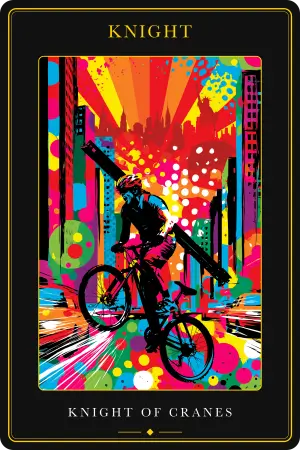
A bike messenger riding a wheelie through Manhattan traffic with a steel beam on his shoulder: pure momentum, thrilling while balanced and one degree from the pavement.
Card at a glance
- Numerology
- Knight
- Element
- Fire
- Astrology
- 20 degrees Scorpio to 20 degrees Sagittarius (Fire of Fire)
- Kabbalistic path
- Atziluth, Yod of the divine name, Chokmah
- Timing
- Very fast, late autumn into early winter
- Yes / No
- Upright a bold yes, reversed no
Upright
momentum
bold action
adventure
charisma
ambition
passion
risk-taking
the green light
Reversed
recklessness
burnout
scattered energy
all flash no follow-through
the crash
impulsive anger
abandoned projects
lost direction
Knight of Cranes in each deck
Every deck reimagines the same archetype. Compare the art, then open a deck to read its full interpretation.
Imagery and symbolism
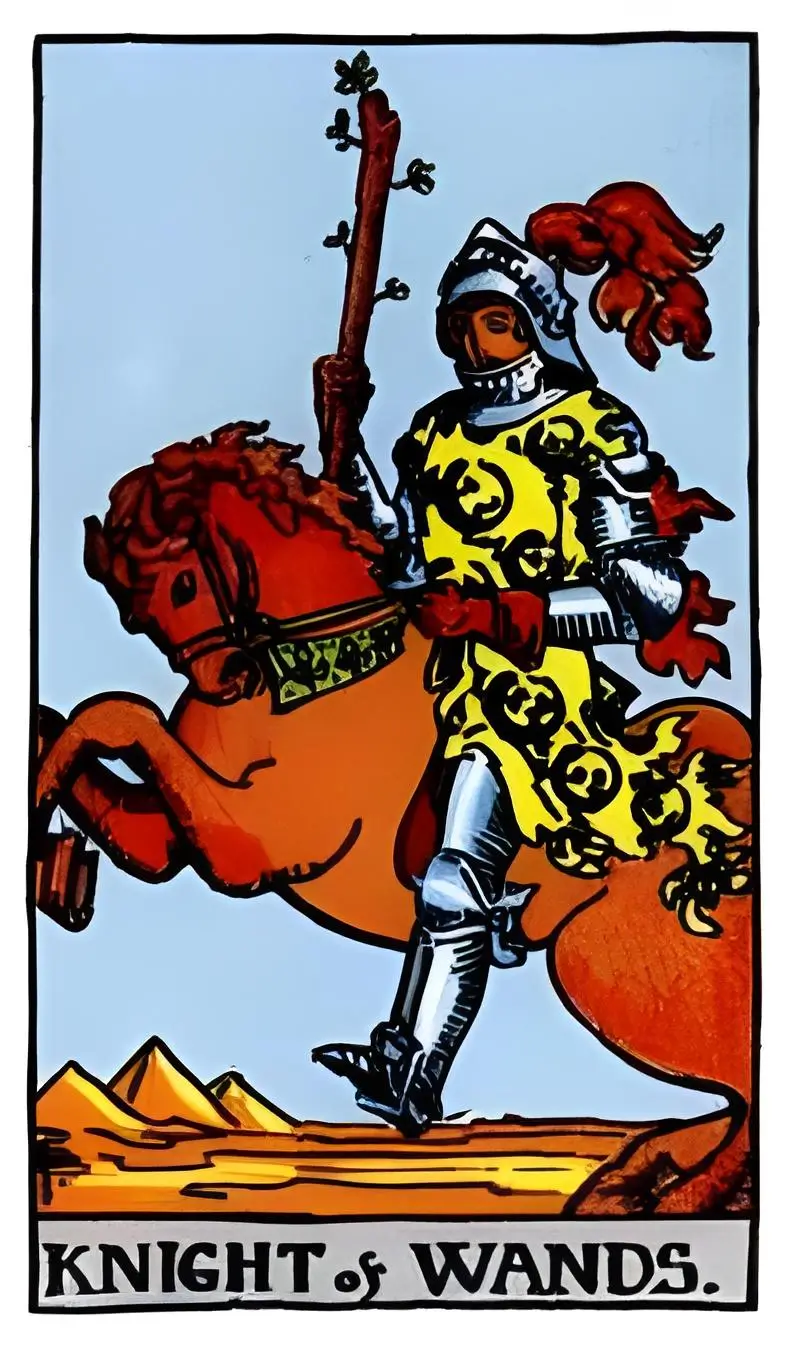
In the Tarot of New York City the Knight of Wands becomes the Knight of Cranes, and the charging stallion becomes a bicycle. The figure is a bike messenger rendered as a flat black pop-art silhouette, caught mid-wheelie with the front wheel lifted clean off the pavement. Where the Rider–Waite–Smith Knight rears a chestnut horse onto its hind legs, this rider rears the machine itself. It is the same message in a new body: readiness to move without hesitation, motion so eager it cannot keep both wheels on the ground.
Across his shoulder he balances a long steel beam. This is the deck's version of the leafing wand the RWS Knight brandishes like a lance, but here the object is heavier and more literal. The beam is raw ambition, an idea with enough weight to matter, carried through traffic by sheer will. He does not wait for a crew or a truck. He takes it himself. His helmet stands in for the Knight's armor, a reminder that these battles are fought at street level among real hazards rather than on a medieval field.
Behind him the sky detonates in sunburst rays of red, orange, and yellow, radiating outward from a low point and impossible to ignore. This is the Fire element made visible, the heat of the Cranes suit turned into light. Fields of halftone dots swarm the air like sparks thrown off by his speed, and speed lines streak the pavement beneath the wheels. Color blocks crowd the frame, so the rider is traveling through maximum stimulation and holding his course anyway.
The skyline stands in dark silhouette with the Statue of Liberty raised at his back. The towers are what the beam on his shoulder wants to become, and the background is the future he is pedaling toward. One detail decides the reading. The lifted front wheel is glorious and unstable in the same instant. Held with skill it is mastery; held a second too long it is the crash. The card holds the surge of energy that builds the city and the same surge that ends up in the intersection.
Core meaning
The Knight of Cranes is the moment the internal spark becomes physical motion. The Ace of the suit is the idea; this card is getting on the bike and going before the plan is fully drawn. He is the deck's engine of forward movement, the figure who trusts that action itself produces clarity and that the ride matters more than the arrival. The Golden Dawn titled the parent card the Lord of the Flame and Lightning, and that is the charge here: sudden, high-velocity power aimed at the space ahead.
As a court card he carries the most concentrated fire in the deck. Each Knight is the fiery, active edge of its suit, so the Knight of the fire suit is Fire of Fire, double heat with a matching potential for excess. Poured into the Cranes, this deck's suit of ambition and the build, it becomes restless drive: the courage to launch, the appetite for the next project, the pull toward whatever is bigger and faster. This is the part of the psyche that finally stops talking about the idea and pedals into traffic.
The card also carries an honest caveat about pace. Fire this hot burns fast, and speed without aim is the Knight's defining risk. The lifted wheel that reads as mastery when balanced becomes the wipeout the instant it tips. His whole lesson lives in that gap: point the wand before you commit the body to it.
Upright meaning
Upright, the Knight of Cranes says the whole city seems to move at your speed. Activity, dynamism, and initiative are running at a sprint. The funding clears, the texts blow up, the project that crawled for a year suddenly runs. It is a period that rewards bold, decisive action and a fundamental intolerance for routine and hesitation. In a yes or no reading it is a bold yes, a direct signal that you already have the correct instinct and should not wait for further permission. The counsel is to swing your leg over the bike and go, but keep your eyes up, because the window is open and windows in this city do not stay open long.
In love. The romance that moves like the express train. Expect a rapidly developing connection full of enthusiasm and the urge to explore at full speed: the second date the same week, the spontaneous trip across town. It can announce the arrival of someone magnetic and thrillingly certain who repaints your calendar. The connection runs on passion and grand gestures, and for a while at least the ride is unforgettable. The card urges initiative, so text first and say the daring thing.
In career. The suit of Cranes is the deck's most career-positive suit, and this is its charge of rapid advancement. It favors charisma, salesmanship, and high-energy initiative, the colleague everyone wants on the impossible deadline. Expect a surge of creative energy and a workload that grows because you keep delivering. Because the Knight also carries the learning and expansion of Sagittarius, the card can point to fast-mastered skills, a promotion taken at a run, or success in study and research.
In finances. Capital in motion, the wire that clears fast and the opportunity that demands an answer by Friday. It heralds new income streams and ventures that reward the bold, so put money to work instead of letting it idle and be ready for calculated risks. The fire behind a bet may be genuinely right, but the wallet still has limits, so pace the investment and keep some structure around the enthusiasm.
In health. Pure kinetic charge and the appetite to spend it: intense training, a new athletic challenge, the bike instead of the train. This spontaneous energy suits forming new habits or taking on a sport that scares you a little, and the city itself becomes the gym. The one instruction inside the velocity is to build in rest, because even messengers stop at some lights.
Reversed meaning
Reversed, the Knight of Cranes is the messenger who wiped out in the intersection, velocity with nothing to show but bruises. The fire has either turned destructive or run out entirely. It is the classic case of all heat and no follow-through, someone who comes on strong and fades just as fast. Expect inefficient use of energy and hasty actions that create chaos: the deal rushed before the paperwork was read, the project launched before the foundation cured. The core question is whether the failure is too much directionless speed or a complete loss of aim and motivation. The counsel is plain: pull over, check the route, and adjust your actions to what the ground can actually hold.
In love. The whirlwind that flames out between boroughs. Expect emotional turbulence and a lack of discipline, hasty words that breed conflict, passion fading because it was velocity rather than depth. It warns of broken promises or a partner who loses interest once the chase ends, a connection built on intense but superficial attraction with no foundation poured. The reversed knight asks whether this is love or just the wheelie, spectacular and one degree from the pavement.
In career. Momentum dying or the rider losing the handlebars. Interest fades, projects drift, and the once-fast mover coasts into burnout. The opposite failure is a compulsion to execute every idea without planning, which ends in slipped deadlines and sloppy work until the load of tasks becomes the beam that bends your back. Reversed in a career context it also warns of quitting a job too fast out of frustration. The card urges a slowdown: rethink the plan, redistribute effort, and defend time for recovery.
In finances. The courier who lost the package, energy spent and nothing delivered. It warns of losses from impulsive moves, capital sunk into a glossy pitch or a lease signed at first viewing. Expect delays or a launch that misfires, and stop making decisions at intersection speed. It can also flag overheated growth, expansion outrunning its foundation. The profitable move now is the careful one, so brake first and then steer.
In health. The body after too many double shifts, exhaustion and activity that has lost all balance. It points to athletic overload or ignoring fatigue signals until something gives: the strain, the sprain, the wipeout. The burnout can also read as a total loss of the stamina the upright card boasts about. Listen to the body, notice the signals early, and remember that the fastest way through this city is intact.
Historical notes
The Knight of Cranes inherits the long history of the Knight of Wands. In the Tarot de Marseille, which began in northern Italy in the fifteenth century and was popularized in France by the seventeenth, the figure was the Cavalier de Baton. That older card read as youthful enthusiasm and the energetic start of a new venture, a trailblazer rooted in nature and driven by desire, curious and full of potential but short on control. The Marseille tradition used pip-style number cards and generally read without reversals, relying on color and numerology.
The late nineteenth and early twentieth centuries transformed the card. The Hermetic Order of the Golden Dawn folded in Kabbalah, astrology, and elemental dignities, and its Book T gave the mounted figure the title Lord of the Flame and Lightning, King of the Spirits of Fire. Two of its initiates then split over the courts. A.E. Waite kept the medieval ranks of King, Queen, Knight, and Page for the Rider–Waite–Smith deck of 1909, and kept the Golden Dawn's fire attribution for the charging Knight. Aleister Crowley reworked the ranks so that the Knight, mounted on a horse, heads his Thoth court, though both systems give the galloping figure the same span of Scorpio into Sagittarius read as Fire of Fire.
The Tarot of New York City takes that inheritance and gives it an address. The rearing stallion becomes a bicycle popped into a wheelie, the leafing wand becomes a steel beam, the desert and pyramids become the downtown skyline and the towers the beam wants to become, and the medieval field of battle becomes an avenue full of traffic. The Golden Dawn's flame and lightning becomes the city's own charge, ambition on two wheels racing a green light.
Correspondences
Number. As a court card the Knight carries rank rather than a pip number. He sits third in the Rider–Waite–Smith court, behind the King and Queen and above the Page, the active messenger who delivers the suit's energy into the world.
Astrology. The Knight governs the third decan of Scorpio and the first two decans of Sagittarius, the span from 20 degrees Scorpio to 20 degrees Sagittarius, roughly November 12 to December 12. The Scorpio root gives him a heavy, intense undercurrent of brewing power held back before it detonates, and the crossing into mutable Sagittarius releases it as expansive, truth-seeking speed. In the horoscope his home is the Ninth House of long-distance travel and the far horizon, which this deck makes literal in the skyline and the bridge he has not yet crossed.
Element. Fire, and specifically Fire of Fire, the most concentrated elemental charge in the deck. The Knights are the fiery edge of every suit, so the fire Knight is double fire, the primal and most volatile aspect of the element, the lightning flash and the roaring blaze.
Kabbalah. The Knights belong to Atziluth, the highest of the Four Worlds and the realm of pure Emanation. Mapped to the divine name Yod-Heh-Vav-Heh, Fire of Fire aligns the Knight with the Yod of Yod, the first and most primal letter, the initial spark of creation linked to Chokmah, Wisdom, on the Tree of Life. He is the origin point of active energy.
Elemental dignity. As pure Fire he strengthens and accelerates other Cranes and fiery court cards. Beside the Swords his speed sharpens communication, beside the Cups his heat can scald or scatter, and beside the Pentacles his urgency meets the resistance of Earth.
Psychological perspective
The Knight of Cranes is the psyche of pure momentum, the Adventurer who treats the city like it owes him speed. Its patron energy is the bike messenger who knows every gap in traffic, the founder pitching from a folding table who will have an office by spring, the crew chief who volunteers for the impossible deadline. These people react fast, act with total confidence in fast-changing conditions, and physically cannot tolerate standing still. They are contagiously enthusiastic and aggressively honest, without the calculating cunning of the Swords suit, so they are exactly what they appear to be. If angered the fire flares at once, and once the moment passes it is forgotten.
The archetype's lesson is to trust instinct over prolonged deliberation. In any situation that needs momentum, launching a business, pitching an idea, moving across the city, the Knight supplies the courage to act before certainty arrives. His shadow lives one degree past that same instinct. The developmental task is not to extinguish the flame but to aim it, to check the direction before committing the whole body to the delivery.
Reversed, the same engine runs hot with no destination. Energy leaks out of every seam: three gigs taken and none finished, motion mistaken for progress, responsibility experienced as boredom. Passion sours into irritability and impulsive anger, and the rider becomes a big talker whose grandiose claims outrun his discipline. Under the impatience is usually confusion, an aim that was lost and papered over with speed. This is the rider who is brilliant in a straight line and a hazard at every turn, and the work is to build a structure strong enough to sustain the fire past its first burst.
The Knight of Cranes across decks
The Knight of Cranes is one deck's answer to a court figure every tradition draws differently. In the Tarot de Marseille he is the Cavalier de Baton, a mounted rider holding a plain staff, a trailblazer of youthful energy read through color and numerology rather than a fixed scene. In the Rider–Waite–Smith deck Pamela Colman Smith paints him charging on a rearing chestnut stallion, clad in yellow and orange armor patterned with salamanders, red plumes streaming like flames, a leafing wand raised over a desert of three pyramids. A famous detail hides in his footwear: the mismatched shoes that mark how suddenly the call to adventure struck.
In Crowley's Thoth deck, painted by Lady Frieda Harris, the figure heads the court as the Knight of Wands, a fierce armored rider on a black flaming horse, brandishing a torch above a mane and a landscape of fire. The rank shifts but the attribution holds, Fire of Fire from Scorpio into Sagittarius. Modern decks keep reinventing the charge, some as literal riders, some as abstract bursts of flame.
The Tarot of New York City keeps the headlong momentum and swaps the horse for the city's own machine. The rearing stallion becomes a bicycle popped into a wheelie, the salamander armor becomes a helmet and a messenger's silhouette, the leafing wand becomes a steel beam carried through traffic, and the desert and pyramids become the downtown skyline with the Statue of Liberty at his back. The warning survives the translation: the lifted front wheel says the same thing the rearing horse did, that this much speed lives right beside the fall.
In combination and context
The Knight of Cranes rarely acts as a quiet card. His function is acceleration, so he strips the buffer of time out of whatever sits beside him and pushes it to arrive faster and hotter. Read him first for how much velocity the spread can safely hold.
Against the heavy cards he speeds up a reckoning. With the Tower he is the sudden discovery, the affair or the truth uncovered by one impulsive move, a structure blown open with no time to brace. Beside the Three, Five, or Ten of Swords he is heartbreak or betrayal delivered fast, sabotaging speed that leaves no one able to win. Paired with the Moon or the Seven of Swords the rush is being actively hidden behind deception.
Among the cards of love he accelerates bonding, often past the point of safety. With the Lovers he suggests a return or a spark that moves fast, driven more by the thrill of re-conquest than by grounded repair. With the Five or Eight of Cups he is the realization of a betrayal or the rider physically walking away toward the next desire. The card's romantic charge is genuine in the heat of the moment and structurally short on the patience that long roads require.
For timing, most readers take him as very soon, because fire burns fast. Think days rather than weeks, the late autumn window of his own Scorpio-to-Sagittarius span, or the fire-sign seasons. Whatever method a reader uses, this Knight tends to override it and insist the thing is already in motion, faster than the querent expects.
Questions for reflection
- Where in your life is the light turning green the moment you reach the corner, and what would it take to move before the window shuts?
- You have the speed. Have you actually checked the address you are delivering to, or are you pedaling harder to cover for a lost aim?
- When your fire flares, does it build something by evening, or does it just burn fuel and leave you winded at a red light?
The general meaning follows the Rider-Waite-Smith reading — the reference used across Tarot Academy. Open a specific deck above for its own interpretation.
Frequently asked questions
Explore the Tarot
Latest Posts
Discover the ancient wisdom of tarot cards and unlock the mysteries of your spiritual journey. Our blog is your gateway to understanding the rich symbolism, meanings, and practical applications of tarot reading.