 TL (Tagalog)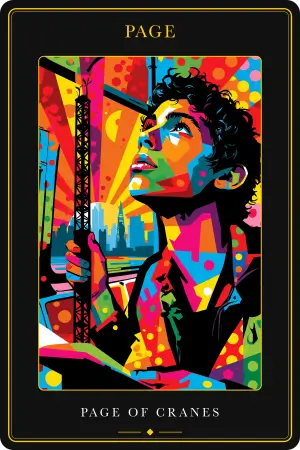

Minor Arcana ·
Knight ng mga Crane
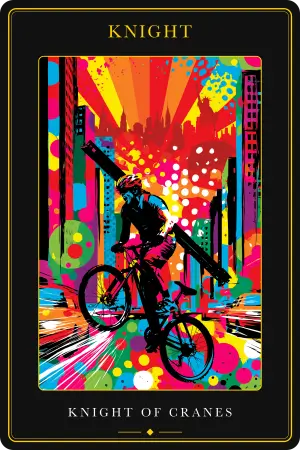
Isang bike messenger na naka-wheelie sa trapiko ng Manhattan na may dalang steel beam sa kanyang balikat: purong momentum, nakakasabik habang nakabalanse at isang hakbang lang mula sa simento.
Kard sa isang sulyap
- Numerolohiya
- Knight
- Elemento
- Apoy
- Astrolohiya
- 20 degree Scorpio hanggang 20 degree Sagittarius (Apoy ng Apoy)
- Landas ng Kabala
- Atziluth, Yod ng banal na pangalan, Chokmah
- Panahon
- Napakabilis, huling bahagi ng taglagas hanggang maagang taglamig
- Oo / Hindi
- Pataas isang matapang na oo, baliktad hindi
Patayo
momentum
matapang na pagkilos
pakikipagsapalaran
karisma
ambisyon
simbuyo ng damdamin
pagkuha ng panganib
ang luntiang ilaw
Baligtad
pagka-burnout
pabigla-bigla
kawalang-ingat
galit
pagkainip
nakakalat na enerhiya
sobrang pangako
baling na layunin
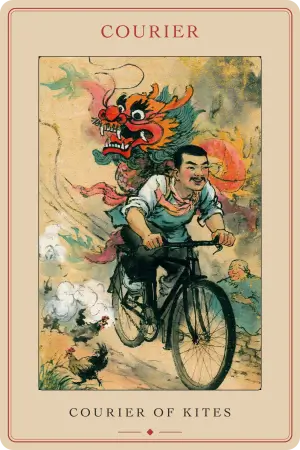
Knight ng mga Crane sa bawat deck
Muling inilalarawan ng bawat deck ang parehong arketipo. Ihambing ang sining, pagkatapos ay magbukas ng deck upang basahin ang buong interpretasyon nito.
Sikolohikal na pananaw
Ang Knight ng mga Crane ay ang psyche ng purong momentum, ang Adventurer na tinuturing ang lungsod na parang may utang itong bilis sa kanya. Ang patron nitong enerhiya ay ang bike messenger na alam ang bawat siwang sa trapiko, ang founder na nagpi-pitch mula sa isang folding table na magkakaroon ng opisina pagsapit ng tagsibol, ang crew chief na nag-vovolunteer para sa imposibleng deadline. Ang mga taong ito ay mabilis mag-react, kumikilos nang may buong kumpiyansa sa mabilis na nagbabagong mga kondisyon, at hindi matitiis na nakatayo lang nang walang ginagawa. Sila ay nakakahawang puno ng sigla at tahasang tapat, walang kalkuladong katusuhan ng suit ng mga Subway, kaya't kung ano sila, iyon na talaga sila. Kung magagalit, ang apoy ay sumisiklab agad, at kapag lumipas ang sandali, nakakalimutan na ito.
Ang aral ng archetype ay magtiwala sa instinct kaysa sa matagal na pagdedesisyon. Sa anumang sitwasyon na nangangailangan ng momentum, tulad ng pagsisimula ng negosyo, pag-pitch ng ideya, o paglipat sa lungsod, binibigay ng Knight ang lakas ng loob na kumilos bago dumating ang katiyakan. Ang kanyang anino ay nakatira ng isang antas lampas sa parehong instinct na iyon. Ang gawain ay hindi patayin ang apoy kundi itutok ito, upang suriin ang direksyon bago ibigay ang buong katawan sa pagdedeliver.
Kapag baliktad, ang parehong makina ay umaandar ng napakabilis na walang destinasyon. Tumatagas ang enerhiya sa bawat tahi: tatlong raket ang kinuha at walang natapos, ang paggalaw ay napagkakamalang pag-usad, ang responsibilidad ay naranasan bilang pagkabagot. Ang simbuyo ng damdamin ay nauuwi sa pagka-irita at pabigla-biglang galit, at ang rider ay nagiging malaking mambobola na ang kanyang magagarbong pahayag ay nilalampasan ang kanyang disiplina. Sa ilalim ng pagkainip ay karaniwang kalituhan, isang layunin na nawala at tinakpan ng bilis. Ito ang rider na napakagaling sa tuwid na linya ngunit mapanganib sa bawat pagliko, at ang trabaho ay bumuo ng isang istraktura na sapat na matibay upang panatilihin ang apoy lagpas sa unang pagsiklab nito.
Ang Knight ng mga Crane sa iba't ibang deck
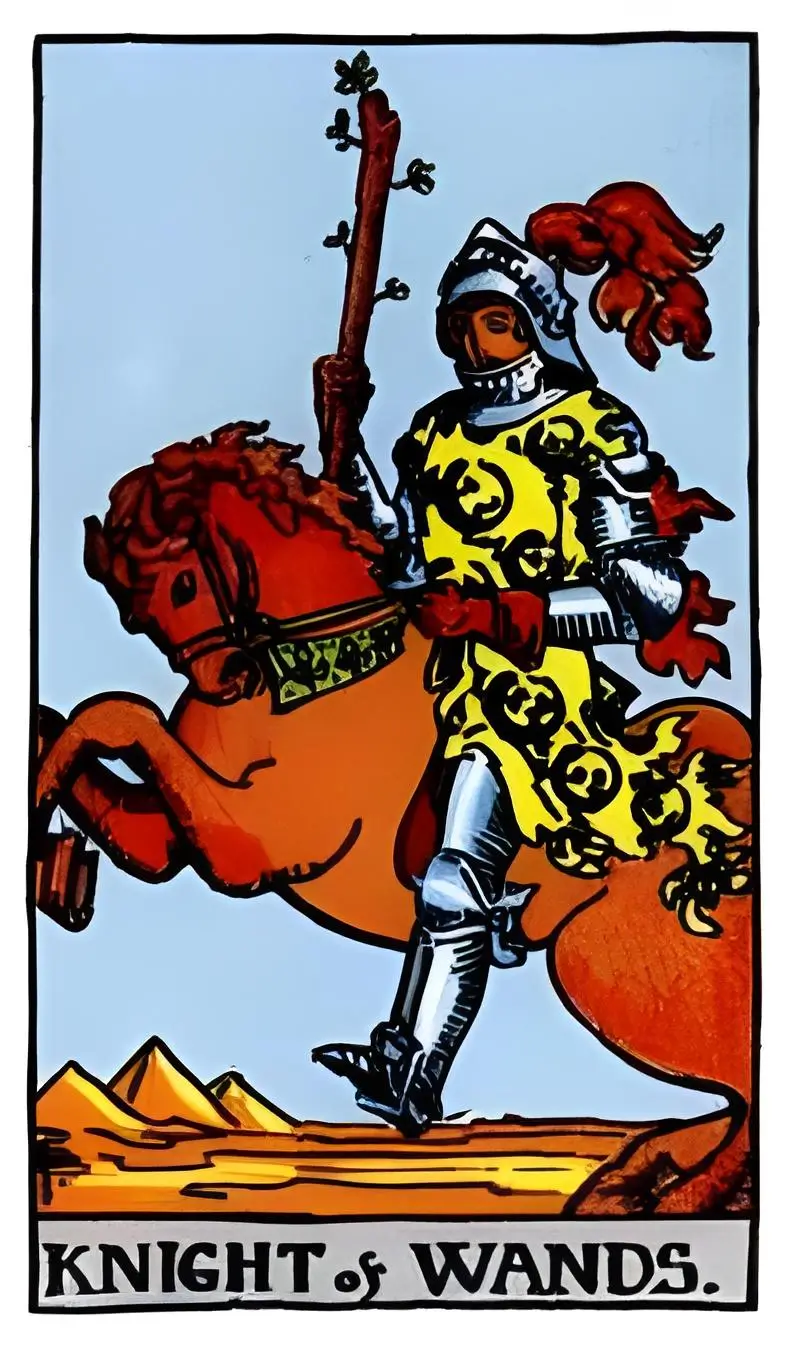
Ang Knight ng mga Crane ay sagot ng isang deck sa court figure na idinudrowing nang iba't iba ng bawat tradisyon. Sa Tarot de Marseille siya ang Cavalier de Baton, isang nakasakay na rider na may hawak na simpleng tungkod, isang tagabukas ng landas na may kabataang enerhiya na binabasa sa pamamagitan ng kulay at numerolohiya sa halip na nakapirming eksena. Sa Rider–Waite–Smith deck, ipininta siya ni Pamela Colman Smith na sumusugod sakay ng isang umaalmang chestnut stallion, nakasuot ng dilaw at kahel na baluti na may disenyong salamander, mga pulang balahibo na umaagos na parang apoy, isang nagyayabong na wand na nakataas sa isang disyerto na may tatlong piramide. Isang sikat na detalye ang nagtatago sa kanyang kasuotan sa paa: ang hindi magkatugmang sapatos na nagmamarka kung gaano kabilis dumating ang tawag sa pakikipagsapalaran.
Sa Thoth deck ni Crowley, ipininta ni Lady Frieda Harris, ang pigura ang namumuno sa court bilang Knight of Wands, isang mabangis na nakabaluting rider sa isang itim at nag-aapoy na kabayo, nagwawasiwas ng sulo sa ibabaw ng isang mane at tanawin ng apoy. Nagbabago ang ranggo ngunit nananatili ang pag-uugnay, Apoy ng Apoy mula Scorpio hanggang Sagittarius. Patuloy na iniimbento muli ng mga modernong deck ang pagsugod, ang ilan ay bilang mga literal na rider, ang iba bilang abstract na pagsiklab ng apoy.
Pinapanatili ng Tarot of New York City ang mabilis na momentum at pinalitan ang kabayo ng sariling makina ng lungsod. Ang umaalmang stallion ay nagiging isang bisikleta na naka-wheelie, ang baluting salamander ay nagiging isang helmet at silweta ng isang messenger, ang nagyayabong na wand ay nagiging isang steel beam na dala sa gitna ng trapiko, at ang disyerto at mga piramide ay nagiging downtown skyline kasama ang Statue of Liberty sa kanyang likuran. Ang babala ay nananatili sa pagsasalin: ang nakataas na gulong sa unahan ay nagsasabi ng parehong bagay na ginawa ng umaalmang kabayo, na ang ganitong kabilis na takbo ay naninirahan sa tabi mismo ng pagkahulog.
Sa kumbinasyon at konteksto
Ang Knight ng mga Crane ay bihirang kumilos bilang isang tahimik na kard. Ang trabaho niya ay pagpapabilis, kaya tinatanggal niya ang nakalaang oras sa anumang katabi niya at itinutulak itong dumating ng mas mabilis at mas mainit. Basahin muna siya para kung gaano karaming bilis ang kayang dalhin ng spread nang ligtas.
Laban sa mabibigat na kard, pinapabilis niya ang paghaharap. Kasama ang The Tower, siya ang biglaang pagtuklas, ang lihim na relasyon o katotohanan na nabunyag ng isang padalus-dalos na galaw, isang istraktura na sumabog nang walang oras para maghanda. Katabi ng Tatlo, Lima, o Sampu ng mga Subway (Swords), siya ay pagkasawi o pagkakanulo na mabilis na naihatid, nananabotaheng bilis na iniiwang walang panalo. Kapag ipinares sa The Moon o ang Pito ng mga Subway, ang pagmamadali ay aktibong itinatago sa likod ng panlilinlang.
Kabilang sa mga kard ng pag-ibig, pinapabilis niya ang pagbubuklod, kadalasang lagpas sa punto ng kaligtasan. Kasama ang The Lovers, nagpapahiwatig siya ng pagbabalik o isang spark na mabilis gumalaw, hinihimok ng higit pang kagalakan ng muling pananakop kaysa sa nakaugat na pag-aayos. Kasama ang Lima o Walo ng mga Copa, siya ang pagkakatuklas ng isang pagkakanulo o ang rider na pisikal na naglalakad palayo patungo sa susunod na nais. Ang romantikong singil ng kard ay totoo sa gitna ng sandali ngunit structurally ay walang sapat na pasensya na kinakailangan para sa mahabang kalsada.
Para sa pagti-timing, karamihan sa mga reader ay kinukuha siya bilang napaka-lapit na, dahil ang apoy ay mabilis masunog. Isipin ang mga araw sa halip na linggo, ang huling window ng taglagas ng kanyang sariling Scorpio-hanggang-Sagittarius span, o ang mga panahon ng fire-sign. Anuman ang pamamaraan na ginagamit ng isang reader, ang Knight na ito ay madalas binabalewala ito at iginigiit na ang bagay ay gumagalaw na, mas mabilis kaysa sa inaasahan ng querent.
Reversed meaning
Reversed, the Knight of Cranes is the messenger who wiped out in the intersection, velocity with nothing to show but bruises. The fire has either turned destructive or run out entirely. It is the classic case of all heat and no follow-through, someone who comes on strong and fades just as fast. Expect inefficient use of energy and hasty actions that create chaos: the deal rushed before the paperwork was read, the project launched before the foundation cured. The core question is whether the failure is too much directionless speed or a complete loss of aim and motivation. The counsel is plain: pull over, check the route, and adjust your actions to what the ground can actually hold.
In love. The whirlwind that flames out between boroughs. Expect emotional turbulence and a lack of discipline, hasty words that breed conflict, passion fading because it was velocity rather than depth. It warns of broken promises or a partner who loses interest once the chase ends, a connection built on intense but superficial attraction with no foundation poured. The reversed knight asks whether this is love or just the wheelie, spectacular and one degree from the pavement.
In career. Momentum dying or the rider losing the handlebars. Interest fades, projects drift, and the once-fast mover coasts into burnout. The opposite failure is a compulsion to execute every idea without planning, which ends in slipped deadlines and sloppy work until the load of tasks becomes the beam that bends your back. Reversed in a career context it also warns of quitting a job too fast out of frustration. The card urges a slowdown: rethink the plan, redistribute effort, and defend time for recovery.
In finances. The courier who lost the package, energy spent and nothing delivered. It warns of losses from impulsive moves, capital sunk into a glossy pitch or a lease signed at first viewing. Expect delays or a launch that misfires, and stop making decisions at intersection speed. It can also flag overheated growth, expansion outrunning its foundation. The profitable move now is the careful one, so brake first and then steer.
In health. The body after too many double shifts, exhaustion and activity that has lost all balance. It points to athletic overload or ignoring fatigue signals until something gives: the strain, the sprain, the wipeout. The burnout can also read as a total loss of the stamina the upright card boasts about. Listen to the body, notice the signals early, and remember that the fastest way through this city is intact.
Historical notes
The Knight of Cranes inherits the long history of the Knight of Wands. In the Tarot de Marseille, which began in northern Italy in the fifteenth century and was popularized in France by the seventeenth, the figure was the Cavalier de Baton. That older card read as youthful enthusiasm and the energetic start of a new venture, a trailblazer rooted in nature and driven by desire, curious and full of potential but short on control. The Marseille tradition used pip-style number cards and generally read without reversals, relying on color and numerology.
The late nineteenth and early twentieth centuries transformed the card. The Hermetic Order of the Golden Dawn folded in Kabbalah, astrology, and elemental dignities, and its Book T gave the mounted figure the title Lord of the Flame and Lightning, King of the Spirits of Fire. Two of its initiates then split over the courts. A.E. Waite kept the medieval ranks of King, Queen, Knight, and Page for the Rider–Waite–Smith deck of 1909, and kept the Golden Dawn's fire attribution for the charging Knight. Aleister Crowley reworked the ranks so that the Knight, mounted on a horse, heads his Thoth court, though both systems give the galloping figure the same span of Scorpio into Sagittarius read as Fire of Fire.
The Tarot of New York City takes that inheritance and gives it an address. The rearing stallion becomes a bicycle popped into a wheelie, the leafing wand becomes a steel beam, the desert and pyramids become the downtown skyline and the towers the beam wants to become, and the medieval field of battle becomes an avenue full of traffic. The Golden Dawn's flame and lightning becomes the city's own charge, ambition on two wheels racing a green light.
Correspondences
Number. As a court card the Knight carries rank rather than a pip number. He sits third in the Rider–Waite–Smith court, behind the King and Queen and above the Page, the active messenger who delivers the suit's energy into the world.
Astrology. The Knight governs the third decan of Scorpio and the first two decans of Sagittarius, the span from 20 degrees Scorpio to 20 degrees Sagittarius, roughly November 12 to December 12. The Scorpio root gives him a heavy, intense undercurrent of brewing power held back before it detonates, and the crossing into mutable Sagittarius releases it as expansive, truth-seeking speed. In the horoscope his home is the Ninth House of long-distance travel and the far horizon, which this deck makes literal in the skyline and the bridge he has not yet crossed.
Element. Fire, and specifically Fire of Fire, the most concentrated elemental charge in the deck. The Knights are the fiery edge of every suit, so the fire Knight is double fire, the primal and most volatile aspect of the element, the lightning flash and the roaring blaze.
Kabbalah. The Knights belong to Atziluth, the highest of the Four Worlds and the realm of pure Emanation. Mapped to the divine name Yod-Heh-Vav-Heh, Fire of Fire aligns the Knight with the Yod of Yod, the first and most primal letter, the initial spark of creation linked to Chokmah, Wisdom, on the Tree of Life. He is the origin point of active energy.
Elemental dignity. As pure Fire he strengthens and accelerates other Cranes and fiery court cards. Beside the Swords his speed sharpens communication, beside the Cups his heat can scald or scatter, and beside the Pentacles his urgency meets the resistance of Earth.
Psychological perspective
The Knight of Cranes is the psyche of pure momentum, the Adventurer who treats the city like it owes him speed. Its patron energy is the bike messenger who knows every gap in traffic, the founder pitching from a folding table who will have an office by spring, the crew chief who volunteers for the impossible deadline. These people react fast, act with total confidence in fast-changing conditions, and physically cannot tolerate standing still. They are contagiously enthusiastic and aggressively honest, without the calculating cunning of the Swords suit, so they are exactly what they appear to be. If angered the fire flares at once, and once the moment passes it is forgotten.
The archetype's lesson is to trust instinct over prolonged deliberation. In any situation that needs momentum, launching a business, pitching an idea, moving across the city, the Knight supplies the courage to act before certainty arrives. His shadow lives one degree past that same instinct. The developmental task is not to extinguish the flame but to aim it, to check the direction before committing the whole body to the delivery.
Reversed, the same engine runs hot with no destination. Energy leaks out of every seam: three gigs taken and none finished, motion mistaken for progress, responsibility experienced as boredom. Passion sours into irritability and impulsive anger, and the rider becomes a big talker whose grandiose claims outrun his discipline. Under the impatience is usually confusion, an aim that was lost and papered over with speed. This is the rider who is brilliant in a straight line and a hazard at every turn, and the work is to build a structure strong enough to sustain the fire past its first burst.
The Knight of Cranes across decks
The Knight of Cranes is one deck's answer to a court figure every tradition draws differently. In the Tarot de Marseille he is the Cavalier de Baton, a mounted rider holding a plain staff, a trailblazer of youthful energy read through color and numerology rather than a fixed scene. In the Rider–Waite–Smith deck Pamela Colman Smith paints him charging on a rearing chestnut stallion, clad in yellow and orange armor patterned with salamanders, red plumes streaming like flames, a leafing wand raised over a desert of three pyramids. A famous detail hides in his footwear: the mismatched shoes that mark how suddenly the call to adventure struck.
In Crowley's Thoth deck, painted by Lady Frieda Harris, the figure heads the court as the Knight of Wands, a fierce armored rider on a black flaming horse, brandishing a torch above a mane and a landscape of fire. The rank shifts but the attribution holds, Fire of Fire from Scorpio into Sagittarius. Modern decks keep reinventing the charge, some as literal riders, some as abstract bursts of flame.
The Tarot of New York City keeps the headlong momentum and swaps the horse for the city's own machine. The rearing stallion becomes a bicycle popped into a wheelie, the salamander armor becomes a helmet and a messenger's silhouette, the leafing wand becomes a steel beam carried through traffic, and the desert and pyramids become the downtown skyline with the Statue of Liberty at his back. The warning survives the translation: the lifted front wheel says the same thing the rearing horse did, that this much speed lives right beside the fall.
In combination and context
The Knight of Cranes rarely acts as a quiet card. His function is acceleration, so he strips the buffer of time out of whatever sits beside him and pushes it to arrive faster and hotter. Read him first for how much velocity the spread can safely hold.
Against the heavy cards he speeds up a reckoning. With the Tower he is the sudden discovery, the affair or the truth uncovered by one impulsive move, a structure blown open with no time to brace. Beside the Three, Five, or Ten of Swords he is heartbreak or betrayal delivered fast, sabotaging speed that leaves no one able to win. Paired with the Moon or the Seven of Swords the rush is being actively hidden behind deception.
Among the cards of love he accelerates bonding, often past the point of safety. With the Lovers he suggests a return or a spark that moves fast, driven more by the thrill of re-conquest than by grounded repair. With the Five or Eight of Cups he is the realization of a betrayal or the rider physically walking away toward the next desire. The card's romantic charge is genuine in the heat of the moment and structurally short on the patience that long roads require.
For timing, most readers take him as very soon, because fire burns fast. Think days rather than weeks, the late autumn window of his own Scorpio-to-Sagittarius span, or the fire-sign seasons. Whatever method a reader uses, this Knight tends to override it and insist the thing is already in motion, faster than the querent expects.
Mga tanong para sa pagninilay
- Saan sa iyong buhay ang ilaw ay nagiging berde sa sandaling makarating ka sa kanto, at ano ang kinakailangan upang kumilos bago sumara ang pagkakataon?
- Nasa iyo ang bilis. Nasuri mo na ba talaga ang address na iyong pagdedeliveran, o mas mabilis kang nagpe-pedal para takpan ang nawawalang direksyon?
- Kapag sumiklab ang iyong apoy, nakakabuo ba ito ng isang bagay sa gabi, o nag-aaksaya lang ng gasolina at nag-iiwan sa iyong pagod sa pulang ilaw?
Ang pangkalahatang kahulugan ay sumusunod sa pagbasang Rider-Waite-Smith — ang sangguniang ginagamit sa buong Tarot Academy. Magbukas ng partikular na deck sa itaas para sa sarili nitong interpretasyon.
Mga madalas itanong
Tuklasin ang Tarot
Pinakabagong Post
Tuklasin ang sinaunang karunungan ng mga tarot card at buksan ang mga misteryo ng iyong espirituwal na paglalakbay. Ang aming blog ang iyong daan tungo sa pag-unawa sa mayamang simbolismo, kahulugan, at praktikal na gamit ng pagbasa ng tarot.