
 EN (English)


Minor Arcana ·
Queen of Cranes
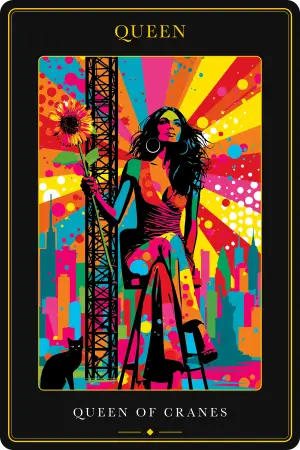
A pop-art woman leans against the crane mast as if she owns the block: fire mastered into warm command, the confidence that makes a whole crew want to work harder.
Card at a glance
- Numerology
- Queen
- Element
- Fire
- Astrology
- Water of Fire: last decan of Pisces through the first two decans of Aries
- Kabbalistic path
- Binah (Understanding) in Atziluth
- Timing
- Spring, Aries season, or a person in the reading
- Yes / No
- Upright yes, reversed no
Upright
magnetic confidence
warm leadership
creative fire
charisma
the woman who builds
vision plus follow-through
generosity
self-assurance
Reversed
ego running the project
burnout
arrogance
jealousy
mood swings
manipulation
insecurity behind bravado
warmth withheld
Queen of Cranes in each deck
Every deck reimagines the same archetype. Compare the art, then open a deck to read its full interpretation.
Imagery and symbolism
In the Tarot of New York City the Queen of Wands becomes the Queen of Cranes, and the throne room becomes a construction site the Queen treats as her own front room. She is drawn as a black pop-art silhouette, a woman leaning against a sturdy crane mast with a pose that is casual and completely in command. She is not straining to hold the mast up. She leans on it the way you lean on something you built. The crane is this suit's symbol of ambition and the build, and she handles it like familiar territory rather than a prize she is still fighting for.
Her crown is a ring of sharp, jagged rays, fire stylized into an ornament and worn on the head. Where the Rider-Waite-Smith Queen wears a crown tipped with leaves, this one wears the element itself, flame turned into a headpiece. Her clothing is a brilliant patchwork of magenta, cyan, yellow, and red blocks. The fire of the suit has been woven straight into the fabric she wears, so she does not merely wield the energy of Cranes, she is dressed in it.
Behind her the New York skyline stands in a vibrant yellow, and in this deck yellow is the colour of intellect and clarity. The city is not an obstacle she has to conquer. It is a bright, legible landscape she already reads at a glance, the block she navigates as if she owns it. A sun bursts in the upper background, throwing out bold rays and halftone dots, the continuous radiant energy she gives off just by being present.
One idea decides the whole card. The Queen of Cranes does not shout to be heard. Her fire has been mastered, so it no longer threatens to burn anything down. It has become the light everyone else in the room reads by.
Core meaning
The Queen of Cranes is the moment you stop asking for permission and start giving directions. She carries warmth, sociability, and a leadership nobody argues with, and she works by moving people rather than just outworking them. In older tarot she is the Water of Fire, the emotional and intuitive part of the fire suit, which is why her power warms a room instead of scorching it. She reads the mood of the city and acts on it with timing that looks effortless.
Her confidence is an achievement, not a starting condition. Because the suit of Cranes is about growth and the build, she is understood to have come through the fear of judgment and out the other side, which is what lets her put her whole self on display without apology. She is the creative director, the seasoned organizer, the boss who will get into the mud with the crew to prove she understands the work. Progress under her comes through collaboration and the plain force of a magnetic personality. Her one honest caveat is that this kind of fire is generous only while it is fed, and a person running the room this hard has to tend her own energy or it turns to smoke.
Upright meaning
Upright, the Queen of Cranes hands you a period governed by confidence and a clear vision. It is a favourable time to lead: gather the room, set the tone, and stop apologizing for your certainty. People follow this Queen because they want to, so the counsel is to act decisively while staying warm, and to treat your intuition and your network as your strongest tools. Open the door and invite the city in.
In love. A relationship with passion, warmth, and strong mutual support, alive and expressive and genuinely fulfilling. The partner it describes is confident and fiercely loyal, someone who lights up the room and chooses to share it with you. For singles it marks a highly attractive phase where independence and magnetism draw attention on their own. Be open and bold, and say plainly what you want.
In career. High visibility and earned respect. You are positioned to lead, inspire, and manage well, your ideas are heard, and your energy sets the pace for the team. It favours promotions, taking charge of a major project, or moving into a role built on strong interpersonal skill. If you are not officially in management you are already acting like it, and your warmth is what makes you hard to replace.
In finances. Financial confidence and proactive management, money earned through your own initiative and the courage to take up space. This is not passive income but a return that rewarded boldness. Trust your instincts, be generous with your success, and stay open to backing from an influential, supportive person.
In health. A body that feels strong, vital, and alive, with excellent energy and a confident relationship to your own physical presence. It points to fitness that comes from joy rather than punishment, dancing and moving and taking up space in the city. You are radiating health, and it shows in how you carry yourself.
Reversed meaning
Reversed, the Queen of Cranes is fire turned to smoke and ash, burned out or controlling or running purely on ego. The confidence curdles into arrogance and the warmth becomes a tool of manipulation. It marks conflict, mood swings, and the attempt to command loyalty without earning it, energy drained by trying to be everything to everyone until nothing is left. Sometimes it points to another person in the situation who acts impulsively and demands attention rather than commanding respect. The counsel is to step back from the mirror, name your limits before you burn out, and rebuild your energy quietly instead of chasing immediate validation.
In love. A fire that scorches: jealousy, possessiveness, or a relationship dominated by one partner's mood swings and ego. There may be manipulation, constant demands for attention, or conflict sparked by insecurity wearing the mask of pride. The connection exhausts rather than supports. Ask honestly who is managing whose emotions, then reestablish the boundaries the relationship lost.
In career. Toxic leadership or a culture driven by ego instead of strategy. Decisions ride on the leader's mood, turnover climbs, and bridges burn, while micromanagement covers for insecurity and image gets prioritized over substance. The business suffers because the fire at the top is uncontrolled. The remedy is to check the ego and restore professional boundaries.
In finances. Mismanagement driven by ego or impulse. Extravagance, reckless investments made to impress, or letting pride set the spending will drain what you have, and a project can bleed money simply because its leadership is erratic. Step away from emotional spending and bring cold, clear strategy back to the accounts.
In health. Exhaustion masquerading as energy, running on adrenaline and caffeine until the crash arrives. It can flag a punishing approach to the body driven by vanity rather than health, with overheating, inflammation, or plain burnout as the risks. Stop pushing to maintain an image. Real vitality needs rest, so step out of the spotlight and let yourself recover.
Historical notes
The Queen of Cranes inherits the history of the Queen of Wands. In the older Tarot de Marseille tradition she is the Reyne de Bâtons, shown looking downward with both hands resting at her waist and the base of a heavy golden wand set in her lap. She is a feminine figure with an overwhelmingly strong personality who speaks softly while holding a big stick, secure enough in her position that she never needs to flaunt it.
The esoteric decks sharpened her. The Hermetic Order of the Golden Dawn gave her the formal title Queen of the Thrones of Flame and fixed her mechanics: as one of the Queens she belongs to Binah on the Tree of Life, and she expresses that form-giving mother energy in Atziluth, the world of pure Archetypal Fire, which makes her the mother of the fire element. A.E. Waite and Pamela Colman Smith, both initiates of that order, published the version most people picture now in 1909, seating her on a throne carved with lions, a sunflower in one hand, a leafing wand in the other, and a black cat at her feet. Aleister Crowley and Lady Frieda Harris pushed her further in the Thoth deck of 1944, wreathing her in flame with a leopard at her side.
The Tarot of New York City takes that long inheritance and gives it an address. The throne of lions becomes a crane mast, the sunflower and leafing wand become a crown of jagged rays and a coat of coloured blocks, and the Golden Dawn's mother of fire becomes the creative director who runs the city block by the warmth of her own command.
Correspondences
Rank. Queen, the form-giving, containing power of the court. A Queen takes the raw force of her suit and grounds it into something stable and sustaining, which for the fire suit means turning ambition into warmth that lasts rather than a flare that spends itself.
Astrology. The Queen of Cranes governs the watery part of Fire, running from the last decan of Pisces through the first two decans of Aries. Aries supplies the initiative, the pioneer spirit, and the confidence to lead, while the Pisces decan adds depth, the emotional intelligence that turns a boss into a leader who can read the room. The blend describes someone who senses the mood of the city and acts on it with perfect timing.
Element. Fire, and in this deck the fire of ambition, construction, and the hustle that raises steel out of bedrock. In her hands it is fire that warms rather than consumes, the emotional engine of the suit that draws people in.
Kabbalah. Binah, the third sphere, called Understanding, in the world of Atziluth. Binah is the supernal mother who gives form to raw force, so seated in the fiery world she becomes the mother of the fire element, the boundary that lets the flame heat the hearth instead of taking down the house.
Elemental dignity. As a fire court card she strengthens other Cranes and fire-sign figures and lends them her warmth and drive. Beside the Cups her fire can either comfort or scald depending on the company, and beside the cold logic of the Swords she supplies the conviction their discernment lacks.
Psychological perspective
The Queen of Cranes describes a psyche that has integrated its own fire instead of fearing it. Her patron energy is the person whose arrival changes the temperature of the room, the connector and organizer who leads through infectious enthusiasm rather than rigid rules. Underneath the charisma is real work: she is confident because she stopped needing external approval, and that is what frees her to put her whole authentic self on display and to smile at the parts of herself she once struggled to like. She acts as her own source of light, which is why she can afford to be generous with everyone else's.
Her developmental task is to keep the fire warm rather than let it turn predatory. Mastery here is not suppression of the primal, driven self but conscious use of it, sitting comfortably on top of the ambition and aggression she once had to tame. True magnetism leaves room for other people to shine, and the healthy Queen knows the difference between a room that revolves around her and a room she has lifted.
Reversed, that balance collapses and the water boils off the fire. The confidence hardens into narcissism and vanity, and the emotional depth that made her perceptive turns into deep, irrational grudges held for far too long. She can become volatile and demanding, snapping at the very people carrying the load, mistaking attention for respect. Often the arrogance is a mask: under the aggressive display sits insecurity, a person dimming or overplaying her own light because she has lost trust in it. The work is to feel the sting, forgive quickly, and turn the focus back toward building rather than defending.
The Queen of Cranes across decks
The Queen of Cranes is one deck's answer to a court card every tradition draws differently. In the Tarot de Marseille she is the Reyne de Bâtons, subdued and secure, looking down with the heavy base of her wand resting in her lap, a woman who speaks softly while holding a big stick. In the Rider-Waite-Smith deck Pamela Colman Smith seated her front-on in a wide, commanding stance, a sunflower in her left hand and a leafing wand in her right, her stone throne carved with facing lions and her yellow dress echoing the sun. At her feet sits the black cat, once an omen of witchcraft and here placed proudly in the spotlight, the shadow self acknowledged without shame.
In Crowley's Thoth deck, painted by Lady Frieda Harris, she is wholly inflamed, her hair merging into the flames around her throne, one hand resting on the head of a winged leopard and a pinecone-tipped wand in her grip. Despite the Shakti fire that engulfs her she radiates a calm, unshakeable composure, the drive to nurture balanced against the drive to conquer.
The Tarot of New York City keeps that composed command and swaps the objects for the city's own. The lion throne becomes a crane mast she leans on, the sunflower and leafing wand become a crown of jagged rays and a coat of magenta, cyan, yellow, and red, the sun behind her head becomes a burst of pop-art rays and halftone dots, and the open country behind the RWS Queen becomes a skyline in clear yellow that she reads like her own block. The cat at the feet gives way to a woman who simply owns the mast, fire mastered into the light the whole city reads by.
In combination and context
The Queen of Cranes usually reads as a person or as the quality of leadership the situation calls for, and the cards around her decide which. As a person she is the confident, generous, fiercely loyal figure who lights up the room, often an inspiring woman or mentor whose support can change the trajectory of your work. As an energy she is the instruction to step up, make the bold pitch, and lead with visible passion.
Beside her elemental counterpart, the King of Cranes, she forms a power couple of two independent, passionate people who amplify each other's zest for life rather than draining it, the tempered warmth of fire meeting its outward, driving heat. With the Sun or other bright cards her optimism is confirmed and her leadership pays out cleanly. Set against the cold logic of the Queen of Swords, the pairing reads as a choice between ruling by warmth and ruling by discernment, or a shift from one to the other.
Her shadow combinations turn the fire toxic. With the Devil her passion curdles into obsession, hedonism, or a manipulative dynamic that traps her formidable energy in an unequal bond. Near the reversed cards of ego and burnout she becomes the overbearing boss or the mean-girl influence, warmth deployed only when she needs something. For timing, most readers place her in spring, in Aries season, or wherever the fire signs of Aries, Leo, and Sagittarius fall, but her clearest signal is simpler: the moment you are ready to lead the room instead of waiting in it.
Questions for reflection
- Where in your life are you ready to stop asking for permission and start giving directions, and what is holding the last of that back?
- The Queen leads people rather than just outworking them. Whose energy could you lift right now, and are you leaving room for them to shine?
- When your confidence has tipped into ego before, what was it covering for, and what would tending your own fire look like instead?
The general meaning follows the Rider-Waite-Smith reading — the reference used across Tarot Academy. Open a specific deck above for its own interpretation.
Frequently asked questions
Explore the Tarot
Latest Posts
Discover the ancient wisdom of tarot cards and unlock the mysteries of your spiritual journey. Our blog is your gateway to understanding the rich symbolism, meanings, and practical applications of tarot reading.




















































