
 EN (English)

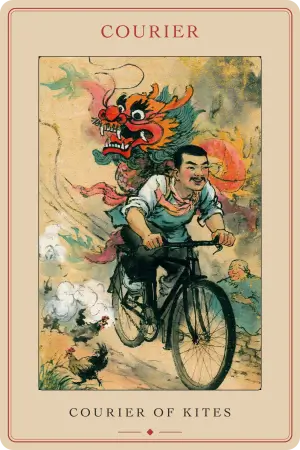
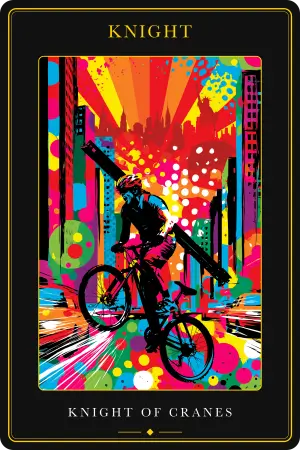

Minor Arcana · Wands (Fire)
Knight of Wands
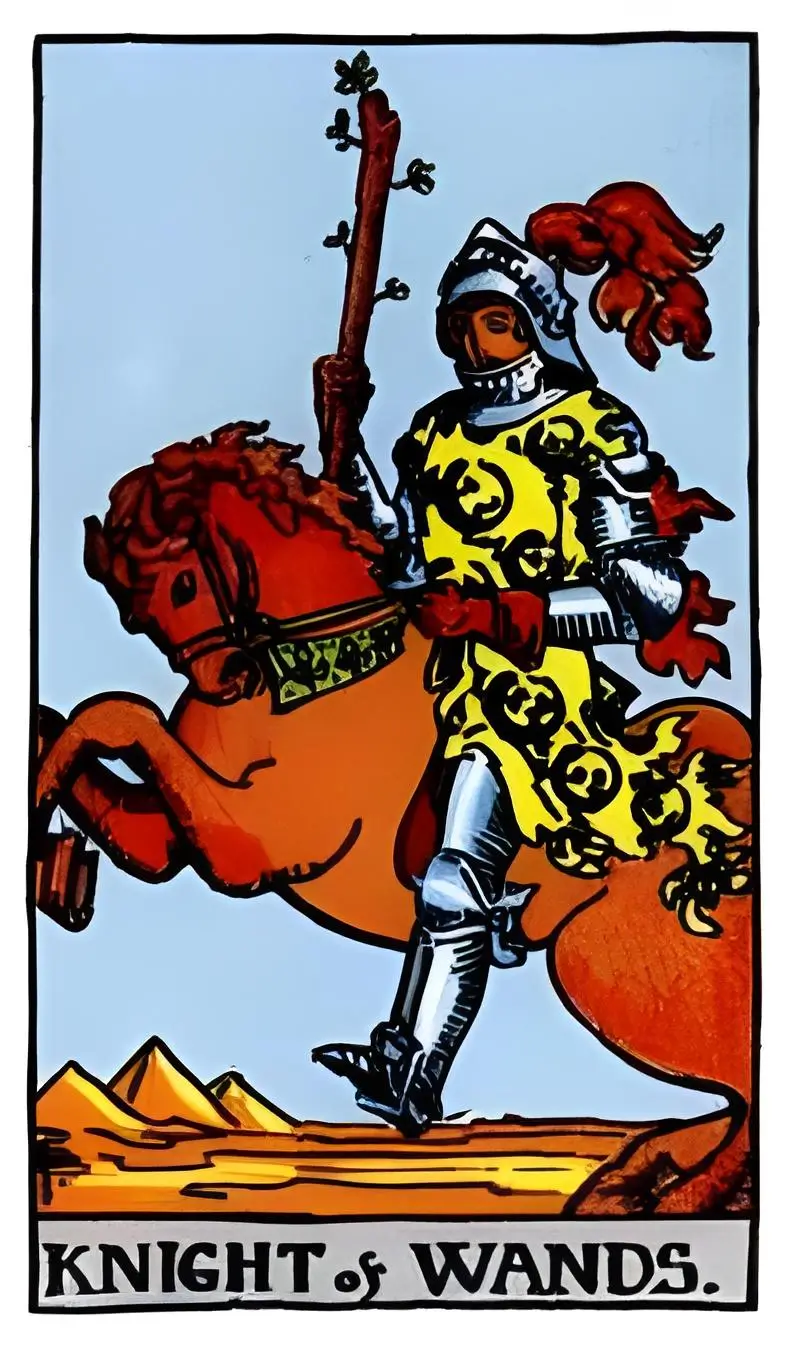
Smith drew the one horse in the deck with both front legs off the ground, and the salamanders on his tunic have not yet closed their circle.
Card at a glance
- Numerology
- Knight
- Element
- Fire
- Astrology
- 20 Scorpio to 20 Sagittarius, Fire of Fire (roughly November 12 to December 12)
- Kabbalistic path
- Chokmah (Wisdom) in Atziluth
- Timing
- Immediate, the fastest tempo in the suit
- Yes / No
- Upright a bold yes, reversed no
Upright
Bold action
Passion
Adventure
Momentum
Charisma
Initiative
Risk-taking
Quick decisions
Reversed
Recklessness
Exhaustion
No follow-through
Scattered energy
Impulsive anger
Loss of direction
Big talk
Delays
Knight of Wands in each deck
Every deck reimagines the same archetype. Compare the art, then open a deck to read its full interpretation.
Imagery and symbolism
Pamela Colman Smith composed this card around a single anatomical decision. The chestnut stallion rears on its hind legs with both front hooves entirely off the ground, caught mid-leap. Set the four Knights side by side and the choice reads as deliberate: the Knight of Pentacles sits a heavy draft horse standing firmly planted, the Knight of Cups rides at a measured pace, and only this mount is airborne. Momentum has already overtaken prudence at the moment of the drawing.
Medieval reality supplies the warning underneath. A knight in full heavy armour thrown from a rearing horse faced disorientation from the impact and often could not find the footing to rise again under the weight of his own plate. Smith drew a rider with immense talent sitting permanently on the razor's edge of disaster.
The armour is yellow and orange, the colours of Fire and of the sacral and solar plexus chakras, and red plumes burst from the helmet and the arm joints and stream backwards so the rider appears engulfed in flame as he moves. He raises a wooden wand sprouting fresh green leaves, held at an aggressive angle like a lance. His shoes do not match. That detail is a psychological signifier rather than an oversight: the call to adventure struck so suddenly that he mounted without properly equipping himself, and his power comes from internal fire rather than from his gear.
Salamanders run in a repeating pattern across the golden tunic. In alchemy the salamander is the elemental creature of Fire, born in flame and immune to it, its twisting body mimicking the curl of a flame. Wearing the motif, the Knight signals that he is not afraid of being burned because he is made of the same substance. Smith then drew the same creature differently one card later: on the Knight's tunic the salamanders are curved but open, mouths not reaching their tails, while on the King of Wands's cloak and throne they close into an ouroboros. The open circle is uncontained potential that has not found its structural limit. The closed one is the discipline that finishes what the Knight starts.
Behind him lies a stark, arid brown desert, Fire's dryness dominating Water and Earth outright, with three pyramids in the distance as the exotic and monumental ambition the suit rides toward. The perspective is engineered so the landscape recedes rapidly, which is Smith's way of saying he is travelling too fast to look at any of it. This deck's own reading of that background adds a second layer: the barren ground warns that uncontrolled fire turns destructive, and the raised land ahead marks the obstacles he is eager to conquer.
Core meaning
In the Rider-Waite-Smith line this Knight is the pure, sudden force of the element, the point where the Ace's internal spark becomes physical action. Waite kept the Golden Dawn's elemental attribution for the charging mounted figure while giving him a medieval name, so the card carries Fire at full concentration with no second principle mixed into it. Crowley's mounted Knight of Wands reads the same way, reserving the chariot-bound intellectualising of Air of Fire for his Prince, the card that answers to the Rider-Waite King.
This deck's own meaning file frames him first as a period of intense activity and initiative: new steps taken to transform your circumstances, energy and ambition arriving together, sometimes in the form of an influential person who shares your goals or inspires the work already underway. The recommendation attached to that reading is direct. Let the energy unfold, move decisively, and do not fear the responsibility or the risk.
The Golden Dawn's title for him, Lord of the Flame and Lightning, the King of the Spirits of Fire, names the hazard as well as the gift. Fire of Fire is the most intense elemental concentration available in the deck, which is why the same figure reads as the visionary entrepreneur in one spread and as a trail of unfinished projects in the next.
Upright meaning
Upright, this deck reads the Knight as quick reaction and the ability to act: energy, adventurousness, courage, an inquisitive mind, and a readiness for rapid change. He makes decisions fast and takes the lead without being asked. He is aggressively honest and plays no mind games, having none of the calculating cunning of Swords, and when he is angered the flare is immediate and the anger is forgotten once the moment passes. The one condition on all of it is aim. Check where the wand is pointing before you accelerate, because speed without direction is his signature failure.
In love. The Rider-Waite reading here is speed and heat together. A new romance develops at incredible pace on mutual enthusiasm and a shared appetite for exploration, with sudden romantic adventures and feelings that intensify quickly. The deck names the instability alongside the generosity and attraction, and it tells you to take the initiative rather than wait. A significant meeting may happen while travelling, or someone arrives and sweeps you off your feet.
In relationships more broadly. Initiative that stimulates lively discussion, joint projects pitched to peers, and a move into managing group dynamics. Enthusiasm and visible self-confidence pull people in, so expect new acquaintances and shared ventures.
In work and business. Resourcefulness and high motivation, a fast new phase of project development, and an increased workload that comes with it. You may introduce new technologies or ideas into daily tasks and master new skills quickly enough to advance. In business the same energy opens new markets, launches a division, and closes major deals. Wands is the most career-positive suit, and the Sagittarian half of this Knight's decan range also ties him to study, research, and teaching.
In money. Rapid financial movement, new income sources, and returns on a courageous venture, provided you stay proactive. This deck is explicit that calculated risk is welcome but optimism alone is not: evaluate your actual capabilities. The fire behind an investment can be genuinely correct while the wallet still has limits.
In the physical realm. A demand for more activity. Intense training, a sports event, a highly active hobby such as dancing, with a sharp rise in stamina. Schedule the rest as well, because this much energy exhausts the body if it is left unmanaged.
Reversed meaning
Reversed, the fire either turns destructive or drains away, and this deck lists both failure modes rather than choosing one: disappointment and exhaustion on one side, recklessness, aggression, and loss of control on the other. What connects them is the gap between what you want and what you can actually do, showing up as awkward attempts to force progress. Plans get postponed, direction is lost, and effort is wasted on poor judgement. The useful diagnostic is whether the trouble is too much directionless speed or a complete loss of aim.
In love. Emotional turmoil and instability. Passion that flared quickly fades just as fast, and interest can vanish as suddenly as it appeared. The deck points to broken promises and a lack of responsibility toward a partner, a connection built on physical attraction with no emotional depth beneath it, and one partner acting purely on their own desires. Modern reading communities have made this the card of love bombing followed by ghosting, which is the same pattern under a newer name.
In relationships more broadly. Conflict rooted in selfishness or plain disinterest, a clash of interests escalating into confrontation, and inconsistency that pushes people away. The initiative can also turn tactless and pushy: boundaries violated, involvement in matters that are not yours.
In work and business. A drop in momentum and loss of professional interest, or the opposite, an uncontrollable urge to push ideas forward without checking the resources, which ends in burnout. In business it reads as frantic activity that produces nothing, sloppy execution, and no strategy behind the bursts of energy.
In money. Delays and wasted capital, spending on poorly considered investments, a failed launch or stalled advancement. Growth may be overheated and want a step back before the losses get heavier.
In the physical realm. Exhaustion and unbalanced activity, sports overload, injuries from badly chosen exercise, and clear fatigue signals being ignored. It can also mark an obsession with training or diet that crowds out basic self-care.
Historical notes
Before Smith, the figure was the Cavalier de Baton of the Tarot de Marseille, a deck that originated in northern Italy in the fifteenth century and became popular in France by the seventeenth. That system uses pip-style number cards and traditionally reads without reversals, so his impulsive self-expression came through colour symbolism and numerology rather than an upended card. The Cavalier is a trailblazer rooted in nature and driven by desire, curious and full of potential, and short on control.
The Golden Dawn rebuilt the court on Kabbalah, astrology, and elemental dignities in the late nineteenth century, and the Rider-Waite Knight is a product of one specific decision inside that rebuild. In Book T, MacGregor Mathers set the court as King (mounted), Queen (seated), Prince (in a chariot), and Princess (standing). Waite reverted to the medieval nomenclature of King, Queen, Knight, and Page while keeping the Golden Dawn's elemental attribution for the charging mounted figure. Crowley went the other way. In his 1912 revision of Liber T and later in The Book of Thoth he formalised the ranks as Knight (mounted), Queen, Prince (in a chariot), and Princess, treating the medieval names as a structural error to be corrected.
The schism is real, but this particular card comes through it intact. Crowley's mounted Knight of Wands is the direct counterpart of Waite's: both run from the twentieth degree of Scorpio through the first two decans of Sagittarius, both are Fire of Fire, and both answer to Yod. What the two systems disagree about is rank rather than content. Crowley's Knight stands at the top of his court, while Waite's Knight sits third behind King and Queen. The card the reshuffle actually displaces is the Rider-Waite King of Wands, whose counterpart is the Thoth Prince of Wands at 20 degrees Cancer to 20 degrees Leo, read as Air of Fire. Comparative studies of the two systems keep producing conflicting elemental and Kabbalistic assignments for what looks like a single card, and this is why. Most modern practitioners work from Rider-Waite-derived decks and read the Knight through the Fire of Fire and Yod lens described below.
Correspondences
Rank. Knight, which in the Golden Dawn scheme carries Fire as its rank element over whatever suit it sits in. That gives Fire of Water for the Knight of Cups, Fire of Air for the Knight of Swords, and Fire of Earth for the Knight of Pentacles.
Element. Fire of Fire, the only doubled attribution of its kind and the most intense elemental concentration in the deck. Macrocosmically it is the sudden lightning flash and the roaring physical blaze, the element in its most violent aspect.
Astrology. He governs from the twentieth degree of Scorpio through the first two decans of Sagittarius, roughly November 12 to December 12. The Scorpio third decan is the ground of the Seven of Cups, the Lord of Illusionary Success, and it supplies his hidden shadow: obsessive fantasy, jealousy, and immense power held back just short of detonation. Crossing into mutable Sagittarius releases it, across the Eight of Wands (Mercury in Sagittarius) and the Nine of Wands (Moon in Sagittarius). This deck adds the natural-horoscope placement, the Ninth House of long-distance travel, philosophy, and higher education, which is where his appetite for distant lands and new ideas comes from.
Kabbalah. The Knights belong to Atziluth, the highest of the Four Worlds, the realm of pure Emanation and primal intuition. Fire of Fire aligns the Rider-Waite Knight with the Yod of Yod in the Tetragrammaton, Yod being the primal letter, the Primal Father, and Chokmah on the Tree of Life. He is the origin point of active energy, and the Thoth Knight of Wands holds the same letter and the same span. It is the Rider-Waite King of Wands who answers to Vav and to the Thoth Prince of Wands, read as Air of Fire, the intellectual application of creativity.
Elemental dignity. As doubled Fire he strengthens every Wand and fiery court card near him and quickens airy Swords into action. Cups and Pentacles work against him, which is the structural reason the water-and-earth business of emotional maintenance and steady finance is where he tends to fail.
Psychological perspective
This is the part of the psyche that stops planning and gets on the horse. The Rider-Waite portrait is consistent about the personality type: progress, courage, and independence, high energy paired with an intolerance for inaction, an open and straightforward approach that clears obstacles by going through them rather than around.
His extreme dualities trace back to the astrology. He carries the emotional intensity, secrecy, and capacity for cruelty of Scorpio and acts them out with the reckless philosophical speed of Sagittarius, which is why he reads as sudden and fierce. He is a figure mid-transition from deep water into open flame. The Sagittarian influence also lends him a sense of luck and near-invincibility, and this deck is candid that the same confidence is what pushes him into danger.
Reversed, the type inverts into someone who cannot use their own energy: scattered, unpredictable, unable to hold a single task, derailing their own progress with hasty decisions, with emotional outbursts and impatience finishing the job. The card's teaching is not to put out the flame for fear of being burned. It is to build a structure strong enough to hold it, which is exactly the difference Smith drew between the Knight's open salamanders and the King's closed ones.
The Knight of Wands across decks
Tarot de Marseille. The Cavalier de Baton is a plainer, less dramatic rider than Smith's. He is a curious and potent youth gathering resources for immediate goals, the foundational Wands association of the suit with action, without the structured discipline that comes later. There are no reversals in the tradition, so his lack of control is read from context rather than orientation.
Crowley-Thoth. This is one of the few court cards the two systems agree on. Crowley's mounted Knight of Wands is the counterpart of Waite's, carrying the same span from 20 degrees Scorpio to 20 degrees Sagittarius, the same Fire of Fire, and the same Yod. The disagreement is over rank: Crowley's Knight holds the top office of his court, Waite's Knight ranks third. The figure the reshuffle genuinely moves is the King, since the Thoth Prince of Wands, titled the Prince of the Chariot of Fire, answers to the Rider-Waite King and reads as Air of Fire, the meeting of air and fire producing expansion and volatilisation. A Thoth reader and a Rider-Waite reader discussing the Knight of Wands are describing the same card at different heights in the hierarchy.
Modern decks. Contemporary decks in the Rider-Waite line keep Smith's core gesture, the rearing horse and the headlong charge, while restyling the medieval knight into their own settings. Some keep a literal rider, others substitute any figure caught in the act of leaping before looking. The salamander and the streaming plumes recur often enough to work as the visual shorthand for unrefined fire in motion.
In combination and context
Measure him against the other Knights, who all deliver their element in motion but at wildly different speeds. He does not analyse the risk like the Knight of Swords, romanticise the journey like the Knight of Cups, or wait for a solid foundation like the very slow Knight of Pentacles. He follows his whims and trades reliability and emotional depth for unfiltered courage, which has real value wherever a situation needs someone to move before certainty arrives.
In questions of secrecy and betrayal his impulsive lust makes him a common indicator of a cheater, someone driven by immediate gratification rather than malice, and particular pairings sharpen the picture. With the Tower he is the sudden explosive discovery of an affair. With the Three, Five, or Ten of Swords he is heartbreak and malicious fallout, or a situation where neither party can win. With the Five or Eight of Cups the betrayal ends in emotional abandonment, or in him walking away toward a new desire. With the Moon or the Seven of Swords the cheating is being actively hidden.
Reconciliation questions get blunt answers. Reversed, and especially beside a reversed Four of Wands, practitioners read him as a definitive no: blocked passion, no movement, an impulsive ending that holds. Upright with the Lovers he says the person does return, but fast and driven by physical desire and the thrill of re-conquest rather than any grounded wish to repair, so the problems that broke the relationship tend to survive it.
Questions for reflection
- Look at where your wand is pointed before you spur the horse: is the direction actually the one you want, or just the nearest thing to charge at?
- Which of your projects died in the desert once the first burst of excitement wore off, and what structure would have kept that fire alive?
- Smith gave the Knight open salamanders and the King closed ones. Which of the two are you wearing right now?
The general meaning follows the Rider-Waite-Smith reading — the reference used across Tarot Academy. Open a specific deck above for its own interpretation.
Frequently asked questions
Explore the Tarot
Latest Posts
Discover the ancient wisdom of tarot cards and unlock the mysteries of your spiritual journey. Our blog is your gateway to understanding the rich symbolism, meanings, and practical applications of tarot reading.




















































