
 EN (English)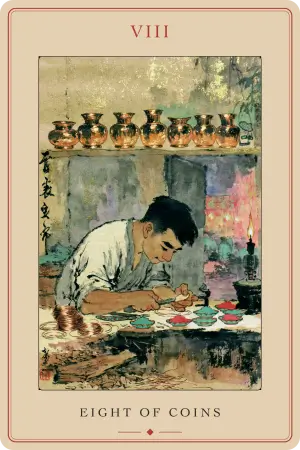


Minor Arcana ·
Nine of Coins
A lady alone in the courtyard she planted, tended, and paid for: earned abundance enjoyed without needing anyone's permission.
Card at a glance
- Numerology
- 9
- Element
- Earth
- Astrology
- Venus in Virgo · second decan (Sept 2–11)
- Kabbalistic path
- Yesod (Foundation) in Assiah
- Timing
- Early autumn · Virgo season · harvest
- Yes / No
- Upright yes · Reversed no
Upright
earned abundance
self-made comfort
financial independence
dignified solitude
refinement
security
self-possession
enjoying what you have
Reversed
borrowed comfort
isolation
money anxiety
dependence
hoarding
wastefulness
low self-worth
enjoyment lost
Nine of Coins in each deck
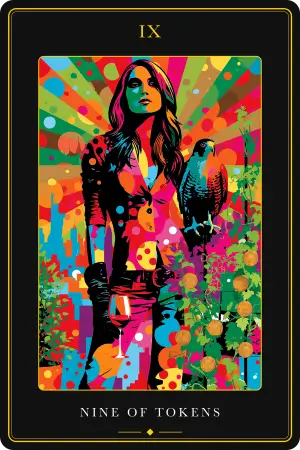
Every deck reimagines the same archetype. Compare the art, then open a deck to read its full interpretation.
Imagery and symbolism
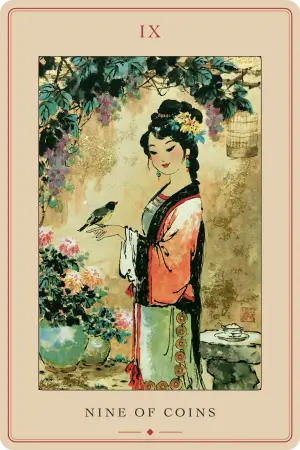
In the Tarot of Beijing the Nine of Coins shows a lady alone in her own small courtyard garden. She stands beneath a grape trellis she trained herself, heavy now with ripe clusters. Potted chrysanthemums bloom at her feet. A songbird steps calmly onto her outstretched hand while its bamboo cage hangs open and empty from the trellis above. Nine copper coins are sewn as ornaments down the hem of her garment, and on a stone table beside her wait a teapot and a single cup. Everything inside these walls she planted, earned, or tamed herself, including the quiet. The scene is drawn in the deck's Feng Zikai manner: a few calm brush lines, muted washes touched with vermilion and teal, warm aged paper flecked with gold, a small red seal in the corner.
The courtyard wall encloses a world she built. It is not a fortress against life but a form given to it. Every element answers one question: what does honestly earned comfort look like?
The grapevine is the classical emblem of abundance in both East and West, and here it is trained along a trellis rather than found growing wild. Wealth in this deck is cultivated, never stumbled upon, and the ripe clusters overhead say the season of labor has passed into the season of tasting. The chrysanthemums, the autumn flower of the scholar's garden that blooms when everything else fades, stand for dignity and refinement: prosperity with character, not just quantity.
The songbird is the deck's answer to the hooded falcon of the old decks. In old Beijing a caged songbird was the connoisseur's quiet luxury, yet this bird's cage hangs open and it stays anyway. What has been well tended no longer needs guarding, so mastery has become trust. The nine coins sewn along her hem are wealth worn as ornament rather than locked in a chest: money in its ripest form, when it has become ease, taste, and freedom of movement. The teapot with its single cup is the card's signature of contented solitude. In a deck where an offered cup is an offered heart, here she pours for herself, and that too is a form of love.
Core meaning
The Nine of Coins is the season when the courtyard you planted finally blooms for you. Long, patient effort has yielded visible reward: a project matures, savings bear fruit, the household runs smoothly, and you may enjoy comfort without guilt. The card speaks of material and inner well-being at once, joining independence and security to the rare skill of being happy in one's own company.
Where the canonical Nine of Pentacles frames this as sovereign leisure in a walled vineyard, the Beijing card grounds the same idea in the hutong courtyard, where sitting in the sun with a bird and a pot of tea is nobody's idea of laziness. Enjoyment here is the whole point of the courtyard, not a break from the work that built it. The lady is alone because she is sufficient, which is the difference between an empty house and a full one that happens to be quiet.
This is earned abundance in the strict sense. Not luck, not inheritance, not anyone's favor, only the real satisfaction of having worked for something and arrived somewhere good. It can mark the fulfillment of a long-held plan, a home finally made truly yours, or the moment your reputation and resources let you set your own terms.
Upright meaning
Upright, the card asks one thing of you: be in your garden long enough to actually enjoy it. Pour the tea that is already on the stone table before you rush to plant the next vine. Care for what you have built, whether home, finances, body, or name, with the same patience that built it, and allow yourself pleasures you have honestly earned. Value your solitude, but keep the courtyard gate unlocked, because self-sufficiency is a strength only as long as it stays a choice.
In love. Maturity, comfort, and mutual respect: the love of two people who each bring a tended garden of their own. Values align, the shared household is cared for both materially and emotionally, and the perception of one another is appreciative rather than infatuated. For those who are single, the card often shows a person genuinely content alone, whose next relationship, when chosen, will be a preference and not a rescue. Such love, entered from fullness, tends to last.
In career. The mastery stage of a career: stable, respected, well-rewarded. Your competence is recognized, your responsibilities run long-term rather than hand-to-mouth, and you carry the quiet authority of someone who no longer needs to prove basic skill. Continue delivering the careful work that built your reputation, and also allow yourself to enjoy the standing you have earned.
In finances. The harvest under the grape trellis: stability, security, and abundance that were cultivated rather than found. Savings have quietly grown, an investment bears fruit, a debt closes, and money stops being a daily worry. Wealth here serves life rather than ruling it. Keep the ledger honest and the trellis in repair, and this stability will hold.
In health. The well-tended garden made flesh: a settled routine of movement, rest, and good food that has become as natural as watering the chrysanthemums. No punishing new regimen is needed, only maintenance of the practices that brought you here. Treat care of your appearance as self-respect rather than performance, and count good tea, sunlight, and unhurried mornings as part of health.
Reversed meaning
Reversed, the Nine of Coins shows the same courtyard gone slightly wrong: the vine untended, the coins on the hem counted nervously every evening, the bird back in its cage for safety. The gate is locked but the mind is not at ease. It points to missed opportunities, anxiety about property and income, or an inability to enjoy achievements that are, in fact, real. Comfort may depend on someone else's money or approval, and independence proves thinner than it looked. Reassess what your walls are for, protection or imprisonment, and put the ledger in order: know what you own, what you owe, and what merely decorates you.
In love. The beautiful courtyard grows quiet in the wrong way. Partners focus on property, comfort, and appearances while emotional closeness thins, so the household functions and the marriage does not. Sometimes self-sufficiency has hardened into isolation, a heart so well defended that no one is invited to tea anymore. Reopen the gate before comfort is mistaken for love.
In career. Stagnation behind a respectable façade: promotion delayed, motivation thinning, an unfinished project weighing on your name. You may cling to a comfortable position that has quietly stopped nourishing you, like a bird that returns to the cage out of habit. Identify where you have coasted on past achievement, finish what is half-done, and restore the balance between the workshop and the courtyard.
In finances. The courtyard's finances gone to weed: income delayed, savings draining faster than they refill, or comfort quietly financed by debt. It warns of spending on appearances while the rice jar empties, or the opposite failure of hoarding so anxious that money brings no ease at all. Separate what you own from what merely decorates you, cut the luxury kept for others' eyes, and rebuild coin by coin.
In health. The garden going untended: neglected routines, dissatisfaction with your physical state, self-care abandoned to work. Sometimes it shows the opposite excess, grooming pursued anxiously as armor for shaky self-worth. Return to gentle, regular tending rather than dramatic correction, and give the body the daily care it quietly asks for.
Historical notes
The suit of Coins traces back to the Italian Renaissance, most notably the Visconti-Sforza decks of the mid-fifteenth century (circa 1441–1447) painted by artists such as Bonifacio Bembo. There the Nine of Coins was an unillustrated pip, simply nine golden discs, made for the aristocratic elite of Milan as both a trick-taking game and a display of dynastic wealth. Its place in wealthy noble courts planted the earliest seed of the card's link to status and material accumulation.
The recognizable modern image arrived in 1909 with the Rider-Waite-Smith deck. Pamela Colman Smith painted a richly dressed woman standing alone in a lush, cultivated vineyard, one hand resting on a pentacle, a hooded falcon on her gloved wrist, a snail at her feet, and a manor in the distance. The Golden Dawn had already titled the card 'The Lord of Material Gain', and Waite assigned it keywords of prudence, safety, accomplishment, and discernment. Smith's touches, drawn from her theatrical and literary background, gave the card its psychological depth: the falcon as mastered instinct, the snail as the slow pace of earned wealth, the Venus glyphs woven into the woman's gown.
The Tarot of Beijing keeps that meaning and re-roots it in a courtyard rather than a European estate. The falcon becomes an uncaged songbird, the vineyard becomes a trained grape trellis, the distant manor becomes the courtyard wall, and the solitary woman becomes the self-possessed lady of the hutong. What survives unchanged is the card's core argument, that true wealth is cultivated by one's own hands and is finally meant to be enjoyed.
Correspondences
Number. Nine, the last single digit, the culmination and completion of a cycle: fruit at full ripeness just before it becomes seed again. It carries wisdom, maturity, and self-sufficiency, the stage at which what was built can at last be inhabited. In the Chinese tradition that saturates this deck, nine (九) is the number of completeness and lasting endurance, a homophone of 久, 'long-lasting', and the imperial number of the old city itself, whose great gates were studded with nine rows of nine nails.
Astrology. The second decan of Virgo, roughly September 2 to 11, ruled by Venus. Virgo is the hand that trained the vine, weeded the pots, and balanced the ledger. Venus is the reason there are chrysanthemums among the vegetables, coins sewn as ornament, and a songbird instead of a guard dog. Together they describe stability that is also lovely: grounded resource management joined to the capacity for delight.
Element. Earth, the deck's suit of 铜钱, the square-holed copper cash of work, body, and household. Heaven round, earth square; the suit keeps both in one small disc. Earth is the slowest of the four elements, and lasting wealth in it is acquired through patient, deliberate work rather than overnight.
Kabbalah. All Nines correspond to Yesod, the Foundation, the sphere of the moon where energy crystallizes just before it manifests. In the suit of Earth this is Yesod operating in Assiah, the world of action and materiality: the moment a financial plan establishes a solid footing in the real world.
Psychological perspective
The person of this arcana is self-made and self-possessed, entirely at ease in their own company. Like the lady of the card, they planted, earned, or tamed everything around them, and their manners carry the quiet confidence of someone who owes nothing to anyone. They know the price of things and also their worth, and they never confuse the two. They are disciplined without harshness and hospitable in the old Beijing way, the teapot always warm for a guest, yet they do not need the guest in order to be content. The rarest art they have mastered is the one the whole suit points toward: enjoying what they have.
The number nine is closely linked with the Hermit, and that solitude runs through this card too. Just as the Hermit withdraws to the mountaintop, the figure here retreats to her walled garden to enjoy her success away from the clamor of the marketplace. The shadow is what happens when that withdrawal curdles. Some become anxious proprietors, outwardly settled but inwardly counting losses that have not happened, unable to relax behind their own walls. Others let comfort harden into isolation, keeping the gate locked and the bird caged, mistaking emotional distance for dignity. Their real work is trust: in others, in the future, and in their own ability to rebuild if the vine ever fails.
Nine of Coins across decks
Rider-Waite-Smith. The canonical card sets a richly dressed woman alone in a walled vineyard, a hooded falcon on her wrist, a snail at her feet, a manor behind her, Venus glyphs on her gown. The Beijing card keeps her solitude and her earned comfort but trades the falcon for an uncaged songbird and the estate for a hutong courtyard, so the same self-sufficiency speaks in a Beijing register.
Tarot de Marseille and early pips. The Visconti-Sforza and Marseille traditions show the Nine of Coins as an arrangement of nine discs with no human figure, a game card that carried value long before it carried narrative. Beijing belongs instead to the scenic, illustrated line that Smith began.
Crowley-Thoth. Crowley titled the card simply 'Gain' and stripped out the human figure, painting three interlinked disks ringed by six planetary sigils on deep emerald green, pure energetic dynamics of wealth. The Beijing card moves in the opposite direction, telling the whole meaning through one woman, one bird, and one pot of tea.
Modern reframings. Recent decks read the card as the 'soft life' and quiet luxury, wealth that whispers rather than shouts. The Tarot of Beijing shares that instinct, its lady in fine cloth pouring her own tea a picture of understated elegance and earned rest rather than flashy display.
In combination and context
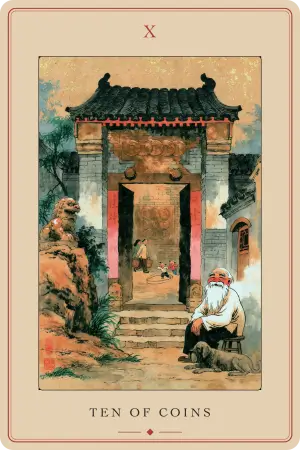
The Nine of Coins pulls a spread toward stability, self-sufficiency, and the enjoyment of earned results. Its meaning shifts with the position it lands in and the cards around it. Beside the Ten of Coins it extends personal comfort into family and legacy, private harvest becoming shared inheritance. Next to the Eight of Coins it shows the artisan's patient labor finally paying its dividend, the seventh vessel shining while the eighth takes shape.
In love spreads the neighbors decide whether the solitude is fullness or retreat. Alongside warm cups and unions it reads as a whole person choosing partnership from abundance. Beside cards of grief or isolation it warns of the gate locked too long, comfort quietly become a cell. In money and business spreads it confirms that resources are ripening and reputation is solid, though a nearby reversed or unstable card asks you to keep the ledger honest and the reserves intact.
When the card keeps returning in a reading, treat it as an instruction rather than a mere forecast. Stop pruning next year's vine long enough to taste this year's grapes. The cage door is open and the bird stays anyway, so notice where you carry that quiet confidence, and pour the tea that is already on the table.
Questions for reflection
- What have you built and paid for with your own hands that you have not yet let yourself sit down and enjoy?
- Is the wall around your courtyard protecting your peace, or has it quietly become the reason no one is invited in for tea?
- Where do you already have enough, and what would change if you trusted that the way the lady trusts the uncaged bird to stay?
The general meaning follows the Rider-Waite-Smith reading — the reference used across Tarot Academy. Open a specific deck above for its own interpretation.
Frequently asked questions
Explore the Tarot
Latest Posts
Discover the ancient wisdom of tarot cards and unlock the mysteries of your spiritual journey. Our blog is your gateway to understanding the rich symbolism, meanings, and practical applications of tarot reading.




















































