
 EN (English)


Minor Arcana ·
Eight of Coins
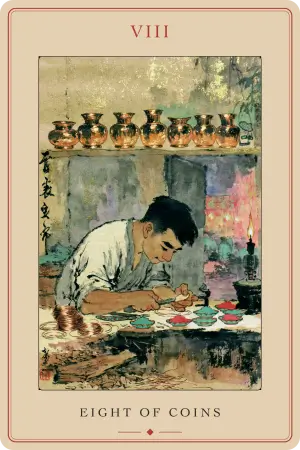
Mastery earned vessel by vessel: a cloisonné apprentice at his bench while the fair passes unheard through the door.
Card at a glance
- Numerology
- Eight
- Element
- Earth
- Astrology
- Sun in Virgo, 1st decan · Lord of Prudence
- Kabbalistic path
- Hod (Splendor)
- Timing
- Late summer · harvest · Aug 23 to Sep 1
- Yes / No
- Yes, if you do the work · Reversed no
Upright
mastery
craftsmanship
diligence
apprenticeship
patient repetition
skill
attention to detail
chosen focus
Reversed
burnout
perfectionism
monotony
cutting corners
stagnation
feeling unseen
lost focus
overwork
Eight of Coins in each deck
Every deck reimagines the same archetype. Compare the art, then open a deck to read its full interpretation.
Imagery and symbolism
In the Tarot of Beijing the Eight of Coins is a cloisonné apprentice bent over his workbench in a lamplit workshop, somewhere behind the noise of a temple fair. Where the Rider-Waite craftsman chisels pentagrams into gold coins on a bench outside a town, this deck moves the same scene into an old Beijing back room and hands the young worker copper, wire, and enamel.
Seven finished copper vessels stand in a row on the shelf above him, glowing where the lamplight catches the gilding. They are the deck's version of the hung pentacles: each one a completed cycle of the same exacting process. The eighth is taking shape in his hands, and that is the whole meaning of the card. After every finished piece the work begins again.
He is caught mid-gesture, shoulders curved, face lowered, file in hand and entirely inside the task. The fine copper wire coiled on the bench is the signature of the craft. Cloisonné is built by bending thin wire into cells one at a time, before any color exists at all, so the wire stands for the invisible preparatory labor beneath every finished result. Beside it sit small lotus-shaped dishes of enamel powder in teal and vermilion, the deck's two accent colors measured out in spoonfuls.
An oil lamp burns at his elbow and tells the hour. It is evening, the fair can be heard faintly through the door, and he does not hear it. The lamp is his own small sun, lit indoors, while the world's entertainment goes on without him. Clipped ends of wire lie scattered on the floor, the honest debris of practice, and the warm glow of the fair bleeds kindly through the open doorway. Nothing chains him to the bench. He stays because the eighth vessel matters more, and that free choice, repeated nightly, is what the card calls discipline. Gold flecks on the kraft-paper wall echo the gilded pots, and a small red seal in the corner marks the work the way a maker signs a finished piece.
Core meaning
The Eight of Coins is the card of the apprentice and the artisan, and in the Tarot of Beijing that is the highest compliment the deck can pay. It marks a stretch of time given over to mastery and skill: patient, repetitive, exacting work that turns learning into expertise the way finished vessels accumulate on a shelf, one at a time, none of them skipped.
The archetype you already know from the standard Eight of Pentacles is present here, the solitary worker refining a craft away from the crowd. What this deck adds is the specific weight of cloisonné, a craft that cannot be rushed and that shows every shortcut. The apprentice becomes a master not through a sudden leap but through the willingness to sit back down at the bench tomorrow evening, and the evening after that.
The card points to knowledge and skill being turned into something stable and secure. It honors the tedium of the fine wire and the small dish of enamel, and it promises that effort here is not wasted. Old Beijing workshops became famous the same way, not by announcing themselves but by never letting a flawed piece out the door.
Upright meaning
Upright, the Eight of Coins asks you to sit down at your bench and let the fair go by for a while. This is a period of real growth through hard, often unglamorous work, the kind that only looks like gold later, on the shelf. Do not shy away from the slow process. Keep learning, focus on raising your competence without neglecting the details, and complete each piece with attention to quality. Self-education matters now: find your master, or become your own.
In love. Stability, reliability, and love practiced as a craft. Care shows in the small remembered detail, the tea poured before it is asked for, the wire-fine attentions that hold a bond's enamel in place. This often marks an active building phase: a shared home, a family, a life arranged vessel by vessel, with devotion proven in repetition rather than declared in fireworks.
In career. The apprentice's card, and here that means skill, learning, and progress toward a new level of mastery. It favors deep specialization over scattered breadth, and it says your professionalism is noticed, perhaps quietly but genuinely, the way a good workshop is known along the whole lane. The seven finished vessels on the shelf are a résumé no interview can argue with.
In finances. Money earned by skill, patience, and hands that do not cut corners. Energy invested in your work is starting to bear fruit: a flourishing career, income from a craft or specialty, or steady returns on patient investment. Enjoy the results while keeping the discipline that produced them, since the eighth vessel still needs its wire. Learning a new technique may raise the value of your hour.
In health. The craftsman's approach to the body: unhurried, regular, precise. It favors steady routines, a consistent diet, faithful appointments kept, and systematic exercise repeated until the form polishes itself. You come to know your body the way the apprentice knows his wire, by long attention, and real progress accumulates like vessels on a shelf, one good day at a time.
Reversed meaning
Reversed, the Eight of Coins shows the apprentice who has begun to hear the fair. The wire slackens in his fingers, the file scratches instead of shaping, and the eighth vessel sits half-clad while his attention drifts through the door. It points to a loss of perseverance and care, to work turned to monotony with no music left in it, or to such fixation on the finished shelf that the piece in your hands is neglected. The opposite fault also lives here: obsessing over tiny flaws, filing and refiling what was already good, sliding toward burnout.
In love. Monotony and emotional flatness, the bond gone all bench and no fair. One partner files away dutifully at the relationship while the warmth drains out of it, or buries themselves in the workshop and keeps missing the important moments. The counsel is Beijing-plain: put down the file some evenings and take your partner to the fair, because cloisonné cracks not from a single blow but from layers laid on without warmth.
In career. The learning has stalled. You may feel stuck at one skill level, an eternal apprentice with no path to the master's seat, and that stagnation is blocking growth. Excessive persistence without renewal leads to burnout, so even the most devoted craftsman must leave the lamp and walk the fair sometimes. Working only for recognition, watching the door to see who admires the shelf, corrodes real development.
In finances. Losing focus, weakening discipline, or work turned into joyless grind that no longer pays what it costs. A full shelf and an empty cashbox. This can warn of burnout, of inattention that spoils otherwise good work, or of effort poured into the wrong vessel entirely. Watch the small numbers and avoid busyness for its own sake, or you risk spending all your copper wire on pieces no one ordered.
In health. The body of someone who has sat too long at the bench: skipped meals by lamplight, a hunched back, strained eyes, rest endlessly postponed for one more task. Or the reverse, a sedentary slump with no desire to move at all. Straighten the spine, step out into the air, and give your health the same discipline you give the work, before the tool dulls and the hand can no longer hold the file.
Historical notes
The card's oldest form is abstract. In the Tarot de Marseille the Eight of Deniers shows two columns of four coins woven with floral motifs, no human figure and no scene. Marseille readers drew its meaning from the eights of the Major Arcana, Justice (VIII) and The Moon (XVIII), and read it as a card of evaluation and inventory: assessing resources, measuring what has been gathered, and discerning what is truly useful.
The narrative image most people picture arrived with the 1909 Rider-Waite-Smith deck. Pamela Colman Smith drew a young craftsman on a wooden bench, dressed in red and blue, carving a pentagram into a coin with hammer and chisel. Six finished pentacles hang on a post, one rests at his feet, one is under his tool, and his back is turned to a distant town, an image of shutting out distraction to pursue excellence. That single figure fixed the card's modern meaning of incremental mastery and focused, solitary labor.
The Tarot of Beijing keeps that Rider-Waite narrative and re-roots it in a real Chinese craft. The bench outside a European town becomes a lamplit cloisonné workshop behind a temple fair. The hung pentacles become seven gilded copper vessels on a shelf, the chisel becomes a file and a coil of wire, and the turned back becomes an open door the apprentice chooses not to walk through. The lesson is the same, dressed in the tools of old Beijing.
Correspondences
Number. Eight, and in this deck a number old Beijing itself treasures, since 八 (bā) sounds like 发 (fā), prosperity. Numerologically eight carries balance, order, and discipline, its two closed loops the endless cycle of the workshop: finish a vessel, begin a vessel. On the Tree of Life the eights sit in Hod, the sphere of Splendor, intellect, and structured mental process, and are ruled by Mercury, which grounds the number in hyper-focused attention and the patient breaking of a large goal into small repeated tasks.
Astrology. The first decan of Virgo, roughly August 23 to September 1, the sign of the craftsman's eye: precision, service, and the refusal to let a flawed piece leave the workshop. Its decan ruler is the Sun, which gives the Golden Dawn its title for the card, the Lord of Prudence. In this deck the Sun has been carried indoors as the oil lamp at the apprentice's elbow, light placed exactly where the work is.
Element. Earth, the material realm of the Coins suit, the element of the square hole in the round copper coin: heaven round, earth square, 天圆地方, and the work exactly coin-sized.
Elemental dignity. As an earthy card in an earthy suit it grounds and stabilizes its neighbors. Challenging cards such as the Five of Coins or a swords card of anxiety pull it toward its shadow of overwork and perfectionism, while cards of completion draw out its promise of skill turned into lasting security.
Psychological perspective
The person of this card has learned to disappear into the work. Esoteric writers call it productive myopia, a Zen-like focus in which the ego dissolves into the task and any tedious job becomes fascinating once the mind looks closely enough at its inner workings. It is the state of the apprentice who does not hear the fair because the wire in his fingers matters more, the flow that turns repetition into a kind of meditation.
At its best this is grounded, self-reliant intelligence: long hours given willingly to complex detail, quiet pride in the seventh vessel done and the eighth begun, a name earned by the work itself rather than by announcement. The shadow is the same Virgoan drive turned against the person. Perfectionism files the copper down to nothing, and the craft becomes armor: a socially acceptable place to hide from the messy, vulnerable reality of human connection. The piercing question the card can ask is whether you are working to grow or working to prove you deserve to exist.
Eight of Coins across decks
Rider-Waite-Smith. A young craftsman on a bench carves pentagrams into coins, six finished works hung beside him and his back to a distant town. This is the source image the Tarot of Beijing adapts, trading the European woodcarver for a cloisonné apprentice and the hung pentacles for gilded copper pots.
Tarot de Marseille. The Eight of Deniers is purely abstract, two columns of coins among floral motifs, read as evaluation, auditing, and the prudent management of what one already owns.
Crowley-Thoth. Crowley and Frieda Harris drop the human figure and title the card Prudence, painting a plant with eight disk-centered flowers. The image shifts mastery from mechanical labor to organic cultivation: growth that cannot be forced, and a warning that weeds left unpulled will strangle the crop.
Modern decks. The Wild Unknown sets a spider at the center of an eight-pointed web, patience as the architecture of reality and a reminder to break big tasks into digestible parts. The Light Seer's Tarot leans into joyous flow and divine timing, and the Modern Witch Tarot places the craft in diverse modern hands, honoring economic self-determination. The Tarot of Beijing sits among these reframings, grounding the archetype in a named, real-world craft that carries the card's meaning without a word of explanation.
In combination and context
The Eight of Coins pulls a spread toward work, skill, and patient accumulation, and its neighbors tell you which stage of the craft you are in. Near the Three of Coins it marks the move from collaborative planning into independent, self-sufficient production, the apprentice who no longer needs the architect at his shoulder. Alongside cards of completion such as the Ten of Coins it reads as skill maturing into lasting security, the shelf that finally fills.
With the Hermit its Virgoan, lamp-lit isolation deepens into genuine retreat, work as a form of inward descent. Beside anxious swords cards or the Five of Coins it tips toward the shadow, overwork and perfectionism that cost more than they earn. In a love spread its meaning depends on the company it keeps: with warm, settled cards it is devotion practiced daily, while with cold or stagnant cards it becomes the partner buried in the workshop who has forgotten the fair.
When the card keeps returning across readings, practitioners treat it as a blunt message to stop looking for shortcuts and commit to a daily discipline, or as a question about whether that discipline has quietly become a hiding place. Either way the counsel is the same: light your lamp, let the fair go by, and do good work on the one vessel in your hands.
Questions for reflection
- What is the one vessel in your hands right now, and are you giving it your full attention or admiring the seven already on the shelf?
- Is your discipline a genuine pursuit of mastery, or has it become a productive place to hide from people?
- Which detail of your craft deserves more patience today, and which fair could you let go by unheard to give it?
The general meaning follows the Rider-Waite-Smith reading — the reference used across Tarot Academy. Open a specific deck above for its own interpretation.
Frequently asked questions
Explore the Tarot
Latest Posts
Discover the ancient wisdom of tarot cards and unlock the mysteries of your spiritual journey. Our blog is your gateway to understanding the rich symbolism, meanings, and practical applications of tarot reading.




















































