
 EN (English)



Minor Arcana · Pentacles (Earth)
Nine of Pentacles
The Rider-Waite woman alone in her vineyard: earned abundance enjoyed on her own terms.
Card at a glance
- Numerology
- Nine
- Element
- Earth
- Astrology
- Venus in Virgo (second decan)
- Kabbalistic path
- Yesod (Foundation)
- Timing
- Early autumn, Virgo season
- Yes / No
- Upright yes · Reversed no
Upright
Self-sufficiency
Earned abundance
Independence
Luxury
Discipline
Rest
Financial security
Gratitude
Reversed
Overwork
Living beyond means
Superficiality
Financial insecurity
Keeping up appearances
Isolation
Envy
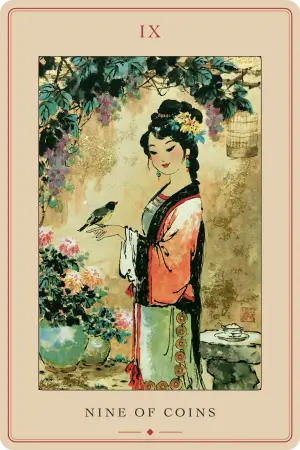
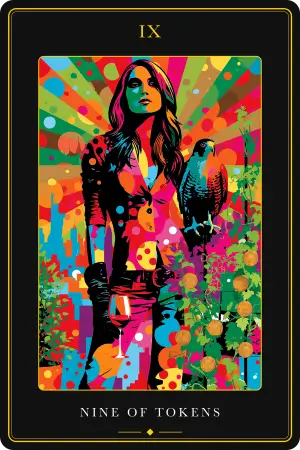
Nine of Pentacles in each deck
Every deck reimagines the same archetype. Compare the art, then open a deck to read its full interpretation.
Imagery and symbolism
The Rider-Waite-Smith image gives the card its familiar scene: a woman in rich garments stands alone in a walled, well-tended vineyard, nine pentacles woven into the vines around her. One gloved hand holds a hooded falcon, and her other hand rests lightly on one of the pentacles. A snail inches across the ground near her feet, and a manor or castle sits far off behind her.
This deck reads the details closely. The headpiece she wears marks her high status, and her bright cloak stands for purity of intention and for protection. Her golden gown is patterned with small red flowers shaped like the glyph of Venus, the planet that rules the card and governs beauty, pleasure, and self-worth; she wears the finery for herself, not for an audience. The falcon stands for talent and the disciplined handling of one's own thoughts and ambition. Its hood keeps it calm and unfocused until the hunt, so the bird reads as wild instinct brought under control, and the heavy gauntlet guards her from her own talons; this deck also takes the bird as her knack for seeing a situation from several angles and putting her skills to work. The snail recalls Rosalind's line in Shakespeare's As You Like It, that a snail comes slowly but armed with his own house, an image of the woman who carries her own security. It also marks the slow pace of earthly wealth, its shell tracing the logarithmic spiral of sacred geometry, and it hints at the small pests that eat away at abundance if left unwatched. The ripe grapes signal maturity and vitality, the enclosed garden her wish to stay in the comfortable, safe world she built herself, and the distant castle the stability and security already won.
Core meaning
The Nine of Pentacles is the card of earned abundance and self-sufficiency. It sits second from last in the earth suit, the culmination of long effort just before the generational wealth of the Ten. The Golden Dawn titled it the Lord of Material Gain. The woman built her comfort through discipline, saving, and study, and she now enjoys the reward without needing anyone's approval.
In this deck her solitude reads as contentment rather than loneliness, and the enclosed garden reads as the safe world she made for herself. On the Tree of Life the number nine belongs to Yesod, the Foundation, the sphere where imagination settles into shape just before it turns solid. In the earth suit that means a plan or a dream has taken firm form in reality, giving a stable platform to stand on. The card is the moment the garden is grown and the gardener is free to walk through it.
Upright meaning
Upright, the Nine of Pentacles says the effort has paid off. Discipline and sacrifice have matured into security, and the querent can step back and enjoy what they built. It carries a steady confidence, the sort that comes from wealth cultivated rather than inherited. The card also insists on rest: the work is stable enough to run on the systems already in place, so leisure and living well are part of the point.
In love. A notably independent card. It often reads as someone whole on their own, admired for that self-sufficiency yet hard to pull into a co-dependent bond. Where a relationship is already settled, this deck frames it as mature and mutual, built on respect and a realistic view of a shared future. As advice about a draining relationship it points toward choosing solitary peace over a partner who takes without giving back.
In career. Thriving work, matured investments, and a reputation that carries weight with colleagues and competitors alike. It frequently marks a hobby turned into a profitable venture, with the field well enough under control that there is room to expand or clear old debts.
In finances. Genuine security, earned and self-made. Money is handled with the careful, discerning eye of Venus in Virgo, quality valued over show, resources put to good use, and room now to enjoy what has been saved.
In health. Confidence in a physical state reached through steady self-care, regular activity, and time outdoors. The advice is to keep the routine that works rather than launch something drastic. As a card of endings it can also mark a significant biological milestone, such as pregnancy or the change of life.
Reversed meaning
Reversed, the ease of the card curdles. One common reading is workaholism: the querent cannot stop or relax, letting the career swallow their health and social life even when the money is no longer needed. The garden is there, but they never sit in it.
The other reading is financial trouble dressed up as success, a flashy lifestyle funded on credit and a designer surface over an empty account, with status and appearances put ahead of real security. It is the reversed card's warning against conspicuous consumption and the hunt for external validation, the hollow feeling that lingers no matter how much is accumulated. In a wider sense it is the bust after the boom, a fortune built in good times now strained by weak long-term planning.
In love. Staying in a hollow relationship for financial security, or an isolation so complete it has stopped being peace and become a cage. Partners may fix on possessions and forget the emotional closeness that once held them together.
In career. Tireless work that feels unrewarded, or a promising start pushed toward decline by neglecting the wider picture. Poor spending and weak management can dent both finances and reputation.
In finances. Living beyond one's means, keeping up appearances, and setbacks that follow from valuing status over stability. Funds drain faster than they arrive.
In health. Burnout from overwork on one side, neglect of the body and lost interest in self-care on the other. Either way it is a call to reassess your habits and take your physical state back in hand.
Historical notes
The earliest Nine of Coins appears in the mid-fifteenth-century Visconti-Sforza decks, painted for the Milanese nobility around 1441 to 1447. There it was an unillustrated pip, simply nine golden discs, used in the trick-taking game of tarocchi and as a display of dynastic wealth. Its placement in those wealthy courts planted the early link between the card and high status and aristocratic leisure.
The scene most readers picture arrived in 1909 with the Rider-Waite-Smith deck. Pamela Colman Smith, illustrating under Arthur Edward Waite, gave the Minor Arcana full scenes for the first time. Her Nine of Pentacles set the elegant woman in her vineyard, drawing on her theatrical and literary background for details like the snail borrowed from Shakespeare. Waite's keywords were prudence, safety, and accomplishment, with roguery and bad faith reversed, though it was Smith's imagery that gave the card the psychological depth readers still work with.
Correspondences
Number. Nine, the last single digit, standing for near-completion and the maturity gathered through the eight stages before it. It echoes The Hermit (Key IX) and his chosen solitude, and numerology also ties it to generosity, a readiness to share both results and knowledge.
Astrology. Venus in the second decan of Virgo (roughly September 2 to 11). Venus governs pleasure and value; Virgo brings analytical rigour and a critical eye. Together they make a careful, discerning approach to both wealth and love, the master farmer discarding spoiled grapes to protect the vintage.
Element. Earth, through the suit of Pentacles: work, body, money, and material results.
Kabbalah. The sephirah Yesod, the Foundation, sphere of the Moon and the astral plane, here operating in Assiah, the world of action, where imagination settles into solid form.
Elemental dignity. As an Earth card it grounds and supports Water cards and steadies Fire, though piled with other earth it can tip from comfort into stagnation.
Psychological perspective
Psychologically, the Nine of Pentacles describes sovereignty, the wholeness of a person who has stopped outsourcing their sense of worth. The hooded falcon is the key image: ambition and appetite are held calm until they are actually needed. This deck reads the same bird as skill under command, the ability to weigh a situation from several angles before acting on it.
Modern readers often meet the card as a redirect. Asked about someone else's feelings, it turns the question back on the querent and their own completeness. Its shadow is the point where independence hardens into avoidance, where the walled garden shuts out connection along with noise, and where achievement becomes a way to prove worth. The card asks whether the solitude is freely chosen contentment or a fortress against being needed.
The Nine of Pentacles across decks
The foundational decks frame the card in different registers, and setting them beside the Rider-Waite-Smith vineyard sharpens what this deck is doing. The Tarot de Marseille and the earlier Visconti-Sforza show it as an abstract arrangement of nine coins, its meaning read from number and value rather than any scene.
Crowley and Harris's Thoth deck titles the card Gain and drops the human figure for sacred geometry: three interlinked disks at the centre, ringed by six coins bearing planetary sigils, set against deep emerald green, the point where planetary forces harmonise into material success. Among modern decks, the Mystic Mondays Tarot replaces the woman with a peacock whose tail carries the nine pentacles, an emblem of earned display, while the Tarot of the Sidhe names it Maker Nine and stresses the deserved return on labour already spent. Against all of these the Rider-Waite-Smith version stands out for its solitary human figure and the psychological weight Smith packed into her.
In combination and context
In tarot communities the Nine of Pentacles has picked up the nickname the Rich Aunt card, the archetype of the woman who is financially secure, travels freely, and stays unbothered by pressure to marry or settle. That colours how it reads beside its neighbours. Next to warm, relational cards it can soften into shared comfort; next to cold or draining ones it becomes a firm case for walking away and keeping one's peace.
Position shapes it further. In a past slot it points to the discipline that built the present security. As advice it says rest, trust the systems already in place, and stop overworking for people who have not earned it. As an outcome it promises earned abundance and independence. In a yes-or-no reading it is a strong yes upright, and reversed a no that asks whether the wealth, or the relationship, is solid or only for show.
Questions for reflection
- What have I built through my own discipline that I have not yet let myself enjoy?
- The falcon on her wrist is powerful but hooded. Where do I hold my own ambition calm until it is genuinely needed?
- If I measured my wealth by peace of mind rather than status, how rich would I be?
The general meaning follows the Rider-Waite-Smith reading — the reference used across Tarot Academy. Open a specific deck above for its own interpretation.
Frequently asked questions
Explore the Tarot
Latest Posts
Discover the ancient wisdom of tarot cards and unlock the mysteries of your spiritual journey. Our blog is your gateway to understanding the rich symbolism, meanings, and practical applications of tarot reading.




















































