
 EN (English)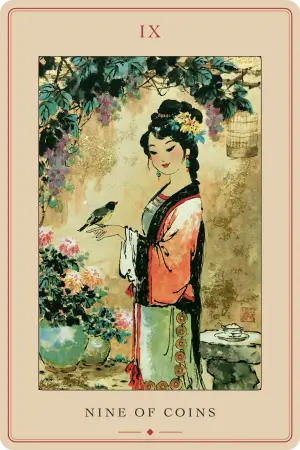


Minor Arcana ·
Ten of Coins
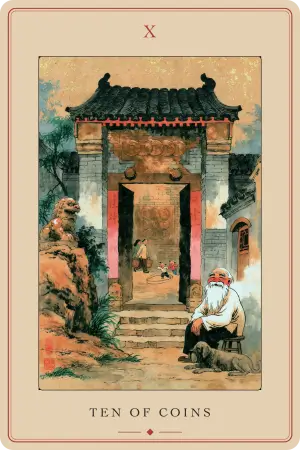
Wealth so old it has become architecture: ten coins set into the screen wall of a courtyard house no one counts anymore.
Card at a glance
- Numerology
- 10
- Element
- Earth
- Astrology
- Mercury in Virgo · third decan (Sept 12–22)
- Kabbalistic path
- Malkuth (the Kingdom) in Assiah
- Timing
- Golden hour · late Virgo season · the long term
- Yes / No
- Upright yes · Reversed no or warning
Upright
legacy
generational wealth
family
stability
inheritance
security
completion
home
Reversed
instability
financial loss
family conflict
gilded cage
inheritance disputes
decay
insecurity
attachment
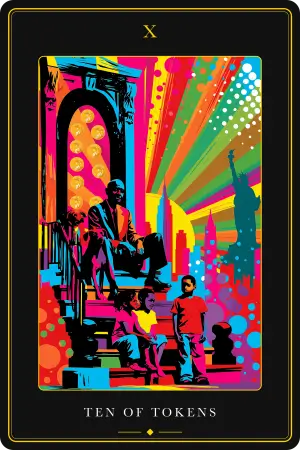
Ten of Coins in each deck
Every deck reimagines the same archetype. Compare the art, then open a deck to read its full interpretation.
Imagery and symbolism
The Tarot of Beijing sets its Ten of Coins at the great gate of an old siheyuan, a courtyard house, at the golden hour of an ordinary day. Three generations occupy the scene at once. A white-bearded grandfather sits on a low stool beside the gate with his eyes closed in contentment, the wisdom of a lifetime resting in what he built. A woman passes through the gateway carrying two loaded baskets, the working generation mid-errand, because prosperity here provisions itself daily and never goes idle. Two children chase a rolling hoop across the threshold, the future playing carelessly in the safest place in their world. An old dog lies at the grandfather's feet, loyalty and peace in a household where even the animals have grown old in comfort.
The ten copper coins appear twice, and both times as ornament that has hardened into structure. A row is molded into the lintel above the gate, and a full pattern of ten square-holed coins is set into the brick screen wall inside the entrance, in the place where a spirit wall traditionally guards the home. This is the deck's central statement of the card: wealth so old that it has become architecture. No one in the family looks at the coins anymore. They walk past them every day. Abundance, at its ripest, is what you no longer need to count.
Every coin is round with a square hole, the old cosmology of heaven round and earth square, so the wall joins the daily to the eternal the way the household joins work, love, and lineage. A stone lion on its rock guards the threshold, marking the family's dignity and standing in the lane. Faded red couplets on the gateposts are blessings written by earlier generations and left in place, still honored as the paper pales. A dark tiled roof with upturned ends shelters everything beneath it, bamboo leans in from the left as the emblem of upright resilience, and the gold-flecked kraft-paper sky lights an ordinary evening from within. The small red seal in the corner is the artist's quiet witness, as on every card of the deck.
Core meaning
This is the suit of Earth at its final completion, the coin that has stopped being currency and become home. The Beijing deck reads the Ten of Coins as lasting prosperity, security, and a life fully and well built: material wealth, stability, and quiet influence rooted in harmony at home. It is well-being achieved long ago and maintained ever since, a meeting with the past and the acceptance of a legacy.
The archetype you already know is the estate, the trust fund, and the family name. What this deck adds is the specific image of enough. The generic Ten of Pentacles can feel like a fortress guarding old money against outsiders. Here the gate stands open, because there is nothing inside that fear built. The grandfather does not guard his wealth. He sits in the middle of it with his eyes closed and lets the life he helped build go on around him, and the deck calls that the highest expression of the card. Abundance is measured not by the coin in the hand but by the coin in the wall: money that has become house, security, and continuity for the people you love.
Upright meaning
Upright, the Ten of Coins signals the approach of financial prosperity or the achievement of lasting material stability. A long undertaking has been completed, a career has reached its peak, or a financial matter has resolved for good, and prosperity may also arrive through inheritance or family support. This is wealth laid brick by brick over a long time, so reliable that the household no longer notices it. The gate is open, the elders are at rest, the children are playing, and the errands of the day move through it all without friction. The system you built now carries you. Sit for a while on the grandfather's stool, relish what stands, and keep investing patient effort without abandoning what you began.
In love. Love that has become a household: comfort, security, mutual respect, and a bond that has reached wholeness and can hold weight. Family values, trust, and a cozy shared home are central, and there may be talk of marriage, children, or the joining of two families into one courtyard. The happiness present now is the fruit of long mutual effort.
In career. Stability, seniority, and prosperity earned over years rather than weeks. You have become part of the load-bearing structure of your workplace, one of the people others build on. It favors a well-knit team, stewardship of an important project, career advancement, or a salary increase, and it confirms your choice of profession: this is a house worth continuing to build.
In finances. Solid material success and security achieved over the long term: savings grown quietly, property that holds its value, inheritance or family wealth, and the generous, unhurried yield of long honest work. The household ledger balances, financial concerns are resolved, and you can enjoy the fruits of your labor and share them with close ones without fear.
In health. The body as a well-kept household: good vitality, steady energy, and a stable condition earned through patient self-care. Consistent exercise and careful eating become visible as strength and endurance. The card points to good constitution, family health, and longevity, like the grandfather who has reached old age in comfort, warmed by the evening sun with the dog at his feet.
Reversed meaning
Reversed, the card shows cracks in the brickwork of the household: instability, crisis, loss of well-being, financial trouble, or family conflict. Often it points to a person so focused on material values that they neglect the living warmth those values were meant to shelter. The courtyard is full, but no one is looking at anyone. There may be a fear of change, a reluctance to loosen your grip on stability, or friction with relatives over property and inheritance. What took generations to set into the brick can be pried out in a single season, so the card urges you to tend the people in the courtyard and not only the courtyard itself.
In love. A shared home where the warmth has gone out of the rooms: family problems, misunderstandings, disputes over money or property, and sometimes a couple who have everything material and have stopped seeing each other across the full courtyard. Open conversation and genuine compromise are needed to restore stability before the distance hardens into the architecture.
In career. Structural or financial problems at work, stagnation, or delays in finishing what should have been done long ago, sometimes an institution living off its old name while the roof leaks. It suggests reassessing honestly, not fearing major decisions, and, if necessary, leaving the gate to be valued elsewhere and redirecting effort toward your real talents.
In finances. A threat to accumulated wealth: a lost job, reduced income, unexpected expenses, a disputed or squandered inheritance, or property troubles. Careless spending or unwise decisions may be draining the household. The card warns of resource depletion and urges frugality and sober awareness, so that habit and pride do not undermine the foundation.
In health. A house maintained by no one: fatigue, depleted reserves, and loss of balance, sometimes rooted in hereditary predispositions or long-standing habits never questioned. Physical well-being is an inheritance that must be actively preserved rather than passively spent, so review your lifestyle, treat the body with care, and begin repairing the wall before winter.
Historical notes
The card the Beijing deck reimagines is the Ten of Pentacles, the final pip of the suit of Earth. The earlier Marseille tradition drew the suit as geometric arrangements of coins with no human figures, so the Ten was simply ten coins in a pattern. The scene of family and estate arrived with the 1909 Rider-Waite-Smith deck, illustrated by Pamela Colman Smith under Arthur Edward Waite, which gave the Minor Arcana vivid allegorical scenes.
The Rider-Waite-Smith Ten of Pentacles shows an elderly patriarch beneath a stone archway, a younger couple and a child, two white dogs, and a family coat of arms carved into the arch. Its ten pentacles are positioned to form the Tree of Life, so an ordinary domestic scene is quietly overlaid with the Kabbalistic pattern of divine order. Smith wove a psychological subtext into the picture too: the figures stand close but make no eye contact, a deliberate critique of the idea that total material security guarantees emotional intimacy.
The Tarot of Beijing keeps the three generations, the old man, and the loyal dog, and translates the estate into a Beijing siheyuan. The Tree-of-Life arrangement of coins becomes a pattern set into the brick spirit wall, and the coat of arms becomes the stone lion and the faded couplets on the gateposts. The deck's most pointed change is emotional. Where the Rider-Waite-Smith family stands isolated and disconnected, the Beijing courtyard is warm: the errands of care move smoothly through an open gate, and the gate stays open because nothing inside was built by fear.
Correspondences
Number. Ten, the number of completeness and fulfillment that also opens the next cycle: the harvest gathered while the field already waits for spring. Numerology reads ten as the movement from one to zero, from the single upright act of will to the boundless open circle. In this deck the pairing takes physical form, since the copper coin is itself a circle with an opening at its center, fullness holding emptiness. Ten coins set into a courtyard wall are ten completed cycles that have become the very structure the family now passes through every day.
Astrology. The third decan of Virgo, roughly September 12 to 22, ruled by Mercury. This is Virgo's energy at its peak, when skill, diligence, and precise patient action yield their reward, just as the courtyard house is the reward of decades of exact unglamorous labor.
Element. Earth: stability, practicality, and firmness. In this deck Earth is the suit of the square-holed copper coin itself, the element of work, body, and household, grounding the card in brick, tile, grain, and kin.
Mercury in Virgo. Mercury brings exchange, accounting, and analysis, the abacus in the shop and the ledger that balances. Under its influence the card emphasizes the wise management of resources, structured thinking, communication across generations, and the quiet administration of a prosperous household. The pairing gives the card its Golden Dawn title, the Lord of Wealth, where wealth is the byproduct of long foresight and careful stewardship.
Kabbalah. Malkuth, the Kingdom, in Assiah, the world of action. As the tenth sphere in the lowest of the four worlds, the Ten of Coins is the most material step of the most material level, the final coagulation of energy into a physical, enduring structure.
Psychological perspective
The person of this card is devoted to family and tradition and builds a whole life around the well-being of the household. Like the grandfather at the gate, they have earned the right to sit quietly, yet their presence still anchors everyone around them. They think in generations, plan for the long term, and build homes that other people feel safe inside. They keep the old couplets on the gateposts and know why they are there.
The strength carries a matching shadow. Because the structure is so solid, it can also feel stagnant, rigid, or overly traditional, a reality so heavy that immense force is needed to change it. The same walls that shelter a family can turn into a gilded cage, where security is used to enforce compliance and belonging is offered only to those who stay inside the name. The card asks the honest work of telling a foundation that supports you from a tradition that traps you, and it warns against loving the material so much that warmth and spirit get crowded out. Its highest expression is the open gate: enough to give from, stability wide enough to shelter others, and the confidence to let the life you built go on around you.
The Ten of Coins across decks
Rider-Waite-Smith. The canonical Ten of Pentacles shows a grey-bearded patriarch, a couple, a child, and two dogs beneath an archway carved with a family crest, its ten coins arranged as the Tree of Life. The figures are pointedly disconnected, a critique of material security bought at the cost of intimacy. The Beijing deck keeps the three generations and the loyal dog but warms the scene, replacing the isolation with the moving traffic of daily care.
Tarot de Marseille. The older Marseille Ten of Coins is purely geometric, ten coins in an ordered arrangement with no human figures, closer to the pattern the Beijing deck sets into its brick spirit wall than to any narrative scene.
Crowley-Thoth. Crowley and Lady Frieda Harris renamed the card the Ten of Disks, titled Wealth, and dropped the human figures for ten coins arranged as the Tree of Life over a heavy sealed vault, most of them marked with the symbol of Mercury. Crowley warned that wealth accumulated past a certain point loses its dynamism and decays into a stagnant vault unless it keeps circulating. The Beijing deck answers that warning through its working generation and open gate: prosperity here is not idle, it provisions itself daily.
Modern reframings. Contemporary decks tend to loosen the card from aristocratic dynasty toward the immediate reality of where you live, a long lease, a safe home, or a community of support. The Tarot of Beijing belongs to that movement, reading the coin in the wall as house, security, and continuity for the people you love rather than as a fortune to be hoarded.
In combination and context
The Ten of Coins pulls a spread toward completion, security, and the long view. Its neighbors reveal whether the courtyard is warm or merely full. Beside cards of emotional fulfillment it reads as a home that is both prosperous and loved, the estate with the warmth still in the rooms. Beside cards of the working world it points to a stable, profitable source of income, sound partnerships, often family or long-standing, and contracts that bring substantial and lasting returns.
With cards of solitary reward, such as the self-sufficient Nine of Coins, it marks the shift from the private garden to the shared courtyard, the moment wealth becomes bigger than just you and must be managed for descendants, employees, or community. In money and business readings it favors preservation, increase, and succession: how to pass the shop, the craft, or the client book into good hands.
Reversed or crossed by difficult cards, the same solidity turns into a trap: inheritance disputes, a family business fracturing over control, or a household coasting on an old reputation while the foundation quietly erodes. When the Ten of Coins keeps returning, treat it as a prompt to look at your own wall clearly, count what you already have, and share something forward, whether time, attention, a resource, or a story from before the children were born.
Questions for reflection
- What have you already built that has become so familiar you walk past it every day without seeing it?
- Which of your walls shelter the people you love, and which have quietly become a cage that keeps them compliant?
- What values, resources, or habits of care are you setting into the wall for those who come after you?
The general meaning follows the Rider-Waite-Smith reading — the reference used across Tarot Academy. Open a specific deck above for its own interpretation.
Frequently asked questions
Explore the Tarot
Latest Posts
Discover the ancient wisdom of tarot cards and unlock the mysteries of your spiritual journey. Our blog is your gateway to understanding the rich symbolism, meanings, and practical applications of tarot reading.




















































