
 EN (English)



Minor Arcana · Cups (Water)
Five of Cups
Smith wrapped a mourner in a black cloak, spilled three cups at their feet, and left two standing behind their back where grief keeps them from looking.
Read the complete guide: The Five of Cups Tarot Card: A Complete Guide to Its Symbolism and Meaning
Card at a glance
- Numerology
- 5
- Element
- Water
- Astrology
- First decan of Scorpio (October 23–November 2), ruled by Mars
- Kabbalistic path
- Geburah (Severity), where the Fives sit
- Timing
- The first ten days of Scorpio, late autumn near Allhallowtide
- Yes / No
- Upright no, reversed yes
Upright
Grief
Loss
Regret
Disappointment
Mourning
Heartbreak
Dwelling on the past
Fear of change
Reversed
Acceptance
Forgiveness
Moving forward
Recovery
Emotional maturity
Release
New perspective
Hope returning
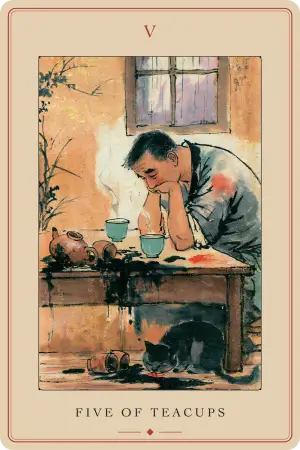
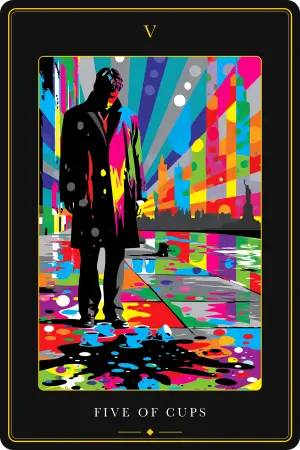
Five of Cups in each deck
Every deck reimagines the same archetype. Compare the art, then open a deck to read its full interpretation.
Imagery and symbolism
Pamela Colman Smith drew this card as a body that has turned away from its own rescue. A solitary figure stands draped in a heavy black cloak, head bowed and shoulders hunched inward under the weight of loss. This deck reads the black cloak twice over: it is the traditional garment of mourning, and it is a wall, the instinct to withdraw and shut out any further hurt during a stretch of acute vulnerability. The figure faces left, toward the west and the setting sun, and that direction does real work in Smith's composition. West is the past, historical memory, the events already behind. The gaze is tethered there, caught replaying the moment of loss and blind for now to anything present or ahead.
At the figure's feet lie three overturned cups, their contents spilling onto bare ground. This deck reads them as missed opportunities and mistakes, dashed hopes and emotional investments that failed to return what was promised. Smith coloured the spilled liquid red and green, and that pairing opens two readings the plainer decks never offered. Red suggests wine or blood, a purified drink poured out or a visceral wound where an essential bond was severed. Green suggests poison or toxicity, which turns the loss ambiguous: if a cup held something harmful, the spill may have spared the figure rather than robbed them, ending a toxic attachment mourned only because it was strong. The grief and the possible mercy sit in the same three cups.
Behind the figure, upright and undisturbed, stand two full cups. This deck reads them as the opportunities that survive the loss, the reserves and connections still able to bring satisfaction, ignored while the figure grieves. The tragedy of Smith's image is not only the spill. It is the self-imposed blindness, the fact that the figure need only turn around to find that not everything is gone.
The background carries the way out. A river flows past the figure toward a sturdy stone bridge, and the bridge leads to a distant castle set among trees. This deck reads the river as emotion in motion and as cleansing water, energy that can be redirected once disappointment is left behind. The bridge is the path to a better future or a spiritual home, the crossing from raw grief into new areas of life. The castle is the stability waiting on the far side. Green grass and trees frame the scene as a tie to the natural flow of life, while the cloudy sky overhead reflects oppressive thoughts and anxiety, or a higher vision put out of reach. At the moment Smith painted, the figure sees none of it: not the two standing cups, not the bridge, only the three that spilled.
Core meaning
This deck reads the Rider-Waite Five of Cups as regret, anxiety and the fear of change. It names a specific ending grieved, the loss of a person, a relationship or a project, and it is honest about the difficulty at the centre of the card: seeing what still remains while the loss fills the whole field of vision. You may feel that everything is over and nothing can improve. Two upright cups behind the figure say otherwise.
Underneath the scene sits the number's severity. Five shatters the settled stability of the four, and in the Qabalah the Fives belong to Geburah, Severity, ruled by Mars, the force that breaks down stagnant form so the soul has to move. Poured into the water of the Cups suit, that force overturns the vessels and floods the querent with sorrow. The card's defining move is the narrowing of sight. Three cups out of five are down, and the figure sees only those three, so present blessings and the bridge to the future drop out of view.
This deck's standing recommendation follows from the image rather than around it. Acknowledge the loss as part of your experience, give the grief its time, then change your perspective to recognise what is still valuable. The card does not deny that something real was lost. It warns against the distortion that calls everything ruined when two cups are still standing just behind you, and it points steadily at the bridge as proof that recovery is a matter of turning the eyes toward what is left.
Upright meaning
Upright, this deck reads active mourning: feelings of loss, disappointment and sadness, grief over an ending, and the difficulty of seeing past it. The figure is caught on the spilled cups and cannot yet turn around. The card validates that pain rather than hurrying it, its cloudy sky and black cloak a reminder that grief has to be sat with before it can be released. The two standing cups are the eventual message, held back until the figure is ready to look.
In love. Loss and deep disappointment, a lost sense of mutual understanding or a loneliness felt inside the relationship, with attention fixed on what went wrong rather than what still works. This deck names the emotional distance that opens as a result and asks for self-reflection, the healing of old wounds, and the forgiveness that lets new opportunities become visible. Around an ex the card turns cautionary: the pull to reach out chases a fantasy of what was lost rather than the reality, and it tends to lead back into disappointment.
In relationships more broadly. A sense of hopelessness whose real task is to stop dwelling on the loss, since self-pity worsens the situation and blocks forward movement. This deck warns that contacts can be tested by conflict, often born of a reluctance to acknowledge what is happening, and it asks you to resolve the past, let go of what is unnecessary, and look for the internal resources that open new pathways for dialogue.
In work. A real setback grieved like any loss: projects that end in failure, missed opportunities, workplace conflict, a genuine sense of disappointment. This deck reminds you that something valuable survives even so, the lessons drawn from the difficulty, and it asks you to reflect on the past and then shift focus to new opportunities. Some goals fell short because interest faded or old methods stopped working, and reassessing the situation is what uncovers the potential still underappreciated in your work.
In business. Disappointments, failures and losses, outcomes that did not meet expectations despite the resources invested, lost clients or unexpected financial setbacks. This deck reads it as a call to reassess strategy and to recognise that some plans are simply not working. Survival depends on seeing opportunity inside the setback, since even amid losses there are new directions for growth and a way out of the crisis.
In money. Losses and disappointments, unsuccessful investments, lost funds, a bad deal or missed opportunity that leaves you sad about your finances. This deck keeps pointing at the two untouched cups: the chance to rectify the situation remains. Review your expenses, sort out your affairs, learn from the mistake and evaluate what truly holds value, because not all is lost and some resources are still worth appreciating.
In the body. Loss or disappointment felt in the body: a sudden decline in well-being, lost fitness, an unexpected change in appearance, and the sadness and dissatisfaction that pull down self-esteem. This deck warns against surrendering to the negative feeling and mourning what is gone, and it turns the same energy toward renewal, a readiness to increase self-care through regular exercise and balanced food while focusing on the good that remains.
Reversed meaning
Reversed, this deck reads the letting go of a negative past and the parting from melancholy and pain. The most suffocating phase of mourning has passed, the gridlock breaks, and the figure lifts their head, lets the heavy cloak fall, and finally notices the two cups still standing. It brings psychological healing, release from old trauma, forgiveness of oneself and others, and an acknowledgment of your own role in the situation. In some cases the reversal shows the opposite, someone still stuck in the past and unable to accept change, where overcoming the lingering fear may take real help such as therapy.
In love. A shift away from a prolonged phase of disappointment. Reassessing things becomes a step toward new relationships, and acknowledging your own mistakes has a healing effect that lets you find more joy ahead. This deck reads the release of grief and a fresh perspective, occasionally a reluctance to move forward because of past sorrow, but mostly a healing process where lessons are learned and the future comes clear.
In relationships more broadly. A breakthrough from stagnation and negativity, a sudden and swift turn in relationships. Negative manifestations decrease, communication starts on a more positive note, and old grievances give way to a new phase of interaction. This deck asks you to open to new opportunities and to shift focus from dwelling on pain toward accepting it, which restores dialogue and deepens understanding.
In work. Time to recover from past losses at work, since too much attention has gone to negative events. This deck asks you to concentrate on the aspects of work that bring satisfaction, which loosens the hold of the past and builds optimism, and it may call for forgiveness where there have been conflicts with colleagues. Perceived failures often prove less dire than they seemed, and the lessons they carry are what let you move on wiser.
In business. Recovery and regained hope after a run of business failures, a chance to revisit strategy and reclaim lost ground. This deck reads the reorganising of processes, an updated product line or new partners, the end of a difficult period and the start of a more productive phase. The losses can turn into renewal, provided you learn from the past errors rather than repeat them.
In money. The ability to learn from mistakes and start again, an emergence from a bad financial state. This deck asks you to accept what happened, adopt a new approach to your resources, and concentrate on what remains rather than what is gone. Say goodbye to past financial troubles and welcome new prospects, while staying cautious enough not to repeat old errors.
In the body. A release from negative feeling about the body and an acceptance of how things are. This deck asks you to accept your appearance, recognise the importance of caring for your health, and revisit old approaches to food and activity. Stop focusing on problems and grievances, see your body's potential instead, and let interest in an active life return.
Historical notes
The scenic Five of Cups most readers picture is a Rider-Waite-Smith invention. In the older decks the Five of Cups was a bare pip, five cups arranged by rule with no figure and no story, carrying its number and its element and little else. Working under A. E. Waite in 1909, Pamela Colman Smith turned that arithmetic into a scene: the cloaked mourner, the three spilled cups and the two standing, the river with its bridge to a distant keep. Her scenic pips let the card be read at a glance, without memorising numerological tables, and the mournful figure became what people now mean by the Five of Cups.
The darker machinery under the picture comes from the Golden Dawn system behind the deck. It fixed the card to Mars in Scorpio and to Geburah, the fifth sphere, a heavy Martian severity dropped into the water of feeling. Crowley and Lady Frieda Harris carried the same attribution into the Thoth deck and named the card outright, "Disappointment," the Golden Dawn's "Lord of Pleasure Lost," the severe force of Geburah overturning the stagnant comfort of the Four.
A calendrical reading adds one more layer specific to this card's placement. The first decan of Scorpio falls in late October, around Allhallowtide and the old festivals of the dead, which reframes the spilled wine as a deliberate libation poured out for those who have passed rather than a clumsy accident. Modern decks keep adapting Smith's scene while holding its structure. Some keep the sun visible over turbulent waves to insist clarity survives the storm. Others set the cups on a sandy shore where the liquid soaks into the earth, an image of grief slowly absorbed while the figure looks out at the open ocean.
Correspondences
Number. Five, the number of change, movement, conflict and instability. It shatters the settled four so the soul is forced out of stagnation, a crisis that demands a decision and marks an emotional turning point on the way toward the harmony of the six.
Astrology. The card is the first decan of Scorpio, roughly October 23–November 2, under Mars. Scorpio is fixed water, the sign of transformation, depth and intimacy that does not shy from confronting hard emotion. Mars, its traditional ruler, brings conflict, severance and a fighting spirit, and working through the possessive waters of Scorpio it produces an intense, cutting grief, the forceful severing of a deep emotional bond.
Element. Water, the element of emotion, intuition and the inner world, cleansing when it is allowed to flow rather than left to stagnate.
Kabbalah. On the Tree of Life the Fives belong to Geburah, Severity or Strength, itself ruled by Mars, the cosmic force that breaks down form to prevent decay. In the Cups suit that severity troubles the water of feeling, which is why the card carries such turbulence.
Elemental dignity. A Water card, it flows with Earth and clashes with the Fire that Mars carries, and that friction shows in its boiling-over quality. Numerology also ties five to The Hierophant (Key V), pointing toward counsel, tradition and support, and to Temperance (1 + 4 = 5), its antidote of patient integration, the angel who pours liquid between cups without spilling a drop.
Psychological perspective
The Five of Cups maps a grief that refuses to be hurried. Its central lesson is that loss hurts most where we resist the change: the harder the figure clings to the spilled cups, the longer the suffering lasts, and healing begins only when the resistance ends and the loss is accepted as real. Older tarot writers illustrate that yielding with Zen stories of Master Hakuin, who accepts a ruined reputation and then relinquishes it again without struggle, a reminder that the fight to hold on is itself the wound.
Modern practice reads the card as a stand against toxic positivity. Telling a grieving person to look on the bright side, or to turn around to the two standing cups before they are ready, is spiritual bypassing, using uplift to skip an unhealed wound that only resurfaces later. This deck's own gentleness runs the same way: acknowledge the loss, name what you are mourning, and let the feeling flow rather than damming it, since expressed grief eventually cleanses where repressed grief festers.
The card also draws a line between two kinds of pain, and readers often set it beside the Three of Swords to do so. The Three of Swords is heartache, the mental cut of a harsh truth or a betrayal, an older and more intellectual wound. The Five of Cups is heartbreak, the raw somatic flood after an ending, the heavy chest and the tears and the low energy. Its gift is permission to mourn, with the quiet promise that the two standing cups will still be there once the tears have run their course.
The Five of Cups across decks
Older pip decks. In the Marseille pattern and the Renaissance decks before it, the Five of Cups is a bare arrangement of five vessels, no figure and no scene, carrying the number's disruption and the suit's water without narrating them. The mourning had not yet been drawn.
Rider-Waite-Smith. The version on this page is the one that gave the card its story. Smith set a cloaked mourner over three spilled cups, left two standing unnoticed behind, and opened a bridge across the river toward a distant castle. The red and green liquids, the westward gaze, the cloudy sky and the black cloak of mourning all belong to her hand, and this deck reads the whole as loss framed for eventual recovery. Everything most readers picture when the card is named comes from here.
Crowley-Thoth. Painted by Lady Frieda Harris and titled "Disappointment," the Thoth version strips the human figure for sacred geometry, five cups drained and troubled by the severity of Geburah in the deep water of Scorpio. No mourner, no bridge, only the emotional weather itself.
Modern decks. Later creators reinterpret Smith's symbols to soften or widen the grief. The Mystic Mondays deck runs five cups vertically along waves, three flowing with one colour and two with another, and keeps the sun visible on the right so optimism stays present through the turbulence. The Modern Witch Tarot spills the cups on a sandy shore where the liquid seeps into the sand, an image of loss absorbed by the earth, while the figure gazes out at the vast ocean. Under each version sits the same structure: what was lost, what remains, and the crossing still ahead.
In combination and context
The Five of Cups takes much of its trajectory from its neighbours. With the Tower it marks a sudden, disruptive breakup or loss, necessary but severe in its fallout. With the Two of Wands it becomes a pivot, grief giving way to ambition and a plan for a new path. With the Star or the Four of Swords it counsels rest and genuine healing rather than a rushed hope for reconciliation, since hope without real work can stay a pipe dream. With Death it points to the grief around a major life transition, not a physical ending, and with the Ten of Swords to an absolute bottom that also means the only way left is up.
The most common question it answers is about an ex, and the answer is usually a caution. Reaching out tends to reopen the wound, driven by a denial of grief and a fantasy of what was lost, so the advice is to grieve the relationship fully before acting on the impulse. For someone single, unprocessed hurt projects onto new prospects and blocks connection, and the past heartbreak has to be finished before the two standing cups of new love come within reach.
Position shapes the card further. As advice it says feel the loss, and then, when you are ready, turn around and cross the bridge. As an outcome it promises that recovery is possible once the mourning has been honoured, the figure lifting their head at last and beginning the long walk toward the castle.
Questions for reflection
- Smith turned the mourner to face west, toward the past and the setting sun. What have you spilled that you keep looking back at, and what would it cost you to face the other way?
- Two full cups are standing behind the figure, unseen. Which reserves and connections has your grief hidden from view right now?
- The bridge in the background leads somewhere and simply waits to be crossed. Are you giving this loss the mourning it deserves before you cross, or trying to skip past it before you have felt it?
The general meaning follows the Rider-Waite-Smith reading, the reference used across Tarot Academy. Open a specific deck above for its own interpretation.
Frequently asked questions
Explore the Tarot
Latest Posts
Discover the ancient wisdom of tarot cards and unlock the mysteries of your spiritual journey. Our blog is your gateway to understanding the rich symbolism, meanings, and practical applications of tarot reading.




















































