
 EN (English)


Minor Arcana ·
Four of Tokens
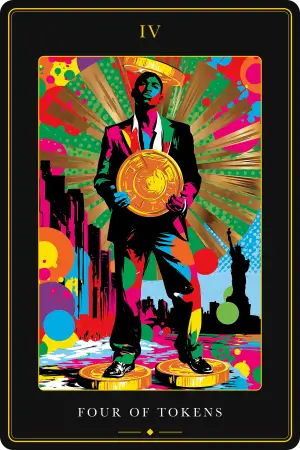
A man in a dark suit stands at the harbor with the whole city at his back, pressing a golden subway token to his chest. Currency made to move, held still.
Card at a glance
- Numerology
- 4
- Element
- Earth
- Astrology
- Sun in Capricorn, third decan (approx. January 10–19)
- Kabbalistic path
- Chesed (Mercy) in Assiah
- Timing
- Deep winter, Capricorn season
- Yes / No
- Upright a cautious yes · Reversed no
Upright
stability
material security
savings
financial control
the rent covered
discipline
self-sufficiency
holding what you earned
Reversed
hoarding
fear of loss
stinginess
missed chances
money leaking out
rigidity
isolation
poverty of spirit
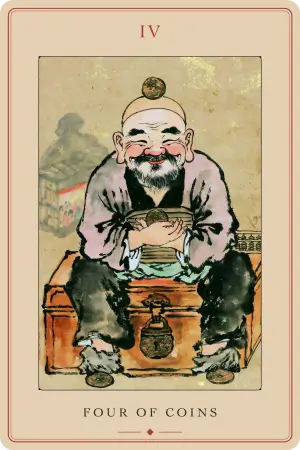
Four of Tokens in each deck
Every deck reimagines the same archetype. Compare the art, then open a deck to read its full interpretation.
Imagery and symbolism
The Tarot of New York City renders the Four of Tokens in the deck's pop-art language: black silhouette planes broken by saturated blocks of pink, green, blue, and red, laid over a field of halftone dots and gold sunburst rays. A man in a dark suit stands at the water's edge of the city. He presses one enormous golden subway token to his chest with both hands, gripping it the way the classic figure of the Four of Pentacles clutches his coin. The token is held close to the heart, protected from loss, and at the same time it covers the heart, so nothing can reach it.
A second token floats above his head like a halo, taking the place of the coin balanced on the crown in the Rider-Waite image. What he owns has become how he thinks: the token crowns him and fixes the ceiling of his thoughts, which circle around preserving what he already has. Two more tokens lie flat beneath his feet, and he stands on them like pedestals over the water. His footing in the city is made of money. It holds him up, and it is all that holds him up.
The token is the deck's suit symbol for the Pentacles: the brass New York subway token, the old physical currency of movement. In his hands it moves no one anywhere. Currency that exists to circulate has been taken out of circulation, and that is the central tension of the card. Behind him the skyline rises in black and pink silhouette, and the Statue of Liberty stands small in the distance: the city of opportunity and the harbor of arrival, both at his back. Like the figure in the classic card who sits facing away from his city, he guards rather than participates. The golden sunburst behind his shoulders marks real prosperity he has accumulated, genuine rather than illusory, while the cool set of his face shows what the accumulation cost.
Core meaning
The Four of Tokens is stability and material security won in a city built to take both from you. Four is the number of structure, and in the suit of Earth that structure becomes a defended perimeter: the rent covered, the accounts in order, the position held token by token against a place that never stops charging admission. The card carries dense earth energy, solidity and cautious conservatism in everything material. It is the most defended card in the suit.
Underneath the security sits a single question. A subway token is worth something only when it is spent, because it is fare for going somewhere. Clutched to the chest, it takes its owner nowhere. So the card holds two readings at once. At its most grounded it is good stewardship, the discipline that carries a person through the years when the math barely works. Past a certain point that same discipline calcifies, and protection turns into hoarding, stability into stagnation. The Four of Tokens is the card of earthly well-being at its most secured, and it asks what exactly is being defended, and from whom.
Upright meaning
Upright, the Four of Tokens reflects steadfastness and financial control. The rent is covered, the accounts are in order, the position is defended. It points to economic independence earned through persistence, the New Yorker who tracked every dollar until the dollars finally stacked. There is real material comfort here, and it was held rather than given. Keep the discipline that got you here, and check whether the grip has become the goal. Money in this city works like the subway: it serves you when it moves.
In love. A bond that has become solid ground, the couple that made it through the roommate years and the two-job stretches into something built. Confidence about the future and mutual support prevail, a partnership durable enough to plan in years. The one caution is that holding a person and holding onto a person are not the same act.
In career. Solid professional ground built carefully over years, the reputation that gets your name said in rooms you are not in. Competence and resources match the responsibilities. A conservative approach fits, measuring each step the way you would read a lease, but apply your experience toward the next stage rather than only defending the current one.
In finances. A solid foundation: savings accumulated through thrift, resources under control, the rare state of not fearing the first of the month. A time to build wealth deliberately and to consider long-term investing rather than letting money sit inert. You held the ground; now decide what the ground is for.
In health. A body maintained the way a good tenant maintains an apartment: the standing gym slot kept like a lease, the routine that survives every deadline. In a city that runs on chaos, a kept rhythm is a fortress, and this card is that fortress standing.
Reversed meaning
Reversed, the Four of Tokens is often fear dressed up as prudence, or control lost the other way entirely. On one side, irrational anxiety about security: checking the balance five times a day, refusing the small pleasure, turning down the opportunity because the deposit felt holier than the future. This is the rent-controlled lease held long after the life around it emptied out, the chances missed because standing on the pile felt safer than moving off it. On the other side, control gone completely, money leaking through a life with no ledger, small charges that quietly total the rent. Either way the relationship with resources has stopped serving the person and started running them.
In love. Emotional stinginess, or a bond kept mainly because leaving feels expensive. Finances and logistics crowd out tenderness until the partnership runs like a well-managed account and feels like one. A heart pressed behind a coin is protected from loss and from love at the same rate.
In career. A position held out of fear rather than choice, the job kept because it pays just enough, the promotion never pursued because the desk is safe. Stability turns into stagnation the moment change stops being an option. Money is not the only ladder in this town; skills, relationships, and reputation climb further.
In finances. Greed and fear of poverty, an obsession with holding that has outgrown its use, or the opposite leak of spending with no plan. Reassess the whole approach: release the choke-hold or restore the discipline. The money was always supposed to buy a life, not just insulation from one.
In health. Attachment to old habits and fear of change, the same three exercises for ten years, the checkup postponed another quarter. A reluctance to invest effort or money in the body while every other account is scrupulously managed. That is false economy; the body is the one property in this town you can never move out of.
Historical notes
The Four of Tokens is this deck's treatment of the Four of Pentacles, a card the Tarot of New York City reimagines through its own suit and setting. In older Continental decks such as the Marseille, the four pip cards of Coins carried no scenic illustration, only four coin emblems in an ordered arrangement, and the meaning was read from number and suit rather than from a figure. The dramatic scene of a person clutching wealth arrived with the Rider-Waite-Smith deck of 1909, illustrated by Pamela Colman Smith, which gave the card its crowned figure gripping one coin to the chest, one balanced on the head, and two underfoot.
The New York deck keeps that exact posture and translates every element into its city. The coin becomes the brass subway token, the deck's suit symbol for Earth and the old physical currency of movement. The medieval throne and distant town become the harbor's edge, the black-and-pink skyline, and the small far figure of the Statue of Liberty. The reading the deck publishes stays faithful to the traditional meaning of guarded material security while grounding it in a specific place, the New Yorker who held their ground dollar by dollar in a city that never stops charging for the privilege of staying.
Correspondences
Number. Four, the number of stability, structure, and the foundation. In this deck the four is the city grid itself, streets crossing avenues at right angles, a regular and predictable system you can count on, which at its edge becomes rigidity, since a grid holds everything in place, including you. The four tokens draw an invisible quadrangle, one at the heart, one at the head, two underfoot, a frame closed on every side.
Element. Earth, the suit of Tokens. The token stands for material reality, work, rent, and value you can hold in your hand, tying the card to analysis, planning, and the careful weighing of every move before it is made.
Astrology. The Sun in the third decan of Capricorn, roughly January 10 to 19. Capricorn is the cardinal earth sign of ambition, structure, and iron self-discipline, the pragmatic climber's sign at home in this city. The ruling planet of the decan is the Sun, which floods the card with vitality and willpower, visible as the golden sunburst behind the figure, and quietly insists that the person holding the token is worth more than the token.
Kabbalah. Chesed, the sphere of Mercy, in Assiah, the dense material world of action. When the expansive majesty of Chesed filters down into the suit of Earth it solidifies into strict structural discipline, a static power grown from peace and security and held defensively in reserve.
Elemental dignity. As an Earth four, the card reinforces other earthy, stabilizing cards and steadies volatile ones, though beside Fire or Air it can read as the drag of caution that slows momentum.
Psychological perspective
Security is a genuine need, and in this city it is never handed out. There is nothing wrong with wanting stable ground, knowing next month's rent is covered, or protecting what you fought to build. The Four of Tokens at its most grounded is simply that instinct doing its job. The psychology turns when the instinct outgrows its purpose. Fixation on the material can start to block emotional and spiritual growth, producing the person who can recite their net worth but not the last time they enjoyed an afternoon.
The deck's figure gives the state a precise shape. He stands with the entire living city behind him, the skyline, the harbor, the statue that welcomed everyone in, and he faces away from all of it, guarding rather than joining. That posture is the inner move the card describes: a protective wall that keeps resources safe and, past a point, keeps out the connection and change that would make the resources worth having. The developmental task is the self-awareness to notice when the wall has stopped being a shelter and become a box, and the willingness to loosen the grip slightly and find that the sky does not fall.
The Four of Tokens across decks
In the Rider-Waite-Smith deck the card shows a crowned figure on a plain stone seat, one coin held to the chest, one on the head, two under the feet, his back to a distant city. The New York deck adopts this composition beat for beat and swaps the coins for subway tokens and the throne for the harbor's edge.
In the Thoth Tarot, painted by Lady Frieda Harris to Aleister Crowley's design, the Four of Disks is titled Power and drawn as a fortress of projective geometry, established law and strength held in reserve. Crowley frames its power as growing from peace and security while warning that overrated attachment to that comfort turns into fear of loss.
Modern decks push toward raw psychology. In Kim Krans's The Wild Unknown, four pentacles lock into an impenetrable diamond bound by threads, background lines failing to reach it, asking whether the querent's safety is genuine or manufactured. In Patrick Valenza's Deviant Moon Tarot the card dwells on the primal fear of losing what one has. Across all of them the shared theme holds: a heavy boundary built to secure resources that ends up trapping its maker inside. The Tarot of New York City keeps that theme and stakes it to one city, where the fortress is an apartment, a lease, and a token that will not be spent.
In combination and context
Spread position sharpens which face of the Four of Tokens is showing. In a money or business layout it leans toward the grounded reading, savings, discipline, a venture past its brutal early years standing on its own tokens. In a love or friendship layout the same energy can read as guardedness, a bond or a circle protected so tightly it becomes a wall with the living city on the other side of it.
Surrounding cards tip the balance. Beside abundance cards like the Ten of Tokens the card shifts from stinginess to prudent saving toward a stable future, a reason to consolidate. Next to an opening card such as an Ace of Cups it can flag a heart guarded against the very overflow the Ace offers. The card that follows it in the suit, the Five, matters most: the tighter the grip in the Four, the more the traditional reading warns that clinging precipitates the loss and cold of the Five. Read the Four of Tokens as a fork. Held with an open hand it is a foundation; clenched, it is the first move toward losing what it was built to keep.
Questions for reflection
- What are you gripping right now that a subway token is standing in for: money, a routine, a role, an apartment that feels safe mostly because it is familiar?
- The whole city is at the figure's back. What have you turned away from while guarding what you have, and what would it cost to turn around?
- Where is the line, for you, between a boundary that protects your resources and a wall that isolates you from the people who make them worth holding?
The general meaning follows the Rider-Waite-Smith reading — the reference used across Tarot Academy. Open a specific deck above for its own interpretation.
Frequently asked questions
Explore the Tarot
Latest Posts
Discover the ancient wisdom of tarot cards and unlock the mysteries of your spiritual journey. Our blog is your gateway to understanding the rich symbolism, meanings, and practical applications of tarot reading.




















































