
 EN (English)


Minor Arcana ·
Three of Tokens
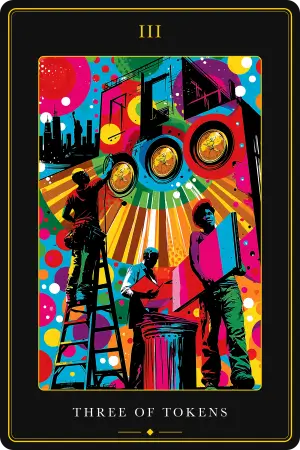
A renovation crew mid-job under a pop-art sunburst, three golden tokens already shining on the wall they are raising together.
Card at a glance
- Numerology
- 3
- Element
- Earth
- Astrology
- Mars · Capricorn (second decan)
- Kabbalistic path
- Binah (Understanding) in Assiah
- Timing
- Early January · second decan of Capricorn
- Yes / No
- Upright yes · Reversed no
Upright
collaboration
skilled craft
the crew that works
apprenticeship on the job
recognition through quality
mentorship both ways
first real results
building something that lasts
Reversed
corners cut
no coordination
the stalled job site
credit to the wrong person
resistance to learning
sloppy work redone
skill going unseen
Three of Tokens in each deck
Every deck reimagines the same archetype. Compare the art, then open a deck to read its full interpretation.
Imagery and symbolism
In the Tarot of New York City the Three of Tokens is the renovation crew mid-job, painted against a pop-art explosion of color. Three figures, three golden subway tokens, and half-built city architecture climbing out of the frame: the deck's translation of the Rider-Waite stonemason, monk, and architect under the abbey arch. The saturated blocks of red, cyan, yellow, magenta, and green carry the card's mood, which is labor as celebration rather than drudgery.
The three tokens hang in an arc across the upper half of the card, each a gold coin set in a bold ring, echoing the three pentacles carved into the abbey stonework of the classic card. Here they are the city's own currency of work, the subway fare that gets you to the job, and their placement high on the unfinished wall says the reward is built into the structure itself. Do the work well and the tokens are already up there waiting. Beneath them a sunburst of rays fans out, the deck's recurring halo, working like a blessing on labor: the light of recognition falls on the crew from the thing they are building, not from any outside authority.
Each figure carries one of the three roles. The worker on the ladder, in a red shirt and cap with tools at his belt, reaches up toward the first token. He is the craftsman, the stonemason of the original scene, and the ladder is one of the deck's honest symbols, since in this city you rise rung by rung and the ladder only stands because someone braced it well. The figure in the white shirt holds the red plans, the architect-consultant, the design side of the work turning drawing into material fact. He stands at a classical column base, a wink at the abbey of the Rider-Waite card and at the courthouse-and-cornice architecture of old New York. The young figure carrying the bright panel is the apprentice hauling drywall. He carries the largest, plainest object on the card, and he carries it looking outward without shame, because in this deck the lowest rung of the craft is honored as the load-bearing one.
Behind and above them the building is unfinished on purpose: raw openings, scaffolding lines, a crane arm crossing the top edge. The Three is an early card, first results rather than final ones, and the black silhouette skyline with the Statue of Liberty on the horizon sets this one job inside the city's endless collective construction. Every tower back there was once this scaffold. The halftone dot fields scattered across the background, the deck's signature texture, read almost as sparks and confetti, the visual noise of a working city. The composition sets the crew low and the tokens high, joined by the ladder and the sunburst: cooperation below, structure rising, reward built in.
Core meaning
The Three of Tokens marks the moment when the work becomes real and shared. This is the Rider-Waite-Smith Three of Pentacles moved to the renovation site, where the electrician, the architect, and the kid carrying drywall raise a wall together because each one knows their part. It shows a period of learning, building, and collaboration: a project underway, a team forming, skills tested against actual material. It tends to appear once you have moved past the idea stage into execution, and once the quality of what you do is starting to be noticed by people whose opinion matters.
The number three is where a pattern first becomes structure. One is the seed, the Ace of Tokens and its single stamped offer. Two is the balancing act of the juggler holding rent against gigs. Three is the triangle, the first shape that holds its own weight, and here that shape is design plus skill plus labor meeting at the same wall. The card's promise for this suit is plain: in New York, craft plus crew plus time is how anything real gets made. It is the city's quietest form of promotion, not the ticker-tape parade but the foreman who asks for you by name on the next job. The structure you are contributing to is sound, and your contribution to it is visible.
Upright meaning
Upright, the Three of Tokens says the building is going up and your hands are part of why. Keep showing up and keep the standard high, because right now the details are being watched and remembered. Ask questions of the people above you and answer the questions of the people below you, since in this card knowledge is supposed to move in both directions. Do not try to carry the whole job alone. The card's entire point is that the wall rises because three different skills meet at it, so share your drawings, listen when the electrician says the plan will not work in the field, and respect the craft of trades that are not yours. If you are offered training, a mentor, or a spot on a more ambitious project, take it.
In love. The relationship is entering its construction phase, two people working on something joint and material: the apartment found, the lease signed together, the wedding planned, the renovation survived. It promises that the skills of partnership, dividing the labor and respecting each other's competence, are present or learnable. It values effort made visible, the partner who shows up and does their part without being managed, and it treats learning each other as a craft in itself. The structure being built here is meant to hold weight.
In career. Being good at your job on a team that functions. It points to productive collaboration where the designer, the engineer, and the coordinator actually mesh, and to recognition arriving through the work itself: the review that notes your craft, the lead who requests you, the promotion justified by visible results. It is an excellent card for the early and middle career, for apprenticeships and probation periods passed with distinction and the first project you are trusted with. Let the quality of the output do your politics for you.
In finances. The point where skill starts converting into income. The crew gets paid because each one is demonstrably good at their piece, and in this city competence compounds. It can mark a raise justified by the quality of your work, a first profitable stretch for a business built with partners, or income from a collaborative project where the whole earns more than the parts. The card favors earned money over lucky money and strongly supports investing in yourself, since skill is the asset with the best yield here.
In health. Treat the body as a structure that responds to skilled, consistent work, and do not do it alone. It favors the training block finally programmed properly and the expertise borrowed or hired: the trainer who corrects your form, the physical therapist who fixes the shoulder, the running club that gets you out at 7am. Progress is incremental and real, measurable strength and better bloodwork earned through repetition rather than a transformation montage. The work you do on this structure now, done correctly, compounds and shows.
Reversed meaning
Reversed, the Three of Tokens is the job site where nothing lines up. The trades are not talking to each other, the plans on paper do not match the conditions in the wall, and the work that gets done has to be torn out and redone. It can point to a project stalling from disorganization, a team lacking coordination or mutual respect, or your own resistance to learning: the apprentice who thinks he is already a master, or the master too proud to explain. Sometimes it simply says the wrong approach was chosen and the sunk cost is making everyone defensive about admitting it. Stop hammering and re-read the blueprints. Get the whole crew in one room, re-establish who does what in what order, and if the problem is skill, get the training instead of hiding the gap, because in this city the gap always surfaces at inspection.
In love. A couple failing as a crew. The chores, the money, the planning, and the emotional maintenance are unevenly split or done at cross purposes, and resentment accumulates like a punch list nobody addresses. It can feel like being roommates on a stalled project, living parallel lives in the same apartment, each keeping score of unrecognized effort. Communication is the broken tool. Name the imbalance without prosecuting it, redistribute the actual labor, and say what you appreciate before listing what is missing. Most structures here are repairable, but both people have to pick their tools back up at roughly the same time.
In career. The dysfunctional job site: roles muddled, communication failing, the project slipping while everyone documents whose fault it is not. It can indicate conflict with colleagues over territory or credit, a manager who does not understand the work well enough to run it, or your own errors surfacing when quality slipped and the inspection failed. It often marks feeling unvalued, doing solid work that vanishes into a structure that never acknowledges it. Get roles stated explicitly, ask for the feedback nobody is volunteering, and close the skill gap with real training. If craft genuinely does not matter where you are, start building the portfolio for the exit.
In finances. Poor coordination or poor craft is leaking money. It can show a partnership where the split does not match the work, a project going over budget because trades and timelines were not aligned, or the classic New York trap of paying twice: hiring cheap, getting sloppy work, and paying again to redo it. It can also flag being underpaid relative to your competence, doing master-level work on an apprentice's check. Put the numbers in writing, tie pay to defined roles, and close the skill gap that is capping your rate.
In health. The bodywork has become disorganized, excessive, or misdirected. It can mean training hard but wrong, no program and no rest built in, effort producing injury and fatigue instead of progress. It may flag conflicting inputs, three influencers and two diets instead of one competent professional, or the city schedule grinding the body down with workouts stacked on six hours of sleep. Rebuild like a professional: one qualified guide, a program scaled to your real schedule, and rest treated as seriously as work.
Historical notes
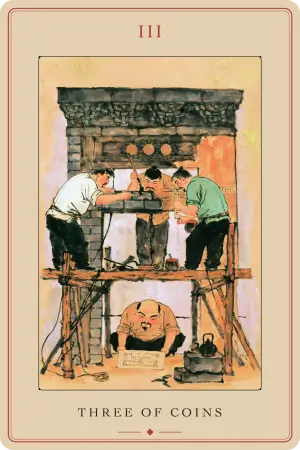
The Three of Tokens inherits its scene from the Rider-Waite-Smith Three of Pentacles, published in 1909 and drawn by Pamela Colman Smith under A.E. Waite's direction. That card set three figures inside the vaulted arches of a stone monastery: a young stonemason elevated on a wooden bench with a chisel, a monk with a tonsured head, and an architect holding building plans, all in deep consultation. Above them three pentacles were carved into the archway in an upward-pointing triangle. Both Waite and Smith were members of the Hermetic Order of the Golden Dawn, and their version broke entirely from the abstract pip tradition, replacing geometry with a theatrical tableau of people at work.
The three figures carry the card's oldest lesson. The monk stands for the spiritual backing, the architect for logic and rational planning, and the mason for physical labor, and the card insists that any great work is completed only when those faculties align. Waite's own reading placed the mason on a bench of scaffolding rather than letting him float, a detail that made human mastery depend on temporary, earthly support. Older traditions framed the same beat differently. In the Tarot de Marseille it was the Three of Coins, three floral coins in a triangular column bound by vine work, a card of realization and the sacrifices that sustainable growth demands. In Crowley and Harris's Thoth deck it became the Three of Disks titled Works, or the Lord of Material Works, its human narrative stripped away for a pyramid built on the bricks of earth with three disks bearing the hourglass of Saturn and the masonic tools of plumb, square, and level. This deck keeps the archetype whole and moves it downtown: the abbey arch becomes a renovation site, the carved pentacles become subway tokens on an unfinished wall, and the mason, monk, and architect become the worker on the ladder, the apprentice hauling drywall, and the consultant holding the red plans.
Correspondences
Number. Three, the number of first manifestation, where separate elements combine into something none of them was alone. It carries creativity, synthesis, and growth, and on this card it is everywhere and always load-bearing: three tokens on the wall, three workers on the site, three roles in the build. This is the three of synthesis rather than the three of celebration, which pours drinks on a rooftop over in the suit of Cups. Here the creative principle wears work gloves, and the triangle it forms is the first shape in the suit that stands on its own.
Astrology. Mars in Capricorn, the second decan of Capricorn from roughly December 31st to January 9th. Capricorn is the cardinal earth sign, the zodiac's builder and climber, supplying the discipline of the job site: the schedule kept, the code followed, the structure that must hold weight for decades. Mars, the decan's ruler, injects drive into that patience, the 6am start and the physical push, and Mars is exalted here, so its fire compresses into productivity rather than scattering into conflict. The second decan specifically marks the phase where work begins to show results, past the cold start of the first decan and not yet the summit of the third.
Element. Earth, the suit of Tokens, carrying money, rent, work, security, and the material grind, everything in New York that must be paid for, built, and maintained. Earth grounds the card in the verifiable: not what you say you can do, but what is on the wall when the scaffold comes down.
Kabbalah. The card sits at Binah, Understanding, the sphere of all the Threes, within Assiah, the dense material world of action. Binah is the great mother of form, the principle that takes raw energy and gives it structure and boundaries, which is exactly the work of turning a drawing into a wall.
Elemental dignity. As a card of skilled, cooperative Earth it stabilizes its neighbors and lends them competence, and it stiffens beside cards of conflict or scattering that break a crew's coordination before the job is done.
Psychological perspective
The Three of Tokens describes the people the city actually runs on: the ones genuinely good at their piece of the work and genuinely able to mesh it with everyone else's. They are craftspeople in the wide sense, a contractor or a line cook or a software lead, marked by practical skill and the habit of doing the job right even when nobody is checking. They collaborate naturally, respecting other trades and giving credit accurately, explaining without condescending and asking without embarrassment. They are usually in some form of continuous learning, watching the older hands or taking the certification course, because they understand that in this city standing still is moving backwards. Many are natural mentors who enjoy bringing a newcomer up to speed, and their ambition runs through quality rather than around it.
The developmental moment the card names is the apprenticeship in its best sense: being around people who know more than you and letting that rub off. It rewards a teachable spirit, the willingness to remain the student, to make mistakes and refine slowly, to embrace feedback as material for the next pass. The shadow side is the refusal of exactly that. Reversed, the personality either bluffs and resents correction, or overestimates itself grandly, the self-declared expert whose work never survives contact with an inspector. Underneath there is often real discouragement, the feeling of being unvalued and of effort disappearing into a structure that never says thank you. The card's counsel is to choose humility or a better room, because the alternative is a project that stalls and a reputation that thins.
The Three of Tokens across decks
The same collaboration appears in different settings across the tradition, and this deck's contribution is to move it to a working renovation site and set it inside the city's endless construction. In the Rider-Waite-Smith deck the scene is three figures under a monastery arch, a stonemason on a bench with his chisel consulting a monk and an architect who holds the plans, three pentacles carved above them in an upward triangle, the picture of spiritual, mental, and physical faculties brought into alignment.
The Tarot de Marseille shows the abstract Three of Coins, three floral coins arranged in a triangular column bound by organic vine work, a card of realization and the growth that costs something. In the Thoth deck Crowley and Harris title it Works and strip away the human narrative for a pyramid built on the bricks of earth, three disks floating above it carrying the hourglass of Saturn and the masonic plumb, square, and level, the meaning shifted from the crew to the cosmic mechanics of endurance. The Tarot of New York City keeps the archetype whole and swaps the abbey for the scaffold: the mason becomes the worker on the ladder in a red cap, the monk and architect become the apprentice hauling drywall and the consultant holding the red plans, the carved pentacles become three golden subway tokens shining on an unfinished wall, and the sunburst halo falls on the crew from the building itself. The Statue of Liberty and the black skyline flank the job, and the lesson stays the same across all four: design, skill, and labor have to meet at the same wall for anything to stand.
In combination and context
Numerologically the Three of Tokens is the step past the balancing act of the Two, the moment a divided effort resolves into a structure that holds its own weight. It grounds the number three in the material world, in floors and invoices and skills certified, and its promise is that structured, combined effort at this stage compounds: the triangle built now becomes the foundation of the Ten of Tokens' brownstone, the legacy held for three generations. Surrounding cards shift its weight. Beside romantic cards it sheds any ambiguity and marks a couple who can both love each other and build a life together. Beside a card of exploitation or entrapment it can warn of corrupt office politics or a golden cage, work that pays but chains, and beside cards of secrecy it can raise the old third-party anxiety, a hidden collaboration not yet brought to light.
Spread position changes its job. As advice it asks for exactly what the crew is doing on the card: raise your standard, ask for help, respect the other trades, and let the work be seen. As a challenge it can flag the reversed problem, a team failing at coordination or your own resistance to being taught. Asked for timing it favors the patient, incremental pace of the second decan of Capricorn, progress measured in one course of bricks rather than a finished skyline. The card's steady counsel holds across positions: do the work well, do it together, and the tokens are already on the wall.
Questions for reflection
- Which part of your current project are you trying to carry alone that clearly needs a second or third pair of skilled hands, and what is stopping you from asking?
- The card honors the apprentice hauling drywall as the load-bearing role. Where in your life are you the student right now, and are you carrying that role without shame or pretending you are already the master?
- If someone inspected the quality of what you built this week, not the speed of it, what would they find, and which corner did you cut hoping it would not show?
The general meaning follows the Rider-Waite-Smith reading — the reference used across Tarot Academy. Open a specific deck above for its own interpretation.
Frequently asked questions
Explore the Tarot
Latest Posts
Discover the ancient wisdom of tarot cards and unlock the mysteries of your spiritual journey. Our blog is your gateway to understanding the rich symbolism, meanings, and practical applications of tarot reading.




















































