
 EN (English)



Minor Arcana · Pentacles (Earth)
Four of Pentacles
A crowned figure clutching four coins with the city at his back: security held so tightly it hardens into stagnation.
Card at a glance
- Numerology
- Four
- Element
- Earth
- Astrology
- Sun in Capricorn (20°–29°)
- Kabbalistic path
- Chesed (Mercy)
- Timing
- Mid-to-late January, or a phase of consolidation and holding
- Yes / No
- Upright conditional yes · Reversed no
Upright
Stability
Security
Saving
Control
Boundaries
Conservation
Possession
Status quo
Reversed
Hoarding
Fear of loss
Greed
Release
Overspending
Letting go
Isolation
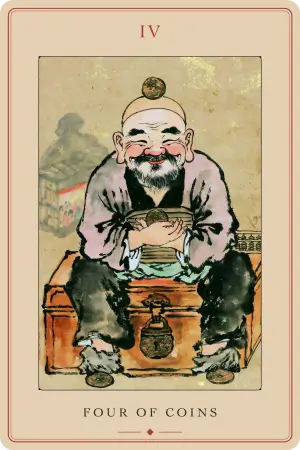
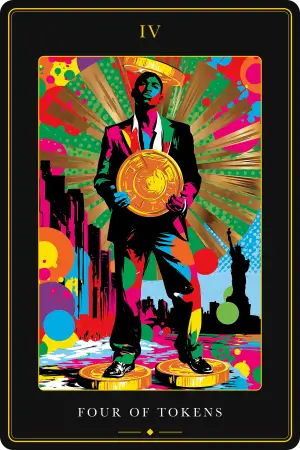
Four of Pentacles in each deck
Every deck reimagines the same archetype. Compare the art, then open a deck to read its full interpretation.
Imagery and symbolism
Pamela Colman Smith's Four of Pentacles is stark and cautionary. A crowned figure, often read as a minor king, sits on a plain gray box of a stone throne. There are no flowers and no growth, none of the lush garden that fills the Nine or Ten of the suit; the setting is sterile, and the wealth in it is cut off from anything that lives and cycles. Waite and Smith went out of their way to add this figure: the deck keeps only four Kings and one Emperor as its crowned authorities, and here they placed a fifth, a deliberate choice that marks the card.
The posture is the whole message. The figure clutches four gold coins, each stamped with a pentagram, and their placement is anatomically exact, blocking the energy centres of the body. One coin sits on the crown of the head, a mind wholly given over to material concern and cut off from anything higher. One is clamped to the chest and throat by both arms, shielding the heart and the voice, guarding feeling as if it were a finite hoard rather than something shared. Two rest under the feet, grounding the figure in wealth but making a single step forward impossible. He is frozen by his own grip.
He sits with his back turned to a bustling city, a conscious refusal of community and the flow of exchange that a healthy economy runs on. In this deck the city is open and ringed with green trees, real opportunity waiting just behind him while he stays inside the familiar. He looks straight out at the viewer, a rare thing in the Minor Arcana that it shares mainly with the King of Swords and the Nine of Cups, and the gaze fixes the card in a stubborn contentment with things exactly as they are. His red and black clothing reads as practicality, responsibility and an appetite for power, while yellow dominates the card, tied here to intellect, energy, growth and prosperity. A crowned figure in the suit of Earth also links the card by number to The Emperor (IV) and to Death (XIII, which reduces to four): the quiet warning that what stops flowing and refuses to change risks necrosis.
Core meaning
In the Rider-Waite-Smith deck the Four of Pentacles is the anchor of the material suit, the point where potential hardens into something owned and held. Its plainest reading is prudent stewardship: stability, security, financial acumen, the protection of what has been earned. Read at its best it is the architect of boundaries, the person who can say with certainty that they have enough and are safe.
What Smith's image insists on is the tipping point. The same grip that keeps a person secure can freeze them in place, and the card diagrams exactly how: block the crown, the heart and the feet, and a fear-based reliance on external security starves the inner life. This is not simply the "miser" of older readings. It holds both a genuine, reasonable need for stable ground and the warning that when caution curdles into hoarding, the fortress becomes a tomb and the wealth turns from a tool for living into an anchor.
Upright meaning
Upright, the Four of Pentacles signals a focus on material accumulation and a firm hold on the status quo. It points to frugal habits, sound financial planning, and the successful protection of assets, a solid foundation built through discipline. Its shadow sits right alongside its strength: the same stability can settle into stagnation if nothing is allowed to move.
In love. Steady, comfortable relationships with real security underneath, mutual support and a shared future being built on stable ground. The same energy carries a controlling edge, a wish to keep things fixed exactly as they are, so the card asks whether the stability is nourishing the bond or just guarding it.
In career. A secure, established position where material needs are consistently met, competence and resources enough for the work at hand. It warns against staying in a deeply unfulfilling job purely out of risk aversion, trading real growth for guaranteed mediocrity, and it advises a conservative, considered approach with room kept for rest.
In finances. A strong financial foundation, resources built through thrift, money broadly under control. It is a time for saving, cautious management and perhaps long-term investment, with the one caution that protecting wealth can tip into holding it too rigidly.
In health. Stability and routine: regular exercise, steady habits, balanced eating, moderation as the priority. The shadow is holding onto old patterns or deep wounds that are quietly costing the body, so the card can also be a call to release physical tension and seek support.
Reversed meaning
Reversed, the entrenched energy of the card breaks open, and the release runs one of two ways. As a breakthrough it is the intentional dismantling of the defensive wall: loosening the grip, opening the heart, moving from external security toward genuine internal worth, and a new generosity with time and resources. As a collapse it is the fortress breached rather than opened, resources hemorrhaging out of control.
In love. Instability, emotional stinginess, or a fear of change, with material worry crowding out feeling. A reluctance to share can harden into alienation, and caution can calcify into a refusal to let the relationship grow. It calls for working through the fear and opening to something new.
In career. An unpleasant environment or a stalled situation where excessive caution blocks growth. Stability can curdle into stagnation, a fear of losing a job or standing can hold back development, and an over-focus on pay can cost the balance and meaning of the work itself.
In finances. Two faces again: greed, fear of poverty and clinging on one side; impulsive overspending, poor management and losses on the other. It can warn of expenses eating into savings, or advise loosening a grip that has grown too tight to let life in.
In health. Stagnation and attachment to old habits, a reluctance to change a lifestyle that no longer serves. The remedy is proactive: vary the diet, add movement, and take an attentive rather than passive stance toward the body, or, at the other extreme, rein in the overexertion that leads to burnout.
Historical notes
The Rider-Waite-Smith Four of Pentacles of 1909 gave the card its enduring human drama. Waite fixed its doctrinal and astrological meaning from Golden Dawn material, and Smith staged the crowned figure with his coins, his throne and his back to the city, adding the fifth crowned authority the deck did not strictly need. That single composition turned an abstract idea of consolidation into a portrait of a person and fixed the "holding on" reading for the English-speaking tradition.
The card carried older weight into that image. In the Thoth tradition Crowley titles it "Power," the Lord of Earthly Power, and frames it as a fortress of established law, a comfort earned by good work that mutates into fear of loss the moment attachment overrides it. Modern tarot scholarship has since moved past the flat "miser" reading: Rachel Pollack cast the card as the mind imposing necessary structure on chaos, a psychic barrier that protects a fragile self after trauma, while therapeutic readers such as Lindsay Mack frame it as the right to draw a protective boundary around one's own time, health and energy. The warning stays constant across all of them, that the sanctuary can become a prison.
Correspondences
Number. Four: stability, consolidation and manifestation in the physical world. After the Ace's spark, the Two's balance and the Three's collaboration, the Four is the point of condensation, mirroring the four seasons, directions and classical elements.
Astrology. The card carries the Sun in the third decan of Capricorn, roughly 20° to 29°, about 10 to 19 January. Capricorn is a cardinal Earth sign ruled by Saturn, the taskmaster of ambition and boundaries, and the Sun here illuminates the drive for earthly power. Crowley's 777 gives the decan image as a man holding a javelin in one hand and a lapwing in the other, the javelin for striving reach, the lapwing, a bird that feigns injury to guard its nest, for the protective posture the card is built on.
Element. Earth, the element of the body, resources and the material world.
Kabbalah. As a Four it belongs to Chesed, Mercy, the sphere of condensation and stabilizing structure. In the suit of Earth this is Chesed in Assiah, its majesty pressed into the densest, most material world, where it is most liable to harden into possessiveness.
Elemental dignity. Its Earth is steadied further by the fixed, Saturnine discipline of Capricorn, which is why the card reads as static, held power rather than a moving or creative force.
Psychological perspective
Psychologically the Rider-Waite-Smith Four of Pentacles maps the human instinct to impose order on a chaotic world by structuring and guarding what one has. Rachel Pollack's reading is the generous one: after real chaos or trauma, a phase of material and emotional self-protection is not a vice but a survival mechanism, the structural foundation that keeps the self from collapse. The four coins are the walls that hold while something inside repairs.
The danger is that the walls outlast their purpose. When the fear of scarcity supersedes the joy of living, the same posture that protected becomes the thing that starves, and the card's blocked crown, heart and feet show exactly where the inner life stops receiving. Reversed, this appears as a person clinging to possessions or achievements to avoid an emotional wound, cultivating power precisely because they feel powerless within. The work the card asks for is the self-awareness to notice when the protective circle has become an isolating one, and the resilience to let resources flow again.
The Four of Pentacles across decks
The archetype holds across traditions while the imagery shifts. In the Rider-Waite-Smith deck, the version this page follows, it is the crowned figure clutching four coins with his back to the city, the staging that fixed the card's meaning as security held too tightly. In the Thoth deck Crowley titles it "Power," a heavily architectural, geometric image of a fortress, comfort and establishment earned by good work with the warning of fear-of-loss built into it.
Modern independent decks strip the medieval figure away to reach the raw state underneath. Kim Krans's Wild Unknown replaces the king with four pentacles locked into a rigid diamond, one of the hardest materials there is, bound by intertwined threads that background lines are drawn toward but never penetrate, and asks whether the querent's security is real or a manufactured illusion. Patrick Valenza's Deviant Moon dwells on the psychological weight of holding on and the primal fear of losing what has been acquired. Across all of them the theme is one image: a heavy, impenetrable boundary built to secure resources that ends by trapping its own maker inside.
In combination and context
The Four of Pentacles reads heavily off the cards around it. With the Ten of Pentacles its energy shifts from stinginess to prudent consolidation, saving deliberately toward a stable, abundant home. With the Ace of Cups it warns of a heart guarded so fiercely that the emotional overflow the Ace promises cannot land. With the Four of Wands it shows someone clinging to an idealized memory of a past connection while stuck in the reality of the present.
The card also reads as a narrative step. Practitioners often note the strict causal line from the Four to the Five of Pentacles: the tighter the grip in the Four, the more the sand slips through the fingers, and the obsessive control and refusal to adapt precipitate the loss and cold isolation of the Five. As advice the card says set a boundary and conserve your resources; as an obstacle it points to fear-based paralysis and risk aversion; as an outcome it promises security, with the standing question of whether that security still serves growth or only manages fear.
Questions for reflection
- What am I holding onto so tightly right now, and is my grip protecting me or freezing me in place?
- Which of my resources, money, time, energy, or feeling, am I guarding out of genuine need, and which out of fear of loss?
- If I turned around to face the city at my back, what opportunity has been waiting there for me to look?
The general meaning follows the Rider-Waite-Smith reading — the reference used across Tarot Academy. Open a specific deck above for its own interpretation.
Frequently asked questions
Explore the Tarot
Latest Posts
Discover the ancient wisdom of tarot cards and unlock the mysteries of your spiritual journey. Our blog is your gateway to understanding the rich symbolism, meanings, and practical applications of tarot reading.




















































