
 EN (English)


Minor Arcana ·
Ace of Subways
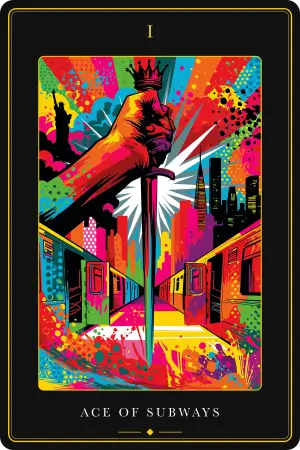
A crowned fist punches a sword down into an open subway platform: the clean idea that walks into the car when the doors slide open and cuts through the whole loud city.
Card at a glance
- Numerology
- Ace
- Element
- Air
- Astrology
- Root of Air · Gemini, Libra, Aquarius
- Kabbalistic path
- Kether (Crown) in Yetzirah
- Timing
- Swift, days to a few weeks
- Yes / No
- Upright yes · Reversed no
Upright
Clarity
Breakthrough
Truth
New idea
Honesty
Decisiveness
Justice
Fresh route
Reversed
Confusion
Clouded judgment
Miscommunication
Mental block
Harsh words
Bad signal
Anxiety
Ace of Subways in each deck
Every deck reimagines the same archetype. Compare the art, then open a deck to read its full interpretation.
Imagery and symbolism
In the Tarot of New York City the Ace of Swords becomes the Ace of Subways, and the scene drops underground into the suit of mind, conflict, and the daily grind. A powerful fist grips a sword above an open subway platform. Where the classic hand reaches out of soft clouds, this one thrusts up out of the pop-art chaos of the city, ringed by halftone dot fields, sunburst rays, and saturated blocks of color. Inspiration here is not handed down from a calm heaven. It is seized out of the noise.
The fist is crowned. The crown floats above the clenched hand for victory and sovereignty of mind, the authority that clear thinking buys in a city of endless competition. The blade points downward, driving into the platform between the rails, because an idea in New York is only worth something once it lands as a decision made, a word spoken, or a route chosen. A white starburst flares where fist, blade, and skyline meet, the visual crack of a clean thought cutting through everything else.
Two subway trains stand on either side of the blade with their doors open, converging in perspective. They are the card's twin edges: two directions and two lives you could ride out of this exact moment, the choice available right now. The empty platform between them is the reader's own mind before anything is built on it, nothing there yet but light and the blade.
Behind the scene rises the black silhouette of the skyline, the problems and ambitions waiting above ground. The Statue of Liberty stands at the edge of the frame with her torch, the promise that a sharp mind used honestly serves liberty and justice rather than mere advantage. The halftone clouds and rays filling the sky replace the divine clouds of the older card. Here the higher force is the electric hum of the metropolis itself, a vast mind whose current now and then surges through one person as a single perfect idea.
Core meaning
The Ace of Subways is the pure seed of the suit of Subways, which is this deck's suit of Swords, and the raw essence of the element Air: intellect, language, and the sharp arrival of truth. As an Ace it is the number One, unbroken potential before anything has taken shape. It is a flash of insight or a door sliding open rather than a finished outcome, and it asks you to board while the doors are still open.
Its job is to cut. The card severs the bonds of illusion and hands over sudden clarity, the moment the fog on the platform lifts and a tangled situation finally reads like a lit map. That same edge can turn cruel, which is why the suit that begins here runs through so much argument and strife. The Ace holds both at once. It is a tool that frees the mind and a blade that draws blood, and in a crowded car a careless blade cuts strangers.
Upright meaning
Upright, the Ace of Subways is the moment the doors slide open and a single clean idea walks into the car. Reason wins out over confusion, and you can finally read the signs. It points to seeing a situation exactly as it is, stripped of bias, and it champions plain honesty: speaking clearly, naming the tangled thing, setting a boundary without flinching. It often carries the suit's sense of justice, with the courthouse steps of Foley Square standing behind an honest thought. As the seed of Air it also marks the start of a mentally demanding venture, a course of study, a writing project, or a fresh route through an old problem.
In love. Honest conversation and hard clarity. The card favors saying the true thing face to face instead of reading a text three ways at midnight, cutting through months of confusion about where a relationship stands, even when the truth is not what either person hoped.
In career. A brilliant idea or a decisive strategy pulls into the station. It rewards quick rational thinking, the sentence that reorganizes the meeting, and the courage to say the true thing everyone was avoiding. It can also mark honest effort finally recognized, or readiness for a radical change of line.
In finances. The math of your life finally reads clean. The card supports a cold, wise plan and cutting through wishful thinking about money, reading the terms the way a New Yorker reads a lease. Positive change tends to come through analysis rather than the scratch-off at the bodega counter.
In health. A plain, honest look at the body and a decision made with a level head. It points to a real training plan in place of a vague intention, or a clean break with an old destructive habit, discipline chosen once and ridden like a line to its stop.
Reversed meaning
Reversed, the blade points down and the card's mental energy jams or turns into a weapon. It is the train that never comes and the announcement nobody can make out. Judgment clouds over: information overload, bias, or plain misinformation thickens the fog until a clear decision feels impossible, and the mind gets stuck between stations, certain there is no way out when the doors were never locked. Words start to harm rather than help, and the card warns of circular arguments, intellectual arrogance, and a refusal to hear the other side.
In love. Two people in the same car staring at different doors. Misunderstanding, garbled communication, or the 3am loop of fears crowds out real connection, and an argument gets won by being crueler. The card warns against that hollow win, because the silence afterward costs more than the fight was worth.
In career. The venture stalled between stations while everyone insists the track is fine. Facts get twisted, credit is taken by the one who ran the angle, and communication garbles like a platform announcement until tasks are misunderstood and results scatter.
In finances. Riding without knowing your balance and hoping the swipe goes through. The card warns of rash spending, deals signed without reading, and money conflicts left to drain you like a small leak that becomes a flooded station.
In health. The double edge turned inward. Fatigue, irritability, and a harsh inner voice sharpened into a blade against your own body, often from overtraining or a punishing diet. The counsel is genuine rest, because devotion to self-improvement that ends in injury is only its counterfeit.
Historical notes
The Ace of Subways sits on top of a long line of blades that arrived in Europe carrying no occult meaning at all. The suit of Swords traces back to the 14th-century Mamluk playing decks of Islamic Egypt, drawn as curved scimitars, emblems of military and aristocratic power. European card-makers straightened those scimitars into broadswords. The earliest Tarot version appears in the mid-15th-century Visconti-Sforza deck, painted for the Milanese court, where the Ace was a single upright blade on a gilded base and worked as a high-value unit card in the trick-taking game of tarocchi, with no documented occult sense.
Meaning was layered on later. Around 1491 the Sola-Busca Tarocchi of Ferrara treated the sword as an instrument of enlightenment rather than warfare. After Antoine Court de Gebelin's 1781 claim that Tarot held ancient Egyptian wisdom, the occultist Etteilla assigned the suit of Swords to the element Air and the domain of intellect. Eliphas Levi, in Dogme et Rituel de la Haute Magie (1854-1856), recast the blade as a fiery sword of divine will and justice. The Hermetic Order of the Golden Dawn formalized the card in Book T (1888) as 'The Root of the Powers of Air', describing a white angelic hand issuing from clouds and grasping a sword. That is the description A.E. Waite and Pamela Colman Smith drew in 1909. The Tarot of New York City inherits the whole lineage of the airy blade, then trades the angelic hand and its clouds for a crowned fist rising out of the halftone noise of the subway.
Correspondences
Number. One, the monad in Pythagorean and esoteric numerology: primal, unbroken unity, the first spark before anything is differentiated. It is the first train of the dawn and the first clean thought after a long fog, potential rather than finished form.
Astrology. The card holds the pure essence of Air, so it belongs to no single planetary decan. It is the root of the whole Air triplicity, standing over Gemini, Libra, and Aquarius. Gemini gives the quick, dual thinking mirrored in the two trains, Libra adds the balance and justice of the courthouse behind every honest thought, and Aquarius supplies the visionary current of a city that rebuilds itself every generation.
Element. Air, the element of intellect, speech, and strategy. In this deck Air runs underground: the subway is the city's nervous system, a network of moving thought and millions of minds in transit, which is why the suit of Subways inherits the element of Swords.
Kabbalah. The Ace sits at Kether, the Crown, the first sphere of the Tree of Life, within Yetzirah, the formative world of mind and Air. It is the clearest emanation of thought before it descends into action or emotion.
Elemental dignity. As an Air card it works with Fire and sharpens against Water, lending focus and decision to the cards around it, for better or worse.
Psychological perspective
Read psychologically, the Ace of Subways is the moment the mind cuts itself free, the flash of insight that ends a stretch of confusion and lets a person see a situation without the bias and nostalgia clouding it. In relationship readings this often shows up as someone reaching cold, settled clarity and cutting the cord for good, operating on logic instead of feeling.
The deck gives that state a face in the people who read the whole platform in one glance and already know which car will stop in front of them. They think in logic, need clarity and truth, and stay calm when the train stalls and everyone else panics, the way a New Yorker recalculates a route the second a line goes down. Their shadow is the 3am mind that cannot find the off switch, riding its own loop of worst cases while the city sleeps.
Modern readers reframe the blade's harshness as useful, treating it as an editor's pen or a surgeon's scalpel rather than a weapon, a tool for the clean removal of cognitive distortions and limiting beliefs. There is a link to the Zen idea of shoshin, the beginner's mind that meets a problem fresh. The conflict the card brings is the constructive friction it takes to break a comforting illusion, and the work is learning to wield that edge without turning it on yourself.
The Ace of Subways across decks
Under the pop-art fist lies the same blade the older decks all drew. In the Tarot de Marseille the Ace is stark 18th-century woodblock work, a hand gripping an oversized sword that pierces a crown at the tip, ringed by a plain leafy wreath, the blade often bold red against blue. The effect is raw, penetrating intellect with none of the softer angelic gloss.
The Rider-Waite-Smith version, drawn by Pamela Colman Smith in 1909 from the Golden Dawn's Book T, turns that force toward balanced truth: the crown of Kether, the olive and palm branches of mercy and severity, and six falling Yods of divine blessing above a ridge of jagged mountains. In Crowley and Harris's Thoth deck the Ace becomes the 'Higher Mind', its hilt copper for Venus and its blade steel for Mars so that will is driven by love, the word THELEMA on the hilt, a serpent coiled six times around a greenish blade, and a 22-rayed crown tying the pure intellect of the Ace to the whole Major Arcana.
The Tarot of New York City keeps every one of those functions and swaps the objects for the city's own. The angelic hand becomes a crowned fist, the mysterious clouds become halftone dots and sunburst rays, and the highest spiritual realm becomes the electric hum of the metropolis. The blade no longer floats. It drives down into the concrete of the platform, and the two open trains carry the double edge the older decks left implied.
In combination and context
The Ace of Subways shifts sharply with its neighbors. With The Empress it becomes an intellectual breakthrough that leads to real growth, cutting away a toxic situation so something can heal. With Justice it reads as absolute truth and accountability, a fair and swift ruling with no room for manipulation. Beside The Devil it is the flash of clarity that recognizes a chain, the blade that finally severs an addiction or an abusive tie. With Death it marks a surgical, irrevocable end, the mind accepting a paradigm it can no longer deny.
Court cards color it too. Paired with the King of Subways it is mental mastery, a brilliant idea flawlessly executed. With the Knight of Subways it is reckless momentum, the rider charging the closing doors before the idea has cooled. The suit's darker cards circle the reversed reading: the cleverness-without-conscience of the Seven of Subways, the 3am loop of the Nine of Subways, and the fear-built cage of the Eight of Subways, whose doors were never actually locked. In timing questions the Ace runs fast, days or a few weeks, because Air is the quickest element. In a yes-or-no reading it is a clean yes that cuts through the ambiguity around it, and reversed a no built of confusion and bad signal.
Questions for reflection
- What truth about my situation have I been riding past, and what would change if I got off at that stop and named it out loud?
- Where am I using a sharp mind to win instead of to understand, and which of the two trains am I actually about to board?
- If I saw this decision with total clarity and no wishful thinking, what would I already know I have to do?
The general meaning follows the Rider-Waite-Smith reading — the reference used across Tarot Academy. Open a specific deck above for its own interpretation.
Frequently asked questions
Explore the Tarot
Latest Posts
Discover the ancient wisdom of tarot cards and unlock the mysteries of your spiritual journey. Our blog is your gateway to understanding the rich symbolism, meanings, and practical applications of tarot reading.




















































