
 EN (English)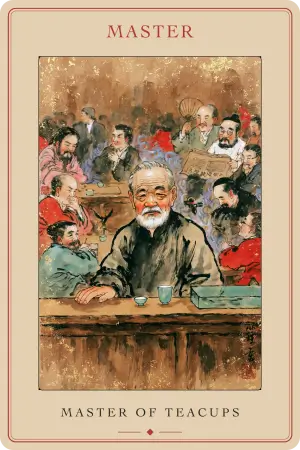


Minor Arcana ·
Ace of Brushes
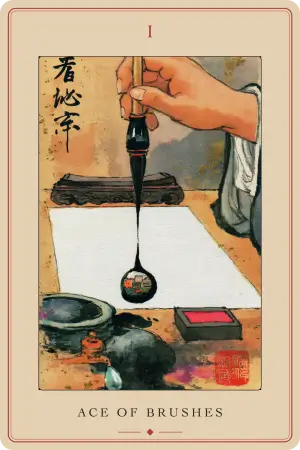
A fresh brush lifted over blank paper, one drop of ink at the tip holding the whole yet-unwritten sentence.
Card at a glance
- Numerology
- Ace
- Element
- Air
- Astrology
- Root of the Powers of Air · Gemini, Libra, Aquarius
- Kabbalistic path
- Kether (The Crown) in Yetzirah
- Timing
- Swift · days to a few weeks
- Yes / No
- Upright yes · Reversed no
Upright
breakthrough
clarity
first stroke
truth
decision
honesty
new idea
mental sharpness
Reversed
confusion
blocked thought
miscommunication
hesitation
borrowed words
harshness
distortion
indecision
Ace of Brushes in each deck
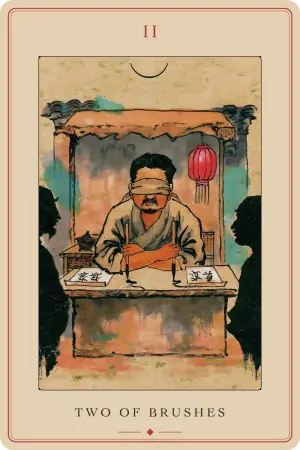
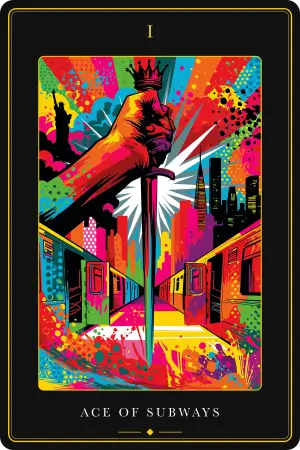
Every deck reimagines the same archetype. Compare the art, then open a deck to read its full interpretation.
Imagery and symbolism
In the Tarot of Beijing the Ace of Swords becomes the Ace of Brushes, and the change of instrument changes everything. Where the Rider-Waite Ace shows a disembodied hand thrust from the clouds gripping a blade, here the hand is human, sleeved in everyday cloth, at an ordinary writing table. A brand-new brush has just been lifted from its carved wooden rest and held vertical above a clean sheet of paper. In this deck the cosmic arrives through the small. Revelation looks like a person about to write.
The card's central symbol is the single drop of ink hanging from the brush tip, stretched to the instant before it falls. Inside the drop a tiny reflection of the city is visible: roofs, a doorway, the world itself. The drop contains the entire yet-unwritten sentence. All possibility sits concentrated in one point of ink, thought not yet turned to word, and so still everything at once.
The blank paper is the largest white shape on the card, the open situation and the mind before commitment. Clean, waiting, and slightly frightening, the way blank pages are. The suit's law is written into it: the first stroke cannot be unmade, because ink permits no erasure. That is the warning folded inside the promise. Once the truth is spoken and the decision written, the page is changed for good.
The supporting objects each carry a piece of the meaning. The inkstone with freshly ground ink stands for preparation, insight earned by patient grinding rather than luck. The vermilion seal-paste box, its red the sharpest color on the card, waits at the paper's edge: every finished text must eventually be signed and answered for. The empty brush rest marks the point of no return, since the brush has already been taken up. Calligraphy on the wall behind and the warm gold-flecked kraft paper of the ground set the scene in a lineage of clear words handed from hand to hand, and the small red seal in the corner, present on every card of this deck, rhymes with the seal-paste box as the artist's signature answering for the stroke.
Core meaning
The Ace of Brushes opens the suit of Brushes (毛笔), the deck's suit of Air, mind, words, and trials, and it opens in the quietest way possible: nothing has happened yet, and everything is about to. This is the seed of the intellect, pure potential held one breath before the first stroke, the mind ground fine like fresh ink. It reads as a breakthrough, a sudden lifting of mental fog, the sentence that has been waiting to be written finally becoming clear.
The generic Ace of Swords already gives you a cognitive breakthrough and the triumph of reason over illusion. Beijing keeps that and adds its own law. The deck's counsel comes as a calligrapher's maxim: grind your ink slowly and write quickly. Prepare with care, gather the facts, be honest with yourself, and once the thought is clear, commit to it without flinching. Say the thing plainly, put the decision in writing, begin the project while the ink of insight is still wet.
The warning lives inside the same image. The first stroke cannot be unmade. Clarity here obliges. A word written is a word binding, so the card asks whether you act from real clarity or only from the wish to win before you let the brush touch the page.
Upright meaning
Upright, the Ace of Brushes marks the moment the mind awakens and the page lies clean. A truth surfaces, an important question resolves, a new study or piece of writing begins. The situation calls for logic, objectivity, and clear thinking, and then for the nerve to make the first stroke. A new level of understanding is near, and it will clarify what has been muddy and bring inspiration with it. State your terms, name the problem by its true name, and do not let hesitation dry on the brush.
In love. Mental clarity about the heart: the moment you finally understand what you feel, what you need, and what must be said. The drop of ink holds a confession, a question, a boundary, or a proposal, ready at the tip. Conversations turn honest and direct, and the bond benefits. For a new acquaintance it can mark a connection that begins with words, in letters and long conversations, a meeting of minds.
In career. New thoughts and a clean sheet at the start of a project. It favors quick rational thinking and precise problem-solving: the report that finally states the issue plainly, the proposal that cuts through months of circling, the first day of a role defined by your mind and your words. Original approaches and clearly argued positions bring advantage, and professional honesty earns the quiet authority of the examiner whose brush has never trembled.
In finances. The moment the whole ledger suddenly makes sense. A clear plan emerges, whether a new idea about income, an investment thesis, or a budget finally written down in black ink. The card favors putting money matters onto paper: drafting the agreement, calculating precisely, reading the contract to its last character before signing. Name your numbers honestly, because a truth written clearly can be acted on.
In health. The clean sheet at the start of a clear-headed relationship with your own body. Understand what your body actually needs, see through fashionable noise to a simple plan, and then begin. Discipline here reads as calligraphy rather than punishment, a practice of precise repeated strokes that over time produce form.
Reversed meaning
Reversed, clarity and fairness are needed but not available. The ink has been spilled, or it dried while the hand hesitated. Thoughts tangle, ideas conflict, and the decision that should have been one clean stroke becomes forty crooked ones. This is confusion, blocked thinking, and stalled decisions, often an unconscious refusal to read what is already written plainly on the page in front of you. The cure is not speed but preparation: rinse the brush, clear away borrowed opinions and your own excuses, and avoid signing or promising anything binding in this state.
In love. The letter read four times that says the same thing every time and still is not accepted. Misunderstandings, an inability to express feelings, conversations that go in circles because neither person will name the real matter. Words spoken carelessly wound here, sarcasm where tenderness was needed. Slow down, listen before answering, and remember that being right is a poor substitute for being understood.
In career. Tasks set in vague words and executed in vaguer ones, instructions misread, the essential point of the project lost under crooked strokes of correction. It can point to credit taken for someone else's lines, to criticism delivered as cruelty rather than precision, or to your own ideas left underdeveloped and therefore dismissed. Stop, clear the desk, and rewrite the task as one honest sentence before committing to any deadline.
In finances. The blotted ledger: figures never quite added up, agreements made in vague words each party remembers differently. Signing without reading and promising without calculating lead to losses. Watch for a flaw in the fine print or misinformation around a deal. Postpone the stroke until the page is clear, because in ink, as in money, mistakes do not erase cheaply.
In health. Mental strain wearing the body down: overthinking, stress, poor sleep, the third watch of the night spent upright with hands over the face. It warns against harshness toward your own body, against impossible standards and regimens adopted rashly. The remedy is gentler precision: rest as discipline, honest but kind assessment, one small clearly defined change at a time.
Historical notes
The suit of Swords reached Europe from the 14th-century Mamluk playing decks of Islamic Egypt, where it appeared as curved scimitars, emblems of military rank. European card-makers straightened the eastern blades into classical broadswords while keeping the fourteen-card structure per suit. The earliest surviving Ace of Swords in a dedicated tarot appears around 1450 to 1460 in the Visconti-Sforza deck, painted for the Milanese court, a single upright blade on a gilded base used in the trick-taking game of tarocchi, where the Ace was simply the high-value unit card with no occult meaning.
The card gained its inner life later. The Sola-Busca Tarocchi of about 1491 wove alchemical and classical imagery into the suits, treating the sword as an instrument of enlightenment. After Antoine Court de Gébelin claimed in 1781 that the tarot preserved ancient Egyptian wisdom, esotericists began assigning correspondences, and in the 1780s Etteilla tied the Suit of Swords and its Ace to the element of Air and the domain of intellect. Eliphas Levi reimagined the blade as a fiery sword of divine will in his Dogme et Rituel de la Haute Magie (1854 to 1856), and in 1888 the Golden Dawn's Book T formalized the card as the Root of the Powers of Air, describing a white radiating hand from the clouds grasping a sword. Waite and Pamela Colman Smith rendered that description for the 1909 Rider-Waite-Smith deck.
The Tarot of Beijing reframes the whole lineage. It replaces the blade with a brush, the hand from the clouds with a human hand at a writing table, and the act of cutting with the act of writing. The Root of the Powers of Air survives, but its power is now the power of the first clear word rather than the first clean cut.
Correspondences
Number. One, the monad, beginning and initiation, the first stroke on the blank page. The card draws it literally: a single hand, a single brush, a single drop of ink in which the whole city is reflected. Before the first character is written the text is still one undivided possibility. One carries the active, deciding principle, and its shadow is the arrogance of intellect and the haste of judgment, since in calligraphy a first stroke begun wrongly forces everything after it to compensate.
Astrology. Because the Ace holds the pure essence of Air, it corresponds to no single planetary decan. It is the Root of the Powers of Air, the archetype behind the whole Air triplicity: Gemini for the scribe's twin movements of reading and answering, Libra for the balance of the composed stroke and the search for the just word, Aquarius for the fresh idea and the independence to disagree with a whole examination hall.
Element. Air, which in this deck moves as wind through the hutongs: thought, language, judgment, examination, and exchange, everything the suit of Brushes carries. Air is also the fastest of the classical elements, which is why the card reads as swift, sudden developments rather than slow ones.
Kabbalah. The Ace sits at Kether, the Crown, within Yetzirah, the formative world of mind and Air. Kether is undifferentiated potential and the first motion of creation, so the card stands for the clearest emanation of thought before it descends into the friction of action.
Elemental dignity. Air strengthens the other Aces of thought and communication and is weakened by heavy earthbound cards that bog its speed. Beside watery cards it can read as cold, beside fiery ones as sharp and quick.
Psychological perspective
Psychologically the Ace of Brushes is the beginner's mind, the state calligraphers reach for when they breathe once before the first stroke. Modern readers describe the Ace of Swords through the Zen idea of shoshin, and this deck makes the image concrete. The brush is an editor's pen or a surgeon's scalpel, not a weapon. What it removes is a cognitive distortion or a limiting belief, and the friction it brings is the constructive kind, the discomfort of breaking a comfortable illusion.
The inner moment is the instant of naming. A muddled feeling holds power over you exactly as long as it stays unwritten, and the card is the decision to write it down in plain words. That act is a form of courage, because ink does not erase and a named truth cannot be quietly un-known. Held upright and balanced, the brush also models restraint: clarity spoken with care, honesty offered as respect rather than as a way to win the argument.
Ace of Brushes across decks
Rider-Waite-Smith. A white hand emerges from a grey cloud gripping a double-edged steel sword, its tip crowned by a golden circlet standing for Kether. Six Yods fall as divine blessing, an olive branch and a palm branch drape from the crown for mercy and severity, and jagged mountains warn that the road to clarity is steep. Beijing keeps the crown's meaning of pure mind but trades the blade for a brush and the clouds for a human hand.
Tarot de Marseille. The classic Ace is a bold red sword driven through a crown wreathed in plain leafy branches against a blue ground, raw penetrating intellect with no angelic softening. Beijing shares that directness but shifts the red from the blade to the vermilion seal-paste box waiting at the paper's edge.
Crowley-Thoth. Crowley's Ace is the Higher Mind: a copper hilt for Venus and a steel blade for Mars, the word THELEMA inscribed on the hilt, a serpent coiled six times, and a crown of twenty-two rays linking the card to the whole Major Arcana. The blade glows green as the synthesis of fire and water. Beijing reaches the same idea, that clear thought must be driven by love and will, through the maxim to grind the ink slowly and write quickly.
Modern reframings. Recent decks increasingly present the Ace of Swords as an instrument of insight rather than violence, the pen or the clearing wind. The Tarot of Beijing belongs to that movement, replacing the sword entirely with the writing brush and making the card's whole drama the moment before a single honest sentence is committed to paper.
In combination and context
The Ace of Brushes pulls a spread toward clarity, truth, and the decisive first move, and its neighbours tell you what that clarity is for. With the Courtyard Grandmother (the Empress) it is intellectual breakthrough leading to tangible growth, the brush cutting away a toxic environment so that something can heal and flourish. With Justice it is absolute accountability, an ethical or legal ruling that is fair, swift, and strictly by the book. With The Devil it is the sudden recognition of one's own bondage and the tool required to sever the chain of an addiction or a self-limiting belief.
The court cards sharpen it. Beside the Master of Brushes (the King of Swords) the Ace is the initial spark married to flawless execution, mental mastery and a logical boundary that emotional manipulation cannot cross. Beside the Courier of Brushes (the Knight of Swords) it is reckless momentum, swift steps and quick opportunities carrying a warning that passion may cool as fast as it ignites. With Death it is a surgical and irrevocable transformation, the mind accepting an ending and letting an outdated worldview go.
One caution belongs to the whole suit. Because the numbered Brushes cards carry the old stigma of conflict and grief, a run of them can breed a dread that taints the reading. Read the Ace as the surgeon's first clean incision rather than the wound: swift timing, days to a few weeks, and in a simple yes/no spread a definitive yes that cuts through the surrounding ambiguity.
Questions for reflection
- What is the one clear sentence you could write on a clean sheet today without hesitating, and what has kept the brush hovering over it?
- Before you commit the stroke, are you acting from real clarity or from the wish to win the argument?
- Which borrowed opinions and other people's phrasings would you have to rinse from the brush before you could write something honestly your own?
The general meaning follows the Rider-Waite-Smith reading — the reference used across Tarot Academy. Open a specific deck above for its own interpretation.
Frequently asked questions
Explore the Tarot
Latest Posts
Discover the ancient wisdom of tarot cards and unlock the mysteries of your spiritual journey. Our blog is your gateway to understanding the rich symbolism, meanings, and practical applications of tarot reading.




















































