
 EN (English)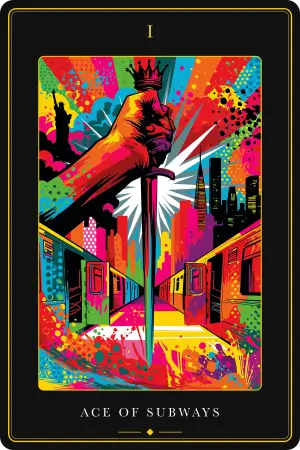


Minor Arcana ·
Two of Subways
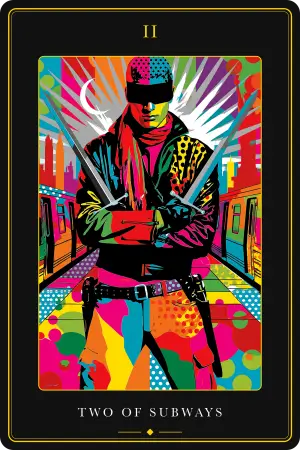
A blindfolded commuter stands dead center on a platform between two trains, doors open on both sides, holding the choice at a standstill while both directions stay equally open.
Card at a glance
- Numerology
- 2
- Element
- Air
- Astrology
- Moon in Libra (first decan)
- Kabbalistic path
- Chokmah (Wisdom)
- Timing
- Autumn · Libra season and the equinox
- Yes / No
- Upright not yet · Reversed no
Upright
Standstill
Hard choice
Balance
Neutrality
Mediation
Contemplation
Composure
Indecision
Reversed
Avoidance
Denial
Paralysis
Missed departure
Fear of change
Following the crowd
Frozen choice
Procrastination
Two of Subways in each deck
Every deck reimagines the same archetype. Compare the art, then open a deck to read its full interpretation.
Imagery and symbolism
The New York deck moves the Two of Swords underground and rebuilds it in flat, saturated pop-art. A lone figure stands dead center on a subway platform. A train has stopped with its doors open on either side of him, and those two trains are the two choices: equal, real, and heading in opposite directions. He belongs to neither until he moves, and the whole composition pins him between them.
A black blindfold covers his eyes, and nobody on the platform put it there. It is self-imposed, a withdrawal from the countdown clocks into internal deliberation, a decision to consult intuition rather than the boards. It carries a warning too, because refusing to look is also a choice, and the information he is avoiding is glowing on both sides of him. His arms are crossed tight over his chest, and in each gloved hand he holds a long blade, the two rails of the Subways suit crossed at his heart. The crossed blades guard his center and stall him at once: while he holds the standoff, both hands are full and he cannot swipe in or hold a door.
The single warm note is a red scarf wound at his neck, feeling that is present but wrapped up and kept from spilling into the decision. Behind his head a white pop-art sunburst explodes across the card, the deck's halo of mental intensity, so the stillness of the body reads as a lie while the mind detonates with calculation. A white crescent moon hangs in the upper left, carried over faithfully from the Rider-Waite card as intuition and the hidden side of the situation. Opposite it, the black silhouette of the Statue of Liberty raises her torch, the deck's counterweight to the moon: liberty as the burden of choice, since in this city you are free to take either train, which is exactly the problem. The skyline runs across the horizon, indifferent, and the platform floor is a checkerboard of color blocks and halftone dots, the noise of a thousand city signals he has blindfolded himself against. Each platform edge drops to the tracks, so the decision has a real gap to mind.
Core meaning
The Two of Subways is the platform moment. Where the Ace of Subways was a single clear spark that walked in through the open doors, the Two splits that focus into a pair: two trains, two directions, two versions of your life, each with its own line and its own final stop. It is the standstill where a decision is delayed or feels impossible, held up by missing information or by contradictions between considerations that are equally real.
The balance the figure keeps is genuine but fragile. He blocks out the platform's noise and zips his feelings inside the jacket to hold a temporary equilibrium, the kind a seasoned commuter keeps on a crowded platform. At its best the card is that pause put to good use, an inner room wide enough to weigh both trains before boarding. At its worst it is avoidance dressed as patience, a way of not choosing that lets the schedule choose for you once one set of doors finally closes.
Upright meaning
Upright, the Two of Subways marks suspension and a crossroads. You are caught between two options of seemingly equal weight, and the mind, overwhelmed or afraid of choosing wrong, retreats into a defensive stance: blindfold on, feelings held down, a surface calm kept in place. The card's better mandate is to weigh honestly rather than freeze. Standing still for one more train is not failure while you gather information and picture where each line actually terminates, but do not let the pause harden into residence, because nobody lives on the platform.
In love. Strong feelings on one side of the car, hesitation on the other. The card can ask you to choose between two people, or to finally clarify what you feel about the one you are with. Its essence is real attraction paired with reluctance to make the active move, so weigh where the relationship is headed, then look at your partner without the blindfold.
In career and work. Two projects or two job offers stand at your desk like two trains with open doors. This is a moment of balance before an important step, a time to compare the routes and read what each option pays and costs. A workplace dispute now is best handled from the neutral center of the platform, through compromise, which makes this card a natural mediator's card.
In finances. The fare gate you have not swiped yet. It is a period for auditing income against outgoings and weighing two money opportunities that both look like they go somewhere. Read every hidden fee and every transfer before boarding, because the value here is in the terms, not the sprint.
In health. An honest audit of ambitions against limits, and a balanced approach rather than an extreme one. The card asks you to pause and listen to your physical state the way you would finally listen to a sound the train has been making for weeks, leaning on routine as an ally: regular schedule, decent food, moderate movement.
Reversed meaning
Reversed, the pressurized balance breaks. The card points to an unwillingness to decide at all, or avoidance of responsibility dressed up as patience, the person who has let four trains go by and calls it keeping options open. It is a period of denial where the comfortable illusion of the platform wins out over the commitment of a direction, often because the fear of consequences is running the show. It can also mean plain paralysis, a choice so heavy the mind freezes, or a problem ignored in the hope the service fixes itself. It rarely does, since the map does not redraw itself while you wait.
In love. Riding with your eyes deliberately shut. Problems get waved past like skipped stations, and denial hardens into a refusal to speak. It can accompany a breakup or a loss of closeness, and it marks the split between heart and mind, two trains pulling in opposite directions through the same person.
In career and work. The transfer you keep not making. There is chronic postponement of important calls, a sense of helplessness, or pressure toward a hasty decision made just to end the discomfort. Denial of workplace reality and dodged accountability ripen into conflicts and failing projects, so the decision must be made rather than avoided.
In finances. Frozen at the MetroCard machine while the balance drains anyway. It flags stagnation and an inability to move past a single question while the rent clock keeps running, sometimes money already committed to the wrong line. Indefinite waiting is itself a cost, charged daily.
In health. Neglected signals and scattered, contradictory thoughts about self-care. One aspect gets all the attention while another is skipped, like maintaining one track and letting the other rust. The reversed card is a call to think it through, study the options, and then actually commit.
Historical notes
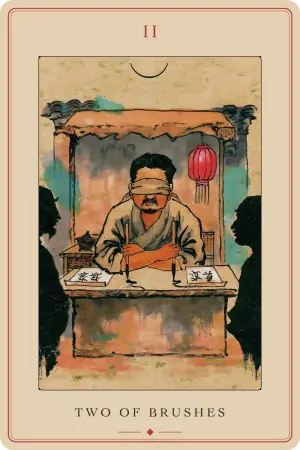
The New York deck names its ancestor openly: the Two of Subways is the Two of Swords sent underground, and its bones come straight from that lineage. In the older Tarot de Marseille the Two of Swords (Deux d'Epees) is a non-scenic pip, two curved scimitar-like blades enclosing a floral motif, seen in decks such as the Jean Noblet of around 1650. Marseille readers took it plainly as respite and relief, a literal pause in the fighting rather than a deep psychological knot.
The scenic image most people know arrived in 1909, when Pamela Colman Smith drew the blindfolded woman on the shore under A.E. Waite's direction, borrowing the idea of fully illustrated pip cards from the 15th-century Italian Sola-Busca deck and layering it with the astrological and Kabbalistic scheme of the Golden Dawn. That order titled the card the 'Lord of Peace Restored'. Aleister Crowley disagreed: because the card is rooted in Chokmah, the very first emanation of force, nothing had yet been disturbed to restore, so he renamed it simply 'Peace', while noting that a sword makes even that peace a tense, temporary one. The New York deck keeps every load-bearing symbol of the Waite-Smith card, the blindfold, the crossed blades, the crescent moon, and swaps the lonely shore for the most New York setting of indecision there is, a platform between two trains.
Correspondences
Number. Two, the number of duality and opposition, rendered here as the most New York geometry there is: uptown and downtown, local and express, this platform edge and that one. It splits the single spark of the Ace into a pair of forces that must be balanced or reconciled, and it also carries partnership and cooperation, since every negotiation and every compromise is a two.
Astrology. The Moon in Libra, and specifically the first decan of Libra, from 0 to 9 degrees, which the deck dates to roughly September 23 to October 2. Libra is the sign of the scales, and the figure on the platform is Libra made literal, standing at the midpoint between two equally loaded pans. The Sun's entry into this decan marks the autumnal equinox, the day of equal light and dark.
Element. Air, the suit of intellect, communication, and mental process, which this deck sends underground as the city's circulating current of minds in transit. Air is active and volatile, which is why its balance never fully rests.
Kabbalah. Chokmah, Wisdom, the second sphere, in Yetzirah, the formative world of Air and mind. Set so high on the Tree of Life, the suit's usual strife is neutralized into a pre-conflict balance.
Elemental dignity. As an Air card it holds two forces in tension rather than resolving them, and it tends to stall the momentum of the cards around it until a choice is made.
Psychological perspective
The Two of Subways is the psychology of the stalemate. It is the stuck feeling of trying to keep everything balanced by refusing to deal with the hard part, holding an earlier clarity in place through denial. Rachel Pollack framed the Two of Swords exactly this way in Seventy-Eight Degrees of Wisdom, and the trap is subtle: delaying a choice feels like a neutral, harmless act, when in truth not choosing is itself a choice, and usually a poor one.
The danger has a name, analysis paralysis. A first pause to gather facts is wise, but waiting too long builds inertia, and if the figure stands on the platform forever, one set of doors closes and the schedule decides for him on its own terms. At their best these are people with real composure, calm and neutral in conflict and often excellent mediators both sides will actually listen to. Reversed, they are locked in an internal standoff, preferring the dim light of the tunnel, the state of not-quite-knowing, to the glare of the facts. The card's swords are a reminder of agency: use the mind to cut the false from the true, make the less-bad choice, and answer for it with a level head.
The Two of Subways across decks
The New York deck is one voice in a long conversation about the same fragile balance. In the Tarot de Marseille the card is a plain pip, two curved swords around a central floral motif, read as respite and a pause in conflict rather than an inner deadlock.
The Rider-Waite-Smith version is the scenic ancestor this card leans on: a blindfolded woman on a grey bench at the water's edge, crossed swords over the heart, a crescent moon in a twilight sky, a study in defensive equilibrium and denial. In the Thoth deck Crowley and Harris strip out the human figure for sacred geometry, two swords crossing at the center of a five-petalled blue rose with the Moon balanced on a dagger above and Libra on a dagger below, while faint pinwheels behind the calm warn that the mind never truly stops. The New York Tarot carries the same tension into pop-art: the shore becomes a subway platform, the twin swords become the two rails of the Subways suit, and the water's rocky flux becomes the halftone noise of the city, with the Statue of Liberty added opposite the moon so the choice reads as both a freedom and a weight.
In combination and context
The static energy of the Two of Subways bends easily to its neighbours. With The World it points to a relationship at a major juncture where deep commitment is possible but one or both people hold back, paralyzed at the final step. With the Three of Pentacles it shows a partnership that runs on the surface while a hidden block or an unmade choice stops real progress. Alongside the Eight of Swords the two compound into a person who feels wholly trapped, unable to decide their way out, often from a misplaced sense of obligation.
Some neighbours break the deadlock. With The Sun the truth surfaces no matter how tightly the blindfold is held, and the period of denial cannot last. In timing questions the card leans on autumn and Libra season. In a yes-or-no reading it rarely gives a clean answer, and the usual verdict is 'not yet', a call to step back and gather what is missing before deciding, without letting the wait become permanent avoidance.
Questions for reflection
- Both trains have their doors open right now. Which direction am I refusing to look at, even though its board is glowing right above my head?
- What am I calling patience that is really a way of letting the schedule choose for me while I stand still?
- Which train am I weighing with my head only, and which one does my gut already know feels like home?
The general meaning follows the Rider-Waite-Smith reading — the reference used across Tarot Academy. Open a specific deck above for its own interpretation.
Frequently asked questions
Explore the Tarot
Latest Posts
Discover the ancient wisdom of tarot cards and unlock the mysteries of your spiritual journey. Our blog is your gateway to understanding the rich symbolism, meanings, and practical applications of tarot reading.




















































