
 EN (English)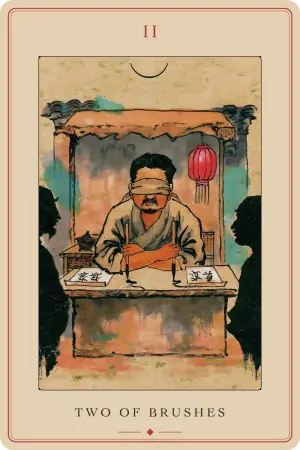


Minor Arcana ·
Three of Brushes
Heartbreak written down: the character for heart struck through by three brushstrokes that cannot be unmade.
Card at a glance
- Numerology
- Three
- Element
- Air (the brush: mind, words, trials)
- Astrology
- Saturn in Libra, second decan
- Kabbalistic path
- Binah (Understanding)
- Timing
- Early October, mid-Libra season
- Yes / No
- Upright no, Reversed easing toward yes
Upright
heartbreak
words that wound
a painful letter
betrayal
separation
grief
a truth that will not change
sorrow
Reversed
healing
forgiveness
setting the letter aside
recovery
reconciliation
suppression
a reopened wound
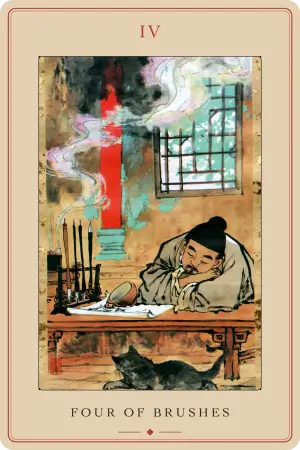
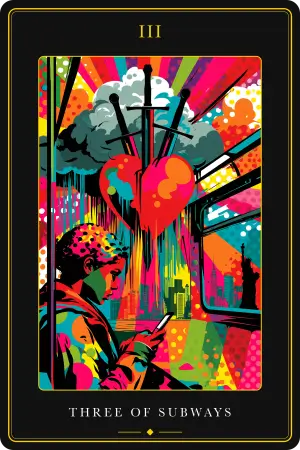
Three of Brushes in each deck
Every deck reimagines the same archetype. Compare the art, then open a deck to read its full interpretation.
Imagery and symbolism
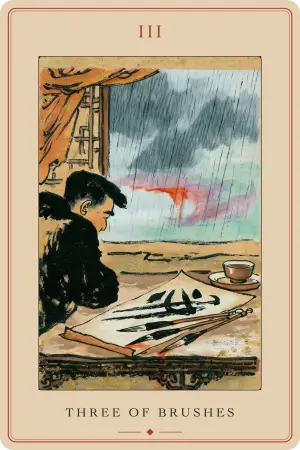
In the Tarot of Beijing the Three of Swords carries no blades. A scholar in a dark padded jacket sits at his desk before a window streaked with rain. On the paper in front of him lies a letter, and its central character, 心 for "heart", has been struck through by three hard brushstrokes that are not his own. He has read it four times. It says the same thing every time. That is the card's whole argument: in this suit a stroke of ink cannot be unmade, so what has been written has been done.
The three brushes lying across the page are the deck's swords, instruments of the mind and of words and of trials. The strokes cross the heart-character deliberately, by a hand, with intent, which is why the wound reads as betrayal rather than accident. The character 心 stands where the classical card's pierced heart would be. It is the heart as it exists in language, feeling made visible and therefore open to being crossed out.
Beyond the glass, bruised grey clouds and slanting rain give the oppressive weather of grief, but the rain is also the sky's own ink wash, and rain in Beijing ends. A faint band of teal and a smudge of vermilion sit low on the horizon, proof the storm is not the whole sky. A cup of tea stands full and untouched at the desk's edge, comfort within reach that the reader cannot yet taste. The curtain is pulled warmly aside: he did not shut out the world, he simply sat down where the light was, to read the truth by it.
Core meaning
The Three of Brushes is heartbreak in its clearest form: grief, betrayal, loss, and the severing of a tie. It corresponds to the Three of Swords of the classical deck and carries the same energy, but here the wound is made by ink rather than steel. The pain arrives in written form, a letter, a message, a sentence said or sent that strikes the heart with the precision of three hard brushstrokes.
Where the number three usually promises the unity of mind, spirit, and heart, this card shows that unity broken so it can be rebuilt consciously. Much of the pain is the refusal to believe what is plainly written. The scholar reads the letter a fourth time hoping the characters will rearrange themselves. They will not, and the card's real work begins the moment he accepts that. In this deck ink is also the medium of the mind, so understanding what is written is the first step out of the rain. The card confirms a truth the reader already suspected and asks them to stop re-reading and start feeling.
Upright meaning
Upright, the Three of Brushes marks a period of significant emotional trial and sorrow, usually delivered in words. It points to a breakup, a betrayal, or sad news that causes deep disappointment, and to conflicts and misunderstandings that raise walls between people who were close. The advice is direct: do not read the letter a fifth time hoping it will soften. Accept what is actually written, give time to the wound, seek support, and in this deck's own language take up your own brush and name the hurt in clear strokes to someone you trust.
In love. A separation, a breakup, or an infidelity, and characteristically the news comes in words: a letter, a message, a confession. The relationship is being tested for its durability or reaching its endpoint. Grieve it fully, and in time the card asks you to forgive and to learn to trust again.
In career. Deep emotional pain or stress at work, often a stinging email, a bad evaluation, or a rejection. The card holds that real understanding comes through hard experience, the way a calligrapher's hand is trained by crooked strokes. Keep composure, read what is actually written rather than what you fear between the lines, and take the lesson.
In finances. Sorrow delivered on paper: a refusal letter, a bad contract, a bill, a notice. You may keep going over the numbers hoping they will change. They will not. Reassess your finances, read every document to the end, and make the necessary changes.
In health. Stress and pain telling on the body: sleep problems, headaches, tension in the chest, a general decline in vitality. The suffering is rooted in grief or worry rather than in the body itself. Treat yourself with the patience you would give a wound, because that is what this is.
Reversed meaning
Reversed, the letter has finally been folded and set under the teacup, and the storm outside the window is thinning. The card marks the start of healing after grief caused by past traumas, separations, or cruel words. Some feeling may linger the way ink ghosts through thin paper, yet the hardest phase has passed. What was written cannot be unwritten, but a new sheet can always be laid on the desk. There is a warning side, and the neighbouring cards decide which it is: the pain may be shoved into a drawer unanswered rather than processed, so it festers, or an old wound that never closed is being reopened.
In love. The first steps toward reconciliation or the mending of a broken heart. Wounds of words heal slowly and need patience. Reversed, it can also show a stubborn refusal to accept what was written, re-reading the past in search of a different ending.
In career. The resolution of a painful situation and the end of a stressful stretch. Relations with colleagues or management begin to improve. Do not discard the experience: every trial leaves a stroke in the copybook that steadies the next one.
In finances. Relief from a money problem and recovery from a crisis. You can re-read the old ledgers calmly now, this time for the lesson rather than the pain, and move toward stability on a clean page.
In health. Recovery from illness or injury, the return of appetite and sleep as grief loosens its grip. You gain the ability to accept your body as it is: the page does not need to be flawless to be worth writing on.
Historical notes
The pierced-heart image the Three of Brushes reinterprets is far older than the modern occult decks. It appears in the Sola-Busca Tarot of about 1490 to 1491, the oldest known complete 78-card deck, printed in Venice and the first to fully illustrate the Minor Arcana. There the Three of Swords was a heart pierced by three blades, but its Renaissance meaning was not romantic heartbreak: it stood for silence, altruism, and suffering consciously undertaken for a higher value.
The image drew on Christian devotion, the Sacred Heart of Jesus pierced by the Holy Lance and the Mater Dolorosa whose heart holds seven sorrows. When Pamela Colman Smith illustrated the Rider-Waite-Smith deck in 1909, she had seen the Sola-Busca cards on exhibit at the British Museum, and the Three of Swords is one of the rare cases where she copied its core motif directly, hanging the heart against weeping grey storm clouds.
The Tarot of Beijing keeps that storm and that sorrow but changes the instrument. It trades blades for brushes and the anatomical heart for the written character 心, moving the wound out of the body and into language. The grief is the same grief. What differs is that here it arrives as text, a truth set down in ink that cannot be unmade, read by a scholar rather than suffered by an absent figure.
Correspondences
Number. Three, the number of creativity, communication, and the unity of mind, spirit, and heart. In this card that unity is shown broken: three strokes cross the character for heart so it can be rebuilt consciously. Three also marks a breakthrough, the struck-through character clearing the page for the next sentence.
Astrology. Saturn in Libra, the second decan of Libra, roughly October 3rd to 12th. Libra is the sign of the scales and of relations between people, and this decan under Saturn shows what happens when the balance of a bond breaks and the verdict is delivered in writing. Saturn teaches structure, patience, and endurance, the virtues of the examination cell and the copybook.
Element. Air, in this deck the element of the brush: mind, words, and trials. The pain is a mental realisation landing in the emotional body, carried through communication rather than through the heart alone.
Kabbalah. The card sits at Binah, Understanding, the third sphere, the Great Mother who gives form. Form requires limits and severing, so Binah carries a foundational sorrow, the mourning of the dark sea, which is exactly the weight Saturn lends this decan.
Psychological perspective
The person of this card views pain from a critical, literate distance, like the scholar at the rainy window who analyses his sorrow and parses every stroke of it. Emotional pain lingers with them, and they remember exact phrasings for years, but through hard times they build a strong inner reserve. Their wounds are usually wounds of words, things said or written or left unsaid, and often their difficulty is heartbreak: a belief betrayed by a hand they trusted.
The danger is the fifth reading. Because this is a suit of the mind, the pain can be amplified far past the event by the story told about it, the four re-readings that become forty. The letter says the same thing every time; it is the commentary that grows. The card's counsel is to read the wound clearly once, name it in plain strokes, and then set it down, refusing the seductive sense of empowerment that comes from holding on to righteous anger. Grief read clearly is grief that can move through. Pain met this way sharpens perception rather than dimming it, letting a person see reality more maturely, the way a struck-through character still teaches the eye what was written beneath.
The Three of Brushes across decks
Rider-Waite-Smith. The canonical Three of Swords is a red heart pierced by three blades against grey rain, heartbreak made instantly legible with no figure present. The Three of Brushes keeps the storm and the sorrow but replaces the blades with brushes and the heart with the written character 心, and it puts a reader in the scene where the classical card left only the wound.
Thoth. Lady Frieda Harris replaced the heart with a white rose, symbol of the unfolding soul, violently pierced and shedding its petals against a dark crystallised sea, and Crowley titled the card simply "Sorrow". Beijing shares the Saturn in Libra weight beneath both images but keeps its own scene domestic and legible rather than cosmic and abstract.
Modern reframings. The Robin Wood Tarot moves the focus to the aftermath, a blindfolded figure meditating with the swords set aside, and the Ellen Cannon Reed deck frames the three swords as a doorway to walk through. The Tarot of Beijing belongs to that turn toward aftermath and passage: its scholar is already reading, already partway out of the rain, with a fresh sheet waiting on the desk.
In combination and context
The Three of Brushes pulls a spread toward wounding communication and the sorrow set down in writing. Softer, watery cards nearby point toward comfort and recovery, the tea finally drunk and the curtain still open. Harder cards of the suit keep the letter unanswered on the desk and the wound fresh. In a career or life-path spread its Saturn in Libra note can mean a long-held goal will take patience and painful compromise, delayed rather than denied.
Position sharpens it. In a past slot it names the loss the present was built on. As an obstacle it is grief or bitterness, or a refusal to accept what was written, blocking the way forward. As advice it says stop re-reading, name the wound in clear strokes, and set it down. As an outcome it warns of a painful ending, though the seam of vermilion on the card's horizon promises the storm will pass. In a yes-or-no reading the upright card generally answers no; reversed, as the letter is folded away, it eases toward yes.
Questions for reflection
- Which letter, said or written, do you keep re-reading in the hope that the words will rearrange themselves?
- Where is the wound the truth itself, and where is it the story you have added in the four re-readings since?
- The tea in the card is still full and warm at your elbow. What one act of comfort could you offer yourself before the day ends?
The general meaning follows the Rider-Waite-Smith reading — the reference used across Tarot Academy. Open a specific deck above for its own interpretation.
Frequently asked questions
Explore the Tarot
Latest Posts
Discover the ancient wisdom of tarot cards and unlock the mysteries of your spiritual journey. Our blog is your gateway to understanding the rich symbolism, meanings, and practical applications of tarot reading.




















































