
 EN (English)


Minor Arcana ·
Three of Subways
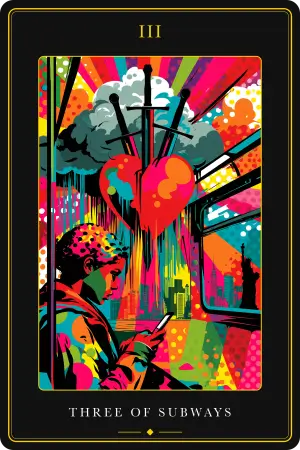
A red heart hanging in a subway car, pierced by three lengths of the train's own steel, while a gray cloud drips down through the pop-art color.
Card at a glance
- Numerology
- Three
- Element
- Air
- Astrology
- Saturn in Libra (2nd decan)
- Kabbalistic path
- Binah (Understanding)
- Timing
- Early October, mid-Libra season
- Yes / No
- Upright no, Reversed easing toward yes
Upright
Public heartbreak
Grief on the train
Betrayal
The painful truth
Separation
Sorrow
Loss
The message read three times
Reversed
Healing
Forgiveness
The ride out
Recovery
Reconciliation
Suppression
Reopened wound
Three of Subways in each deck
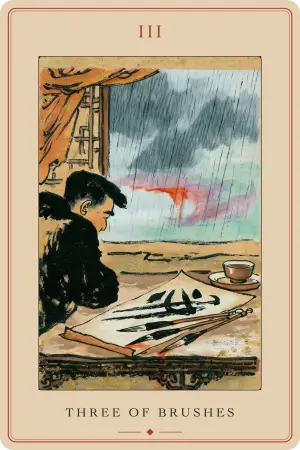
Every deck reimagines the same archetype. Compare the art, then open a deck to read its full interpretation.
Imagery and symbolism
The Tarot of New York City keeps the name Three of Subways and restages the oldest heartbreak card in the deck inside a moving train, all told in its pop-art language of halftone dots, sunburst rays, and hard black line. The suit the deck calls Subways is the Rider-Waite suit of Swords, the suit of Air and the mind, and here that steel is the poles and rails of the daily ride.
At the center of the card a great red heart hangs in the air of the car, pierced by three sword-straight shapes that echo the train's own steel. The heart is the seat of feeling, and the metal that runs through it belongs to the suit of mind, conflict, and the grind. The image says what the suit always says. It is thought that wounds here: the message, the realization, the truth finally understood. It is thought that will eventually cut the way out.
Above the heart a gray storm cloud breaks the card's riot of color and drips long dark streaks down through the pinks and yellows, like rain running down a train window. This is the grief and the oppressive weather of a heavy heart carried through a bright, indifferent city. The colors do not dim for the mourner. The sunbursts keep radiating and the dots keep dancing, which is a true New York detail, because the city does not pause for anyone's heartbreak.
In the foreground sits the rider, a lone figure in the corner seat with head bowed to a phone. This is the deck's own scene for the card: the text read three times on the F train, the betrayal landing in the chest while strangers pretend not to watch you not cry. The pierced heart above is not decoration. It is the inside of that chest made visible, hanging in the car for the reader to see while every other passenger sees only someone looking at a screen. Through the window the skyline and the Statue of Liberty slide past. The line runs on past this station, and the ride eventually ends.
Core meaning
In this deck the Three of Subways is the most direct heartbreak card in the pack, the pain that arrives in public and has to be held still among a car full of strangers. It carries the full weight of the Rider-Waite Three of Swords: sorrow, disappointment, betrayal, and the severing of a tie you thought would hold. The scene stages it as a very specific city experience, hurting where you cannot fall apart, carrying the wound through your stop and up the stairs into the street.
Because Subways is the suit of the mind, the pain here is also a clarity. The card often confirms a truth the querent already suspected and had been protecting themselves from feeling. The kind version of the story was the lie, and now you know the true one. That is the card's hard mercy. It stops you intellectualizing your avoidance and makes you feel the actual wound.
Three is the number of the message and the transfer nobody wanted, the third party in the betrayal, the third reading of the same text. Under the suit of Air that expressive energy turns into worry and painful realization, the pressure of unsaid truths finally blowing. Faced honestly rather than replayed on a loop, that suffering leads to real self-knowledge and the first movement toward healing.
Upright meaning
Upright, the Three of Subways marks a period of significant emotional trial and sorrow. It may be a breakup, a betrayal, or a sad change of life that brings deep disappointment, and it can also signal the conflicts and misunderstandings that disrupt emotional balance and raise barriers to intimacy. The pain is real and heavy, and it is also a form of clarity, since this is the suit of mind and the wound comes with knowledge. The deck's counsel is blunt: do not ride past your own grief. Go through it by accepting what you feel rather than performing composure indefinitely, give real time to the healing, and lean on your people or professional help if the weight does not lift.
In love. The deck's plainest heartbreak, a separation, a breakup, or an infidelity coming to light. The relationship is being tested for its durability or has reached its endpoint, and the truth is that the kind version was the lie. Forgiveness and learning to trust again live further down the line, not on this ride.
In career. Deep emotional pain or stress on the job, the layoff email, the promotion given to someone else, or the colleague who took your idea into the meeting as theirs. The commute home after the worst day is this card's native scene. The experience gained is portable and permanently yours.
In finances. Loss and sharp disappointment, the deal that collapsed or the bad news you read three times before it is real. This is the suit of mind, so the way through is a clear-eyed accounting. Look at the actual numbers, not the story you would prefer.
In health. The grief that writes itself onto the body: insomnia at 3am with the loop running, tight shoulders, appetite gone or doubled. The body keeps the score of what the heart carries. Treat it as an ally in the grief rather than another critic.
Reversed meaning
Reversed, the Three of Subways signals the start of the healing process, the quiet ride out of the neighborhood that broke you with the worst behind you even if you are not yet sure what is ahead. It points to overcoming grief caused by past traumas or separations, and to pain reduction, forgiveness, and letting go. Some emotions may still surface through an old song or a familiar corner, but the sharpest phase has passed and it is time for restoration. In a different register the reversed card warns of a refusal to face what happened, rereading old messages, replaying the argument, or standing on a platform the trains left long ago.
In love. The slow mending of a broken heart, the first steps toward reconciliation, or a clean and final letting go. The tenderness remains and the shared corner still stings, but the card says be patient with the timetable, because healing takes time.
In career. The resolution of a painful situation, the exit from a toxic team, or the new role after the layoff, the first weeks at a job where Sunday night no longer arrives with dread. It can also warn against hasty moves like quitting in anger or sending the email that cannot be unsent.
In finances. Relief from a money problem that has been grinding for some time, the debt restructured and the crisis loosening its grip. Past mistakes stay visible, but now they become experience: the contract you will never sign unread again.
In health. Physical healing and the gradual return of energy and sleep, the body climbing back up the stairs into daylight. The direction of travel has changed, so give the body the same patience you would give a healing heart, because it is one.
Historical notes
The subway car sits on top of a much older image. In the Sola Busca Tarot, printed in Venice around 1490 to 1491 and the oldest known complete 78-card deck, the Three of Swords already appears as a heart pierced by three blades. That motif drew on European Christian iconography, the Sacred Heart of Jesus pierced by the Holy Lance and Our Lady of Sorrows whose Immaculate Heart is run through by seven swords. The same visceral metaphor lived in folk magic too, in love spells that pierced a red flannel heart with three pins.
When Pamela Colman Smith illustrated the Rider-Waite-Smith deck under A. E. Waite, published in December 1909, she had seen photographs of the Sola Busca at the British Museum. The Three of Swords is one of the rare cases where she copied the older card's core structure directly, then stripped away the Renaissance flourishes and set the red heart against bruised gray storm clouds and torrential rain. That is the version the New York deck inherits and moves underground, trading the open sky for the roof of a train car and the anonymous blades for the subway's own steel.
Correspondences
Number. Three: creativity, communication, and expression, the message and the conversation. Under the suit of Air that energy turns tense, the third party and the third reading of the same text, and it insists the pain be spoken rather than sealed in the chest.
Astrology. The card is the second decan of Libra (about October 3 to 12), ruled by Saturn. Libra is the cardinal Air sign of partnership, balance, and justice, ruled by Venus, which is why the wound here is almost always relational. Saturn is restriction, time, and hard limits, and it is exalted in Libra, so its heavy energy runs at full strength. The sorrow is not random cruelty but consequence and lesson, a structured realignment that steers toward a fairer balance.
Element. Air, the element of mind, thought, and communication, which in this deck runs underground as the tunnel gusts that arrive before the train, words that cut, and truths that cannot be unheard once the doors open.
Kabbalah. On the Tree of Life the Threes belong to Binah, Understanding, the great cosmic mother at the top of the Pillar of Severity. Form-giving requires boundaries and the severing of unified potential into separate reality, so Binah carries a foundational sorrow that this card of Air makes sharp.
Elemental dignity. An Air card of conflict, it cuts into Water's feeling, sits uneasily with the calm of Earth, and feeds Fire's heat.
Psychological perspective
Psychologically, the New York Three of Subways is the mind wounding itself, the pain the intellect generates and then keeps sharpening. The suit is Air, not Water, and that placement is the whole point. A painful event may genuinely occur, but it is the cognitive narrative that drives the steel deeper: the obsessive replay, the projected catastrophe, the woulda-coulda-shoulda that keeps a person tethered to the injury long after it happened. The three blades are those looping thoughts, and the card asks a diagnostic question. Are the swords coming out, or are you driving them deeper?
The deck reads this as the city's particular version of grief, the reflex to keep moving, keep your face still, and deal with it later. That composure is understandable, but held too long it becomes suppression, the commuter's mask worn so well it no longer comes off at home. The healthier path is the harder one, letting yourself feel the wound clearly so it can move through, since grief postponed just waits at the next station. Modern practice values this card for its refusal of easy comfort. It gives permission to be in pain, to stop hunting for the lesson before the emotion has been felt, and to let it hurt where it actually hurts.
The Three of Subways across decks
The card's older versions each frame the pierced heart differently, and the New York deck answers them from the corner seat of a train. In the Rider-Waite-Smith deck it is the red heart against bruised gray clouds and rain, pure heartbreak with no human figure to hide behind. In the Tarot de Marseille and earlier pip decks the minor cards showed only three crossed sword-shapes in geometric arrangement, without the pierced heart at all. In Crowley and Lady Frieda Harris's Thoth deck the card is titled "Sorrow," and instead of a heart it shows a white rose violently pierced and shedding its petals over a dark, crystallized sea, Crowley's image of Weltschmerz, the structural melancholy of the material world.
The Tarot of New York City keeps the RWS red heart and its meaning of raw heartbreak, then relocates the whole scene underground. The open sky becomes the roof of a subway car, the anonymous blades become three lengths of the train's own steel, and the weeping storm clouds become a single gray cloud dripping down through sunburst pinks and yellows. Where RWS strips the card of any human figure, New York adds one back, the rider bowed to a phone, and hangs the pierced heart above them as the visible inside of their chest. Under every version sits the same lesson: painful truth felt fully is the first step toward the wound closing.
In combination and context
The Three of Subways is a card of acute wounding whose neighbours tell you whether the blades are going in or coming out. With the Tower the heartbreak is sudden and structural, the news that levels a whole arrangement in one stop. Beside Death the severing is final and a chapter is genuinely ending, the relationship or job not merely bruised but over. With the Star or the Ace of Subways that follows it, the rain has begun to clear and clarity is arriving after the cut, the first honest thought after the worst has landed.
Company can also deepen the suppression the card warns against. Near the Eight of Subways or another card of mental restriction, the grief is being ridden in circles rather than released, the same line back to the same station of memory. In a yes-or-no reading the upright card is usually a no, the timing wrong and the wound still open, though reversed it eases toward yes as healing takes hold. As advice it reads two ways. If you have been performing composure, let yourself feel it and name precisely what happened. If you have been rereading the old messages at midnight, the counsel flips: stop turning it over, delete the thread, and let the train carry you east.
Questions for reflection
- Where am I still driving the swords deeper by replaying the same thought, and what would it take to finally put it away?
- The kind version of this story was the lie. Now that I know the true one, what does it actually ask of me?
- Am I feeling this grief clearly so it can move through, or holding my face still and calling that healing?
The general meaning follows the Rider-Waite-Smith reading — the reference used across Tarot Academy. Open a specific deck above for its own interpretation.
Frequently asked questions
Explore the Tarot
Latest Posts
Discover the ancient wisdom of tarot cards and unlock the mysteries of your spiritual journey. Our blog is your gateway to understanding the rich symbolism, meanings, and practical applications of tarot reading.




















































