
 EN (English)


Minor Arcana ·
Two of Brushes
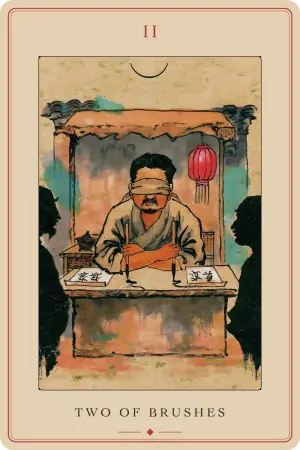
A blindfolded scribe holds two brushes over two petitions while the ink dries on both.
Card at a glance
- Numerology
- 2
- Element
- Air
- Astrology
- Moon in Libra · first decan
- Kabbalistic path
- Chokmah in Yetzirah
- Timing
- Autumnal equinox · first decan of Libra (Sep 23 – Oct 2)
- Yes / No
- Not yet · pause before deciding
Upright
decision
balance
neutrality
mediation
impartiality
stalemate
careful analysis
deliberate pause
Reversed
avoidance
denial
indecision
self-deception
paralysis
hiding behind procedure
postponed verdict
confusion
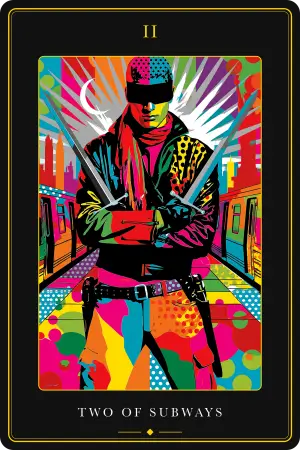
Two of Brushes in each deck
Every deck reimagines the same archetype. Compare the art, then open a deck to read its full interpretation.
Imagery and symbolism
In the Tarot of Beijing the Two of Swords becomes the Two of Brushes, and the scene moves from a rocky shore to a scribe's street stall. A blindfolded scribe sits at the stall with a brush upright in each hand. He tied the blindfold himself, the way an honest judge covers his eyes so he cannot see whose seal is on which petition. It shows the discipline of shutting out the world to consult only what is fair, and it shows how easily impartiality turns into a place to hide.
Before him lie two petitions, a neighbour's complaint and that neighbour's neighbour's complaint, mirror-written so each answers the other. They stand in for the two crossed swords of the older decks. Here the conflict is not steel but words, and in Beijing words are the sharpest instrument sold in any market. The ink is drying on both brushes, which is the card's quiet warning: a brush can wait only so long, and deliberation is paid for in drying ink and thinning patience.
The two petitioners appear only as black silhouettes at the edges of the card, facing each other across the scribe, drawn without faces because to a fair judge they must have none. His lamplit stall holds the narrow middle ground between them. A red lantern hangs at the corner, the single accent of vermilion, burning like the plain fact of the matter, lit and in view for everyone except the man in the blindfold. Above the roof a thin crescent moon curves in the kraft-paper sky, and on the side table the inkstone stands full and waiting. Everything needed for the verdict is already on the table. Nothing is missing except the decision.
Core meaning
The Two of Brushes is Beijing's card of the stalemate: the moment when two options of roughly equal weight clash and freeze, and a person retreats into neutrality to weigh them. The deck's own line for it is that in the suit of Brushes the first stroke cannot be unmade, which is exactly why the scribe does not make it lightly. Where the canonical Two of Swords crosses two blades over the heart, this card lays two well-written petitions on a table and asks which one gets ink first.
At heart the card is a portrait of deliberate suspension. The scribe values the pause because it keeps him from writing the wrong sentence, not because he is idle. The blindfold lets him judge the argument rather than the face making it, and the two petitions ask to be synthesized rather than fought over. This is the equilibrium point of the number two: a complaint on the left answered by a complaint on the right, and one undecided hand between them. The lesson of the card is that the pause is a tool, useful only until enough has been heard, at which point one brush has to come down.
Upright meaning
Upright, the Two of Brushes finds you seated in the scribe's middle seat with a genuine choice in front of you and the clarity, or the courage, still to gather. Two claims lie on your table and both are written in good calligraphy. Weigh the pros and cons, hold the neutral ground, and use the delay for what it is for: collecting the facts, the testimony, and your own honest preference. Do not let the pause become the answer. Ink dries, petitioners lose faith, and a dispute left unjudged eventually judges the judge. When you have heard enough, take off the blindfold and put one brush down.
In love. A decision held in suspension, two brushes raised and neither touching paper. You may be choosing between two people, or two futures with one person, blindfolded by your own wish to be fair to everyone including yourself. Read both petitions your heart has filed, then remember that in this suit the unsaid sentence also leaves a mark. Let one brush finally touch the page.
In career. A difficult choice at work: two projects, two offers, or two colleagues' conflicting accounts laid on your desk like rival petitions. Both sides may have quietly appointed you the judge. Keep the scribe's neutrality, because the moment you visibly favor one silhouette the other stops telling you the truth. Draft twice and send once.
In finances. Two financial petitions on the table, two offers or two ways to allocate what you have, each reading convincingly. This is a period of planning and weighing, not action. Study both papers before dipping the brush and read the fine print twice, once more aloud. An opportunity to invest or increase income exists, but it needs a documented, well-reasoned choice.
In health. A considered decision about the body, a choice between two treatments or two regimens, each lying before you like a well-written petition. The card favors equilibrium and quiet maintenance: a routine kept like the daily discipline of copying characters, unglamorous and cumulative. Do not split sensuality from rationalism or benefit from pleasure. The honest verdict usually balances both papers.
Reversed meaning
Reversed, the blindfold stops being a tool of impartiality and becomes a hiding place. You have chosen comfortable blindness over an uncomfortable verdict. The two petitions have been read many times, nothing new will arrive, and still both brushes stay raised while the ink hardens. This is often a stretch of denial, a pretense that the dispute will settle itself and that silence is a kind of fairness. It is not. The card shows paralysis dressed as prudence, and a mediator whose neutrality has curdled into absence. The remedy is plain: listen to the intuition you have already formed behind the blindfold, say the sentence out loud, and accept that a fair judge is not the one both sides love but the one both sides quote accurately afterward.
In love. The blindfold worn for comfort rather than for fairness. Problems get re-read but never answered, and the two petitions are your own doubts and your partner's unspoken grievances, both drying untouched. It can mark a quiet breakup in progress, a mediator's chair left empty. Name the problem, hear both sides including your own heart's, and decide. Indecision here is a verdict delivered slowly, and the harshest one available.
In career. A refusal to choose. You may lack the information to decide well, feel caught between two managers' contradictory instructions, or sit blindfolded in meetings, present and neutral and completely uncommitted, while colleagues learn to route decisions around you. The card can also mean feeling ignored, your careful judgments going unread. Take responsibility, clarify the matter in writing, and sign your name to it.
In finances. Financial conflict and stagnation, ink drying on both brushes while the accounts wait. Money left idle out of fear, investments made blindfolded, contracts sitting unsigned while the other party's patience thins like watered ink. Be cautious with new investments, but understand that endless caution is itself a losing position. Break the stagnation and check the numbers as they are.
In health. Neglected or misjudged health: symptoms re-read like petitions and never answered, checkups postponed the way an anxious scribe postpones a verdict. You may be tangled in contradictory advice, unable to commit to any course, or lurching between regimens without giving any of them time to work. Take off the blindfold, read the actual results, and commit to a single sustainable routine.
Historical notes
The Two of Swords entered modern tarot through the 1909 Rider-Waite-Smith deck, where Pamela Colman Smith drew a blindfolded woman on a gray stone bench between land and turbulent water, two heavy swords crossed over her chest and a crescent moon in the twilight sky. Her design borrowed visual frameworks from the fifteenth-century Sola Busca deck, one of the earliest to illustrate its pip cards with full scenes, and layered them with the astrological attributions of the Golden Dawn.
Before Smith, the older Tarot de Marseille showed no scene at all. Its Deux d'Epees simply set two curved, scimitar-like swords enclosing a central floral motif, read in traditional French cartomancy as respite and relief, a literal pause in the battle rather than a psychological stalemate. The Golden Dawn titled the card the Lord of Peace Restored. Aleister Crowley later objected that nothing had yet been disturbed to restore, since the card sits in Chokmah, the first emanation of force, and renamed it simply Peace.
The Tarot of Beijing keeps the blindfold, the crescent moon, and the balanced pair, then translates the whole scene into a hutong. The swords become brushes, the rocky shore becomes a scribe's stall, and the two opposing forces become two neighbours' petitions. The card belongs to the suit of Brushes rather than Swords, so the weapon of the mind is the writing brush, and its defining rule is calligraphic: the first stroke cannot be unmade.
Correspondences
Number. Two, the number of duality and opposition. On the scribe's table the symmetry is literal, a complaint on the left mirror-written against a complaint on the right, with one undecided hand between them. In numerology two also carries partnership and cooperation, since every dispute in the lane is at root a relationship out of balance asking to be rebalanced rather than severed. The same two holds doubt, hesitation, and the drying ink of the card.
Astrology. The Moon in Libra. Libra is the hand scale of the zodiac, and the scribe holds his two brushes level like its pans, seeing both sides precisely because he has chosen to see neither petitioner's face. The Moon rules the inner world and the subconscious, everything the scribe knows without having read it, drawn here as the thin crescent above his stall. In harmony it lets him sense which petition rings true before logic can prove it. In disharmony it floods him with doubt and keeps both brushes raised all night.
Element. Air, which in this deck flows through the suit of Brushes: thought, communication, the written word, and mental trials. Air here does not blow through open sky. It hangs over a writing desk, where a single stroke of ink cannot be taken back.
Kabbalah. Chokmah, the second sphere and the seat of Wisdom, in the world of Yetzirah, the formative realm of Air. Because Chokmah sits high on the Tree, the strife usually attached to the suit is neutralized into a pre-conflict balance. The first decan of Libra, roughly September 23 to October 2, opens at the autumnal equinox, when daylight and darkness stand equal, the sky's own image of two level brushes.
Psychological perspective
The person of this card knows how to set boundaries and hold the middle of a room. They keep composure when everyone else is shouting over the fence, and neighbours instinctively bring their disputes to their table. They weigh every word before committing it to paper, because in their world the first stroke cannot be unmade, and they synthesize opposing accounts without letting them clash inside their own head. Highly analytical and reflective, they are fair and objective, sometimes maddeningly slow, and their verdicts once given are trusted like an honest scale.
The shadow is the same discipline gone still too long. Here the person sits blindfolded between two obligations and lets the ink dry on both, citing fairness while acting from fear. Logic and feeling fall out of balance. They deny problems and hope the neighbours will settle it in the lane without them, hiding behind procedure and the appearance of deliberation. They dread the losing party's face more than the wrong decision, and they mistake their paralysis for impartiality while both sides quietly stop bringing their disputes at all. The card asks which hands tied the blindfold, and whether it is worn as a discipline or as a refuge.
Two of Brushes across decks
Rider-Waite-Smith. The canonical Two of Swords seats a blindfolded woman between land and water, two swords crossed over her heart under a crescent moon. The Beijing card keeps her blindfold and her moon but moves her indoors to a scribe's stall, swaps the crossed swords for two raised brushes, and turns the emotional sea behind her into two written petitions on the table.
Tarot de Marseille. The archaic Deux d'Epees shows no figure, only two curved swords around a floral motif, read as respite and a pause in the fight. Beijing restores the human scene the Marseille pip omits, giving the pause a face, a stall, and a lit red lantern, while keeping the sense of a truce that cannot last.
Crowley-Thoth. Crowley placed two crossed swords in a five-petaled blue rose, glyphs of Moon and Libra balanced above and below, and named the card Peace. Behind the tranquil geometry he hid faint pinwheels for the mind's constant activity. Beijing carries the same warning differently, in ink drying on brushes that cannot stay raised forever.
Modern reframings. Recent decks translate the stalemate into their own worlds: the Light Seer's Tarot sets a figure at a crossroads pulled two ways by crows, while the Hezicos Tarot joins two roads into one to show a settled dispute. The Tarot of Beijing belongs to that reframing movement, rendering the choice as a scribe's verdict and the swords as the writing brushes of a city where words are the sharpest instrument in the market.
In combination and context
The Two of Brushes pulls a spread toward suspended judgment, and the surrounding cards reveal what the scribe is really waiting for. Beside cards of self-imposed limitation it deepens into paralysis, a person trapped between two obligations and unable to free themselves for fear of hurting either petitioner. Beside cards of completion and harmony it reads as hesitation at the final step, a good outcome held back because one hand will not commit the stroke.
With cards of illumination and truth the blindfold cannot hold. The lit red lantern in the corner becomes the point: the fact of the matter is already lit and in view, and denial simply cannot last against it. In work and business spreads the neighbours tell you whether the pause is due diligence or avoidance, whether you are gathering testimony or hiding behind procedure long after deliberation has stopped producing anything.
When the card keeps returning to a reading, treat it as the inkstone standing full on the side table. Everything needed for the verdict is present. The card is not asking for more information. It is asking you to check which brush has grown lighter in your hand, put it to the paper, and let the dispute end so the work can begin.
Questions for reflection
- Whose hands tied your blindfold, and are you wearing it as a discipline that gathers fairness or as a refuge from an uncomfortable verdict?
- Which petition on your table do you keep re-reading, hoping it will start saying something easier than what it already says?
- If you checked the ink tonight, which of your two brushes has grown lighter in your hand, and what would it cost to set it down on the page?
The general meaning follows the Rider-Waite-Smith reading — the reference used across Tarot Academy. Open a specific deck above for its own interpretation.
Frequently asked questions
Explore the Tarot
Latest Posts
Discover the ancient wisdom of tarot cards and unlock the mysteries of your spiritual journey. Our blog is your gateway to understanding the rich symbolism, meanings, and practical applications of tarot reading.




















































