
 EN (English)


Major Arcana · 21
The Morning Bell
Resurrection made daily: the dawn bell strikes once, and every gate on the lane opens at the same moment.
Card at a glance
- Numerology
- XX
- Element
- Fire (first light)
- Astrology
- Pluto · fifth watch before sunrise
- Kabbalistic path
- Shin (Malkuth to Hod)
- Timing
- Dawn · the turn from last cold to first warmth
- Yes / No
- Yes
Upright
awakening
the call
renewal
rebirth
second chance
forgiveness
collective rising
answered summons
Reversed
ignoring the call
procrastination
missed opportunity
clinging to the past
self-judgment
avoidance
delay
the shut gate
The Morning Bell in each deck
Every deck reimagines the same archetype. Compare the art, then open a deck to read its full interpretation.
Imagery and symbolism
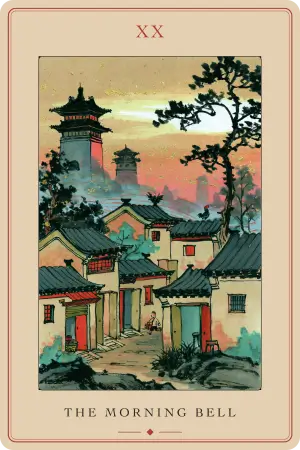
In the Tarot of Beijing the trumpet of the last day is a bronze bell, and the graves are gates. The card is drawn in the deck's Feng Zikai manner: a few calm ink lines, grey wash, accents of vermilion and teal on warm kraft paper flecked with gold, a small red seal in the corner. The Bell Tower and Drum Tower rise at the top, the two instruments that ruled Beijing's time for centuries. Here it is the bell's hour, and the towers stand like two witnesses of the verdict of morning.
The sound itself is not drawn. It is shown, as sound must be in ink, by its consequences: every gate along the hutong standing open at once. The noodle man's rolled-up shutter is the stone rolled from the tomb, rendered in the humblest shopfront terms. The schoolboy running with his satchel is the future answering the summons at full speed. The grandmother with her stool is continuity; she has answered this bell some twenty-five thousand times and still comes out. A rooster on the roof ridge answers the bronze in flesh and feather, nature countersigning the city's decree.
The dawn light is laid in vermilion and gold, the deck's colours of blessing, breaking over grey-blue roofs. The lane runs straight toward the towers, and it is the trumpet's throat: one sound poured down it, and the whole street rose. Nothing in the picture is miraculous, which is the deck's deepest statement. In the Tarot of Beijing resurrection is daily, gentle, and shared.
Core meaning
The Morning Bell is Beijing's Judgement, and the deck answers the Western card of the end of time with a quieter thesis: time does not end, it renews, and renewal is issued in equal daily portions to everyone on the lane. At dawn the great bell strikes once and along the whole hutong every gate opens at once. That is the card: a sudden, unmistakable call announcing an awakening, a summons, or a transition that arrives all at once, in one clear sound, rather than gradually.
Where the classical card stages a single cosmic reckoning with angels and open tombs, this deck reveals the last day to be every day, and the trumpet to be a bell that has never missed a dawn. The card carries re-evaluation, reconciliation, the settling of old accounts in your favour, and the results of past effort finally arriving. Its instruction is blunt. Do not analyse the sound. Answer it. The bell does not strike a private note for each listener; it strikes once, for everyone, and the only question is whether your gate opens. What is asked of you now is presence, not perfection.
Upright meaning
Upright, the bell has struck and the whole street is rising into a new day. A call has come that you already recognize, and the reading turns on the rising, not the hearing. Forgive what the night held, roll up the shutter, and step into the lane. This is the great card of the second chance: recovery after loss, the settling of old accounts in your favour, a case reheard at dawn and ruled the right way. Rise with the street, uncombed and unready and entirely welcome.
In love. Awakening of feeling and honesty, a relationship that had been sleepwalking woken by one decisive conversation that clears the air the way dawn clears the lane. It is the card of reconciliation after a quarrel and, often, the return of a person from the past who is now, and only now, ready. What is confessed at this dawn is pardoned by it, because both of you are rising into the same day.
In career. The summons: the offer, the promotion, the exam result, the project that begins suddenly and all at once. What you laboured at in the dark is pronounced upon in the light, and the pronouncement rewards you. It is a strong card for returning to a former employer or an abandoned path, and for the new team rising together into a shared start. Answer quickly, because summonses of this kind are struck once.
In finances. Old accounts close and new ones open in your favour. Debts return, delayed payments arrive, a frozen matter resolves, the pawned thing is redeemed. Money answers the same law as the street: what rises early prospers. Expect the profitable news in the morning and act on it the same day.
In health. Revival: recovery after illness, the return of strength that felt gone for good, the morning the body simply feels new. Everything begun at sunrise is doubled in power under this card, from the walk to the tai chi in the park. In beauty it favours rest, light, and the freshness of a face that slept honestly and rose early.
Reversed meaning
Reversed, the Morning Bell shows the one gate on the lane that stays shut. The bell has already struck, the call has been given, the whole street is moving, but you have pulled the quilt over your head and declared it someone else's dawn. This is the position of postponed decisions and ignored signals, and of a past clutched instead of released: yesterday's grievances, old guilt, a verdict you keep re-reading instead of appealing. Often the block is fear of judgment, your own or others', that keeps you in the dark room while daylight stands politely outside. The bell is patient, but the day is not; each morning slept through is a morning that happened without you.
In love. Love slept through: the confession postponed until it curdled, the returning person met with a closed gate out of pride, the couple where one has risen into a new day and the other still lives at midnight, relitigating old hurts. Either rise together at the same dawn, or admit you now live in different days.
In career. The vacancy you did not apply for, the raise you did not ask about, the exam you keep preparing for through its third rescheduling. Often an old professional verdict, a failure or a firing or a harsh review, is still being served as a sentence. That case is closed; the gate is not locked, it has simply not been pushed.
In finances. A slept-through financial dawn, the window that opened once and closed while you deliberated. It can show old money-guilt running the accounts, or overcaution after a past loss. Check what summons you are ignoring: an unread letter, an unclaimed sum, a debtor waiting to settle. The loss here is rarely theft; it is oversleeping.
In health. The body's calls ignored: the symptom explained away, the check-up rescheduled into vagueness, fatigue treated as a moral failing rather than a summons to rest. The body issues its bell gently but not forever. Answer the small summons, the sleep or the appointment or the walk at dawn, before it must strike a louder one.
Historical notes
In fifteenth-century Italy the card was called the Angel, and early hand-painted trionfi decks captured a terrifying moment of Christian eschatology: the Last Judgement. The Cary-Yale Visconti deck, made in Milan around 1440, bears the golden inscription Surgite ad Judicium, Rise to Judgment, with angels blowing trumpets above and naked souls rising from stone tombs below. The Charles VI deck of about 1460 shows seven souls emerging, some in ecstatic joy and others with arms crossed in the dread of damnation.
As the Tarot moved to France it became Le Jugement, and the Tarot de Marseille fixed a static triad of figures beneath one massive angel. The occult revival of the late nineteenth century stripped the fear-based Christian frame away and read the summons as internal: the divine spark within calling the soul up from the dead weight of materialism. The 1909 Rider-Waite-Smith deck gave the card its familiar form, Archangel Gabriel with a trumpet, the banner of St. George, a grey-skinned family rising from coffins on an ocean, snow mountains behind. Crowley renamed it The Aeon in the Thoth deck and abandoned the graves entirely for a Thelemic pantheon.
The Tarot of Beijing takes the reframing to its quiet extreme. It keeps the summons and the rising and removes the spectacle. No graves open on this card, only gates, shutters, and eyes. The judge is simply the morning light, which shows everything as it is and holds nothing against anyone. What the whole tradition dramatized with fire and angels, the hutong performs before breakfast.
Correspondences
Number. Twenty, the completed double cycle, two full rounds of one through ten. The night has been lived to its end and the ledger of the previous day is closed. In reduction 2+0 gives Two, the High Priestess: what the Fortune-Teller Behind the Curtain knew in silence and smoke, the Morning Bell pronounces aloud over the whole city. Twenty is also the zero standing beside the two, the blank new day appended to the pair of towers.
Astrology. Pluto, planet of transformation and irreversible renewal, though in this deck Pluto's upheaval is domesticated into the daily cataclysm of dawn: every morning the old day ends absolutely and a new one is issued to everyone without exception. Its hour is the fifth watch, just before sunrise, when the bell traditionally struck. Its season is the turn from the last cold to the first warmth, when the whole city seems to open its gates at once.
Element. Fire in its aspect of the first light, the vermilion line on the horizon, quieter than noon's blaze, that changes everything while touching nothing.
Kabbalah. In the Golden Dawn system the card holds the mother letter Shin, the tooth, and the primal purifying fire of divine inspiration, on the path from Malkuth to Hod. This is the fire that breaks down dense material illusion so it can be released as spiritual energy, distinct from the destructive fire of The Tower.
Psychological perspective
Psychologically, the Morning Bell describes the moment the psyche hears its own summons, the inner call that Jung named vocation and the hutong names, more simply, the bell. The personality of this arcana is built around the capacity to answer, to let an insight, once heard, reorganize the day. Such people experience awareness as obligation: having understood, they cannot un-understand, and so they rise. Their healthy form is remarkable, with low resentment, fast forgiveness, and a clean break between yesterday and today.
The shadow is the reversed card, the sleeper who hears perfectly well. This is avoidance wearing the costume of doubt, the thought "I'm not sure the call was for me" used as a defence against the terror of being seen rising. Beneath it often lies an old internalized verdict, a critical voice from childhood that pronounced sentence once, so that every new summons is heard as a re-arrest rather than a pardon. The work of this card in therapy is the work of the lane at dawn: to discover that the bell is an invitation rather than an accusation, that everyone else on the street is also uncombed and unready, and that presence is what the morning asks. Integration looks like the schoolboy, hearing and rising and running with the satchel packed the night before by the part of the self that already believed in tomorrow.
The Morning Bell across decks
Rider-Waite-Smith. Archangel Gabriel sounds a golden trumpet above a grey family rising from coffins on an ocean, the banner of St. George on the horn. The Morning Bell keeps the summons and the rising but trades the single cosmic reckoning for a daily one, the bell for the trumpet, and the open coffins for open gates along a lane.
Tarot de Marseille. One massive angel hovers over a static triad rising from the earth, the standardized theological resurrection. Beijing keeps the structure of a call answered from above but empties it of the biblical tribunal, leaving only the morning light as judge.
Crowley-Thoth. Crowley renamed the card The Aeon and replaced graves and angels with Nuit, Hadit, and the twin child-god Horus, heralding a new age of self-directed will with no external judge. The Beijing card shares that refusal of an external tribunal but grounds it in the street rather than the cosmos: the summons is collective, not private, and the new day is issued to everyone at once.
Modern reframings. Recent decks render the card as continuous personal transformation, a phoenix rising or skulls sprouting grain. The Tarot of Beijing belongs to that movement, its resurrection stripped of spectacle and folded into the reliable rising of a hutong at dawn.
In combination and context
The Morning Bell pulls whatever spread it lands in toward awakening, the answered call, and the closing of old accounts. In relationship spreads it often stands for the person from the past whose return reopens the case; in career spreads, for the summons itself, the offer or the exam or the announcement pinned up at dawn. Choose it as a significator for the querent who says "I know what I have to do," because the knowing is the bell and the reading is about the rising.
As the arcana of the day it marks a day of the answered call, the best possible day for beginnings that have been postponed: quitting, applying, apologizing, proposing, publishing, opening the literal or figurative shop. Do the important thing in the morning, because the card's power thins by dusk, when the Drum Tower takes over and the day begins closing its gates. One caution rides with it: do not spend the day re-trying old cases, since the night's accounts are already closed.
When the Morning Bell keeps returning to a reading, treat it not as an outside verdict pressing on you but as a bell you have been sleeping through. The summons was already collective, and the profit of the day lies ahead of you, down the lane, in the vermilion light.
Questions for reflection
- The bell has already struck for something in your life. Which gate are you keeping shut, and what would it cost you to simply open it uncombed and unready?
- What old verdict, from a parent or a boss or your own younger self, are you still serving as a sentence long after every court but your own has overturned it?
- If you rose at the same hour tomorrow and performed one small opening gesture before analysing anything, what would you be answering?
The general meaning follows the Rider-Waite-Smith reading — the reference used across Tarot Academy. Open a specific deck above for its own interpretation.
Frequently asked questions
Explore the Tarot
Latest Posts
Discover the ancient wisdom of tarot cards and unlock the mysteries of your spiritual journey. Our blog is your gateway to understanding the rich symbolism, meanings, and practical applications of tarot reading.




















































