
 EN (English)


Major Arcana · 22
The View from the Hill
Completion seen as a panorama: from Jingshan at dawn the whole city stands revealed along one Central Axis.
Card at a glance
- Numerology
- XXI
- Element
- Earth · the four elements united
- Astrology
- Saturn
- Kabbalistic path
- Tav (Yesod → Malkuth)
- Timing
- Dawn · year's end and the next cycle beginning
- Yes / No
- Yes
Upright
completion
wholeness
arrival
homecoming
integration
harmony
the closed circle
perspective
Reversed
incompletion
unfinished business
delay
disorientation
fear of finishing
stagnation
imbalance
the last stretch unwalked
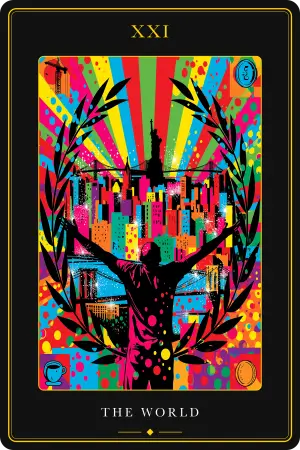
The View from the Hill in each deck
Every deck reimagines the same archetype. Compare the art, then open a deck to read its full interpretation.
Imagery and symbolism
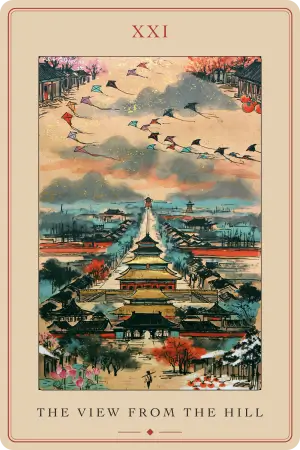
In the Tarot of Beijing the World is called The View from the Hill (中轴线, the Central Axis), and it shows no dancer and no cosmos. It shows the whole of old Beijing seen at dawn from the top of Jingshan, drawn in the Feng Zikai manner: calm brush lines, gray washes lifted with vermilion and teal, gold-flecked kraft paper, a small red seal in the corner. Nothing floats. Everything stands in its place, and in this deck that is the revelation.
The Central Axis runs straight through the Forbidden City to the Drum and Bell Towers, the deck's answer to the dancer's two wands and the wreath's perfect circle. It is the line of order on which the whole world is strung, every gate and hall and tower agreeing on one direction. Above the roofs the kites circle like a garland where the laurel wreath used to be. A wreath is victory closed into a circle; the kites are that same circle kept alive, tugging on strings held by unseen hands in the lanes below.
In the four corners the four seasons happen at once: spring blossom, summer lotus, autumn persimmon, winter snow, each in its own hutong. They stand where Rider-Waite sets the bull, lion, eagle, and angel, the four fixed elements translated into time, the complete year held in one gaze. Hidden among them the four suit emblems appear together for only the second time in the deck: the kite, the teacup, the brush, and the coin. On the Magician's cart they were tools. Here they have become seasons, and what a person once wielded they now simply live inside.
At the center of the panorama, tiny and complete, walks the young man from Card 0, the Newcomer who once stood at the railway station with a paper address in his fist. He is no longer lost. He is the deck's dancing figure, not above the world but inside it, and it fits him. The dawn light and the gold flecks carry what celestial blue carries in the classic card: a quiet illumination, the day beginning over a finished world.
Core meaning
The View from the Hill is Beijing's World, and its whole argument is that wholeness is a matter of vantage. Down in the lanes the city is a maze; from the hilltop it is an order. Nothing in the city changed between the Fool's first stride and this panorama. What changed is the height from which it is seen, and the height was earned by walking. Completion here does not mean acquiring one final thing. It means reaching the view in which everything you already have reveals its arrangement.
The card is the terminus of the deck's telling of the Fool's journey: arrival, all the way into the world. Where the canonical World floats a dancer in a wreath above the earth, this figure walks the Central Axis at street level while seeing the city whole for the first time. Integration means that every card he has been is present in the frame: the Emperor's hill under his feet, the Magician's four tools now the four seasons in the corners, the kites of will still flying, the lanes of every trial still legible below. A true panorama refuses nothing, so the demolished gate and the new nest, the winter corner and the spring corner, are reconciled in one look.
Upright meaning
Upright, the card marks the successful closing of a great circle. A long road has led exactly where it was going: a project completed, a phase of life finished, a cherished dream realized, and the realization feels less like fireworks than like a deep, calm exhale from a hilltop. Work, home, feeling, and thought align like roofs along the Axis. The counsel is to climb the hill before rushing on: stand still, take in the whole of what you have built, draw your conclusions, thank the road, and close the accounts of the finished stage. From above, no single lane's trouble looks like the end of the world.
In love. The card of the shared city. Two people who once held each other like a paper address now hold each other like a map they both know by heart. It favors mature, unhurried love and the major completions that seal it: engagement, marriage, the shared home, the decision that closes the searching years. For someone newly meeting, it promises a person with whom the maze immediately reads as a map.
In career. A professional cycle completes and the reward has a view attached. The long project ships, the training ends in mastery, the probation or degree concludes, and the recognition is real: a promotion or a new title, often a move to a position from which the whole operation is visible for the first time. Efforts invested down the years pay out together, and the satisfaction is the calm of work that finally fits rather than the thrill of a win.
In finances. Financial wholeness: the household economy becomes visible all at once and, seen whole, proves sound. A debt is cleared, a savings goal reached, a property deal closes, a long-awaited sum arrives. Income and expenses align like roofs along the Axis, and wealth settles into structure. It is an excellent moment for a full accounting from the hilltop before planting the next season.
In health. The body as a well-ordered city, everything on its axis. The long work of good habits closes its circle and becomes constitution, and a course of treatment or recovery reaches its genuine end and holds. It favors the practices of the axis: walking, tai chi, breath, whatever teaches the body its center line.
Reversed meaning
Reversed, the hill is climbed on a foggy day. The Axis is there, but you cannot see it. Something remains unfinished, a last stretch of road unwalked or a final account unclosed, and that one incompleteness quietly disorders everything else, like a single season arriving out of turn. The obstacles are usually internal: stress, insecurity, an inability to accept that the stage is over, or a refusal to climb at all because the view might demand conclusions. Name what is actually unfinished, which is nearly always smaller than the fog makes it look, then finish it or consciously set it down. Both close the circle; wandering does neither.
In love. Two people in the same city on different axes. The relationship is almost whole, which is why its one open circle aches: the conversation never finished, the commitment never quite made, the old grievance kept like an unpacked box. Partners litigate single lanes, whose turn and whose fault, while the shape of what they built together goes unseen. The counsel is to take the view together and gently finish the one thing that keeps the circle open.
In career. Work that circles instead of arriving. The project stalls one step from completion, the report stays eternally in draft, the promotion is perpetually next quarter. Sometimes it shows the opposite ailment: a hilltop role without street knowledge, overview without contact, which the whole lane quietly notices. The remedy is completion in miniature, finishing the smallest whole thing on the desk today so the closed circle can teach the open ones.
In finances. The ledger will not close. Affairs are almost in order, which is precisely the problem: one unpaid remainder or unsigned paper keeps the whole from balancing. Money gets managed lane by lane, in reaction, with no view of the year entire, so one corner's winter feels like ruin. The card warns against spending the harvest before it is weighed, and advises the full, unglamorous accounting instead.
In health. The body managed lane by lane and never seen whole: the diet in one season, the sleep in another, symptoms treated corner by corner while the axis goes untended. Regimens stop one step from becoming habit, so every January the same circle reopens. The counsel is one honest overview, a real inventory of sleep, food, movement, and strain, then a rebuild from the axis outward: posture, breath, regular hours.
Historical notes
The World is one of the oldest and most consistent images in the deck. The earliest surviving cards, the Visconti-Sforza set made around 1460 for the rulers of Milan, showed Arcanum XXI as earthly dominion or a celestial sphere held by angelic figures, in the Christian and classical language of the Renaissance. By the eighteenth century French production had settled the pattern: in the Tarot de Marseille the card is titled Le Monde, a semi-nude figure standing inside an almond-shaped mandorla, flanked in the four corners by the four beasts of the tetramorph.
The modern card was shaped by the Hermetic Order of the Golden Dawn. In 1909 Arthur Edward Waite and Pamela Colman Smith kept the Marseille structure but gave the dancer two wands, one in each hand, where the Magician of Card I held only one, and wove the wreath into a green laurel bound top and bottom by red ribbons in the shape of the lemniscate. Working during the Second World War, Aleister Crowley and Lady Frieda Harris renamed the card The Universe in their Thoth deck of 1944, trading earthly completion for a cosmic one and placing the early periodic table of elements at its base.
The Tarot of Beijing carries the reframing to street level. It removes the dancer and the cosmos and keeps the function: completion, the four elemental corners, the closed circle of the wreath. In their place stand the panorama from Jingshan, the four seasons in four hutongs, the garland of kites, and at the center the small walker who ends the Fool's journey on foot, feet on the ground the whole way.
Correspondences
Number. 21, in this deck the number of the completed city. It is the full walk from the railway station of Card 0 to the top of Jingshan with no lane skipped, and in numerology the successful closing of a great cycle. Broken apart, 21 gives 2 and 1: the two towers, Drum and Bell, answering each other down the Axis, and the single vertical line of the Axis itself. The digits sum to 3, the living triad of heaven, city, and walker, the kites above, the roofs below, and the small figure between them.
Astrology. Saturn, the planet of structure, boundaries, patience, and earned form. No card in the deck wears Saturn more plainly: the Central Axis is Saturn drawn in one brushstroke, the discipline of a whole city agreeing to stand in line for seven hundred years. Saturn grants nothing early and nothing unearned, and the view from Jingshan exists only for the one who climbs.
Element. Earth, the settled and material end of the journey, with all four elements gathered into the frame. The four seasons in the corners are the four fixed elements translated into time, fire, water, air, and earth held together as one year rather than four warring forces.
Kabbalah. The Hebrew letter is Tav, the last of the twenty-two letters, on the 32nd path of the Tree of Life. It is the lowest path, the sole bridge from Yesod, the foundation and the astral, down to Malkuth, the physical kingdom. The World is that precipitation itself, the point where an ethereal plan finally crystallizes into hard reality.
Psychological perspective
The person of this arcana has a working inner axis. Values, work, attachments, and memories stand aligned rather than scattered, so under pressure they do not fragment. They have panoramic attention, the capacity to zoom out of a conflict or a bad season and see it as one corner of a larger year, and they carry their past newcomer gently, remembering being lost well enough to keep their confidence hospitable. They complete things, mourn endings briefly and cleanly, and treat arrival as a place to stand rather than to stop.
The hilltop has its shadow. Attachment to the achieved panorama can harden into a reluctance to descend into any new maze, and the person who has seen the whole may refuse tasks that require being lost again. Perspective can cool into detachment, watching the lanes instead of walking them, and there is a risk of premature completeness: declaring the map finished so as never to redraw it, mistaking the comfort of orientation for the end of growth. The cure is written into the card, because the figure at the center is still walking.
The View from the Hill across decks
Rider-Waite-Smith. The canonical World floats a dancing figure in a green laurel wreath, a wand in each hand and the tetramorph in the corners, hovering above the earth in a state of cosmic completion. The View from the Hill keeps the meaning and lowers it to the ground: the dancer becomes a walker on the Central Axis, the wreath becomes a garland of kites, and the completion is architecture rather than ecstasy.
Tarot de Marseille. The older Le Monde sets a semi-nude figure inside an almond-shaped mandorla, the four beasts at the corners, the Vesica Piscis reading as a cosmic womb and portal. Beijing keeps the fourfold frame but turns the corners into seasons and the portal into a vantage, the hilltop from which the whole is finally visible.
Crowley-Thoth. Crowley renamed the card The Universe and pulled it out of the earthly sphere into abstract cosmic force, the dancer wound about by the serpent Ophion and the periodic table set at the base. The Beijing card walks the opposite road, insisting that the cosmic is always shown through the small and human, so its universe is one ordinary city seen whole.
Modern reframings. Recent decks tend to bring the card's completion back to a human scale, favoring integration and homecoming over cosmic abstraction. The Tarot of Beijing belongs to that movement, staging the end of the journey as a young man on a morning street who knows his way home.
In combination and context
The View from the Hill pulls a spread toward completion, perspective, and the closing of accounts. Its strongest pairing is with the Newcomer, this deck's Fool: the two extremes of the journey together hand the querent a master key, the right to start completely over but from a far higher vantage, the finished circle becoming the launching ground for the next leap. In work this reads as the expert who has mastered one field and steps fearlessly into a new one; in love, as a person whole enough to become newly vulnerable without fear of losing themselves. Reversed together, the two describe a purgatory between worlds, a chapter that will not close used as an excuse to avoid the next risk.
Set against the Wheel of Fortune the difference sharpens. The Wheel is fate turning from outside, luck and circumstance beyond control; the View from the Hill is the internal mastery earned by integrating exactly those turns, a rooted and lasting resolution rather than a transient one. Beside the Chariot the war is finally won and the armor can come off, the vehicle of will arriving at its destination. When the card keeps returning, treat it as an invitation to climb your own hill: finish the small stretch left undone, take in the shape of what you have built, and only then sketch the next map.
Questions for reflection
- What has been ninety percent done for too long, and what would it take to walk the last lane and close its circle?
- If you climbed the hill and saw your life whole, which seasons are you refusing to hold in the same frame?
- Whose paper address could you read today, orienting a newcomer near you the way someone once oriented you?
The general meaning follows the Rider-Waite-Smith reading — the reference used across Tarot Academy. Open a specific deck above for its own interpretation.
Frequently asked questions
Explore the Tarot
Latest Posts
Discover the ancient wisdom of tarot cards and unlock the mysteries of your spiritual journey. Our blog is your gateway to understanding the rich symbolism, meanings, and practical applications of tarot reading.




















































