
 EN (English)



Major Arcana · XX
Judgment
Smith's grey families standing up out of floating coffins while Gabriel's red-winged trumpet cracks the sky above them.
Card at a glance
- Numerology
- XX
- Element
- Fire
- Astrology
- Pluto · co-ruler of Scorpio
- Kabbalistic path
- Shin (Malkuth → Hod)
- Timing
- Sudden · a calling
- Yes / No
- A resounding yes, if you answer honestly
Upright
awakening
rebirth
reckoning
absolution
calling
karmic law
forgiveness
second chances
Reversed
procrastination
self-judgment
resistance to change
missed opportunities
guilt
ignoring the signs
Judgment in each deck
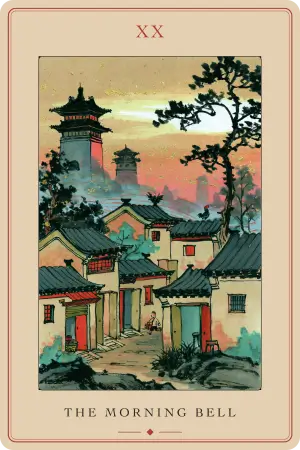
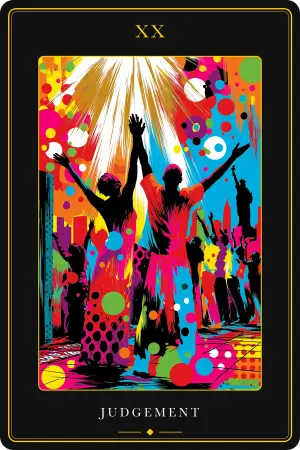
Every deck reimagines the same archetype. Compare the art, then open a deck to read its full interpretation.
Imagery and symbolism
What Waite and Smith did in 1909 was take the static Marseille triad and put the whole scene back in motion, then load every part of it with Golden Dawn doctrine. The Marseille card gave you three figures posed around an angel. Smith gives you six people in two family groups, water under their coffins, mountains behind them, and an angel with red wings.
Gabriel fills the upper half, the divine messenger of the Abrahamic faiths, who in esoteric tradition holds the perfect equilibrium of universal forces and presides over emotional purification. The wings are red in this deck, and that colour does specific work: it is the call to decide, to turn in a new direction, and to spend that energy on real change rather than contemplation. The golden trumpet is the instrument. Sound is a vibration that shatters the stagnation of the physical world, which is why music and art get past defences that argument never reaches, and the note it plays asks one uncompromising question: will you rise when called, or stay in the grave because it is comfortable there.
From the trumpet hangs a white flag bearing a red cross, the flag of St. George, referencing the resurrection at the last trumpet in 1 Corinthians 15. Its equal arms mark where the vertical axis of spirit crosses the horizontal axis of matter. In this deck's own reading the flag stands for purification and release from negative patterns, with white and red together carrying the appetite for change.
Below, six figures rise in two groups of three, the foreground trio a man, a woman, and a child. Read one way they are the conscious, subconscious, and superconscious minds coming into one; read another they are infancy, youth, and old age, the whole cyclical shape of a life. They are naked with arms lifted, which this deck takes as purity, sincerity, and total openness, and the raised posture as readiness to receive. Their skin is a sallow grey, a chromatic choice that strips away racial and ethnic division in front of ultimate truth and marks the liminal state between a dead old self and a new one not yet solid.
The coffins are the self-imposed limits and materialist paradigms that held them, and their lids have been opened from the outside. You must climb out yourself, but the thing that cracks the lid arrives from beyond the ego's reach. The coffins float on water, the subconscious and emotional depth, and an echo of Revelation 20 where the sea gives up its dead. Great clouds spread behind Gabriel for divine intervention and the room being cleared for new thought. Snow-covered blue mountains close the horizon, deliberately recalling the icy peaks of The Fool, so the long circuit of the trumps is visibly returning to its source at a higher turn, and standing equally for the impossibility of outrunning the assessment. Blue and yellow dominate the palette: blue for spirituality, peace, and divinity, yellow for light, truth, and insight.
Core meaning
In this deck Judgment is the Miracle of Transformation. When the Hero has met every requirement of the journey, the miracle happens, and it comes only to someone who has satisfied the conditions and receives it with a pure heart. That framing matters, because it makes the card less a verdict handed down than a threshold reached.
What the card marks is the moment of truth: past actions surface and their weight is finally assessed, then set down. The Hero understands their own actions, takes responsibility for them, and shifts to a level of awareness where past mistakes are visible and healing can start. Their whole relation to the world changes with the recognition of how tightly past, present, and future are tied together. The mission from here is to find truth, heal old wounds, and rethink the path.
The healing that follows is the point: liberation, freedom, and peace of mind, with new goals and priorities set on the far side and trust in one's own strength restored. Smith's picture holds the transition itself rather than either end of it, which is why the figures are captured mid-rise with the coffins still open beneath them.
Upright meaning
Upright, this card points to sudden realization, an important decision, or the move into a new stage of life. The past falls away and openings appear. Circumstances demand real awareness, so it asks you to weigh your actions and choose deliberately, and it carries reevaluation, resurrection, reconciliation, and reward for effort already spent.
The counsel is concrete. Look back at what you actually did and draw honest conclusions. Practise real self-assessment. Remember cause and effect and own your part in it. Forgive yourself and forgive others. Your fate sits in your own hands here, so open the horizon yourself rather than waiting for permission.
In love. A period of reflection, a second chance, or the restoration of a relationship. Old feelings rekindle, neglected bonds get attention, past mistakes get resolved. The deepest and truest emotions rise to the surface and prompt a conscious choice toward love, and there is room to clarify things, end old quarrels, and reach genuine reconciliation.
In work and career. Reevaluating your current position or line of work, and an awareness of your true calling. It can mean a move to a new job, advancement, a major new project, or real transformation inside an organization. It promises reward for past labour: justice, recognition, and merit, with earlier decisions now bearing fruit. In business it is the moment for a decision that shifts direction, built on past experience and analysis rather than impulse.
In finances. A significant decision or a transitional period in money matters, carrying fairness and just reward for past work. It can point to an inheritance, a court case, or an insurance payout, and to new openings for earning or investment. Weigh the pros and cons and decide consciously.
In health and body. Reevaluating lifestyle, with greater body awareness and an inner pull toward cleansing, restoration, and better food. Life force reactivates. It is a period of active self-work and sport where the results of effort become visible.
Reversed meaning
Reversed, the card turns to stagnation, fear of change, and a refusal to own mistakes. Responsibility gets dodged and decisions get harder, so important choices are delayed or blocked outright. It shows up as low self-esteem, guilt, fixation on old errors, and sometimes as fear of an approaching judgment or of being judged harshly by others.
The way out is unglamorous. Overcome the fear that is stalling the decision, look at your life objectively enough to name your mistakes, and take responsibility so they do not repeat. Mistakes are part of growth. Reevaluate the past for its real lessons, then stop dwelling there.
In love. A lack of readiness for change and an unwillingness to close old wounds. Old grievances block progress, a relationship drags on too long or sits in a dead end, and one partner cannot make the decision or admit the mistake. Avoiding the conflict only postpones it and makes it worse.
In work and career. Ill-considered action or unverified information, with a final decision still premature. It warns of trouble in a move to a new position or the launch of a project, of delays needing a stronger plan, and of unfair treatment or dissatisfaction with your professional standing. In business, old methods have stopped producing and the management approach needs reassessing.
In finances. Fair compensation delayed, or a decision you were counting on postponed or resolved differently than expected. It points to an inability to act, missed opportunities, and reluctance to take responsibility, and warns of poorly weighed risk.
In health and body. Reluctance or inability to change habits around health and appearance, with doubts causing indecision and motivation missing. There can be laziness about exercise, low self-esteem, or plain denial that the body needs attention. Change is coming regardless, so prepare for it.
Historical notes
Waite and Smith inherited a card with four centuries of settled iconography behind it. In fifteenth-century Italy it was called L'Angelo, the Angel, and staged one terrifying moment of Christian eschatology. The Cary-Yale Visconti deck of about 1440 carries the golden inscription Surgite ad Judicium, 'Rise to Judgment,' with angels trumpeting above and naked souls climbing from pink stone tombs below a central robed figure believed to be Christ. The Charles VI deck of around 1460 shows seven souls emerging, some in ecstasy and some with arms crossed in fear. The Visconti-Sforza of about 1450 put God at the top with a sword and an orb. As block printing took over in the late fifteenth century the crowds thinned: the Rosenwald and Budapest tarots reduced the scene to one dominant angel and a few figures leaving their graves.
In France the card became Le Jugement, and the Tarot de Marseille fixed the standard that held for over two hundred years, consolidating the Italian crowds into a static triad of a woman on the left, a man on the right, and a central figure with his back turned. In the Conver printing of 1760 and the Gassmann of 1840 that central figure is blue or grey to match the angel's cloud, and wears a tonsure marking him as clergy. The gazes are pointed: the woman looks to the tonsured man, the earthly Church, while the man on the right looks straight up to the messenger.
What Waite's own order did with all this is why the Rider-Waite card reads the way it does. The Hermetic Order of the Golden Dawn stripped the dogmatic, fear-based Christian frame out and rebuilt the card as an internal alchemical process. The summons now came from the divine spark inside the individual rather than a punitive deity, and the figures leaving the graves were spirit rising out of materialism, conditioning, and ignorance rather than corpses awaiting a binary afterlife. Smith's 1909 illustration is that doctrine drawn: Marseille structure, Golden Dawn content. Where French occultists like Oswald Wirth had already revised the Marseille scene into a man, a woman, and a blue child standing for the Fool evolving through the journey, Smith made the family group the emotional centre of the card.
Correspondences
Number. Twenty, the digits being two and zero. The 2 carries balance, partnership, and duality; the 0 carries potential, infinity, and a clean slate, and the zero multiplies whatever it sits beside. So twenty amplifies balance and calls for reevaluation, for a choice between the old and the new. It also reduces to two, which ties this card to Justice, the deck's other reckoning, whose XI reduces the same way. Together the two and the zero picture a move from the individual to the universal, and from the finite to the infinite.
Astrology. Pluto, and by extension co-rulership of Scorpio alongside Death. Pluto governs deep transformation, endings, rebirth, intensity, and willpower, and rules the periods of radical change that growth actually requires. Under it the past is transformed and old grievances and failures fall away. The pairing is exact: both close old debts and lessons to clear ground, both destroy the old completely before the new is born, and both work like the Phoenix rising from ashes. Whatever has been repressed into shadow gets called up to be recognized and integrated.
Element. Fire, of a specific kind. This is not the destructive Mars-driven fire of The Tower but the cosmic, purifying fire of divine inspiration, concentrating on the individual from every side to burn away the grave-clothes of earthly limitation. The premise behind it is that nobody climbs out of the sepulchre of their environment under their own power alone; the impulse must be sparked from above and answered by the True Will within.
Kabbalah. The Hebrew letter is Shin, a mother letter meaning 'tooth.' A tooth breaks down solid food so the body can assimilate it, and this card breaks down the dense illusions of the material world into usable spiritual energy. Its path is the thirty-first, bridging Malkuth (the Kingdom, physical reality) to Hod (Splendour, intellect and structural form). It is often the very first path an initiate walks, the shocking first waking of material sensory consciousness to the existence of higher intellect.
Timing and yes/no. Sudden, a calling rather than a season. As a yes or no it is a resounding yes, conditional on answering honestly and doing the inner work.
Psychological perspective
Someone carrying this card's energy has a deep grasp of cause and effect and a fair approach to decisions. They hold a strong sense of duty, take responsibility, and analyse themselves often. They are wise, open to learning, honest enough to acknowledge mistakes, and inclined to treat past actions as material for the future. The positive traits run to insight, inner strength, generosity, and enough capacity for self-analysis to own everything they have done, with forgiveness extended in both directions.
The shadow side of the same temperament is precise. Guilt and self-criticism accumulate. Fear of society's judgment breeds dependence on other people's opinions and neglect of one's own interests, and the judging faculty turns too harsh on oneself and others without allowing for real human weakness. Accepting the past becomes difficult and the unpleasant lessons will not go down. Most characteristically, the habit of self-examination tips into an excess of it, and the person examines themselves into paralysis. Refuse to change at that point and it hardens into stagnation.
The structure of Smith's picture matches this. Six people stand in coffins that someone else opened, arms already raised. The lifting is theirs to do, and the moment is not offered twice.
Judgment across decks
The Rider-Waite version is the one that translated a theological scene into a psychological one and made it the modern default.
Early Italian decks. Under the title L'Angelo, literal Last Judgment scenes: multiple trumpeting angels, crowded tombs, God with orb and sword, faces showing both terror of damnation and hope of salvation.
Tarot de Marseille. Le Jugement narrows the crowd to a disciplined triad under one massive angel, with a tonsured clergyman at the centre. The theological point is universality: the Church's own representatives stand under the same scrutiny as everyone else.
Crowley-Thoth. Painted by Lady Frieda Harris between 1938 and 1943, and renamed The Aeon. Crowley found the Christian frame too dogmatic and rebuilt the card around a cosmic shift from the Aeon of Osiris, with its patriarchal structures and religions of self-sacrifice, to the Aeon of Horus and its self-actualization and True Will. Graves and angels vanish. The star-arched goddess Nuit spans the top for the macrocosm, the winged sun-disk Hadit burns at the centre for the secret seed of desire, the twin child-god appears as conquering Ra-Hoor-Khuit and silent Harpocrates, and three embryos wait at the bottom for the new ideas being nourished. In reading it heralds the same massive change but removes the external judge, asking the querent to abandon their 'frog perspective' for a higher vantage.
Late twentieth-century modern decks. Titled Judgement or Rebirth, decks like the Alchemical and the Chrysalis reach for the ouroboros, skulls sprouting grain, the phoenix, and liberated dancers, moving the emphasis to continuous transformation and authentic selfhood.
In combination and context
Two cards get confused with this one, and both distinctions are worth holding. Justice and Judgment both reduce to two and both weigh truth, but Justice is earthly and interpersonal, the scales asking whether you were fair to others under the rules, while this card is cosmic and intrapersonal, the trumpet asking whether you are living in line with your soul and have forgiven yourself. Justice hands down accountability. Judgment offers absolution and a clean slate.
Against Death the difference is pacing. Death is slow, organic, and foreseeable, the collapse you watched coming for miles and finally bow your head to. Judgment is sudden and unpredictable, a trumpet blast into a deep sleep, and you do not see it until it is already on you. Sitting just before The World, it is the awakening that has to happen before the final integration.
As a significator this card describes someone ready for major change or already standing on the edge of it, eager to release the old, reconsidering past experience and learning from it. Reversed it describes someone who ignores the calls, fears transformation or refuses it outright, stays fixated on the past, and repeats the same mistakes because the lesson never landed.
In reconciliation questions the card is routinely misread. Its resurrection imagery tempts a hopeful querent into expecting the old relationship back exactly as it was, and experienced readers give a harsher, more useful answer: that dynamic is permanently dead, and the resurrection on offer is a personal rebirth independent of the ex-partner. Any real reunion could only follow both people fundamentally transforming and starting from zero. Clinging to the old version is the reversed card in action.
It also has a reputation as a 'stalker card,' the trump that keeps jumping from the deck for weeks. When that happens, the near-universal read is cognitive dissonance: the querent already knows a toxic cycle has to end or a leap has to be taken, and the ego keeps refusing out of fear. The card stalks until the decision is made.
Questions for reflection
- The coffin lids in Smith's picture were opened from the outside. What has already been opened for you that you are still lying inside of?
- What guilt are you carrying that belongs to a version of you that no longer exists?
- If you drew honest conclusions about the last chapter instead of defending it, what would you have to change tomorrow?
The general meaning follows the Rider-Waite-Smith reading — the reference used across Tarot Academy. Open a specific deck above for its own interpretation.
Frequently asked questions
Explore the Tarot
Latest Posts
Discover the ancient wisdom of tarot cards and unlock the mysteries of your spiritual journey. Our blog is your gateway to understanding the rich symbolism, meanings, and practical applications of tarot reading.




















































