
 EN (English)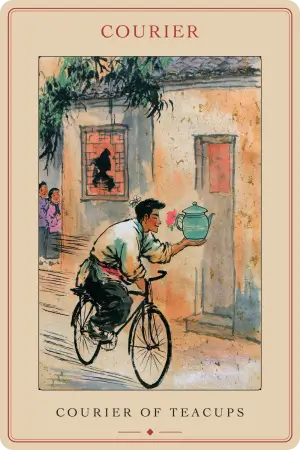


Minor Arcana ·
Matron of Teacups
Emotional mastery shown as timing: the teahouse hostess who refills your cup exactly when the story gets hard to tell.
Card at a glance
- Numerology
- Matron
- Element
- Water of Water
- Astrology
- 21° Gemini to 20° Cancer · Cancer ruled by the Moon
- Kabbalistic path
- Binah (Understanding) in Briah
- Timing
- Cancer season · high summer
- Yes / No
- Yes, trust the quiet knowledge
Upright
empathy
intuition
hospitality
emotional wisdom
tact
healing presence
steady care
keeper of confidences
Reversed
compassion fatigue
care as control
absorbed sorrows
leaked confidences
self-erasure
clouded intuition
quiet resentment
boundary loss
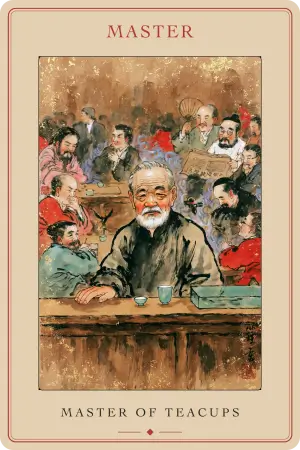
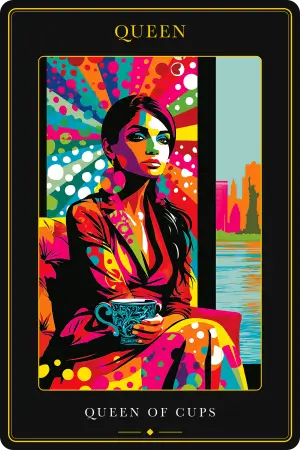
Matron of Teacups in each deck
Every deck reimagines the same archetype. Compare the art, then open a deck to read its full interpretation.
Imagery and symbolism
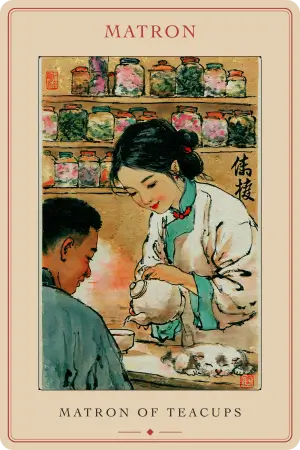
In the Tarot of Beijing the Queen of Cups keeps no throne and no shoreline. She is the hostess of a teahouse, standing behind her counter and pouring from a plump white teapot into a guest's bowl. The guest sits with his head bowed, because his story has just reached the hard part. She is not looking at him, and that is her whole art: the tea arrives, the gaze does not press.
Behind her rise shelves of glass jars, each packed with different leaves and blossoms, green and rose and chrysanthemum. These are the confidences of the whole lane, every jar a story taken in, sealed, labeled, and kept fresh. Nothing spills, nothing spoils, nothing is served to the wrong table. Where the Rider-Waite-Smith Queen guards one closed chalice, the Matron guards a hundred sealed jars, and the meaning is the same: the deepest things people tell her are kept, not repeated.
Her robe is pale over a teal inner garment, the deck's water color, worn close to the body, so feeling is kept nearest the skin with calm cloth over it. At her collar sits a small knot of vermilion, the one accent of fire she permits herself, the warmth that keeps the water from going cold. A white cat sleeps on the counter beside the pouring stream. Animals sleep only where nothing bad can happen, so the cat is the room's verdict on its hostess. Her eyes are lowered to the tea, her face soft with the beginning of a smile, entirely inside the gesture. This is the Beijing equivalent of the Queen gazing into her cup: contemplation not of a vision, but of an act of care done perfectly. The scene stands on warm gold-flecked kraft paper with the red seal in the corner, the deck's reminder that the cosmic here is always domestic. There is no throne and no sea. The throne is a counter, the sea is a teapot, and mastery of the emotional realm is shown as it exists in a hutong: knowing exactly when to refill the cup.
Core meaning
The Matron of Teacups is Beijing's Queen of Cups, and the deck sets her meaning at the counter rather than on the shore. She is the power of feelings held steady, empathy that arrives on time, the refilled cup as an offered heart. Where the canonical Queen sits alone with her sealed chalice and her private visions, the Matron does her feeling in public, at a table, with the whole district passing through. Emotional mastery here is not depth for its own sake. It is knowing when to pour.
She holds others' sorrows without letting them steep into bitterness. That is the second half of her craft, the part the imagery keeps insisting on: the leaves go into labeled jars, sealed and fresh, never left to rot and never leaked to the next customer. She reads people accurately and forgives them realistically, carrying a maternal warmth without the maternal wish to control. If the Courtyard Grandmother feeds the body, the Matron tends the feeling, and the card points to any situation that ripens best in a calm, trusting atmosphere: reconciliation, counsel given gently, creative work drawn from the inner life. Look for the person in a spread who listens more than they speak. The situation turns on them.
Upright meaning
Upright, the card marks a period when feeling and intuition matter more than argument and plan. Someone nearby understands you without explanation, or you are called to be that person for another. The Matron favors the safe place, a table or a kitchen or a friendship, where the truth can finally be said aloud. Pour before you are asked. Listen without rushing to fix, because presence is the remedy here, and trust the quiet knowledge that arrives ahead of its reasons. Keep the pot steady while you let your feelings inform the choice.
In love. A bond kept warm by daily, undramatic care, love shown the Beijing way in gestures rather than declarations. The cup refilled without asking, the coat mended, the silence that lets the other finish a hard sentence. The partner here has deep tenderness and reliable intuition, notices your state before you name it, and accepts you as you are. In new relationships it heralds meeting a genuinely caring person whose kindness is a character trait rather than a courtship tactic, and it advises letting the connection steep at its own pace.
In career. Deep, quiet satisfaction in a role built on empathy and tact: service, care, mentoring, counseling, medicine, teaching, and client work of every kind. For those who lead, it points to leadership by hospitality, the manager who notices the tired employee and adjusts the load before being asked, and whose team therefore stays. The skill rewarded now is listening. The person who hears what a colleague or client almost said finds the answer everyone else missed.
In finances. A warm, well-run household till: stability built on care rather than conquest, everything labeled and nothing wasted, the good leaves saved for the right occasion. It favors income from hospitality, service, and trust, the businesses where customers return because of how they were treated. Generosity is present but weighed on the same honest scale as trade, which is exactly why it is trusted. Expect steadiness and modest, reliable growth, the prosperity of a full pantry and an unworried evening.
In health. The beauty of care: health kept by rhythm rather than heroics, with warm food, proper tea, real sleep, and gentle sustained movement such as walking, tai chi, or swimming. Small rituals of self-care do more here than expensive interventions. Nurture the body the way she nurtures a guest, attentively and on schedule, and listen for its quiet, accurate requests for rest and nourishment.
Reversed meaning
Reversed, the Matron of Teacups shows the hostess after closing time: the hall empty, the cups unwashed, and nothing left in the pot for herself. The card indicates emotional depletion from carrying other people's troubles, care that has curdled into resentment or control, or a warmth performed rather than felt. Intuition is clouded now, and you may be reading people through the steam of your own wishes. Refill your own cup first, which is maintenance of the well rather than selfishness. Say plainly what you feel instead of serving it disguised as concern, and stop rescuing those who have not asked.
In love. Care gone out of balance, one partner pouring endlessly while the other only drinks. It can mean self-erasure in the caretaker role, love proved through service until resentment steeps at the bottom of the pot, or its mirror, smothering attention and jealousy dressed as concern. Sometimes it points to emotional withdrawal behind domestic politeness, the couple who share a table and nothing else. The remedy is plain words for what you feel and need, and the harder art for this card, letting yourself be cared for.
In career. The caretaker's burnout. You may be the office's unpaid counselor, absorbing complaints and smoothing conflicts until your own work and nerves fray. It can show oversensitivity to criticism, moods disrupting output, or a workplace where warmth is spoken over a cold pot. Draw boundaries kindly but firmly: stop carrying what was never assigned to you, deal in facts where feelings have muddied decisions, and restore your own energy before pouring more into the common cup.
In finances. The heart has taken over the ledger. Money leaks through emotional spending, gifts meant to buy affection, loans to anyone with a sad story, generosity the household budget cannot carry. It can mean financing other people's lives while your own pot runs dry, or the mirror of that, kindness with an invoice attached. Separate care from cash, set limits on what you give, and hand the numbers to a cooler head before the tea money follows the rest.
In health. A body neglected by its own caretaker. Everyone else has been fed and looked after while you run on the dregs. Watch for fatigue worn as normality, comfort eating or skipped meals, sleep sacrificed to others, and stress absorbed from other people settling into your shoulders, stomach, and skin. Treat yourself as the honored guest: regular warm meals, real rest, unhurried movement, and the firm cancellation of a few obligations. The pot must return to the fire, or there is nothing left to pour.
Historical notes
The Queen of Cups reached her most familiar form in the 1909 Rider-Waite-Smith deck, where Pamela Colman Smith drew her under Arthur Edward Waite's direction as a woman seated on a grey throne at the water's edge, gazing at an ornate closed chalice. That closed cup is unique in the 78-card deck, where every other Cups figure holds an open vessel. Its lid, its angelic handles, and its cross-topped crown make one statement: she guards her deepest intuitive life and shares it only by choice.
The older Tarot de Marseille imagined her differently. There the sky is a stark white rather than a calming blue, she holds a plain open cup, and in her other hand she carries a white dagger with sinuous lines. Alejandro Jodorowsky read that blade as the protective edge of the good mother, the boundary she will enforce to keep the emotional exchange safe. The open cup gives freely, the dagger sets the limit.
Behind both images sits the Golden Dawn framework the modern decks inherited. The order named her Queen of the Thrones of the Waters and Queen of the Nymphs and Undines, placed her rule from 21° Gemini to 20° Cancer, and fixed her as Water of Water, the receptive soul of the whole suit.
The Tarot of Beijing keeps that whole inheritance and moves it indoors. The throne becomes a counter, the sea becomes a teapot, and the closed chalice becomes shelves of sealed jars. The Marseille dagger survives as tact rather than a blade, the boundary that keeps confidences from leaking into gossip. What the older decks show as a solitary sovereign of the deep, this deck shows as the hostess of a hutong teahouse, mastering the same water by knowing exactly when to refill the cup.
Correspondences
Number. She is a court card, the Matron of her suit, which the Golden Dawn attributes to Binah, the third sphere on the Tree of Life. Binah is the Supernal Mother, the cosmic container that receives raw energy and gives it form, so every Queen is a vessel that holds and understands rather than initiates. In this deck that abstract container has an address: the teahouse and the courtyard, the fourth house of home and hearth, where the district comes to be fed, heard, and mended.
Astrology. Her decans run from 21° Gemini to 20° Cancer. The Gemini portion, ruled by Mercury, gives her the vocabulary to name what she feels, and the Cancer portion, cardinal water ruled by the Moon, gives her the maternal instinct that acts first and pours before it is asked. Her sign is Cancer, and her planet the Moon, which in this deck hangs over the hutong of the Rabbit Lord, the tide of moods and the intuition that reads a guest from the way he sets down his hat.
Element. Water of Water, the element doubled: the tea and the pouring of it, the feeling and the vessel that holds it without spilling. This is her strength and her hazard, since water this deep can drown its keeper in what she has absorbed.
Kabbalah. She belongs to Briah, the World of Creation, the realm of archangels and pure ideas before they take physical shape. Seated at the meeting of Binah and Briah, she gives structure to intuitive forces, translating the abstract language of the heart into feelings a person can actually hold.
Psychological perspective
The person of this arcana is the one the whole lane confides in, warm and observant, with the rare gift of making others feel received rather than examined. She notices when a voice changes and quietly does something about it: a refilled cup, a moved chair, a changed subject. Her inner world is rich and orderly at once, deep feeling stored with care like tea leaves in labeled jars. She reads people accurately, forgives them realistically, and acts as a reliable emotional anchor, the one everyone gravitates toward when a story gets hard to tell.
The shadow is what happens to a well that everyone drinks from. Having listened to everyone, she no longer hears herself, and having comforted the whole district, she goes home to an empty pot. She may grow touchy or tearful, swing between over-involvement and cold withdrawal, or become dependent on being needed and quietly keep others weak so the caretaking never ends. She struggles to name her own needs, expecting others to intuit them as skillfully as she intuits everyone else's, and is wounded when no one does. Prone to illusion, she sees the people she loves not as they are but as they might become after enough tea and kindness. Beneath the hospitable surface there is often quiet resentment, the hostess who has never once been asked how she is. The card's whole lesson is the pot returned to the fire: warmth given, and the well refilled, every time.
Matron of Teacups across decks
Rider-Waite-Smith. The canonical Queen sits on a grey throne at the shoreline, cradling a closed golden chalice she never opens for anyone. The Matron of Teacups keeps that guarded interior but trades the solitary shore for a working counter, and the one sealed cup becomes a whole shelf of sealed jars, private feeling multiplied into a district's worth of kept confidences.
Tarot de Marseille. The older Queen holds an open cup in one hand and a white dagger in the other, giving freely while defending the exchange. Beijing keeps both halves without the weapon: the open cup becomes the endless pour, and the dagger becomes tact, the boundary that keeps a story in its jar instead of on the next table.
Crowley-Thoth. Crowley painted the Queen of Cups as a figure of reflection so total she is almost transparent, a mirror that shows only what stands before it. The Beijing card meets the same idea from the human side, the hostess whose reading of a room is accurate precisely because she wants nothing from it, and whose reversed shadow is the mirror rippled by her own resentment.
Modern reframings. Recent decks tend to recast the Queen of Cups around emotional labor and boundaries, the caregiver who must learn to refill her own cup. The Tarot of Beijing belongs to that movement and states it in one image: the hostess drinks tea too, and the day is measured not by what was finished but by what was received.
In combination and context
The Matron of Teacups softens whatever spread she lands in and pulls it toward feeling, trust, and the safe table. Beside cooler, sharper cards she is the one who lets the truth be said without loss of face, and beside the Courtyard Grandmother she deepens a whole atmosphere of shelter and nourishment. With cards of new beginnings in love she reads as a caring person entering the story, and with the settled, structural cards of the deck she marks the stage where a romance turns into a home.
Her hazard shows in the neighbors too. Alongside cards of exhaustion, debt, or self-sacrifice, the reversed current in her comes forward: the well run dry, the confidence leaked, the sympathy soured into control. Watch for pairings that pile other people's troubles onto her, since her whole risk is absorbing moods that are not hers.
When she keeps returning in a reading, treat her as an instruction rather than a person. Pour before you are asked, guard what you are given, and by evening ask the Matron's question: whose cup did I fill today, and did anyone, including me, fill mine?
Questions for reflection
- Whose sorrows are you keeping in sealed jars right now, and which of them have quietly become your own weather?
- Where do you serve your real feelings disguised as concern instead of saying them plainly?
- When did someone last pour for you, and would you let them if they tried?
The general meaning follows the Rider-Waite-Smith reading — the reference used across Tarot Academy. Open a specific deck above for its own interpretation.
Frequently asked questions
Explore the Tarot
Latest Posts
Discover the ancient wisdom of tarot cards and unlock the mysteries of your spiritual journey. Our blog is your gateway to understanding the rich symbolism, meanings, and practical applications of tarot reading.




















































