
 EN (English)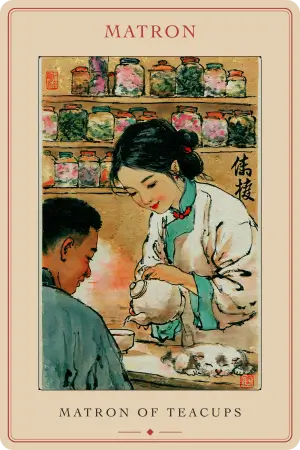


Minor Arcana ·
Master of Teacups
Feel everything, spill nothing: the old teahouse keeper who holds a whole city's feelings warm and unpoured.
Card at a glance
- Numerology
- Master (King)
- Element
- Water
- Astrology
- 21° Libra to 20° Scorpio · Scorpio, fixed water · Pluto and Neptune
- Kabbalistic path
- Chokmah (Wisdom) in Briah
- Timing
- Late autumn · about October 23 to November 21 · Scorpio season
- Yes / No
- Upright yes · Reversed no
Upright
emotional maturity
composure
discretion
hospitality as leadership
safe harbor
keeper of confidences
quiet authority
seasoned intuition
Reversed
emotional depletion
caretaker burnout
secrets turned to leverage
manipulation dressed as courtesy
complicity through silence
procedural warmth
resentment
a shuttered heart
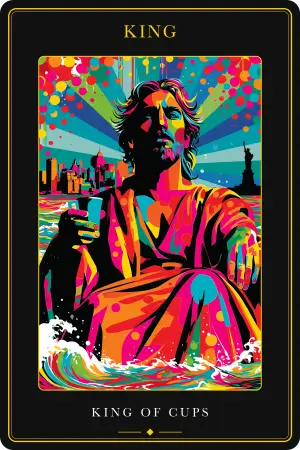
Master of Teacups in each deck
Every deck reimagines the same archetype. Compare the art, then open a deck to read its full interpretation.
Imagery and symbolism
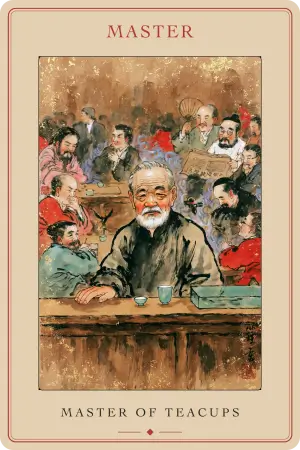
In the Tarot of Beijing the King of Cups is the Master of Teacups, the old proprietor of a great teahouse. The card is a quiet bow to Lao She's play "Teahouse," where one such hall held half a century of the city's fate. He rules the deck's water element, but Beijing water is never an ocean and never a throne. It is tea, poured daily, for everyone.
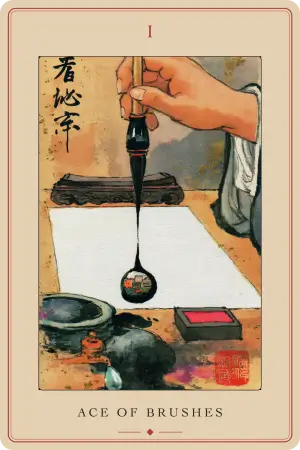
He stands at the center and front of the card, at his long wooden counter, in a plain grey changpao robe drawn in a few calm ink strokes. He wears no crown and holds no cup aloft. His authority is in his posture: settled, symmetrical, at rest. One hand lies flat and open on the counter, the hand of a man with nothing to hide and nothing to grab. Before him sit two small celadon cups, one large and one small, both within reach and untouched. He is not drinking. He is keeping. The cups are the suit emblem in its highest form: not the offered cup of the Ace, not the shared pot of the Two, but the standing readiness to pour for whoever comes next.
Behind him the whole hall of Beijing boils in muted color. Scholars lean into gossip, a man laughs behind his hand, another reads a newspaper, the outside world entering the room as printed rumor. Merchants sit in vermilion, an old man in spectacles, pipe smoke everywhere. This crowd is the sea on which the classical King of Cups floats, a sea of other people's feelings, moods, and schemes. The smoke is the card's water: blue-grey coils of pipe and kettle steam curl between the tables like waves and swirl around every head except his. Around the Master the air is clear. He is inside the element and master of it, undrowned.
His face carries the whole meaning. Eyes lowered and half-lidded, a white beard, an expression that is neither smile nor sorrow but the composure that follows having witnessed both ten thousand times. He hears every conversation and repeats none of them. The polished counter is his throne and his boundary at once, reflecting the room in a dark blur the way his memory holds the district's stories, present but softened, never spilled. Gold flecks scattered across the aged kraft paper glimmer like lamplight on old lacquer, the worth of years of small faithful service, and a small red seal rests in the corner, the deck's constant signature.
Core meaning
The Master of Teacups is Beijing's King of Cups, and the deck reduces his whole meaning to one line: feel everything, spill nothing. Where the canonical King masters a stormy sea by force of will, this old man masters a crowded room by keeping still inside it. Emotional maturity here means holding a whole city's feelings warm and unpoured while staying perfectly quiet at the center of all that noise.
He marks a state of full emotional maturity: you feel everything that moves through your world and you spill none of it. In a reading he often shows a season when your steadiness becomes the load-bearing wall of a family, a team, or a circle of friends, because your counter never shakes and people bring you their storms. He is the keeper of confidences, the one whose discretion has itself become his authority, and the elder whose presence steadies a room. He leads by atmosphere rather than instruction. In his presence people behave better and breathe easier, and the teahouse has watched dynasties change through its paper windows while it went on pouring tea.
Upright meaning
Upright, the card calls for hospitality of the heart. Be the calm point in the room rather than the loudest voice. Receive what comes, refill the cup at the right moment, and keep what people entrust to you like tea leaves in a sealed jar. This is a season of quiet influence, where you lead by the fact that in your presence people are steadier, and of the long view, where you trust a reading of people earned by years at the same counter.
In love. The deepest cup in the deck: a mature, steady, deeply attentive partner whose love shows itself the way the host shows his, by noticing, by keeping, by refilling exactly when it is needed. Feelings run deep but never flood. The bond is often one where love has become a house, warm and established and built to last, and it favors deepening commitment such as moving in, marriage, or growing old at the same counter.
In career. Your value lies in holding people together more than in raw output. You mediate quietly, hear grievances before they become resignations, and steady a boiling room by standing calm at your own counter. It points to mentorship of the old teahouse kind, taught by presence rather than lecture, and to authority earned through fairness and discretion, because people tell you the truth knowing you have never once weaponized it. Careers of communication, counsel, and care are favored.
In finances. The house that has stayed solvent through three eras, not by daring but by keeping. It indicates steady income from work done faithfully and a reputation that has itself become capital, and it favors long-established sources over speculation. It can mark a wise, humane advisor who has seen every kind of fortune cross his counter. Generosity is present but quiet: he covers a struggling regular's bill and forgets it by evening.
In health. The body kept like a good teahouse, immaculate and open every day. Health here is built on regularity: the same rising hour, unhurried meals, tea instead of excess, the long steady habits that outlast eras. Emotional steadiness is the best medicine on the card, since in his house nothing boils over, blood pressure included. Small faithful acts repeated for years beat any grand renovation.
Reversed meaning
Reversed, the Master stands at his counter after the last guest has gone and realizes he has poured for the whole city and never once for himself. The card shows emotional depletion masked as competence: still gracious, still refilling everyone's cup, but the pot inside has run dry. It can also point to the darker use of the gift, someone who has heard everyone's secrets and now moves people like teacups on a tray, or to complicity, the host who watches something wrong unfold in his hall and says nothing for the sake of keeping the peace. A calm surface over an unattended heart eventually cracks in public. Close the teahouse for one evening and sit as a guest of your own life.
In love. A partner who hosts the relationship instead of living in it. Outwardly attentive and endlessly composed, he serves care the way a proprietor serves tea, graciously and from behind a counter you are never invited past. It warns of emotional unavailability wearing the costume of maturity, or of quiet emotional management, a partner who knows your heart so well that he arranges it with perfectly timed warmth. The remedy is the same from either side of the counter: come out from behind it.
In career. The caretaker role turned trap. You have become the office's unpaid host, absorbing every frustration and covering every gap while your own work and growth go unpoured, and a calm surface hides resentment that will one day crack in a meeting. It can mark a senior colleague who trades in the confidences of the team, or a leader keeping false peace while a real problem festers at the corner table. Set boundaries on your availability and say plainly what you need.
In finances. A house living on its old name while the till quietly empties. Money is run by mood and habit rather than by the books, and sentimentality keeps unprofitable arrangements alive. It warns of leaky generosity, endlessly covering others' bills and lending without record, and of money entangled with confidences, informal loans and unwritten agreements that tear the moment anyone pulls on them. Open the ledgers and separate warmth from bookkeeping.
In health. The keeper's body paying for everyone else's comfort. This is the profile of the perpetual caretaker: fatigue worn so long it feels like personality, tension held in the shoulders and jaw, sleep sacrificed to other people's closing hours. It warns of swallowed feelings settling into the stomach and of self-neglect disguised as dignity, refusing rest and refusing help because the house must open on time. Let, for once, someone refill your cup.
Historical notes
The King of Cups appears in the earliest surviving decks, the lavish hand-painted trionfi commissioned by fifteenth-century Milanese families such as the Visconti-Sforza. There he is a straightforward monarch holding a large chalice, called in the French line the Roi de Coupe, with none of the astrological or Kabbalistic overlay that came later. The Tarot de Marseille later fixed his popular pose for the woodblock era, shown in profile facing the sun and raising his cup as if receiving a celestial light, his gaze turned slightly toward the unconscious side.
One strand of his history runs through ordinary playing cards. As the suit of Cups became the suit of Hearts, the King of Cups turned into the King of Hearts, the so-called Suicide King who appears to drive a sword into his own head. That violent image is an accident of manufacture: the early Rouen pattern showed him wielding a battle-axe behind his head, and over decades of worn printing blocks the axe head vanished and its handle merged with a sword. The King of Hearts is also the only king without a mustache, another casualty of the same degraded blocks. Cartomancers later read the self-striking king as a sign of the heavy burden that rides with deep emotional understanding.
The Hermetic Order of the Golden Dawn recast the whole court in the late nineteenth century, mapping it onto the Tree of Life and the elements and renaming the ranks Knight, Queen, Prince, and Princess. Because Arthur Edward Waite kept the old Marseille titles for his 1909 Rider-Waite-Smith deck, the RWS King of Cups corresponds to the Golden Dawn's fiery Knight, while Crowley's Thoth deck routes the same energy through the Prince. This left a lasting debate over whether the card is the Fire of Water or the Air of Water. The Tarot of Beijing takes the reframing further still. It removes the throne, the sea, the scepter, and the crown, and keeps only the function, leaving an ordinary old man at a teahouse counter who holds the same mastery with nothing in his hands.
Correspondences
Number. The court rank of King, the highest figure of the suit, called the Master in this deck. On the Tree of Life the Kings sit at Chokmah, Wisdom, the initiating masculine force. Applied to Cups, in the Qabalistic world of Briah, Chokmah becomes the driving current within the emotional and intuitive realm.
Astrology. The deck follows the Air of Water attribution, ruling the third decan of Libra and the first two decans of Scorpio, from 21° Libra to 20° Scorpio, roughly October 23 to November 21. Its sign is Scorpio, the fixed water sign, which grounds the Master's blend of penetrating insight and absolute discretion. In the natural chart his domain is the Eighth House of transformation, shared resources, and other people's depths, exactly the proprietor's trade as inheritances, debts, and secrets pass across his counter.
Element. Water, but the heated water of the kettle and the gaiwan, poured and given away by the cupful. The four Masters of this deck join the clear air of judgment to the element of their suit, so his water raised by fire becomes steam, which is what fills the teahouse from morning to night.
Kabbalah. Chokmah in Briah, the sphere of Wisdom in the world of creation and water, the sovereign initiating current of the suit of Cups.
Rulership. Pluto, lord of the hidden and transformed, appears as the teahouse's underworld function, where the district's buried matters surface, steep, and settle. Neptune governs the smoke and steam, the boundary-dissolving haze of feeling, though in his house the storm swirls only in the pipe smoke and never in the crockery.
Psychological perspective
This is the archetype of emotional intelligence held under conscious command. If the Queen of Cups is the ocean itself, the King is the seawall and the lighthouse. He does not let feeling consume him, and he does not repress it either. He metabolizes it, cataloging each emotion until no stray feeling or unresolved trauma can subvert his conscious will. Modern readers coined a plain name for this: the therapist, the counselor, the safe harbor, an emotionally available adult who gives real depth without bleeding his own unresolved feelings onto others.
The shadow arrives from two directions. One is depletion, the perpetual caretaker who pours for everyone and is never asked how he is, whose warmth goes procedural while resentment steeps underneath. The other is the weaponized version, the master who knows the emotional realm so well that he turns it against people, disarming them with feigned vulnerability and timed warmth before withdrawing. The card asks the same thing of both: to stop managing feeling long enough to feel it, to name one true thing aloud, and to let someone else refill the cup for once.
The Master of Teacups across decks
Rider-Waite-Smith. The King sits on a stone throne that floats on a stormy sea, posture serene while the waves crash at its base. He wears a blue tunic of water beneath a gold cape of fire, holds a cup on his thigh and a short scepter in his other hand, and a ship and a leaping fish behind him show raw intuition surfacing and being carried safely into the waking world. Mastery here is staying centered amid emotional turbulence.
Tarot de Marseille. The older Roi de Coupe sits in profile and raises his chalice toward the sun, receiving illumination rather than commanding a sea. His slightly averted gaze was read as a turn toward the intuitive, unconscious side.
Crowley-Thoth. The Thoth deck routes this energy through the Knight and Prince of Cups, a warrior only partly clad in armor that looks grown rather than forged, riding a chariot across a watery expanse with an eagle on his helmet. The imagery echoes Bellerophon on Pegasus and the quest for the Grail, emphasizing the volatile, spiritual side of the archetype.
Modern decks. The Sun and Moon Tarot gives the King the Holy Grail and a clairvoyant dolphin; the Golden Serpent Tarot coils a golden serpent around his cup and names its waters both healing and poisonous; the Infinite Visions Tarot dresses him in sea-green before a pounding ocean with an instrument ready to play, the music in his soul. The Tarot of Beijing sets all of it down. It keeps the mastery of feeling and trades the sea for a teahouse, the throne for a counter, and the crashing waves for pipe smoke that swirls around every head but his.
In combination and context
The Master of Teacups reads against the Matron of Teacups, this deck's Queen of Cups, the way force reads against form. The Matron absorbs the room's feeling and lets it flow through her for healing; the Master receives it, holds it, and builds structures and boundaries from it. She is the ocean, he is the seawall and the lighthouse. Beside the Two of Cups he marks the difference between a youthful new exchange and a settled, self-aware depth, since the Master loves with certainty where lower cards show fresh infatuation. Set against the Four of Cups he is the evolutionary goal, the figure who has done the work the brooding one refuses, turning witnessed emotion into power rather than apathy.
Reversed, his neighbors sharpen the warning. With the Seven of Swords, the Three of Swords, The Moon, or The Devil he is widely read as a red flag in questions of fidelity, the sophisticated manipulator who love-bombs and withdraws, juggling connections behind a smooth surface. When he keeps returning in a reading, treat him less as an outside authority and more as an instruction: be the calm point in the room, refill the cup at the moment a story becomes hard to tell, and guard what was told to you in trust rather than trading it.
Questions for reflection
- Whose storms are you holding steady right now, and who, if anyone, holds yours?
- Where has your composure become a wall rather than a welcome, and which brick could you take out by saying one true thing aloud?
- You have poured for the whole hall today. Before it closes, who could you sit down with and tell honestly how you actually are?
The general meaning follows the Rider-Waite-Smith reading — the reference used across Tarot Academy. Open a specific deck above for its own interpretation.
Frequently asked questions
Explore the Tarot
Latest Posts
Discover the ancient wisdom of tarot cards and unlock the mysteries of your spiritual journey. Our blog is your gateway to understanding the rich symbolism, meanings, and practical applications of tarot reading.




















































