
 EN (English)



Minor Arcana · Cups (Water)
Queen of Cups
The friend everyone calls when it all falls apart: emotional mastery on the deep couch above New York Harbor.
Card at a glance
- Numerology
- Queen
- Element
- Water
- Astrology
- Cancer, ruled by the Moon (Golden Dawn: 21° Gemini to 20° Cancer)
- Kabbalistic path
- Binah (Understanding)
- Timing
- Cancer season · early summer
- Yes / No
- Yes · trust your intuition
Upright
empathy
intuition
chosen family
emotional wisdom
presence
healing
quiet strength
Reversed
compassion fatigue
burnout
codependency
emotional flooding
guilt as currency
self-neglect
giving from an empty cup
Queen of Cups in each deck
Every deck reimagines the same archetype. Compare the art, then open a deck to read its full interpretation.
Imagery and symbolism
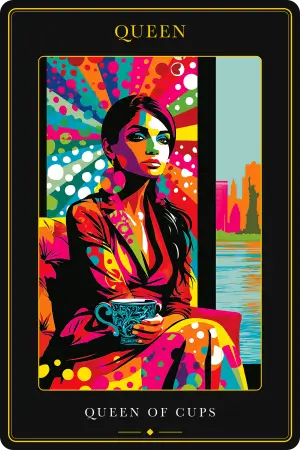
The New York Tarot takes the shoreline Queen off her mythic beach and puts her where the city keeps its emotional life: a deep, flower-patterned couch by a window over the harbor. She is a dark-haired woman in a red patterned wrap, calm-faced, meeting your eyes directly, and the deck renders her in blazing pop-art color. Half her face is lit and half sits in shadow. That split is the whole card made visible. She feels everything, the light and the dark alike, and neither one frightens her.
In her hands is the cup, an ornately worked vessel in deep blue: the deck's version of the classic Greek coffee cup, the "We Are Happy To Serve You" cup that stands as this suit's emblem. In the Rider-Waite deck the Queen holds the only lidded, ornate chalice in the whole suit, a container for the mysteries of the heart, and here the ornament does the same work. She does not drink from it or offer it around. She holds it steady, the way she holds whatever people bring her.
The couch is the throne. Its florals carry the abundance of the traditional Queen's seat, and its depth is the point: this is the couch everyone in her life has cried on at least once. Behind her a sunburst of radiating color and halftone dots fills the room, the emotional field she generates turned into warmth you can see. Those dots pull from printed comics and city signage, so her feeling life reads as vivid and public-facing rather than hidden away.
Through the window sits the harbor, the skyline, and the Statue of Liberty. Where the Rider-Waite Queen sits at the shore of the subconscious sea, this one sits above New York Harbor, and the water still carries every old meaning of emotion, intuition, and the depths. Liberty is her mirror: a monumental feminine figure of welcome, the mother of exiles, holding her own vessel of light. The Queen of Cups is the statue's domestic twin, give me your tired, your poor, your friends who just got dumped. The water in the window is calm and its reflections run warm. Her seas are not stormy, because she has made peace with the tides.
Core meaning
In this deck the suit of Cups is the suit of the blue coffee cup, of feeling and community, and the Queen is its inward summit. In the Hermetic system the Queens are the watery, receptive part of their suit, which makes her the Water of Water, the wateriest card in the deck twice over. She does not push her will on the world the way Wands does, and she does not dissect it the way Swords does. She works as a deep, still mirror, taking in and reflecting the emotional weather of everyone around her.
That total receptivity is her strength and her exposure at once. In the New York Tarot she is the person half the neighborhood quietly depends on: the deep couch, the extra key given to three different friends, the pot on the stove that stretches to feed whoever shows up. She reads the room before anyone speaks and offers care without drowning in the pain she takes on. Her one structural flaw is built into the gift. She holds the others up and rarely says how heavy it gets, which is the whole second half of her lesson.
Upright meaning
Upright, the Queen of Cups puts the situation under the government of feeling rather than logic, and in this deck that is exactly right. Someone in the picture, perhaps you, is holding others up through empathy, presence, and an almost uncanny read of the emotional weather. Intuition is reliable now, relationships deepen, and the correct move is to listen rather than fix. In a city that rewards speed and armor, the card says the real power here is a softness that has been tested and held.
In love. A partner who feels you across the room: the coffee made exactly the way you take it before you asked, the arms open at the end of a brutal day. These bonds run calm and deep rather than loud, and the intimacy lives in midnight kitchen conversations and one look on the subway platform. For those seeking love, it points to meeting someone genuinely safe, and the advice is to let them.
In work and career. She thrives where emotional intelligence is the core skill: caring professions, teaching, hospitality, client relations, creative fields. She reads the unspoken need beneath what a client actually asked for, and the way up runs through the way in. A project that resonates personally is worth taking.
In money. Stability built for the sake of people rather than the number: rent covered, the fridge full enough for surprise guests, a cushion set aside for someone she loves. Her intuition extends to money and senses which arrangements are sound before the paperwork proves it.
In the body. Ease in her own skin, care as ritual rather than correction. Movement wants flow here, a swim or a long walk along the water, and the card advises listening to the body the way you would listen to a friend on your couch.
Reversed meaning
Reversed, the Queen of Cups shows the caretaker running on fumes. The couch is always occupied, the phone never stops, and somewhere in the middle of managing everyone else's crisis she stopped noticing her own. The city will happily take everything a giver gives, and the reversed Queen warns that it has been taking too much.
In love. A partner who gives and gives and never says how heavy it gets, until the resentment surfaces all at once. Or love conducted mostly in the head, a dream projected onto a real person, three paragraphs of meaning read into a two-word text. It can mark dependency, or tears and guilt doing the arguing.
In work and career. Burnout from absorbing the whole team's stress and calling it being a good colleague. Moods set the weather for the floor, workplace friction gets taken personally, and there may be someone spending your empathy as their own resource.
In money. Generosity springs a leak: comfort spending after a bad week, the loan you already know will not come back, the fourth dinner this month you quietly covered. Emotional caretaking turns into funding other people's lives while your own numbers slide.
In the body. The caretaker who feeds everyone and eats standing over the sink, who tracks a friend's health scare in detail and has not seen her own doctor in two years. The lesson across all of it is the same: put the cup down, check what is actually in it, and refill before you pour again.
Historical notes
The card the New York Tarot restyles has two older faces. The Tarot de Marseille draws a more formidable Queen: her sky is a stark white rather than a serene blue, and she holds a plain open cup with none of the angelic carving of the later deck. In her other hand she wields a white dagger with sinuous lines. That weapon in the suit of Cups adds a protective edge, and Alejandro Jodorowsky reads this version as the good mother, boundless in giving through the open cup and strict in the boundaries the dagger enforces.
The Rider-Waite-Smith version of 1909 traded the dagger for a closed, sacred chalice, the only closed cup in the whole 78-card deck, and set her on a grey throne at a calm shoreline. The Hermetic Order of the Golden Dawn gave her the titles Queen of the Thrones of the Waters and Queen of the Nymphs and Undines, naming her sovereign over the entire emotional and subconscious domain. The New York Tarot keeps every promise of that lineage, then dresses it in the city's clothes: a couch for the throne, a coffee cup for the chalice, the harbor for the sea, and Liberty herself standing witness at the window.
Correspondences
Rank. As a Queen she is the watery, receptive part of her suit, the inward master of its element rather than its outward ruler.
Astrology. Her home is Cancer, the cardinal water sign ruled by the Moon. In the Golden Dawn decans she runs from 21 degrees Gemini through 20 degrees Cancer, so the Gemini tail lends her the vocabulary to articulate feeling while the Cancer body gives her the maternal, tidal depth. In the natural horoscope her ground is the fourth house of home and roots, which this deck reads as the rent-stabilized apartment held for twenty years and the kitchen where the whole building's problems get solved.
Element. Water, the suit's element of emotion and intuition, doubled as the Water of Water.
Kabbalah. All Queens sit at Binah, the Supernal Mother, the sphere of Understanding that receives raw energy and gives it form. In the watery world of Briah she is the container that shapes creative, intuitive force into comprehensible emotion.
Elemental dignity. As a yes or no, upright she reads as a clear yes, an invitation to trust your emotional guidance. Reversed she leans no, a sign that unprocessed feeling is clouding judgment and a cooler head should step in for now.
Psychological perspective
The half-lit face is the deck's translation of her psychology. Because her nature is to mirror, the Queen of Cups reflects whatever state the reader brings to her, so when her inner lake is calm she offers a working model of emotional sovereignty, and when it is rippled by resentment or trauma she distorts everything around her instead.
Modern practice has added a sharper reading to Pamela Colman Smith's illustration. Waite called her serene, but many contemporary readers see a frown and take it as the real face of emotional labor. The nurturing that looks beautiful from outside is also an exhausting grind, and her intense focus on the cup is the effort of staying centered while carrying everyone else's weight. This deck names the same blind spot plainly: she holds everyone up and never says how heavy it gets. The developmental task is to check her own cup somewhere in the middle of being everyone's safe place, to eat the real meal, and to answer honestly when someone asks how she is doing rather than defaulting to "good, busy." She is allowed to need the couch and not only to be it.
The Queen of Cups across decks
Tarot de Marseille. She holds an open cup and a white dagger under a stark white sky, a protective good mother who gives freely and guards fiercely, without the dreamy religious staging of the later deck.
Rider-Waite-Smith. She sits on a grey throne at a calm shoreline, cradling the only closed chalice in the deck, carved with cherubs and topped with a cross, her white gown patterned with water lilies. The closed cup means she guards her deepest intuitive insights and shares her inner life selectively.
Crowley-Thoth. In the Golden Dawn lineage behind Crowley's deck she is the Water of Water, the receptive element doubled and imagined as a still reflecting surface, sovereign of every emotional and subconscious current.
New York Tarot. The couch replaces the throne, the blue Greek coffee cup replaces the chalice, and the window frames the harbor and the Statue of Liberty instead of a mythic sea. Every meaning of the classic card survives the move: emotional mastery, intuition, compassion, and the held vessel, all of it in the city's clothes.
In combination and context
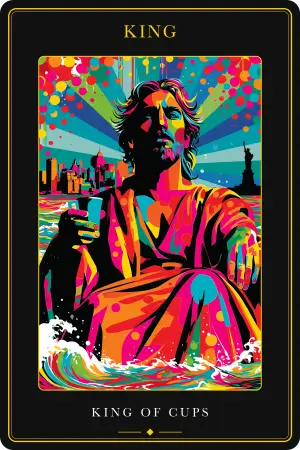
The Queen is best understood against her nearest peers. With the King of Cups she forms the inner and outer poles of emotional mastery. She rules the element within herself, letting feeling flow through her for self-awareness and holding space for others' pain. The King rules the element in others, blending the same depth with an active, managing energy: in a workplace conflict she is the one you cry to privately, while he is the one who calmly restructures the situation so it does not recur.
Novices often confuse her with The High Priestess, since both are intuitive feminine figures near water. Their aims differ. The High Priestess guards the cold, objective mysteries of the cosmos in solitude, while the Queen of Cups works in the messy terrain of the human heart. The Priestess hands you the ultimate truth, and the Queen sits with you to process the fallout of it.
Among the four Queens the base element sets them apart. The Queen of Wands is bold and radiant where this Queen is subtle and inward. The Queen of Pentacles nurtures with a warm home and a cooked meal where this Queen nurtures with a safe emotional container. The Queen of Swords is her near opposite, ruling by the head and cutting through sentiment with impartial logic where the Queen of Cups longs to merge and connect.
Questions for reflection
- Whose emotions are you carrying right now, and where does their weight end and yours begin?
- You hold everyone up: when did you last say out loud how heavy it gets?
- Is your cup open to everyone, or do you keep the deepest part of it steady and your own?
The general meaning follows the Rider-Waite-Smith reading — the reference used across Tarot Academy. Open a specific deck above for its own interpretation.
Frequently asked questions
Explore the Tarot
Latest Posts
Discover the ancient wisdom of tarot cards and unlock the mysteries of your spiritual journey. Our blog is your gateway to understanding the rich symbolism, meanings, and practical applications of tarot reading.




















































