
 EN (English)



Minor Arcana · Cups (Water)
Queen of Cups
Smith gave her the one closed cup in the whole deck and set a cliff at her back, so the card is about what a feeling person keeps private.
Card at a glance
- Numerology
- Queen
- Element
- Water of Water
- Astrology
- Third decan of Gemini and the first two decans of Cancer, ruled by the Moon
- Kabbalistic path
- Binah (Understanding) in Briah, the World of Creation
- Timing
- Cancer season, and the fourth house of home and family life
- Yes / No
- Upright yes, trust the emotional read; reversed no, judgment is clouded
Upright
Empathy
Intuition
Emotional depth
Care and generosity
Quiet wisdom
Healing ability
Artistic inspiration
Inner harmony
Reversed
Emotional overload
Codependency
Manipulation of feelings
Hypersensitivity
Emotional withdrawal
Loss of inner peace
Fantasy over reality
Compassion fatigue
Queen of Cups in each deck
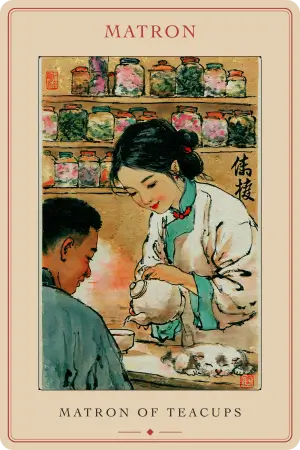
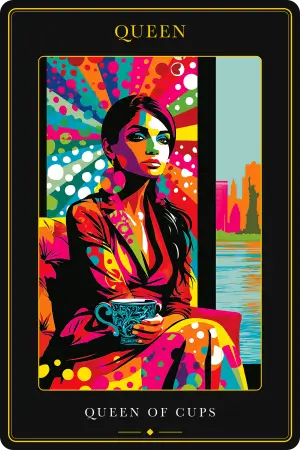
Every deck reimagines the same archetype. Compare the art, then open a deck to read its full interpretation.
Imagery and symbolism
Waite told Pamela Colman Smith he wanted a woman "beautiful, fair, dreamy, as one who sees visions in a cup," and in 1909 she drew exactly that, then added the detail that made the card famous. Every other figure in the suit, from the Page to the King, holds an open chalice. This Queen holds a closed one, the only closed cup in the 78-card deck.
The vessel repays a long look. It is heavily gilded, its sides carved with angelic and cherubic figures, its handles shaped like wings for the ethereal quality of her emotional touch. The lid is topped with a cross in the manner of a Mass chalice, and a brilliant red section in the body reads as a ruby, a stone long tied to royalty and to esoteric protection. This deck describes the cup as the container of her own experiences and sensations, filled with images she examines to understand her inner life. Closing it says she guards her deepest intuitive insights from the mundane world and shares the innermost part of herself by choice.
Her throne sits at the water's edge, in stark grey. The colour is deliberate: she rules her emotional domain with an impartial grace that puts beauty and connection ahead of ego. It is carved over with the sea, with sea-nymphs, scallop shells and cherubs, and this deck reads those water spirits as a sign of how close she stands to the underwater world and its hidden desires. At the base a cherub holds a fish, the same creature that startled the Page of Cups, which places her as the grown version of that early emotional curiosity.
Smith kept her seated rather than standing, and this deck takes that posture literally: it holds her rich emotional life inside ordinary daily reality. Her gown carries water lilies, flowers that rise clean out of dark mud, the traditional emblem of purity and spiritual enlightenment surfacing from the subconscious. This deck's reading also stresses blue in her garments and gemstones set into them, the colour and the stones marking how easily she moves through the subconscious. Her footwear barely touches the water, which is how meditative her immersion is: she enters the feeling rather than falls into it. Her face is focused and peaceful, the picture of inner calm, and behind her stands a cliff, the unyielding force of her spiritual strength.
Core meaning
In the Hermetic scheme the Queens are the watery, receptive part of whatever suit they rule, which makes this one Water of Water, the doubled element and the purest soul of the waters. The fiery suits impose their will on the world and Swords analyses it; she does neither. She works as a deep still mirror that takes in the emotional state of everyone near her and gives it back.
This deck states her plainly as emotionality, intuition, inner wisdom and a deep understanding of the emotional world, with feeling treated as the foundation empathy is built on. Her presence in a spread marks a period when emotional connections and intuitive understanding carry the most weight, often with overtones of motherhood or femininity. She can signal an intuitive breakthrough, a deep emotional insight, or creative work drawn straight from internal feeling.
The exposure comes with the same equipment. Lacking the practical grounding of Earth and the boundary-setting clarity of Air, her porosity leaves her open to whatever is around her, and unbalanced she becomes captive to her own sensitivity or buried under other people's baggage. The closed cup and the cliff are the two answers the artwork gives to that risk.
Upright meaning
Upright, she marks a stretch of emotional connectivity and genuine calm, someone moving through their own subconscious without being swamped by it. This deck's advice is direct: acknowledge your feelings, listen to the inner voice, show compassion, look into your emotions to understand them better. It is a time for listening and offering support, with no agenda to press.
In love. A partner of deep emotional intuition and understanding, able to accept another person exactly as they are. These bonds tend to run quiet and calm rather than turbulent, with love showing in small gestures and mutual understanding treated as the point. The card can mark a romance reaching a new level of intimacy, and in a new relationship it points to a caring person open to sincere communication. Read for how someone feels, it says the feeling is deep and receptive and that they respond to unspoken moods more readily than to declarations.
In career. Diligence, empathy and creative work, with real satisfaction in the current job and confidence in the path. For leaders it points to managing emotions well and holding the line between professional life and personal need. In business she brings a knack for spotting promising directions and for combining logic with intuition, with success in caregiving, real estate, psychology, client service and negotiation. Vocationally the research places her among therapists, counselors, artists, spiritual guides, intuitive healers and human resources professionals.
In finances. Stability and reliability, a considered strategy that balances needs against wants, and a period where a significant purchase or investment becomes possible. She favours projects where intuition and business skill both do work, points to long-term investment and substantial profit, and links financial security to genuine client relationships. Because she is depicted steeping in her element rather than labouring, readers associate her with passive income built from imagination.
In health. Refinement, grace and a strong pull toward aesthetics, with energy going into self-care and elegant dress. She speaks of harmony between the inner self and the body, a full acceptance of it that shows as good health, and an ear for what the body asks in food, rest and movement. Graceful practice suits the moment, ballet, artistic gymnastics or Pilates.
Reversed meaning
Reversed, the pure receptivity of Water of Water turns toxic and the boundary between self and other dissolves. This deck reads it as emotional instability, introversion or excessive emotionality, either an absence of empathy or an unhealthy degree of self-sacrifice, with blocked creative inspiration and a loss of emotional control that can slide into apathy. The instruction is to restore the balance between mind and heart, reassess the emotions rather than withdraw from them, and make time for self-care.
In love. Either an overflow of feeling or complete aloofness. Care gets expressed in a consuming way, or the emotional exchange stops altogether, and one partner ends up unfulfilled. Codependency sits here, along with the risk of losing your identity in the pursuit of attention. Warmth gets blocked by internal pain, mutual resentment or distancing, and the relationship reads better on the surface than it actually is.
In career. Burnout, emotional exhaustion and frustration, with natural empathy draining the person who carries it. Intuition and feeling take up too much room and crowd out an objective approach to the work, decisions get made subjectively, and business relationships turn too personal. The modern reading of her strained expression belongs here, the grinding cost of being everyone's permanent support system.
In finances. A careless attitude toward money and an inability to allocate it. She warns of loss through impulsive spending, poor financial awareness, or generosity that runs past what you have, and of investments driven by uncontrolled emotion instead of logic. The research names the specific habit as retail therapy, spending to soothe a pain that spending never reaches.
In health. An inability to listen to the body, undervaluing physical health and neglecting appearance. Sometimes the responsibility gets handed off entirely to beauticians, trainers or style consultants, and sometimes harsh self-criticism about the body gets in the way of enjoying life. Interest in physical condition fades on the argument that outward beauty matters less than the inner world, and exercise and basic care go with it.
Historical notes
The Rider-Waite-Smith Queen is a departure from what came before her. In the Tarot de Marseille, whose decks date to the 16th century, she is a more active and more formidable figure. Her sky is a stark unyielding white with none of the serene blue, and she holds a plain open cup with no angelic carving or religious iconography anywhere on it. In her other hand she wields a white dagger with sinuous lines.
A weapon in the suit of Cups changes the argument of the card. The dagger says this Queen can cut through emotional manipulation and defend her people from psychological harm. Alejandro Jodorowsky, in The Way of Tarot, ties that version to familial love and the uncompromising protective side of the good mother: the open cup is her boundless willingness to give and receive, the dagger the boundary she enforces around that exchange.
Smith and Waite took a different route in 1909. The dagger went, the cup closed and turned sacred, the sky went calm blue, and the throne filled with sea motifs. Where Marseille externalised her defence as a blade, Rider-Waite internalised it as a lid. The Hermetic Order of the Golden Dawn, whose correspondences structured this deck, gave her the titles Queen of the Thrones of the Waters and Queen of the Nymphs and Undines, naming her sovereign over the water elementals and the emotional domain entire.
Correspondences
Number. Queen, the rank that carries the watery, receptive part of its suit. In Cups that doubles the element, so she is the inward master of emotion itself.
Astrology. This deck gives her the third decan of Gemini and the first two decans of Cancer, the span the Golden Dawn set from 21 degrees Gemini to 20 degrees Cancer. The Gemini tail is Air ruled by Mercury and supplies communication and vocabulary; the Cancer body is cardinal Water ruled by the Moon and supplies maternal instinct, emotional security and the tides of the subconscious. That blend is why she can put the language of the heart into shared words. In a natural horoscope her sphere is the fourth house of home and family life, and under the Moon she gains mystical visions.
Element. Water of Water, the element doubled. Absolute receptivity and reflection, with the standing risk of drowning in the flow of emotion.
Kabbalah. All Queens sit at Binah, the third Sephira, the sphere of Understanding and the Supernal Mother, the cosmic container that receives raw energy from Chokmah and gives it form. Cups corresponds to Briah, the World of Creation, the realm of archangelic force and pure ideas before they take physical shape. She stands at the crossing of the two, which is what makes her a conduit for turning raw empathic data into structures a person can understand.
Elemental dignity. As a yes or no she is a clear yes upright, an instruction to trust emotional guidance and proceed with compassion. Reversed she leans no, warning that unprocessed emotion is clouding judgment and logic needs to step in for a while.
Psychological perspective
Her nature is to mirror, so she reflects whatever the reader brings. When the inner lake is still she offers a working model of emotional sovereignty: the compassionate courage to sit beside the ocean of the subconscious and take its depths as they are. When that lake is rippled by resentment or old trauma she distorts everything around her instead.
The people this deck describes under the upright card have a rich inner world dominated by love and kindness, a keen read on the nuances of human relationships, and enough strength of character to put their emotional resources to constructive use. Maternal care runs through them, extended even to strangers. Reversed, the same temperament turns confused and exhausted by shifting moods, prone to melancholy, dependent on those around them, or burdensome in the wish to care for others. They forget their own needs, immerse themselves in other people's problems, and seek constant validation until the dependency starts friction in their relationships.
Modern practice has added a sharp reading of Smith's illustration. Waite called her dreamy, but many contemporary readers see a frown or an outright scowl and take it as the honest face of emotional labour. In that view her intense focus on the closed cup is the cognitive effort of staying centred while carrying everyone else's weight, and the ocean in front of her is a standing temptation to drop the chalice and swim off. The reading validates the irritability and compassion fatigue that come with deep empathic work. Her own developmental task is the one this deck states in its daily reading: fill your own cup before pouring for others, so you never sacrifice yourself down to nothing.
The Queen of Cups across decks
Rider-Waite-Smith. The version this page describes. Its identifying choices are the closed gilded chalice with winged handles and a cross on the lid, the grey throne carved with sea-nymphs and scallop shells, the cherub holding a fish at its base, and the calm light blue sky. The composition argues for the guardian of the subconscious, intuitive and esoteric and dreamy.
Tarot de Marseille. A standard open cup in one hand and a white dagger in the other, under a stark white sky, on a throne without the deep sea motifs. The archetype shifts to the protective good mother, familial love with defended borders.
Crowley-Thoth and the Golden Dawn. The same lineage that structured the Rider-Waite correspondences, where she is Water of Water and holds the titles Queen of the Thrones of the Waters and Queen of the Nymphs and Undines. The emphasis falls on absolute passivity and reflection, sovereign over every emotional and subconscious current.
Across traditions. However she is drawn, the constant is a woman seated at the border of land and sea who masters feeling by reflecting it, close enough to know the depths and settled enough not to be pulled under.
In combination and context
She reads best against her nearest peers. With the King of Cups she forms the inner and outer poles of the same mastery. She rules the element within herself, letting feeling move through her for release and self-awareness, measuring thoughtfully, crying with those who hurt. The King rules it in others, blending that depth with the active energy Kings carry and managing environments through composed authority. In a workplace dispute she is the one you cry to privately, and he is the one who calmly restructures the department so the conflict does not recur.
Novices confuse her with The High Priestess, since both are intuitive feminine figures seated near water. Their functions separate cleanly. The High Priestess works in pure esoteric wisdom and guards the veil, objective and isolated, needing silence to function. The Queen of Cups works in the terrestrial mess of the human heart. The Priestess hands over the cold ultimate truth; the Queen sits with you and helps you process the fallout, which makes her the bridge between lofty wisdom and lived relationship.
Among the four Queens the base element does the separating. The Queen of Wands is bold and wants the spotlight where this Queen is subtle and inward. The Queen of Pentacles nurtures with a warm home and a cooked meal and physical security, where this Queen nurtures with a safe emotional container and psychological validation, often at the cost of the practical detail. The Queen of Swords is her exact antithesis, in strict profile on a rigid low-backed throne with a double-edged sword upright, cutting through sentiment with impartial logic, valuing privacy over entanglement against the Queen of Cups' desire to merge. In singles' readings she also separates from her own suit: the Two of Cups is mutual attraction and the Nine of Cups is self-sufficient contentment, while this card asks for deliberate self-nurturing and a period of emotional convalescence first.
Questions for reflection
- Smith closed this cup and left every other one in the suit open. What part of your inner life is genuinely yours to keep, and what are you closing out of fear?
- Her footwear barely touches the water. Are you entering your feelings meditatively, or falling in?
- Whose emotions are you carrying right now, and where does their weight end and yours begin?
The general meaning follows the Rider-Waite-Smith reading — the reference used across Tarot Academy. Open a specific deck above for its own interpretation.
Frequently asked questions
Explore the Tarot
Latest Posts
Discover the ancient wisdom of tarot cards and unlock the mysteries of your spiritual journey. Our blog is your gateway to understanding the rich symbolism, meanings, and practical applications of tarot reading.




















































