
 LV (latviešu)



Mazie Arkāni · Zobeni (Air)
Zobenu dūzis
A hand comes out of the cloud holding one upright blade, and the fog a person has been living inside simply stops being there.
Kārts īsumā
- Numeroloģija
- Ace
- Elements
- Gaiss
- Astroloģija
- The Air triplicity entire: Dvīņu, Svaru and Ūdensvīra, with no single decan
- Kabalas ceļš
- Kether, the Crown, within Yetzirah, the formative world of mind
- Laiks
- Fast. Days, or a few weeks at the outside
- Jā / Nē
- Taisnā pozīcijā jā, and a jā that cuts through the ambiguity around it. Reversed nē
Taisni
Izrāviens
Skaidrība of thought
Objectivity
Patiesība
New intellectual project
Decisiveness
Independence of mind
Justice
Apgriezti
Apjukums
Distortion of truth
Blocked thinking
Avoidance of decision
Bad news
Misuse of intelligence
Self-doubt
Loss of fairness
Zobenu dūzis katrā kavā
Katra kava to pašu arhetipu interpretē citādi. Salīdziniet mākslas darbus, tad atveriet kavu, lai izlasītu pilnu skaidrojumu.
Tēlojums un simbolisms
This deck reads the Ace of Swords as intellectual beginnings, insight and discovery. It points to a shift in mindset, the sudden realization of a truth, or a new strategy arriving where there was none. A hand emerges from the clouds holding a sharp sword, which says plainly that ideas and thoughts are tools for reaching goals. The hand stands for universal inspiration and authority, and for mental acuity and logical strength. The clouds it comes from suggest divine intervention or guidance from the Universe, a reminder of what the intellect can actually do.
The sword is crowned, and that combination means victory and dominance. The crown connects to power and leadership, and the card projects confidence and strength through it. The blade points upward, which marks a new way of perceiving a situation and a readiness to act on it. Sharpened on both sides, it carries the duality of the mind and the power of thought at once, and it stands for balance and justice arrived at through logic. The hilt is cross-shaped, pointing to the card's spiritual ideas and to the fight for truth and justice.
Two green branches diverge from the crown. They represent the balance of opposites and the interaction between mind and emotions. Six yellow flames sit at the base of the sword and stand for the six senses.
Behind all of it, mountain peaks in the distance represent challenges a sharp mind can overcome. Read them either as external obstacles or as the internal barriers of self-discovery. The sky above them is bright and clear, and that clarity is the card's point: mental transparency, nothing between the eye and the thing seen.
Pamata nozīme
The Ace of Swords marks the moment the intellect wakes up and awareness arrives. That can be the discovery of a truth, the understanding of an issue that had been sitting unsolved, or the start of a new learning process. It points to a situation that needs logic, objectivity and clear thinking to break through, and it supplies the mind capable of that critical thought. A new level of understanding is approaching, and it clarifies questions rather than only answering them.
Underneath the divinatory reading sits the structural one. As an Ace this is the seed and pure emanation of the whole suit, the unadulterated essence of Air, which governs intellect, rational cognition, language and the hard revelation of absolute truth. The Golden Dawn titled it the Root of the Powers of Air in Book T in 1888, and the deck's own image descends directly from that description.
The blade has two edges for a reason. This card can sever the psychological bonds of illusion and hand over real intellectual clarity. The same edge can turn into intellectual cruelty, cognitive dissonance, or a devastating finality nobody asked for. Both live in the card at once.
Taisna pozīcija
Upright, the recommendation this deck gives is direct: become aware of your own thoughts and use common sense. Be objective and honest with yourself and with other people. Act decisively enough to bring an idea into existence, take a mature and reasoned approach to the problem, and use your thinking to make the decisions and start the projects that have been waiting. Face the truth head on, determine your path, and make decisions oriented toward the future rather than the past.
In love. Mental clarity, and a clearer sense of what you actually want. You get insight into your needs and into the next step. This can be the breakthrough where one partner untangles a complicated situation or resolves the confusion in their own feelings, drawing on mental strength and objectivity to bring the relationship somewhere deeper. Conversations become more honest and direct, understanding improves, and the relationship may move to a level built on intellectual connection where mutual respect matters as much as emotional pull. It is a period for analysis and reflection, for working through problems with logic.
In career. New thoughts, ideas and intellectual ventures, with a call for quick rational thinking and problem-solving. A professional project starts on originality and a fresh approach. Persistence paired with clarity of thought carries plans through and creates real advantage at work, whether that means improving how you work or changing traditional methods outright. Wit and quick response become the deciding factors. This is also the moment of insight where decisions become obvious, the full picture emerges, and a problem that looked insurmountable finally breaks open. The card carries a sense of justice with it, so effort spent tends to get rewarded. In business it signals confidence and determination around new initiatives, and introducing new technology or innovation can change how the operation currently runs.
In finances. Insight and clarity of thought applied to money. A clear plan for improving your standing starts taking shape, along with new ideas about business or investment. The card suggests active involvement in your finances and careful planning, and it can point to a proposal that needs thorough analysis before you commit. Positive change here comes from putting the intellect and analytical skill to work, especially if there is a problem to resolve before the money improves. Base decisions on logic rather than emotion.
In health. The start of a period of deeper understanding and acceptance of your body. It suggests new measures for physical condition: more intense training, new components in the diet, or finally breaking an old negative habit. Expect a re-evaluation of how you see yourself and decisive action on it, a decision to focus on the body, accept your appearance, and bring real discipline into daily life. At its core it is a change of mindset around physical condition and general well-being.
Apgriezta pozīcija
Reversed, the card points to a situation where justice and rationality are needed and unavailable. Clarity is hard to find and conflicts of ideas surface. Intellectual strength is either absent or misused. Thinking gets blocked, decisions stall, and clear thought is obscured by indecision, which usually signals an unconscious denial of the real situation. Expect delays in getting new ideas off the ground.
The deck's recommendation is to work at seeing things more clearly and to overcome the confusion rather than act through it. You may need more research or more information before your conclusions are worth anything. Avoid rushing. Critical thinking and detailed analysis are necessary, and so is taking more time for reflection before committing. Defend your ideas while genuinely considering other opinions, handle disagreement with tolerance, and be careful about applying intellectual force, which has consequences.
In love. Misunderstandings, a lack of connection, or an inability to express feelings. Deceit or miscommunication can hold the relationship back, and fears occupying your thoughts block progress. Conflicts surface and call for reflection and real work. Communication difficulties show up as an inability to convey thoughts to a partner, a reluctance to listen, and conflicts sparked by thoughtless words. The situation gets hard to analyze objectively when both partners are too absorbed in their own beliefs to notice each other. Patience and diplomacy are needed here, along with more attention to the emotional side.
In career. Loss of clarity that complicates objective decisions, and a misreading of the situation that leads to wrong actions. At work it can show up as unfairness toward colleagues or management, or as effort that is not yielding the recognition it deserves. Expect missed opportunities, miscommunicated thoughts and underdeveloped ideas. Information overload or excessive criticism can stall the thinking process altogether. In business, real risk comes from missing information: direction and goals lack clarity, effort scatters, and parts of a plan that look correct may not be. Hidden information or deception can seriously affect profitability, so verify what matters.
In finances. A lack of clarity about where you actually stand. Rash decisions about deals or resources create difficulties, and a felt loss of control makes money harder to manage. Expect conflicts, unexpected expenses and trouble making important calls, along with instability and disorder. Consult a specialist or do a thorough analysis, weigh the pros and cons before any investment or major purchase, and take time on the risks instead of moving fast.
In health. Fatigue, irritability and stress, tied to a negative attitude toward the body or an unhealthy approach to fitness. Overload from excessive exercise, dieting or pressure builds up, and an unhealthy devotion to self-improvement leads to exhaustion or injury. It can also mean resistance to accepting the body as it is, or goals set beyond reach. What the position asks for is rest, respect for the body, and a lifestyle with less self-demand in it.
Vēsturiskās piezīmes
The Ace of Swords reached Europe with no occult meaning attached. The suit descends from the 14th-century Mamluk playing decks of Islamic Egypt, where it was drawn as curved scimitars standing for military prowess and aristocratic power. European card-makers straightened those scimitars into broadswords while keeping the fourteen-card structure per suit intact.
The earliest surviving Ace of Swords in a tarot structure is in the Visconti-Sforza deck, painted between 1450 and 1460 for the Milanese court of Filippo Maria Visconti and then Francesco Sforza, with Bonifacio Bembo among its illustrators. There the card is a single upright blade rising from a stylized base with gold leaf and heraldry. Renaissance tarot decks were used for trick-taking games called tarocchi, and the Ace worked as the unit card, a high-value asset that began a scoring sequence. Prestige, yes. Occult significance, none on record. Around 1491 the Sola-Busca Tarocchi of Ferrara began treating the sword as an instrument of enlightenment instead of warfare, suggesting that the suffering cycles of material rebirth could be pierced by higher wisdom.
Meaning was assigned later. After Antoine Court de Gébelin claimed in 1781 that tarot preserved ancient Egyptian knowledge, Jean-Baptiste Alliette, working as Etteilla, built the first deck made for divination in the 1780s and gave the suit of Swords to the element of Air and the domain of human intellect. Éliphas Lévi recast the blade as a fiery sword of divine will and cosmic justice in Dogme et Rituel de la Haute Magie (1854–1856). The Hermetic Order of the Golden Dawn then formalised the card in Book T (1888) under the title Root of the Powers of Air, describing a white radiating angelic hand issuing from clouds and grasping the hilt of a sword. A.E. Waite and Pamela Colman Smith drew from that description in 1909, which is why the hand in this deck comes out of a cloud and grips rather than merely holds.
Atbilstības
Number. One. In numerology the number corresponds to beginnings, initiation and primacy, and as the initial number the Ace represents unity and wholeness. This deck aligns One with the masculine principle, which shows in the active energy of the Swords suit, and reads it as strength and control. There is a second side to that: the number can indicate conflict driven by excessive ambition or an uncontrollable drive for self-assertion, which echoes the suit's long association with mental battles. Read as a whole, the numerology points to a new intellectual cycle marked by clear thought and activity, with a warning to control your passions and a call to act independently.
Astrology. Because the Ace holds the pure essence of Air, it corresponds to no single planetary decan. It stands instead over the entire Air triplicity. Gemini brings dual thinking and conscious understanding, which guards against self-deception and chaotic thought, and emphasises communication and the reevaluation of old ideas. Libra adds balance, justice and symmetry, stimulates the search for truth, and helps reconcile opposites through insight. Aquarius contributes innovative ideas, higher objectives and a forward-looking perspective, and it encourages freedom of thought and independent judgment.
Element. Air, which governs the mental and communicative spheres, social interaction, and a detailed understanding of the world. Air is volatile and invisible, capable of gentle movement or unstoppable force, and it is reckoned the fastest of the classical elements, which is where the card's rapid timing comes from.
Kabbalah. Kether, the Crown, the first sephira, within Yetzirah, the formative world of angels, mind and Air. Kether symbolises undifferentiated divine potential and the first motion of creation, so the Ace is the clearest emanation of thought before it descends into the friction of material action or emotional turbulence. The golden crown at the tip of the blade is that sphere made visible.
Elemental dignity. The Ace lends focus and decision to whatever sits beside it, which is not always a mercy. It sharpens Fire and cuts against Water, and in a spread of soft or ambiguous cards it tends to force the question.
Psiholoģiskā perspektīva
The people this deck describes under the upright card have strong intellectual capability and real critical thinking. They base their views on logic and rationalism, driven by a need for clarity, truth and justice. Goal-oriented and determined, they will discuss an idea and then make a firm decision about it, and they show courage in front of obstacles. Their wit and logic carry them through critical situations, they assess circumstances quickly, and they take an active stance in defending their rights and beliefs. An analytical mind lets them manage complex work and hold focus without getting pulled off by minor issues. They value learning and self-development.
Reversed, the same temperament shows a different face: aggression, cruelty, ruthlessness. Dissatisfied with life and unsure how to change it, they often read other people's words as attacks and react defensively, which starts conflicts. Indecision and confusion follow, with constant changes of mind and unresolved business from the past. Communication gets difficult and speech turns reserved and confusing, while hasty choices sometimes turn destructive and harsh expressions cause misunderstandings. Focus is hard to hold, and the inner discomfort surfaces as nervousness they cannot settle.
Modern readers reframe the sword's harshness into something usable. Rather than a weapon, it becomes an editor's pen or a surgeon's scalpel, a tool for the clean removal of cognitive distortions and limiting beliefs. Practitioners link this to the Zen idea of shoshin, beginner's mind, which is a useful counter to the dread many readers report at pulling anything from the suit of Swords. That dread is worth naming, since it can create an anxiety feedback loop that taints the objectivity of a reading. The conflict this card brings is the constructive friction it takes to break a comfortable illusion.
Zobenu dūzis dažādās kārtīs
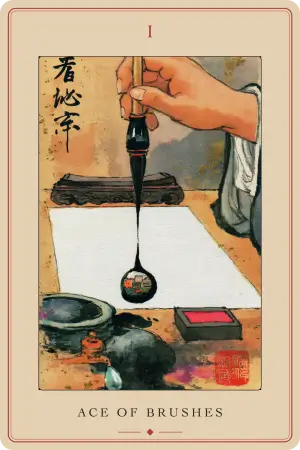
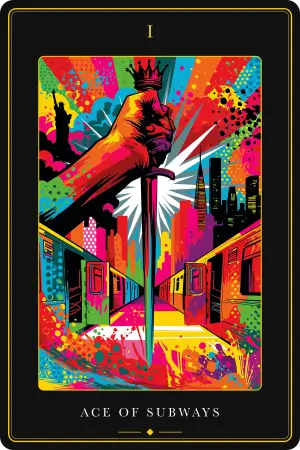
Tarot de Marseille. Stark 18th-century woodblock work. A hand grasps an oversized sword that penetrates a crown at the blade's tip, ringed by an austere wreath of interwoven leafy branches with no botanical species specified. The blade is typically deep red against a solid blue ground, and that red carries the whole reading: active, penetrating, primal intellect with none of the angelic softening the later English decks introduced.
Rider–Waite–Smith. The version this page describes. Smith works from Book T but distils the Kabbalistic and Hermetic material into an accessible allegory: cloud, grip, crowned blade, cross-shaped hilt, two green branches, six flames, and the barren peaks behind. The emphasis lands on balanced truth and on justice reached through logic rather than on raw force.
Crowley-Harris Thoth. Crowley kept the Golden Dawn title and argued that the undisciplined mind is the chief enemy of higher consciousness, which is his explanation for why the Swords suit runs so thick with sorrow and ruin. His Ace is the Higher Mind, cutting through worldly dross. The hilt is copper, the metal of Venus, and the blade is steel, the metal of Mars, so that the pursuit of truth is driven by love, with the word THELEMA inscribed on the hilt. A serpent coils six times around the blade and the lower sphere of the hilt sits at the centre of a rising sun, both pointing to Tiphareth. The blade glows green, which Crowley explained alchemically as yellow (Fire) synthesised with blue (Water) to produce Air. The crown carries 22 rays, tying the Ace to the 22 Major Arcana and the wisdom of Chokmah.
Etteilla. Worth knowing because it inverts everything. In the Grand Etteilla system the upright Ace of Swords is read as a negative: extremes, rage, possessiveness, violent anger, and cutting messages. Reversed it turns positive, standing for reward, the fruits of one's labour, and physical conception and childbirth. Historical reading communities still work this way, and it is the reason the card keeps turning up in fertility discussions.
Kombinācijās un kontekstā
In relationships and communication generally, this deck reads the upright Ace as clarity of thought and the ability to set goals. It is a time for direct dialogue, for courage in stating an opinion, and for openness to truth. Communication runs on objective facts, common sense and frankness, with reasoned and truthful statements in place of assumption. Others come to recognise your intelligence and respect your view, and groups can form around that kind of fact-based exchange. Reversed in the same position, interactions turn into arguments where speaking the truth gets read as aggression, criticism runs high, and communication goes cold and detached.
With neighbouring cards the reading shifts sharply. The Empress turns it into an intellectual breakthrough producing tangible growth, the sword cutting away a hostile environment so something can heal. Justice makes it absolute truth and cosmic accountability, a ruling that is fair, swift and strictly by the book, with no room for emotional manipulation. The Devil gives the blade something specific to sever: the moment of clarity that recognises an addiction, an abusive relationship, or a self-limiting belief for what it is. Death makes the ending surgical and irrevocable, an outdated worldview dying to make room for a rigorous one.
Court cards colour it too. With the King of Swords it is mental mastery, the initial spark executed flawlessly, though the pairing warns you to rely on logic and seek a second rational opinion. With the Knight of Swords it becomes reckless momentum, swift steps and conclusions jumped to, and passions that may cool as fast as they ignited.
One context deserves its own note. In readings about an ex-partner, novices often greet an Ace as a sign of renewed contact. Experienced readers take it the other way: the ex has reached objective clarity, concluded the relationship is unworkable, and cut the cord. If contact does come, it is usually to deliver a hard truth or settle logistics. Paired with the King of Swords that boundary is logical and immovable; paired with the Knight it reads as someone jumping to rapid conclusions about the breakup.
Jautājumi pārdomām
- The clouds in this card hide where real intellect comes from. What did you understand today that you cannot trace back to reasoning?
- The blade is sharpened on both sides. Before your next difficult conversation, ask whether you are acting from clarity or from the wish to win.
- Two green branches balance mind against emotion at the top of this card. Which of the two has been doing all the talking lately?
- Name one thing you understand more clearly tonight than you did this morning.
Vispārējā nozīme izriet no Raidera-Veita-Smita skaidrojuma, kas ir pamata atsauce Tarot Academy. Atveriet konkrētu kavu augstāk, lai iepazītos ar tās interpretāciju.
Biežāk uzdotie jautājumi
Izpētīt Taro
Latest Posts
Atklājiet seno Taro kāršu gudrību un atveriet garīgās ceļojuma noslēpumus. Mūsu blogs ir jūsu vārti uz Taro lasīšanas bagātīgās simbolikas, nozīmes un praktiskās pielietošanas izpratni.




















































