
 LV (latviešu)



Mazie Arkāni · Kausi (Water)
Kausu karalis
Smith set a heavy stone throne on open water and seated a man on it who is not holding on: cup resting on his thigh, face calm, the sea doing whatever it likes underneath him.
Kārts īsumā
- Numeroloģija
- King
- Elements
- Ūdens
- Astroloģija
- Trešais dekāns of Svaru and the first two decans of Skorpiona, eighth house
- Kabalas ceļš
- Chokmah (Wisdom), the Air of Water
- Laiks
- Late October into November, and fluid: Cups count in months
- Jā / Nē
- Taisnā pozīcijā jā, taken calmly; apgrieztā nē
Taisni
Emotional maturity
Diplomacy
Compassion
Calm authority
Intuition
Tact
Reliability
Paternal protection
Apgriezti
Emotional manipulation
Withdrawal
Mood swings
Distrust
Insincerity
Avoidance
Self-admiration
Loss of balance
Kausu karalis katrā kavā
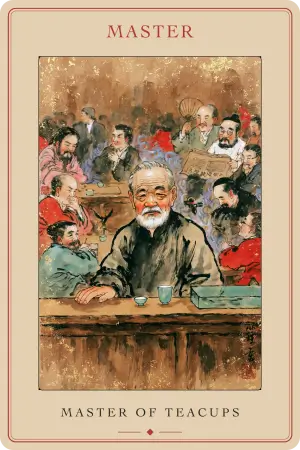
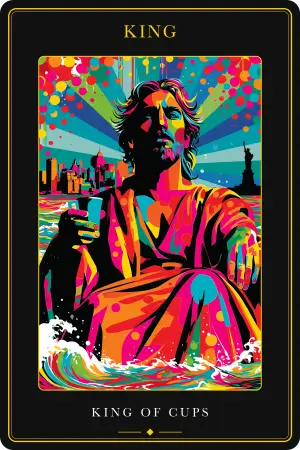
Katra kava to pašu arhetipu interpretē citādi. Salīdziniet mākslas darbus, tad atveriet kavu, lai izlasītu pilnu skaidrojumu.
Tēlojums un simbolisms
Pamela Colman Smith made one decision on this card that carries the rest of it: the throne is out on the water. The Queen of Cups keeps hers on the shore. His floats, a heavy monolithic block of stone riding a sea that is visibly moving, waves breaking at its base. He leans slightly forward, relaxed, contemplative. Nothing in his posture concedes that the water is a problem.
He holds a large cup in his left hand, resting it on his thigh. In the Rider-Waite reading this cup is the source of his emotional experience and the sign that he has mastery over his own feelings. His other hand carries a short scepter, the plain badge of executive authority and will. The clothing splits the same way the card does: a flowing blue tunic for water, intuition and the unconscious, under a heavy golden cape. Blue and gold together point to spiritual values and wisdom, and the gold also carries nobility and confidence. The gold crown marks his spiritual authority and his rule over the realm of feeling.
Watch the feet, because Smith placed them deliberately. His left foot nearly touches the water, a hint of his link to the unconscious. His right foot stays planted on solid ground. He is in contact with the depths without being in them.
Behind him the background does the explaining. A ship with red sails rides the rough waves on one side, and a fish leaps clear of the water on the other. The ship shows his command of the water world and his ability to manage emotion while still meeting the demands of ordinary life; it is the classic symbol of spiritual journey, and it can also hint at a literal voyage. The leaping fish stands for mystery and the subconscious, and points to his skill at reading emotional undercurrents. Higher up, the sea's waves meet the air, water and air coming together, which is the picture's own statement of what he balances: passion against intellect. He is surrounded by water and accepts events as they arrive, since water is the element of pure acceptance.
Pamata nozīme
The Rider-Waite King of Cups is a man who understands the weight of deep emotional experience and knows how to say what he feels. As ruler of the water element he carries emotional strength, sensitivity and depth at full extent, and the card reads as emotional maturity, the ability to put feeling into constructive expression, and a working understanding of the subconscious.
The deck's own emphasis falls on control. Feelings are expressed openly here but stay grounded. He is a leader whose balance sets the tone for everyone else, a wise presence who manages his own emotions while navigating other people's. What the card describes is a life stage defined by kindness and a deep sense of security, with important emotional decisions waiting to be made and enough steadiness to make them.
Esoterically this is the Air of Water. The four Kings of the Tarot are intellectuals of the Air element, each pairing Air with the element of their own suit, so the King of Cups joins intellectual Air with the deep waves of emotion. That pairing is why he can feel the whole thing and still describe it accurately.
Taisna pozīcija
Upright, the situation calls for tact and diplomacy, handled with patience. Trust your emotions and intuition and keep your relationships in balance. Open up to people while staying mindful of what they feel. In conversation, listen closely, say what you feel calmly, and let empathy carry you through conflict.
The people this card describes have high emotional resilience and a real capacity for empathy. They trust their instincts, handle interpersonal conflict easily, and balance their reactions. They share their feelings and keep their tact. They behave consistently and rarely let emotion drive a decision. Because of that natural composure they tend to become the anchor for whoever is around them.
In love. Emotional maturity, harmony, nobility, deep understanding. A generous partner capable of real devotion, ready to share their emotional wealth openly, who accepts and values your feelings; the love here passes through both mind and heart. The card brings a relationship to a new level of trust and intimacy, and it can mark a move into a more serious phase, possibly a wedding.
In career. A professional with complete emotional stability, who earns favor through good communication and a diplomatic approach to conflict. He guides a team with strong social skills and manages with both intellect and emotional intelligence, which produces a team where mutual respect and trust hold. In business, effective management here is built on understanding what employees and partners actually feel, and success comes from a leader with charisma who connects emotionally. Even during economic uncertainty he keeps his calm and makes well-reasoned decisions. Good timing for a project aimed at improving people's well-being.
In finances. Stability and prosperity: a secure position, successful investments, business profits, growing material well-being. A responsible attitude toward money, competent budgeting, and a talent for financial operations. An excellent time for a major purchase or a significant decision. Recklessness and risk are absent; decisions are thought through and built on experience. The card may also point to a trustworthy financial advisor entering your life, and it shows the capacity to think long-term.
In health. Maturity and balance at their most settled: clarity in nutrition, methodical maintenance of physical shape, a well-established sleep routine. No drastic changes are needed. Listen to what your body asks for and it will be met. Resilience here is built through a healthy lifestyle and disciplined activity, regular exercise and good food.
Apgriezta pozīcija
Reversed, the King points to introversion, mood swings, or a total loss of emotional control, with the inner world in chaos. Sometimes he describes someone who abuses their authority to manipulate other people emotionally. It can also mean willful behavior, an inability to manage feeling, and a habit of dodging responsibility and important decisions. The counsel is to manage your inner world deliberately, attend to your own needs without dismissing anyone else's, refuse manipulation, and keep emotional reaction from overpowering rational judgment.
The people described here are emotionally unstable and oversensitive. Unpredictable feeling breeds conflict and misunderstanding. They are prone to emotional delusion and make poor decisions on passing moods, and they may sink into depression when they feel their sensitivity goes unappreciated. Their emotions run them.
In love. An inability to control feeling, which can tip into emotional excess or codependency, with one person overwhelmed by their own emotions and growing unpredictable. Often a partner who uses their feelings to manipulate, a dynamic that calls for firm boundaries. The opposite failure appears just as readily: total emotional aloofness, an unwillingness to share anything, a relationship stalling under the distance while one person stays preoccupied with their own problems.
In career. Problems caused by excessive emotionality or an inability to manage feeling professionally. Decisions grow convoluted under a subjective approach. The reversed King warns against manipulation, since attempts at deceit damage reputation and partner trust badly. A leader may fail to understand their team and make unpopular, careless calls, or their moods may wreck the team's performance outright. Burnout from constant work and a lack of novelty belongs here too.
In finances. Willfulness, reckless spending, expenditure driven by impulse. Unsuccessful investments, or heavy losses from an unviable project. Financial misunderstandings, stagnation, a loss of stability. There is also a careless reluctance to handle complex financial matters and a habit of delegating them away, which leads straight to loss of wealth. Ignoring the problem and hoping for luck produces overspending, loans and mounting debt.
In health. Conflict with your own body and insecurity about your appearance, with self-acceptance turning into a real challenge. Often tied to a lifestyle that is taking a toll. Underlying emotional problems may be affecting physical well-being directly, showing up as fear of change and a tendency to keep harmful habits.
Vēsturiskās piezīmes
The Rider-Waite King of Cups inherits a figure that was, for centuries, far simpler than what Smith drew. The archetype first coalesced in the hand-painted trionfi decks of fifteenth-century Milan, among them the Visconti di Modrone, the Brambilla and the Visconti-Sforza decks commissioned by Filippo Maria Visconti and later Francesco Sforza. There the King of Cups, the Roi de Coupe in the French line, was an opulent monarch holding a large chalice and nothing more, with none of the astrological, Qabalistic or elemental apparatus that arrived in the nineteenth century. Those early decks were fluid enough that in the reconstructed Charles VI deck, split between the Louvre's Rothschild Collection and the Correr Museum in Venice, the image now used for the King of Cups was originally meant for the King of Coins.
Woodblock printing carried the card into France, where the Tarot de Marseille fixed a popular image: the King in profile, facing the sun, raising his cup as if receiving celestial light, his gaze angled slightly toward his left, which later occultists read as the unconscious and intuitive side.
Waite and Smith produced their deck in 1909, and Waite made a choice that still shapes how this specific card is argued about. He used the Golden Dawn's astrological and Qabalistic architecture underneath, but reverted the rank names to the familiar Marseille set of Page, Knight, Queen and King so the deck would sell to the general public. The Golden Dawn had reorganized those ranks around the Tetragrammaton, giving the sovereign fiery rank to Knights and the airy, mediating rank to Princes. So the Rider-Waite King of Cups is read by some as the Fire of Water and by others as the Air of Water, and Crowley's Thoth deck, which kept the strict Golden Dawn structure, assigns this energy to its Prince of Cups. The Golden Dawn titles survive either way: Lord of the Waves and the Waters, King of the Hosts of the Seas, and alternatively King of Undines and Nymphs.
One more branch worth knowing. When Cups became the French suit of Hearts, the King of Cups became the King of Hearts, associated with Charlemagne and known worldwide as the "Suicide King" for appearing to drive a sword into his own head. That image is a manufacturing accident. Cards mass-produced in Rouen for export to England showed him raising a battle-axe behind his head; as the wooden blocks wore down over decades the axe-head vanished and the handle merged with a sword hilt. He is also the only king in the standard deck without a mustache, another casualty of the same worn blocks.
Atbilstības
Number. As a King he is the highest-ranking figure of the suit of Cups, the executive will that takes action on his element.
Astrology. The King of Cups rules the underwater realm and is at home in the deepest mysteries of life. He governs the third decan of Libra and the first two decans of Scorpio. In the natural horoscope his primary domain is the eighth house: sex, inheritance, transformation, and shared resources. He is linked directly to the water sign Scorpio, which accounts for his deep emotional understanding and his analytical mind, and Scorpio is a fixed water sign marked by profound self-awareness. Fixed here means stability, consistency and determination, all of which show in his character. Both the card and the sign fall under Pluto, mythological god of the underworld, which points to an innate grasp of transformation and rebirth. He is also associated with Neptune, god of the seas, who can raise storms and command the tides, a fitting symbol for absolute authority over emotion and passion.
Element. Water, the suit's element of emotion and intuition, governed here by the Air of his rank. The four Kings are intellectuals of the Air element, so this one joins intellectual Air with the deep waves of emotion.
Kabbalah. All Kings sit at Chokmah, Wisdom, the Supernal Father and the first active thrust of creation after Kether. In Briah, the watery world of creation, he is the initiating force inside the emotional realm.
Elemental dignity. Air of Water, evaporation, raw emotion turned into articulated thought. The Golden Dawn also tied the card to the I Ching hexagram Chen of Tui, which touches the Marrying Maiden, Joyousness and inner truth: passions curbed by higher instincts, an opponent won over through joy and diplomacy.
Psiholoģiskā perspektīva
The throne on the open sea is the whole psychological argument, and it works because Smith declined to make him tense. A frightened king would have ruined it. What the picture claims is that emotional mastery is not the suppression of feeling but the capacity to stay grounded and observant in the middle of turbulence, centered on the firm structure beneath him.
The feet carry the rest of the argument. One nearly in the water, one on solid ground: access to the unconscious without immersion in it. The ship and the leaping fish complete the mechanism. Unconscious material breaks the surface, and something seaworthy is standing by to carry it into the waking world. He communicates fluidly with his inner life and converts raw intuition into navigable wisdom without capsizing.
This is also where the Air of Water shows its cost. The archetype of the psychoanalyst and the wise counselor watches his emotions, cataloging and analyzing them at a slight remove. Unbalanced, that same faculty becomes the sleek, silver-tongued man who inflates platitudes, uses detachment to dodge genuine intimacy, and rationalizes vulnerability away as intellectual superiority. The deck's own shadow reading agrees: emotional insight used to manipulate rather than connect. His sensitivity gives him access to what other people feel, and the only question is whose service that access is in.
Set against the Queen of Cups the two match in depth and split on modality. She is Water of Water, the deep ocean, internalizing the psychic weight of those around her and offering intimate counsel. He is the seawall and the lighthouse. He metabolizes what he feels, working through it until no unresolved trauma can subvert his conscious will. Queens carry the energy; Kings manage it.
Kausu karalis dažādās kārtīs
Tarot de Marseille. No stormy sea, no ship. The King stands in profile, facing the sun and lifting his cup as if receiving celestial illumination, his gaze angled slightly left. The gesture blends the temporal power of a monarch with the receptivity of a mystic, and the Rider-Waite version trades that single upward gesture for an entire seascape.
Crowley-Thoth. The energy Smith gave to a seated king appears here as the Prince of Cups, the Air of Water, and he is anything but seated. He is a warrior only partly clad in armor, which Crowley describes as resembling a natural growth, an organic and fluid kind of defense. An eagle surmounts his helmet and he rides a chariot across a watery expanse. The imagery draws on Bellerophon riding Pegasus, chasing rainbows over a sparkling sea, and on the quest for the Holy Grail.
Modern decks. The Sun and Moon Tarot gives the King the Holy Grail, adds a clairvoyant dolphin for free spirit, and a white horse for the mental strength required to control the passions; its Prince carries a goblet with a snake for psychological transformation. The Golden Serpent Tarot coils a golden serpent around his cup and hands him a parchment inscribed with the Alpha and Omega and Latin alchemical rubrics declaring his waters healing yet poisonous; its Prince rides a Hippocampus with a unicorn's horn and carries an Enochian Tablet naming him the Air of Water. The Infinite Visions Tarot reads the court through Victorian and Edwardian portraiture, dressing King and Queen in sea-green before a pounding ocean under cloudy skies, musical instruments ready to play for the music in their souls.
Kombinācijās un kontekstā
Read him first against the Queen of Cups, since the two share an element and split the work. She internalizes, absorbing sorrow and joy alike and giving immediate relief; he externalizes, taking executive action on feeling to build structures and boundaries. In a crisis she takes the emotional hit for everyone while he formulates the emotional budget, issues the diplomatic decrees, and builds the long-term vision on that intelligence.
Against the Two of Cups the difference is maturity. The Two is a youthful, mutual exchange of energy and new connection; the King is introspective and self-aware, and loves with certainty and stability where lower numbers show infatuation. Against the Four of Cups he is the endpoint. That card refuses the emotion in front of it and sinks into apathy, while the King witnesses the same feeling, understands it, incorporates it, and comes out empowered.
Reversed, his neighbors decide how dark the reading gets. Beside the Seven of Swords, the Three of Swords, The Moon or The Devil, the shadow King reads as sophisticated deception, infidelity, or toxic bondage: feigned vulnerability and love-bombing used to disarm someone, then an abrupt withdrawal that leaves them questioning their own reality. The same pattern scales up. In geopolitical readings he becomes the man in high office who is volatile, spiteful and emotionally immature, whose soothing public language pacifies while destructive choices are made behind closed doors.
Jautājumi pārdomām
- Smith gave him one foot near the water and one on solid ground. Where are yours right now?
- When something surfaces in you the way that fish clears the waves, do you have a ship ready for it, or do you let it fall back?
- You can read what other people are feeling. Is that access working in their service, or in your control?
Vispārējā nozīme izriet no Raidera-Veita-Smita skaidrojuma, kas ir pamata atsauce Tarot Academy. Atveriet konkrētu kavu augstāk, lai iepazītos ar tās interpretāciju.
Biežāk uzdotie jautājumi
Izpētīt Taro
Latest Posts
Atklājiet seno Taro kāršu gudrību un atveriet garīgās ceļojuma noslēpumus. Mūsu blogs ir jūsu vārti uz Taro lasīšanas bagātīgās simbolikas, nozīmes un praktiskās pielietošanas izpratni.




















































